What Is MOP on a Drug Test?
If you have looked at a multi-panel urine drug test and noticed MOP, you may wonder what the abbreviation means and what a positive or negative result actually tells you.
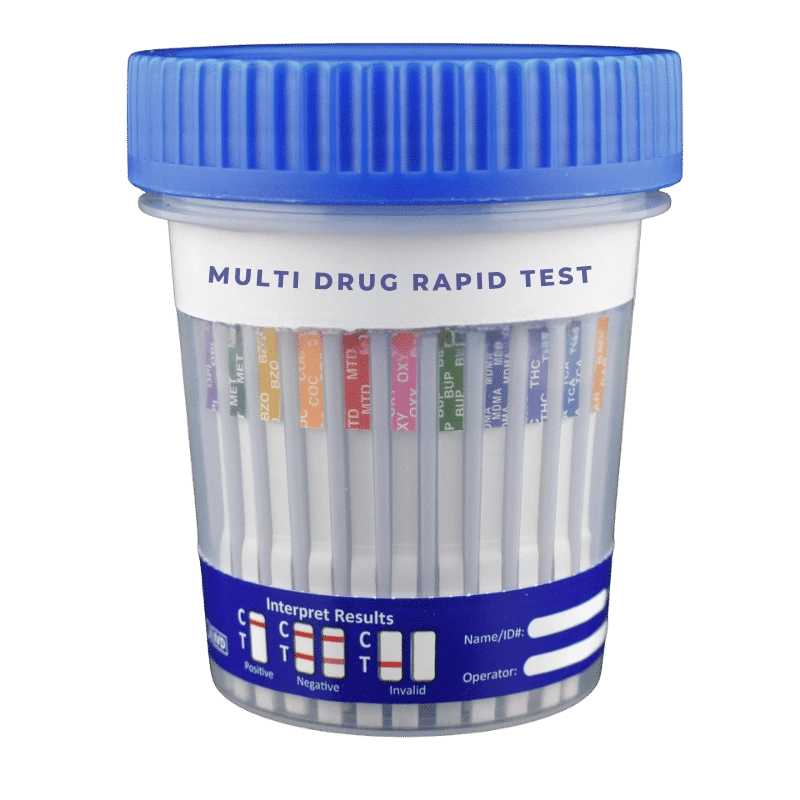
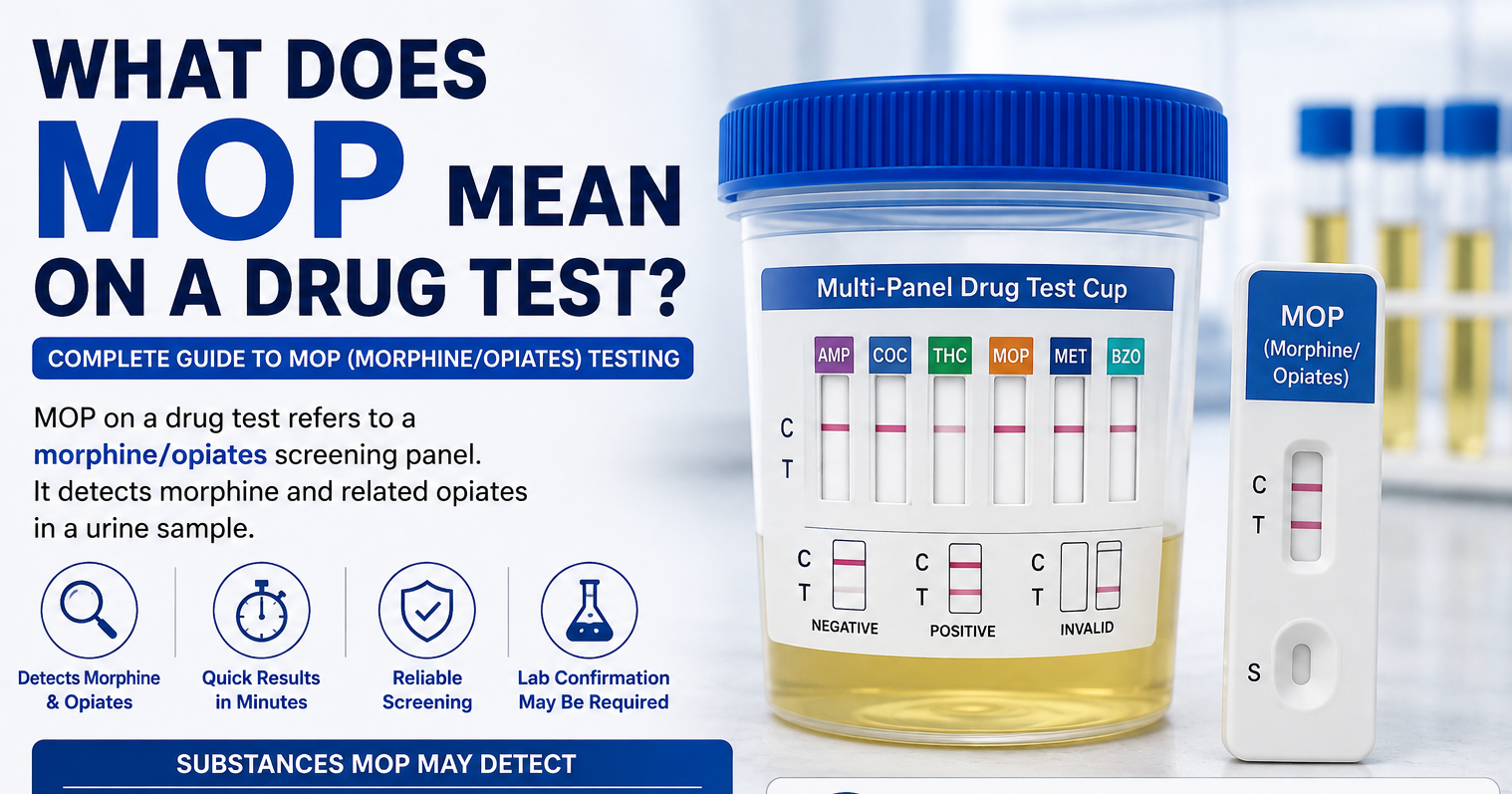
MOP on a drug test generally refers to a morphine/opiates screening panel. Depending on the manufacturer and test design, the MOP panel is intended to detect morphine and related opiates or their metabolites in a urine specimen. It is commonly included in multi-panel drug tests, including some 6-panel, 10-panel, and 12-panel tests.
A key point is that MOP does not mean every opioid will automatically trigger the test. Standard opiate immunoassays have different cross-reactivity and may not reliably detect drugs such as fentanyl, methadone, buprenorphine, or oxycodone unless a separate drug-specific assay is included. SAMHSA explains that different opioid classes require appropriately targeted testing.
In this guide, you’ll learn what MOP means, what substances it can detect, how MOP urine tests work, what positive and negative lines mean, typical detection windows, cutoff levels, false positives, and when confirmatory laboratory testing may be needed.
Quick Answer: What Does MOP Mean on a Drug Test?
MOP usually means morphine or opiates on a drug test.
A MOP panel is designed to screen a urine sample for morphine and/or opiate-related substances, depending on the specific test manufacturer and cutoff.
MOP testing may detect exposure associated with:
- Morphine
- Codeine
- Heroin through its metabolites and subsequent morphine
- Other substances that cross-react with the particular opiate assay
However, the exact substances detected depend on the test’s antibodies, cutoff concentration, and manufacturer specifications.
This distinction is important because the terms opiate and opioid are not interchangeable. Opiates traditionally refer to naturally occurring compounds such as morphine and codeine, while opioids include a much broader group of natural, semisynthetic, and synthetic substances.
What Does MOP Stand For?
MOP is commonly used as shorthand for morphine/opiates on rapid drug screening devices.
Some manufacturers label their panel simply MOP, while others may use terms such as:
- MOP
- Morphine
- OPI
- Opiates
- Morphine/Opiates
- OPI 300
- OPI 2000
These labels should not automatically be treated as identical because the actual cutoff and analytes vary between products.
For example, one MOP test might use a 300 ng/mL cutoff, while another test designed for a different testing setting may use a different threshold.
Always check the manufacturer’s instructions for the exact test being used.
What Does MOP Detect?
The primary target of a typical MOP/opiate screening test is morphine or morphine-like opiate compounds.
Morphine
Morphine is a naturally occurring opioid obtained from the opium poppy. It is used medically for pain management and can also appear in urine after exposure to other substances that metabolize into morphine.
Codeine
Codeine is another naturally occurring opiate. The body can metabolize some codeine into morphine, which can affect the interpretation of an opiate screening test.
Heroin
Heroin is metabolized rapidly. One of its important metabolites is 6-acetylmorphine (6-AM), which can provide specific evidence of heroin exposure when identified by an appropriate confirmatory test. Morphine may subsequently be present as heroin is metabolized.
This means a basic MOP screen generally cannot by itself tell you exactly which source caused a positive morphine/opiate result.
That is one reason laboratory confirmation and clinical interpretation can be important.
MOP vs. Opioids: Are They the Same?
No.
Opiates are a narrower group that includes naturally occurring substances such as:
- Morphine
- Codeine
Opioids is the broader term and includes:
- Morphine
- Codeine
- Heroin
- Oxycodone
- Hydrocodone
- Hydromorphone
- Fentanyl
- Methadone
- Buprenorphine
- Other opioid compounds
A standard MOP/opiate immunoassay should therefore not be assumed to detect every opioid.
For example, SAMHSA notes that methadone and fentanyl require specific testing rather than relying on a standard morphine-based opiate screen.
How Does a MOP Urine Drug Test Work?
Most rapid MOP drug tests use an immunoassay.
The test contains antibodies designed to react with the target drug or related compounds. A urine specimen is applied to the test device, and the sample moves through the test membrane.
The resulting lines are interpreted according to the manufacturer’s instructions.
A rapid test generally provides a screening result, rather than a definitive identification of a particular drug.
Typical process
- A urine specimen is collected.
- The specimen is applied to the drug-testing device.
- The sample moves through the test membrane.
- The MOP antibody system reacts with relevant compounds.
- The control and test lines develop.
- The result is interpreted within the manufacturer’s specified reading time.
Because rapid immunoassays are screening tools, a non-negative result may require additional laboratory testing depending on the purpose of the test.
What Does a Positive MOP Result Mean?
A positive or non-negative MOP screening result generally means the concentration of the substance recognized by the MOP assay is at or above that test’s cutoff level.
It does not automatically prove illegal drug use.
A positive MOP screen can have several possible explanations, including legitimate medication use or exposure to substances that produce morphine or related compounds.
For workplace, legal, or clinical decisions, a screening result may need to be reviewed and confirmed according to the applicable testing procedure.
SAMHSA emphasizes the importance of Medical Review Officer review and confirmatory testing in federal workplace testing.
What Does a Negative MOP Result Mean?
A negative MOP result generally means the concentration detected by the test is below its established cutoff, according to the manufacturer’s interpretation criteria.
It does not necessarily mean that a person has never used an opiate.
Drug concentrations can fall below a testing threshold as the substance is eliminated from the body. Detection also varies according to the substance, dose, timing, metabolism, specimen type, and characteristics of the test.
Therefore, a negative result should be interpreted as negative under that test’s specific conditions and cutoff, rather than as proof that no exposure ever occurred.
What Do the Lines Mean on a MOP Drug Test?
Many rapid urine drug tests use a control line and test line.
The exact interpretation must always follow the instructions supplied with the specific test.
For many competitive immunoassay devices:
Two lines
A control line plus a test line generally indicates a negative result, even when the test line is faint.
Control line only
A control line without the expected test line generally indicates a positive/non-negative screening result for that panel.
No control line
If the control line does not appear, the test is generally invalid and should not be interpreted as positive or negative.
Important: Line interpretation can differ between products, so the manufacturer’s instructions take priority over a generic explanation.
What Is the MOP Cutoff Level?
The cutoff level is the concentration at which a screening test changes its interpretation from negative to positive/non-negative.
It is normally expressed in nanograms per milliliter (ng/mL).
A 300 ng/mL MOP or opiate cutoff is common in some clinical and rapid screening contexts, but it is not universal.
SAMHSA materials distinguish between clinical screening cutoffs and federal workplace testing cutoffs. For example, a 300 ng/mL opiate screening threshold has commonly been used clinically, while federal workplace testing uses different current requirements.
This is why you should never assume that every MOP test uses exactly the same cutoff.
Why the cutoff matters
Suppose a test has a cutoff of 300 ng/mL:
- Below the cutoff → generally interpreted as negative
- At or above the cutoff → generally interpreted as positive/non-negative
The cutoff does not mean that the drug is completely absent below that number. It simply represents the analytical threshold established for that test.
How Long Does MOP Stay in Urine?
There is no single detection time that applies to everyone.
For morphine and many traditional opiates, urine detection is often around 2–3 days, although the actual window can vary.
Mayo Clinic Laboratories states that the presence of morphine in urine can indicate exposure within approximately 2–3 days, while also emphasizing that detection depends on the specific substance and individual circumstances.
Factors that can affect detection include:
- Dose
- Frequency of use
- Time since exposure
- Individual metabolism
- Kidney function
- The specific substance
- Test sensitivity
- Laboratory cutoff
- Urine concentration
- Type of test used
Therefore, statements such as “MOP always stays in urine for exactly X days” are misleading.
Can Prescription Medication Cause a Positive MOP Test?
Yes.
A MOP/opiate screening result can occur because of legitimate prescription medication containing morphine or codeine, depending on the medication and test.
This is why a positive screening result should not automatically be interpreted as evidence of misuse.
For regulated workplace testing, legitimate prescriptions can be considered during the Medical Review Officer process. SAMHSA’s current guidance specifically discusses morphine and codeine results and notes that these substances can come from legitimate medications.
If you are taking a prescribed medication, provide accurate medication information to the appropriate healthcare professional or Medical Review Officer when requested.
Can Poppy Seeds Affect a MOP Drug Test?
Potentially, yes.
Poppy seeds can contain trace amounts of opiate compounds, and consumption of certain poppy-seed foods can result in detectable morphine or codeine in urine.
Mayo Clinic Laboratories notes that large amounts of poppy-seed-containing foods can produce urinary morphine concentrations, although the amount and duration vary.
This is another reason a screening result should be interpreted in context rather than treated as proof of illicit drug use.