What Is EtG on a Drug Screen?
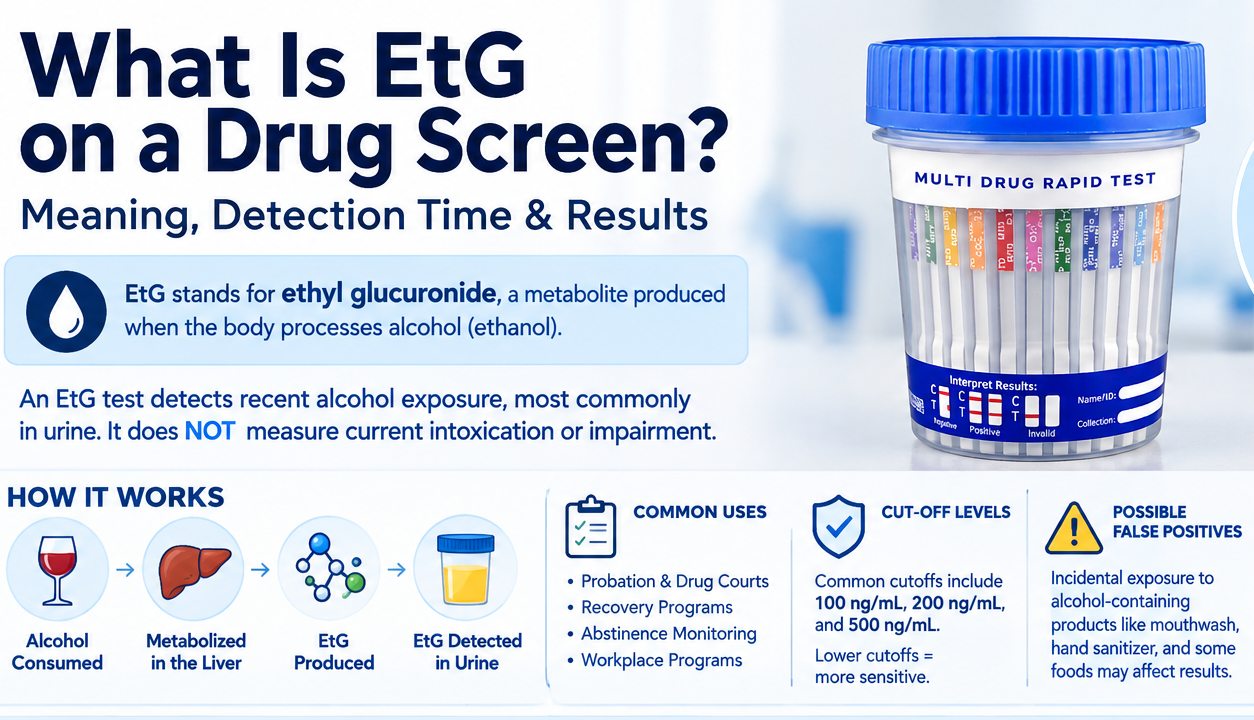
EtG on a drug screen stands for ethyl glucuronide, a metabolite produced when the body processes ethanol (alcohol). An EtG test is an alcohol biomarker test that looks for evidence of recent alcohol exposure, most commonly in a urine sample. Unlike a breath or blood alcohol test, an EtG test is not designed to determine whether someone is currently intoxicated.
EtG testing is commonly used in alcohol-monitoring programs, probation, drug courts, recovery programs, and other situations where recent alcohol abstinence needs to be monitored.
What Does EtG Mean on a Drug Screen?
EtG means ethyl glucuronide. It is a minor metabolite formed after the body processes ethanol.
When a person drinks an alcoholic beverage, ethanol enters the bloodstream and is metabolized through several pathways. A small portion is converted into EtG, which can remain detectable after the alcohol itself is no longer measurable.
This makes EtG useful as a biomarker of recent alcohol exposure.
In simple terms:
Alcohol consumption → ethanol metabolism → EtG formation → EtG can be detected in a test sample
If EtG is detected, the result indicates that ethanol exposure occurred recently. However, the concentration of EtG does not provide a reliable way to determine exactly how many drinks a person consumed.
What Does an EtG Drug Test Detect?
An EtG test detects ethyl glucuronide, not alcohol itself.
Most EtG screening is performed using urine, although EtG can also be measured in hair in certain testing situations.
An EtG urine test is particularly useful because EtG can remain detectable for considerably longer than ethanol in the blood or breath.
This means someone may no longer have measurable alcohol in their breath or blood but may still have detectable EtG in urine.
EtG vs. Alcohol
It is important to understand the difference:
- Ethanol is the alcohol consumed in a beverage.
- EtG is a metabolite formed after the body processes ethanol.
- An EtG test looks for evidence of recent ethanol exposure.
- A breath alcohol test is generally used to assess current alcohol concentration.
- An EtG test does not determine whether someone is currently drunk or impaired.
How Does EtG Form After Drinking Alcohol?
After ethanol enters the body, most of it is metabolized through oxidative pathways. A small amount undergoes a different process that produces ethyl glucuronide.
EtG is then eliminated from the body, primarily through urine.
Because EtG can persist after ethanol has been cleared, testing for EtG can extend the period during which recent alcohol exposure can be detected.
This is one reason EtG testing is commonly used for abstinence monitoring rather than immediate impairment testing.
How Long Does EtG Stay Detectable?
The EtG detection window depends on several factors, including:
- Amount of alcohol consumed
- Time since alcohol consumption
- Test cutoff concentration
- Testing method
- Individual differences in metabolism and elimination
- Characteristics of the urine sample
For urine testing, EtG is commonly detectable for about 24 to 72 hours after alcohol consumption, although detection can sometimes extend beyond this range, particularly after heavier drinking or when a lower cutoff is used.
There is therefore no single detection time that applies to everyone.
EtG Detection Window at a Glance
| Test/sample | General information |
|---|---|
| Urine EtG | Commonly detects recent alcohol exposure for roughly 1–3 days |
| Hair EtG | Can provide information about longer-term alcohol exposure patterns |
| Blood alcohol | Primarily reflects more recent alcohol presence |
| Breath alcohol | Primarily used to assess current alcohol concentration |
These windows are general estimates rather than guarantees. The specific test method and cutoff can substantially affect the result.
Does EtG Mean You Were Drunk?
No. A positive EtG result does not mean that a person was intoxicated when the sample was collected.
EtG is a marker of recent alcohol exposure, not a direct measurement of current impairment.
For example, a person could have consumed alcohol earlier and later have a positive urine EtG result even though the alcohol itself is no longer producing measurable intoxication.
This distinction is particularly important when interpreting alcohol-testing results.
What Does a Positive EtG Result Mean?
A positive EtG result generally indicates that ethyl glucuronide was detected at or above the laboratory’s specified cutoff concentration.
It provides evidence consistent with recent exposure to ethanol.
However, the result should be interpreted according to:
- The laboratory’s cutoff
- The type of test performed
- The time since possible alcohol exposure
- The testing context
- Other relevant information available to the testing professional
A positive result should not automatically be interpreted as proof of a specific amount of alcohol consumed.
What Does a Negative EtG Result Mean?
A negative EtG result means the concentration detected in the sample was below the test’s reporting cutoff.
It does not necessarily prove that a person has never consumed alcohol.
For example, alcohol consumption that occurred outside the test’s detection window may no longer produce EtG above the reporting cutoff.
The meaning of a negative result therefore depends on the test’s sensitivity, cutoff, timing, and sample type.
What Are EtG Cutoff Levels?
An EtG cutoff is the concentration used by a test or laboratory to determine how an EtG result is reported.
Cutoffs are commonly expressed in nanograms per milliliter (ng/mL) for urine testing.
You may encounter EtG cutoffs such as:
- 100 ng/mL
- 200 ng/mL
- 500 ng/mL
- Other laboratory-specific concentrations
The cutoff matters because a lower cutoff can detect smaller concentrations of EtG, while a higher cutoff may reduce the likelihood of reporting very low concentrations.
What Does a 100 ng/mL EtG Cutoff Mean?
A 100 ng/mL cutoff is relatively sensitive and may detect lower concentrations of EtG.
Research has found that lower EtG cutoffs can extend the ability to identify recent drinking, particularly when looking for light or heavy alcohol consumption over several days.
However, greater sensitivity can also increase the possibility of detecting very low concentrations associated with incidental exposure or other factors.
What Does a 500 ng/mL EtG Cutoff Mean?
A 500 ng/mL cutoff is higher than a 100 ng/mL cutoff.
Higher cutoffs can reduce the likelihood that very low EtG concentrations will be reported as positive. They may therefore be preferred in some testing environments where minimizing potential false-positive concerns is important.
Importantly, an EtG concentration should not be converted directly into a specific number of drinks.
The same EtG concentration can be influenced by multiple variables, including the amount and timing of alcohol consumption.
Can EtG Tell How Much Alcohol Someone Drank?
Not reliably.
A higher EtG concentration can sometimes be associated with greater alcohol exposure, but EtG levels cannot reliably tell you exactly how many drinks someone consumed.
The result is influenced by factors such as:
- Amount consumed
- Timing of consumption
- Individual metabolism
- Elimination rate
- Urine concentration
- Test cutoff
- Testing method
There is no simple formula such as:
“X ng/mL of EtG equals X drinks.”
Therefore, EtG should be interpreted as evidence of recent alcohol exposure rather than a precise measurement of the amount consumed.
Can You Test Positive for EtG Without Drinking?
This is one of the most common questions about EtG testing.
EtG testing is sensitive, and researchers have investigated whether exposure to products containing ethanol can produce detectable EtG.
Potential sources of incidental ethanol exposure can include certain:
- Hand sanitizers
- Mouthwashes
- Personal-care products
- Cleaning products
- Alcohol-containing foods or beverages
- Other products containing ethanol
The importance of these exposures depends on the product, degree of exposure, timing, testing method, and cutoff concentration.
This is one reason laboratories and testing programs establish specific cutoff levels.
A person should not assume that every EtG-positive result is caused by incidental exposure, but potential sources of alcohol exposure may be relevant when a result is being professionally interpreted.
Does EtG Test for Drugs?
No. EtG specifically tests for a metabolite associated with ethanol (alcohol) exposure.
EtG is therefore an alcohol biomarker, not a general drug marker.
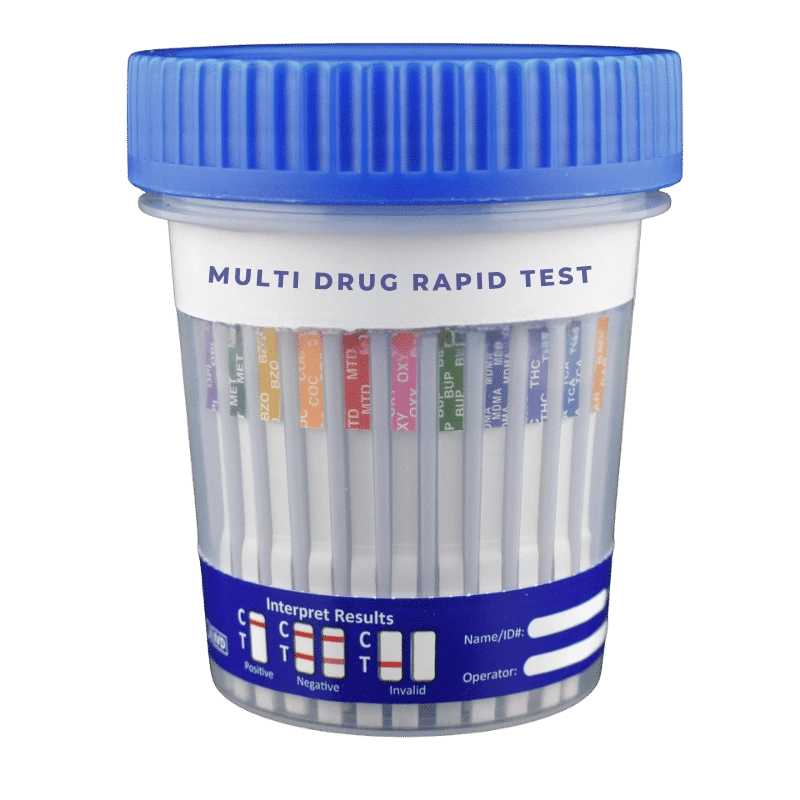
A drug test can contain multiple analytes, and some testing configurations may include EtG alongside drug analytes. Whether EtG is included depends on the specific test panel and manufacturer configuration.
For this reason, the name of a test alone may not tell you whether EtG is included.
Is EtG Included in a 12-Panel Drug Test?
Not automatically.
A “12-panel” drug test refers to a particular configuration containing 12 target analytes or drug classes. The exact substances included can vary between manufacturers and products.
Some 12-panel tests may be designed specifically for drugs, while other drug-and-alcohol testing configurations can include an alcohol marker such as EtG.
If you need to determine whether a particular test includes EtG, check the:
- Product analyte list
- Package insert
- Test panel configuration
- Cutoff table
- Manufacturer specifications
A test should not be assumed to include EtG simply because it is labeled as a 12-panel test.
EtG vs. a Regular Alcohol Test
EtG testing and conventional alcohol testing answer different questions.
| Test | What it detects | Main purpose |
| Breath alcohol | Ethanol in breath | Assess current/recent alcohol concentration |
| Blood alcohol | Ethanol in blood | Assess alcohol currently present in blood |
| Urine EtG | Ethyl glucuronide | Identify recent alcohol exposure |
| Hair EtG | EtG incorporated into hair | Assess longer-term alcohol exposure patterns |
An EtG test should therefore not be viewed as simply another version of a breathalyzer.
Its primary value is detecting evidence of recent alcohol exposure after ethanol itself may no longer be measurable.
EtG vs. EtS: What’s the Difference?
EtG and EtS are both alcohol metabolites.
EtG stands for ethyl glucuronide, while EtS stands for ethyl sulfate.
Both are produced after the body processes ethanol and can be used as biomarkers of recent alcohol consumption.
Some laboratory testing approaches measure both EtG and EtS because using multiple biomarkers can provide additional information when interpreting alcohol exposure.
The exact testing method depends on the laboratory and testing program.
How Accurate Is an EtG Test?
EtG testing can be highly sensitive for detecting recent alcohol exposure, but no test should be interpreted without considering its limitations.
Accuracy depends on factors such as:
- Analytical method
- Cutoff concentration
- Sample quality
- Time since alcohol exposure
- Laboratory procedures
- Potential incidental exposure
- Whether screening or confirmatory testing is being used
A screening result may be followed by additional laboratory testing when required by the testing program or circumstances.
What Factors Affect an EtG Result?
Several factors can influence whether EtG is detected and at what concentration.
1. Amount of Alcohol Consumed
Greater alcohol exposure can produce more EtG, although the relationship is not precise enough to determine an exact number of drinks from a result.
2. Time Since Drinking
EtG concentrations generally decline as more time passes after alcohol consumption.
3. Test Cutoff
A test using a lower cutoff may identify lower EtG concentrations than one using a higher cutoff.
4. Individual Differences
People differ in how they metabolize and eliminate substances.
5. Sample Characteristics
Urine concentration and other sample characteristics can influence measured concentrations.
6. Testing Method
Different laboratories and analytical methods can have different detection characteristics.
Why Are EtG Tests Used?
EtG testing is particularly useful when the goal is to monitor recent alcohol abstinence rather than current impairment.
It may be used in settings such as:
- Probation programs
- Drug courts
- Court-related monitoring
- Recovery programs
- Substance-use treatment
- Abstinence monitoring
- Professional monitoring programs
- Certain workplace testing programs
The exact use of EtG testing varies according to the organization and applicable policies.
Can I Pass an EtG Test in 24 Hours?
There is no reliable way to guarantee a particular EtG result after a specific amount of time.
EtG detection depends on factors including alcohol exposure, timing, cutoff concentration, test method, and individual differences.
Some EtG tests may detect recent alcohol exposure within 24 hours, while detectable EtG can remain for longer periods.
Therefore, 24 hours should not be treated as a guaranteed cutoff for a negative result.
How Much Alcohol Causes a Positive EtG?
There is no universal number of drinks that guarantees a positive or negative EtG result.
The result depends on:
- Amount consumed
- Time elapsed
- Test cutoff
- Individual metabolism
- Testing method
Because of these variables, EtG concentration should not be used as a simple calculator for the number of drinks consumed.
Does Mouthwash Cause a Positive EtG Test?
Some mouthwash products contain ethanol, and incidental alcohol exposure has been investigated in relation to EtG testing.
However, whether a particular exposure produces a reportable result depends on the amount and type of exposure, timing, test method, and cutoff.
If EtG testing is being performed for a formal monitoring program, follow the program’s instructions regarding alcohol-containing products.
Does Hand Sanitizer Affect an EtG Test?
Some hand sanitizers contain ethanol.
Heavy or repeated exposure to alcohol-containing products has been investigated as a potential source of incidental EtG detection. This is one reason cutoff concentrations and the testing context matter when interpreting results.
If a testing program provides specific instructions about hand sanitizer or other alcohol-containing products, those instructions should be followed.
Does a Positive EtG Mean I Was Drunk?
No.
EtG indicates recent alcohol exposure; it does not directly measure current intoxication or impairment.
A positive EtG result cannot, by itself, establish how intoxicated someone was at the time of testing.
Key Takeaways About EtG on a Drug Screen
- EtG means ethyl glucuronide.
- It is a metabolite formed after the body processes ethanol.
- EtG testing is primarily used to identify recent alcohol exposure.
- Urine is a common sample for EtG testing.
- EtG can remain detectable after alcohol itself is no longer measurable.
- Urine detection is commonly around 1–3 days, but the window can vary.
- The detection window depends on alcohol exposure, cutoff, test method, and other factors.
- A positive EtG result does not prove current intoxication.
- EtG concentration cannot reliably determine exactly how many drinks were consumed.
- Incidental exposure to alcohol-containing products can be relevant when interpreting very low EtG results.
- EtG is an alcohol biomarker, not a general drug test.
- EtG is not automatically included in every 12-panel drug test.
- Always check the specific test’s analyte list and cutoff information.
Frequently Asked Questions About EtG Drug Screens
What does EtG stand for on a drug test?
EtG stands for ethyl glucuronide, a metabolite produced when the body processes ethanol. An EtG test is used to detect evidence of recent alcohol exposure.
How long does EtG stay in urine?
EtG is commonly detectable in urine for roughly 24 to 72 hours, although the detection period can sometimes be longer depending on alcohol consumption, test cutoff, testing method, and individual factors.
Does EtG test for alcohol?
Yes. EtG testing looks for ethyl glucuronide, a metabolite produced after the body processes alcohol. It does not directly measure ethanol itself.
Does EtG test for drugs?
No. EtG is specifically an alcohol biomarker. It is not a general marker for drugs such as marijuana, cocaine, opioids, or amphetamines.
Is EtG included in a 12-panel drug test?
Not necessarily. The substances included in a 12-panel test vary by manufacturer and configuration. Check the specific product’s analyte list to determine whether EtG is included.
What does a positive EtG result mean?
A positive result means EtG was detected at or above the laboratory’s specified cutoff. It generally indicates recent alcohol exposure, but the result does not establish current intoxication or an exact amount of alcohol consumed.
Can you test positive for EtG without drinking?
Certain alcohol-containing products can contribute to incidental ethanol exposure, which has been investigated in relation to EtG testing. Interpretation depends on the exposure, timing, cutoff, and testing method.
Can an EtG test tell how many drinks someone had?
No. EtG concentration cannot reliably be converted into an exact number of drinks because many factors affect the measured concentration.
What is an EtG cutoff?
An EtG cutoff is the concentration threshold used to determine whether a test result is reported as positive or negative. Cutoffs may be expressed in ng/mL and can vary between testing methods and laboratories.
Does a positive EtG result mean someone was drunk?
No. EtG detects evidence of recent alcohol exposure and does not directly measure current intoxication or impairment.
Final Thoughts
EtG on a drug screen means ethyl glucuronide, a metabolite associated with recent alcohol exposure. Because EtG can remain detectable after ethanol itself has been eliminated, it provides a longer testing window than tests designed to measure alcohol directly.
The exact meaning of an EtG result depends on the sample type, cutoff concentration, testing method, timing, and testing context. For that reason, a single EtG result should not be used to determine an exact number of drinks or whether someone was intoxicated at the time of testing.
If you are reviewing a specific drug-screen panel, check the manufacturer’s analyte list and cutoff information to determine whether EtG is actually included in that test configuration.