Save Weeks on Automated Patch Clamp Setup: Pressure, Seals, Cell Lines
Automated patch clamp (APC) is the standard method for high-throughput ion channel screening, cardiac safety testing, and lead profiling in drug discovery, and most labs running large compound sets now default to it. Manual patch clamp still wins for primary cells, iPSC-derived neurons, and deep biophysical characterization where individual-cell control matters more than speed. The rest of this guide walks through how APC platforms work, where they outperform manual rigs, and how to set up assays that don’t waste consumables.
TL;DR:
- Automated patch clamp systems are best suited for high-throughput screening of stable cell lines, while manual patch remains superior for primary cells and detailed biophysical studies.
- Planar array platforms offer significant throughput advantages, especially with multi-hole designs, but single-hole formats provide higher resolution, making the choice dependent on the specific assay goal.
- Success in APC relies heavily on optimizing seal formation through cell health and membrane prep, with seal resistance being the key quality metric to monitor during setup.
- APC data quality and reproducibility benefit from standardized protocols and integration with lab information systems, but cell line quality remains the biggest factor influencing assay success.
- Future improvements include higher channel numbers, faster solution exchange, and pairing electrophysiology with structural data to better understand compound-channel interactions.
Table of Contents
- What Are the Main Types of Automated Patch Clamp Platforms?
- How Does an Automated Patch Clamp System Form a Gigaseal?
- Where Does APC Deliver the Most Value in Drug Discovery?
- APC vs Manual Patch Clamp: Which Fits Your Project?
- How Do You Optimize and Troubleshoot an APC Assay?
- How Mayflowerbio Supports Automated Patch Clamp Workflows
- What Software and Data Tools Work With APC Systems?
- What’s Next for Automated Patch Clamp Technology?
- Why Automated Patch Clamp Gets Oversold as an Either/Or Choice
- Sources
- FAQ
What Are the Main Types of Automated Patch Clamp Platforms?
APC systems split into two families: pipette-based and planar array. Pipette-based platforms automate a glass pipette against a cell, mimicking manual technique but with robotic positioning. Throughput sits in the low-to-medium range, often a handful of cells per hour, but data quality approaches gold-standard manual recordings.
Planar array systems flip the geometry. Cells settle onto a chip with a hole (or many holes) instead of a pipette approaching a cell, and multiple wells run in parallel. This is where the real throughput gains show up, with some platforms recording from dozens to hundreds of cells simultaneously.
Within planar systems, you’ll choose between single-hole and population patch clamp (PPC):
- Single-hole mode records one cell per well, giving resolution close to manual patch clamp but a lower per-well success rate.
- Population patch clamp records ensemble currents from multiple cells per well through a multi-hole chip, boosting uniformity and success rates for endpoint assays.
- Run times on modern instruments have dropped from minutes per cell down to seconds, according to method reviews describing second-generation continuous voltage-clamp systems.
- Format scale ranges from 16-channel benchtop units for method development up to 384-well plates for full HTS campaigns.
Picking between these isn’t about which is “better.” It’s about matching format to the question: PPC for a screening funnel, single-hole for a mechanism study.
How Does an Automated Patch Clamp System Form a Gigaseal?
A gigaseal, meaning a seal resistance above 1 gigaohm (GΩ), is what separates a usable recording from electrical noise. Below that threshold, current leaking around the pipette or hole swamps the tiny currents flowing through individual ion channels, and the data becomes unreadable.
APC platforms build that seal the same way a skilled experimenter does manually, just automated. Here’s the general sequence:
- Cell positioning. A cell is drawn onto a pipette tip or planar hole using gentle suction.
- Negative pressure application. A controlled vacuum pulls the membrane tight against the aperture, forming the high-resistance seal.
- Whole-cell access. The platform ruptures the sealed membrane patch with a stronger pressure or voltage pulse, or uses a perforating agent like amphotericin B to create a perforated patch that preserves intracellular signaling.
- Recording. Once access is established, the amplifier records current flowing through channels in that patch of membrane.
Statistic Callout: Method papers describing gigaseal formation and modern whole-cell access techniques report that automated runs have cut per-experiment time from several minutes down to mere seconds, which is the single biggest reason APC scaled into true HTS.
PPC’s ensemble approach matters here too. Because it averages current across many cells in one well, a few failed seals in that well don’t kill the whole read, unlike single-hole mode where one bad seal is the entire data point. That’s precisely why PPC posts higher aggregate success rates even though its resolution per cell is lower, according to the same comparison of manual and automated patch-clamp performance.
Where Does APC Deliver the Most Value in Drug Discovery?
APC earns its place in a screening pipeline because it pairs real throughput with a direct electrophysiological readout, something no fluorescence-based surrogate assay fully replicates. That combination is why most recently characterized ion channel clinical candidates were profiled using automated electrophysiology platforms rather than manual rigs.
The assays that lean hardest on APC include:
- hERG screening, the industry-standard cardiac safety check for QT prolongation risk.
- Nav1.5 profiling, used alongside hERG in cardiac safety assessment pipelines to flag proarrhythmic liability early.
- Target validation panels, running a compound against a channel of interest across dose ranges.
- Variant and phenotype screens, comparing wild-type versus mutant channel behavior for mechanism studies.
Where APC struggles is cell compatibility. Primary neurons and freshly differentiated iPSC-derived cardiomyocytes don’t always tolerate the flow-through handling planar systems require, and reviews comparing manual and automated approaches point to manual patch clamp as the fallback for that kind of work. In practice, most labs sidestep the problem by running APC on stable, assay-ready cell lines engineered to express the channel of interest, which is a large part of why cell line quality drives so much of the eventual data quality.
APC vs Manual Patch Clamp: Which Fits Your Project?
Throughput is APC’s headline advantage, but it’s not the only one. Automated platforms also standardize the seal and access steps, so run-to-run variability drops compared to a manual rig where technique differs by operator and by hour of the day. That reproducibility is what makes APC data defensible in a regulatory safety package.
The tradeoffs run the other direction on flexibility:
- You can’t hand-select an individual cell mid-recording the way you can under a microscope with manual patch clamp.
- Consumable costs (chips, plates) add up fast across large screens, especially during assay optimization when failure rates are still high.
- Cell-type compatibility remains narrower than manual methods, particularly for primary and freshly differentiated cells.
Pro Tip: If your project involves fewer than 50 compounds against a well-characterized stable cell line, the setup time for APC assay optimization may exceed the time you’d spend running those compounds manually. APC’s advantage compounds with scale, not with small one-off experiments.
Pick manual patch clamp when the experiment demands cell-by-cell judgment: unusual morphology, primary tissue, or detailed kinetic analysis where you need to watch the recording develop in real time.
How Do You Optimize and Troubleshoot an APC Assay?
Getting consistent seals on a new cell line rarely works on the first attempt using default settings. Negative pressure pulse strength, duration, and frequency all need tuning per cell line, and vendor-recommended starting points are just that, a starting point rather than a final protocol, per technical guidance on automated patch-clamp implementation.
A practical optimization and troubleshooting sequence looks like this:
- Start with vendor defaults, then adjust pressure pulses in small increments while tracking seal resistance across a full plate.
- Track seal resistance as your QC gate. Anything consistently below the 1 GΓ© gigaseal threshold signals a pressure, cell health, or membrane preparation problem, not a channel problem.
- If PPC shows no seals plate-wide, drop to single-hole mode. Finding acceptable seals in some single-hole wells points to a cell health or prep issue; finding none points to instrument or setup failure.
- Budget for iterative waste. Early optimization runs burn through more chips and plates than production runs, so build that into your cost estimate rather than treating it as a bad batch.
Statistic Callout: Fast-desensitizing ligand-gated channels need rapid solution exchange to capture true kinetics, and many APC platforms offer microfluidic switching under 50 milliseconds, a spec worth confirming before you commit an assay to a given instrument’s performance profile.
When in-house optimization time outpaces your project timeline, outsourcing to a contract research organization with established APC protocols is often the more cost-effective route, particularly for one-off cardiac safety panels rather than ongoing screening programs.
How Mayflowerbio Supports Automated Patch Clamp Workflows
Reliable APC data starts with reliable cells. Mayflowerbio’s ion channel cell lines are built for consistent expression, which is the single biggest lever for cutting seal failure rates across a plate. The KV7.1 (KVLQT1) / minK cell line is one example labs use directly in cardiac safety and channel pharmacology work.
Beyond cell lines, Mayflowerbio’s ion channel services support labs that need assay development help or full-service testing rather than building APC expertise from scratch. That matters most for teams running a single cardiac safety panel who don’t want to carry the overhead of in-house optimization. Reagent needs for controls and pharmacology work are covered under Mayflowerbio’s broader bioassay catalog as well.
What Software and Data Tools Work With APC Systems?
APC platforms generate far more data per run than manual rigs, and the software stack matters as much as the hardware. Most commercial systems ship with proprietary acquisition software that handles real-time seal resistance monitoring, current trace capture, and basic dose-response fitting, but the raw output usually needs a second pass in dedicated analysis tools for anything beyond a quick pass/fail read.
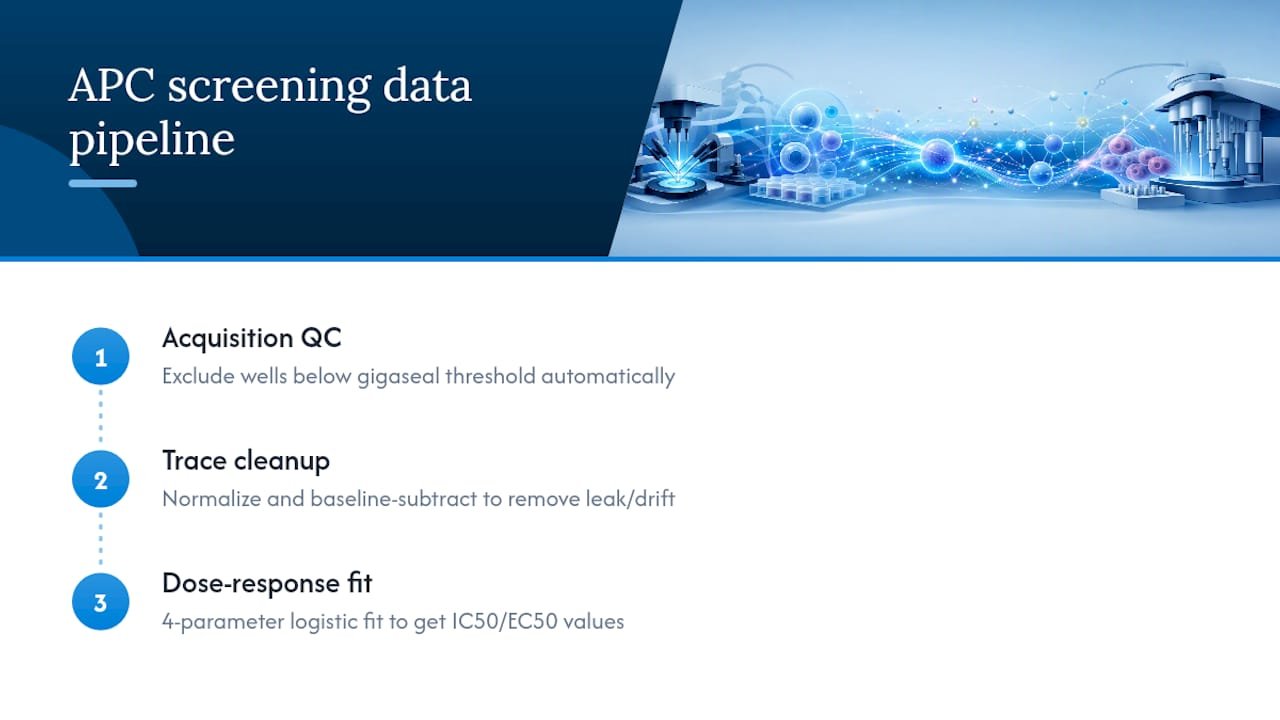
The core data pipeline for a typical screening run breaks into three stages. First, the acquisition software flags wells that never reached gigaseal threshold so they’re excluded automatically rather than manually. Second, current traces get normalized and baseline-subtracted to remove leak current and drift, which matters more on planar arrays where cell-to-cell variability is higher than on a single manual pipette recording. Third, dose-response curves get fit to extract IC50 or EC50 values, usually with standard four-parameter logistic models.
Integration with lab data systems is where APC starts paying off at scale. Larger screening operations pipe APC output directly into a laboratory information management system (LIMS) or an electronic lab notebook, tagging each well’s result with compound ID, plate position, and QC status automatically. That traceability is what makes APC data usable in a regulatory safety submission, since reviewers need a clean audit trail from raw current trace to reported IC50, not just a summary spreadsheet.
For labs running smaller volumes, open-source analysis packages built for patch clamp trace analysis can substitute for a full LIMS integration, though they require more manual curation of which wells to include or exclude based on seal quality.
What’s Next for Automated Patch Clamp Technology?
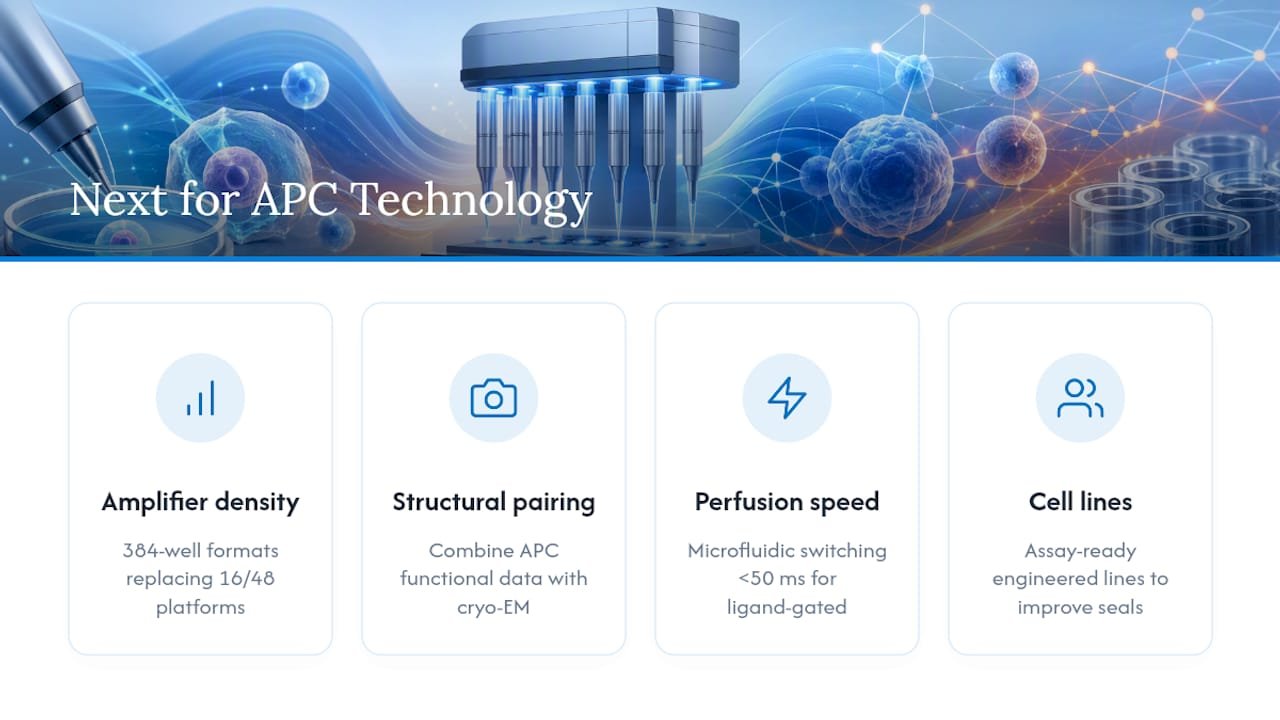
Amplifier density keeps climbing. Platforms that once maxed out around 16 or 48 parallel channels now commonly run 384-well formats, and that jump has done more to expand APC’s role in early discovery than any single software improvement.
The more interesting shift is what APC data gets paired with. Combining functional electrophysiology from APC with structural data from cryo-EM is emerging as a high-value strategy for understanding exactly how a compound modulates a channel, not just whether it does. A hERG hit from an APC screen means much more when you can also see where on the channel structure that compound is binding.
Perfusion speed is improving too, which matters directly for ligand-gated channel work where fast desensitization kinetics have historically been hard to capture on planar platforms. As microfluidic switching speeds push further below the 50 millisecond mark, APC becomes viable for a wider range of channel families that were previously manual-only territory.
Expect continued movement toward assay-ready, engineered cell lines as the default starting material, since cell line consistency remains the biggest lever for improving seal success rates across any platform generation. The hardware is arguably ahead of the biology at this point. Most throughput gains left on the table now come from better cells and better assay design, not faster amplifiers.
Why Automated Patch Clamp Gets Oversold as an Either/Or Choice
The conventional framing pits APC against manual patch clamp as if you’re picking a permanent side. That’s the wrong lens. The stronger read of the evidence is that most serious ion channel programs need both, just at different stages. APC carries the screening funnel because it has to, given the compound volumes involved, but the manual bench doesn’t disappear. It moves downstream to characterize the handful of hits that actually matter.
Where I think labs waste the most time is skipping the single-hole troubleshooting step when PPC assays fail. It’s tempting to blame the instrument and escalate to a service call, when half the time the real issue is cell health or membrane prep that a quick single-hole run would expose in an afternoon. Cell line quality gets underrated too. Teams will spend weeks tuning negative pressure protocols on a mediocre cell line when the higher-leverage fix was sourcing a better-expressing line from the start.
If there’s one priority I’d push above the rest, it’s this: solve the cell line problem before you touch the pressure pulse settings. Everything downstream gets easier once expression is consistent.
— Alina
Sources
- Using automated patch clamp electrophysiology platforms in ion channel drug discovery: an industry perspective
- Patch clamp methodologies and gigaseal formation (method paper / review)
- Automated patch-clamp systems: technical considerations and applications
FAQ
How Does a Patch Clamp Work?
A patch clamp forms a tight seal, called a gigaseal, between a glass pipette or planar hole and a cell membrane, then measures the tiny electrical current flowing through ion channels in that patch once whole-cell access is established.
How Hard Is Patch Clamping to Learn?
Manual patch clamp has a real learning curve, often taking weeks to months to reliably form gigaseals, because it depends on hand technique and cell-by-cell judgment. Automated systems remove most of that manual skill requirement, though assay optimization still demands technical know-how.
Is the Voltage Clamp Method Still Used Today?
Yes. Voltage clamp remains the core electrical principle behind both manual and automated patch clamp, and continuous voltage-clamp capability is a standard feature in modern high-throughput APC platforms.
What Is Whole-Cell Patch Clamp Recording?
Whole-cell recording means the pipette or planar hole has ruptured the membrane patch (or perforated it with an agent like amphotericin B), giving the amplifier electrical access to the entire cell’s interior rather than just the isolated patch.
When Should I Use Manual Patch Clamp Instead of APC?
Choose manual patch clamp for primary cells, freshly differentiated iPSC-derived cells, or detailed biophysical studies requiring individual-cell selection, since these cell types often don’t tolerate automated flow-through handling as well as stable cell lines do.