
Carrier Protein Effects for Labs: Match Chemistry, Prevent Background
The carrier you pick decides three outcomes at once: how much antibody titer you get, how clean your affinity maturation is, and how much anti-carrier noise shows up in your assay later. Bigger, more complex carriers like KLH tend to drive stronger, higher-affinity responses because they carry more T-cell epitopes; smaller carriers like BSA or OVA are easier to work with but often produce lower titers and, if reused for screening, invite background from anti-carrier antibodies. Chemistry matters just as much as carrier identity: maleimide coupling gives you predictable orientation, while EDC/NHS and glutaraldehyde trade specificity for speed.
TL;DR:
- Larger carriers like KLH tend to produce higher antibody titers and better affinity maturation, especially for weakly immunogenic haptens.
- Maleimide conjugation offers predictable, site-specific coupling with consistent ratios, reducing batch variability compared to EDC/NHS or glutaraldehyde methods.
- Using the same carrier for immunization and screening can cause background from anti-carrier antibodies, so heterologous coating improves assay specificity.
- Pre-verified conjugation ratios, confirmed by SDS-PAGE or UV/thiol assays, prevent low titers and batch-to-batch inconsistencies.
- Reusing carriers without tracking exposure or verifying conjugation chemistry increases risks of carrier-induced suppression or reduced immunogenicity.
Table of Contents
- What Are Carrier Protein Effects on Antibody Responses?
- How Do Conjugation Chemistries Affect Orientation and Coupling Ratio?
- Why Do Carrier Proteins Cause Assay Background?
- Which Carrier and Chemistry Should You Choose First?
- What Goes Wrong With Carrier Conjugates, and How Do You Fix It?
- Can Carrier Proteins Suppress the Immune Response to a Hapten?
- Does Carrier Protein Stability Affect the Antibody Response You Get?
- Does the Same Carrier Work the Same Way in Every Animal Model?
- How Do You Stop Anti-Carrier Antibodies From Ruining a Longitudinal Study?
- The Overlooked Variable in Carrier Selection
- Sourcing Carriers, Conjugation Reagents, and Antibodies for Your Next Project
- Sources
- FAQ
What Are Carrier Protein Effects on Antibody Responses?
Carrier proteins do not just carry a hapten around. They provide the T-cell epitopes that a small hapten cannot supply on its own, and that step is what turns a molecule too small to trigger immunity into something the adaptive immune system actually responds to.
Here is the mechanism, stripped down. A B cell binds the hapten-carrier conjugate through its surface immunoglobulin, internalizes the whole complex, and processes the carrier portion into peptide fragments. Those fragments get loaded onto MHC class II molecules and displayed on the B-cell surface. A carrier-specific helper T cell recognizes that MHC II/peptide combination and delivers the signals (CD40L engagement, cytokines) that let the B cell proliferate, class-switch, and undergo affinity maturation in the germinal center. Skip this step, and you get a weak, short-lived IgM response at best. This T-cell dependency is well documented in mechanistic reviews of carrier protein involvement in T-cell help and antibody production.
Carrier size and epitope density change the outcome, not just the mechanism. A Bioconjugate Chemistry comparison of carrier size and complexity found that larger, more complex carriers generally push titers and affinity maturation higher than smaller ones, which is exactly why KLH remains a default choice for weakly immunogenic haptens. BSA and OVA can still work, particularly for haptens that are already reasonably immunogenic on their own, but you should expect a flatter titer curve.
Three variables drive most of the variation you will see between projects:
- Carrier molecular weight and epitope density — more surface area generally means more T-cell epitopes available for presentation.
- Hapten:carrier coupling ratio — too few haptens per carrier under-stimulates; too many can trigger steric hindrance or solubility problems that suppress the response.
- Species and adjuvant context — the same carrier can perform differently in rabbit versus mouse, so pilot immunizations matter more than carrier reputation alone.
Statistic to remember: no single carrier wins across every antigen. Comparative lab work on carrier protein and peptide immunogenicity confirms that carrier performance is antigen-dependent, so matching carrier chemistry to your specific hapten’s properties beats defaulting to whatever worked on the last project.
How Do Conjugation Chemistries Affect Orientation and Coupling Ratio?
The chemistry you choose determines whether your hapten sits in a predictable spot on the carrier or gets scattered across every reactive residue available. That difference shows up later as inconsistent titers, batch-to-batch variability, and headaches during QC.
- Maleimide chemistry targets free cysteine thiols on the peptide, giving oriented, site-specific coupling with a reproducible maleimide:protein ratio. It is faster than glutaraldehyde-based crosslinking and avoids the reticulation problems that come with nonspecific methods, according to protocol comparisons of maleimide-activated carriers. It is the go-to option when your peptide has a single accessible cysteine and you need predictable orientation for consistent immunization or assay coating.
- EDC/NHS chemistry links carboxyl groups on the hapten to primary amines on the carrier, usually lysine side chains. It is convenient because most peptides have accessible carboxyls, but it is also less specific: EDC/NHS can modify lysines that happen to sit within a carrier’s T-cell epitopes, which risks quietly degrading the very epitope presentation the carrier is supposed to provide.
- Glutaraldehyde and other nonspecific crosslinkers react broadly across amines, producing variable orientation and sometimes protein-protein reticulation between carrier molecules. It is quick and cheap, but coupling ratios become harder to control and batch consistency suffers.
Coupling ratio itself is not a “more is better” variable. Work on hapten-carrier conjugation ratios and orientation effects shows that excessively high hapten:carrier ratios can actually reduce antibody affinity compared with a moderate, optimized ratio, likely from steric crowding or reduced carrier solubility.
Pro Tip: Confirm conjugation before you immunize, not after you get a disappointing titer. Run SDS-PAGE to check for a mobility shift, watch for a UV absorbance red-shift, use DTNB (Ellman’s reagent) to confirm free thiols were consumed during maleimide coupling, and estimate your final peptide:protein ratio by mass spec or absorbance ratio before committing animals or wells to the batch.
Why Do Carrier Proteins Cause Assay Background?
Anti-carrier antibodies are an unavoidable byproduct of immunization, and they cause trouble the moment your screening assay uses the same carrier you immunized with. If your ELISA coats plates with the identical carrier-hapten conjugate used for immunization, a meaningful fraction of the signal you read can come from antibodies that recognize the carrier scaffold, not the hapten. That inflates apparent titers and can generate false positives during hybridoma screening or serum titration.
Homologous carrier use is not automatically wrong. Research on BSA as an immunogenic carrier for hapten-specific monoclonal antibody development found that BSA can serve as both immunogen carrier and screening antigen in some workflows without dominant anti-BSA hybridomas overwhelming the screen. The safer default for most projects, though, is heterologous coating, meaning you screen against a different carrier than the one used for immunization.
Practical controls that separate real signal from carrier noise:
- Include carrier-only coated wells as a background subtraction control on every plate.
- Run a carrier-competition preincubation, adding free carrier protein to serum before the assay to absorb out anti-carrier antibodies.
- Use a competitive ELISA with free hapten to confirm that binding is hapten-specific rather than carrier-driven.
- Decide deliberately whether carrier protein belongs in your blocking buffer or should be avoided entirely if it is the same carrier used for coating.
Which Carrier and Chemistry Should You Choose First?
Work backward from the assay you actually need, not from whichever carrier is sitting in the freezer.
- Define the goal. Antibody generation for high titer and affinity calls for different choices than a quick screening reagent or a translational vaccine candidate.
- Assess hapten immunogenicity. Weak haptens need a high-immunogenicity carrier like KLH paired with oriented chemistry (maleimide where possible); reasonably immunogenic haptens can tolerate BSA or OVA.
- Separate immunization from screening carriers. Use a heterologous carrier for coating antigens so you are not measuring your own anti-carrier response.
- Plan for translation early if relevant. If there is any chance this project moves toward a clinical or regulatory pathway, consider clinically acceptable carriers such as CRM197 or tetanus toxoid from the start. Switching later means repeating conjugation work and animal studies, a documented source of delay in translational programs.
- Build QC into the plan, not as an afterthought. Set a target coupling ratio, confirm it experimentally, and check for aggregation before storage.
What Goes Wrong With Carrier Conjugates, and How Do You Fix It?
Most conjugation failures fall into four recurring categories, and each has a fast diagnostic path.
- Low antibody response: verify your coupling ratio actually matches your target, increase hapten density if it is low, or switch to a more complex carrier like KLH. Check adjuvant choice and dosing schedule before blaming the carrier alone.
- High background in screening: add carrier-competition controls, switch to a heterologous coating antigen, or increase blocking stringency with an alternative blocking agent.
- Inconsistent conjugation between batches: favor maleimide chemistry for cysteine-containing peptides for reproducibility, and confirm every batch with DTNB and SDS-PAGE rather than trusting the protocol alone.
- Aggregation during storage: avoid low-pH buffers for carriers sensitive to acidic conditions, store at recommended temperatures, and check for turbidity or particulate before each use.
Pro Tip: Keep a simple conjugation logbook with coupling ratio, DTNB thiol readout, and SDS-PAGE shift for every batch. When a titer disappoints six months later, that record tells you in five minutes whether the conjugate or the animal is the problem.
Can Carrier Proteins Suppress the Immune Response to a Hapten?
Yes, and it is a subtler failure mode than most researchers expect going in. Carrier-induced epitope suppression happens when the immune system’s response to the carrier itself dominates and effectively crowds out the hapten-specific response you actually wanted. This is more common with highly immunogenic carriers carrying a low hapten density, where most of the immune machinery ends up focused on carrier epitopes rather than the conjugated hapten.
Repeated exposure to the same carrier across multiple immunizations, or across different projects in the same animal colony, can also produce a phenomenon sometimes called carrier-preimmunization interference, where pre-existing anti-carrier memory blunts the response to a newly conjugated hapten on that same scaffold. If your lab reuses KLH or tetanus toxoid across many projects, this is worth watching for, particularly in animals or donor sera with prior exposure history.
The practical fix is density and diversity. Raising the hapten:carrier ratio toward the optimal range (not the maximum) shifts immune attention toward the hapten. Rotating carrier choice across sequential projects that share animal cohorts reduces the risk of carrier-specific memory dominating a new immunization. Neither fix requires exotic reagents, just a deliberate look at ratio and immunization history before you commit to a full study.
Does Carrier Protein Stability Affect the Antibody Response You Get?
A conjugate that has partially degraded or aggregated before injection is not delivering the antigen you designed. Carrier proteins vary in their tolerance for freeze-thaw cycles, pH swings, and prolonged storage at suboptimal temperatures, and instability shows up as reduced immunogenicity, unpredictable titers, or, worse, an immune response skewed toward degradation products rather than your intended hapten-carrier epitope.
KLH is particularly sensitive here. It is a large, multi-subunit protein that can dissociate under low-pH conditions or repeated freeze-thaw, and dissociated subunits present a different epitope landscape than the intact protein. BSA and OVA tend to be more forgiving of routine handling but are not immune to aggregation if stored improperly or subjected to repeated freeze-thaw at high concentration.
Practical storage guidance that applies across most conjugates: keep conjugates at the manufacturer-recommended temperature (typically 2 to 8°C for near-term use, minus 20°C or below for longer storage), avoid repeated freeze-thaw by aliquoting on receipt, and steer clear of low-pH buffers unless the carrier is specifically validated for that condition. Check for turbidity or visible aggregation before every use, since a cloudy conjugate is rarely worth injecting or coating a plate with. If your storage log shows a conjugate has cycled through more than two or three freeze-thaws, treat any resulting weak titer as a storage question first, before concluding the carrier or chemistry failed.

Does the Same Carrier Work the Same Way in Every Animal Model?
No, and this is one of the more frequently underestimated variables in carrier selection. The same carrier-hapten conjugate can produce a strong, high-affinity response in rabbits and a comparatively weak one in mice, or vice versa, because MHC class II diversity and existing immune exposure differ by species and even by strain within a species.
Rabbits are commonly favored for polyclonal antibody production partly because their immune systems tend to respond robustly to KLH conjugates and produce high-titer, high-affinity polyclonals across a broad range of haptens. Mice, by contrast, show more strain-dependent variability. Some inbred mouse strains respond well to KLH; others respond better to alternative carriers, and MHC haplotype differences between strains are a large part of why. This is one reason hybridoma projects often run small pilot immunizations across a couple of strains before committing to a full production timeline.
Larger animal models used in translational or preclinical vaccine work introduce another variable: prior natural exposure to certain carriers. Tetanus toxoid, for instance, is a component of routine vaccination in many species-relevant contexts, meaning some animal populations carry pre-existing anti-tetanus toxoid immunity that can either help (faster secondary-type response) or complicate (background from prior memory) a new conjugate study. None of this means one carrier is universally wrong for one species. It means the pilot study is not optional busywork. It is the step that tells you whether your carrier choice matches your model before you scale up.
How Do You Stop Anti-Carrier Antibodies From Ruining a Longitudinal Study?
Longitudinal studies, where the same animals or donor cohort get sampled repeatedly over weeks or months, compound the anti-carrier interference problem because anti-carrier titers tend to rise over the course of the study right alongside your hapten-specific response. By the later time points, separating the two signals gets harder, not easier.
The most reliable fix is planning the assay format before the study starts, not retrofitting controls afterward. Use a heterologous carrier for your screening or endpoint assay from day one, so anti-carrier antibodies generated against the immunization carrier simply do not bind your coating antigen. Build carrier-competition preincubation into your standard sample processing protocol for every time point, not just the final one, so you get a consistent, comparable background correction across the whole study rather than a one-off fix at the end.
Rotating or varying the carrier across sequential immunization boosts, where your protocol allows it, also limits how high anti-carrier titers climb over time. If the study design fixes you to a single carrier throughout, budget extra serum volume at each time point specifically for a carrier-absorption step before your hapten-specific readout. It is a small protocol addition that prevents a slow, creeping background problem from undermining your endpoint data months into a study you cannot easily repeat.
The Overlooked Variable in Carrier Selection
Most guidance on carrier proteins treats the decision as a lookup table: use KLH for weak haptens, use BSA for screening, done. That framing misses the part that actually causes projects to fail, which is treating conjugation chemistry as an afterthought to carrier choice rather than an equal partner in it.
A researcher can pick the theoretically ideal carrier and still get a mediocre response because EDC/NHS chemistry happened to modify a lysine sitting inside a key T-cell epitope. Nobody notices because the conjugation “worked,” meaning the SDS-PAGE showed a shift and the project moved forward. The failure only shows up months later as an unexplained low titer, and by then it is tempting to blame the carrier when the real culprit was the coupling method quietly damaging exactly the feature that made the carrier useful in the first place.
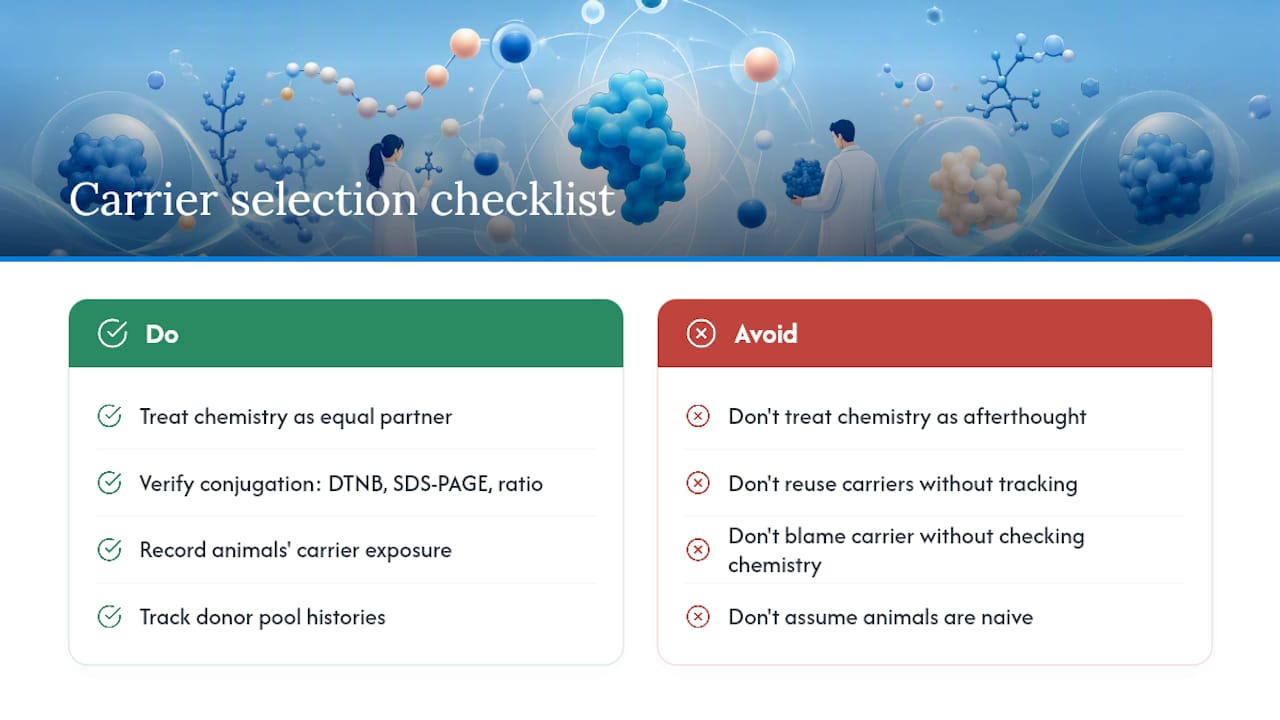
The other underrated factor is how casually labs reuse carriers across projects without tracking prior exposure. Carrier-preimmunization interference does not announce itself. It just makes your new project’s titers look unaccountably weaker than the literature promised, and the literature was working with naive animals.
What actually moves the needle is treating chemistry verification (DTNB, SDS-PAGE, coupling ratio) as seriously as carrier selection, and keeping a real record of which animals or donor pools have prior exposure to which carriers. Neither step is glamorous. Both save more projects than switching carrier brands ever does.
— Alina
Sourcing Carriers, Conjugation Reagents, and Antibodies for Your Next Project
Once you’ve settled on a carrier and chemistry, the bottleneck usually shifts to sourcing reagents that are actually conjugation-ready and getting a straight answer when something in the protocol doesn’t behave as expected.

Stocks carrier proteins, conjugation reagents, antibodies, and peptide pools suitable for workflows like those described above, so you are not stitching together compatible reagents from multiple vendors before starting a coupling reaction. If you are choosing between a homologous and heterologous screening setup, or trying to confirm whether your peptide’s cysteine placement suits maleimide chemistry, technical support teams can advise reagent selection before you commit a batch of animals or a full plate of samples. For teams weighing hapten properties against carrier options at the design stage, this researcher’s guide to immunology peptide study types is also a useful companion read. Browse the antibody product line to see what’s available for downstream screening, or head to the Mayflowerbio home page to reach the team directly about a current conjugation project.
Sources
- Mechanistic overview on carrier protein involvement in T-cell help and antibody production
- Bioconjugate Chemistry study showing carrier size/complexity effects on titer and affinity (2025)
- Maleimidyl activated protein carriers: protocol advantages and trade-offs
FAQ
What Carrier Protein Gives the Highest Antibody Titer?
KLH generally produces the strongest titers and best affinity maturation for weakly immunogenic haptens because of its size and high density of T-cell epitopes, though the optimal choice still depends on the specific hapten involved.
Does BSA Work as Both Immunogen and Screening Antigen?
In some workflows, yes. Research on hapten-specific monoclonal antibody development found BSA can serve both roles without dominant anti-BSA interference, but heterologous coating remains the safer default for most screening setups.
Why Does My Assay Show High Background With Carrier-Hapten Conjugates?
Anti-carrier antibodies generated during immunization are binding your coating antigen if it shares the same carrier. Switching to heterologous coating or adding carrier-competition controls typically resolves this.
Which Conjugation Chemistry Gives the Most Reproducible Coupling Ratio?
Maleimide chemistry, used with cysteine-containing peptides, gives oriented and reproducible coupling ratios more reliably than EDC/NHS or glutaraldehyde-based methods.
Should I Use CRM197 or Tetanus Toxoid Instead of KLH?
Choose CRM197 or tetanus toxoid early if the project has any translational or clinical path, since switching carriers later means repeating conjugation and animal work; KLH and BSA remain the standard choices for purely research-grade projects.