
How Do You Pass a Mouth Swab Drug Test?
If you are searching for “how do you pass a mouth swab drug test,” the first thing to understand is that there is no reliable mouthwash, food, drink, gum, supplement, or last-minute trick that can guarantee a negative result after recent drug use.
A mouth swab drug test—also called a saliva drug test or oral fluid drug test—looks for specific drugs or drug markers in oral fluid. Compared with urine testing, oral-fluid testing generally has a shorter detection window, although the actual window depends on the substance, test method, cutoff concentration, and individual circumstances. SAMHSA notes that oral-fluid detection can range from minutes to up to about two days depending on the drug and testing circumstances.
The most useful way to prepare is therefore to understand how oral-fluid testing works, how detection windows vary, what can affect a result, and which common “pass” methods are unsupported.
Important: This article is educational. It does not provide instructions for adulterating, substituting, manipulating, or falsifying a drug-test specimen.
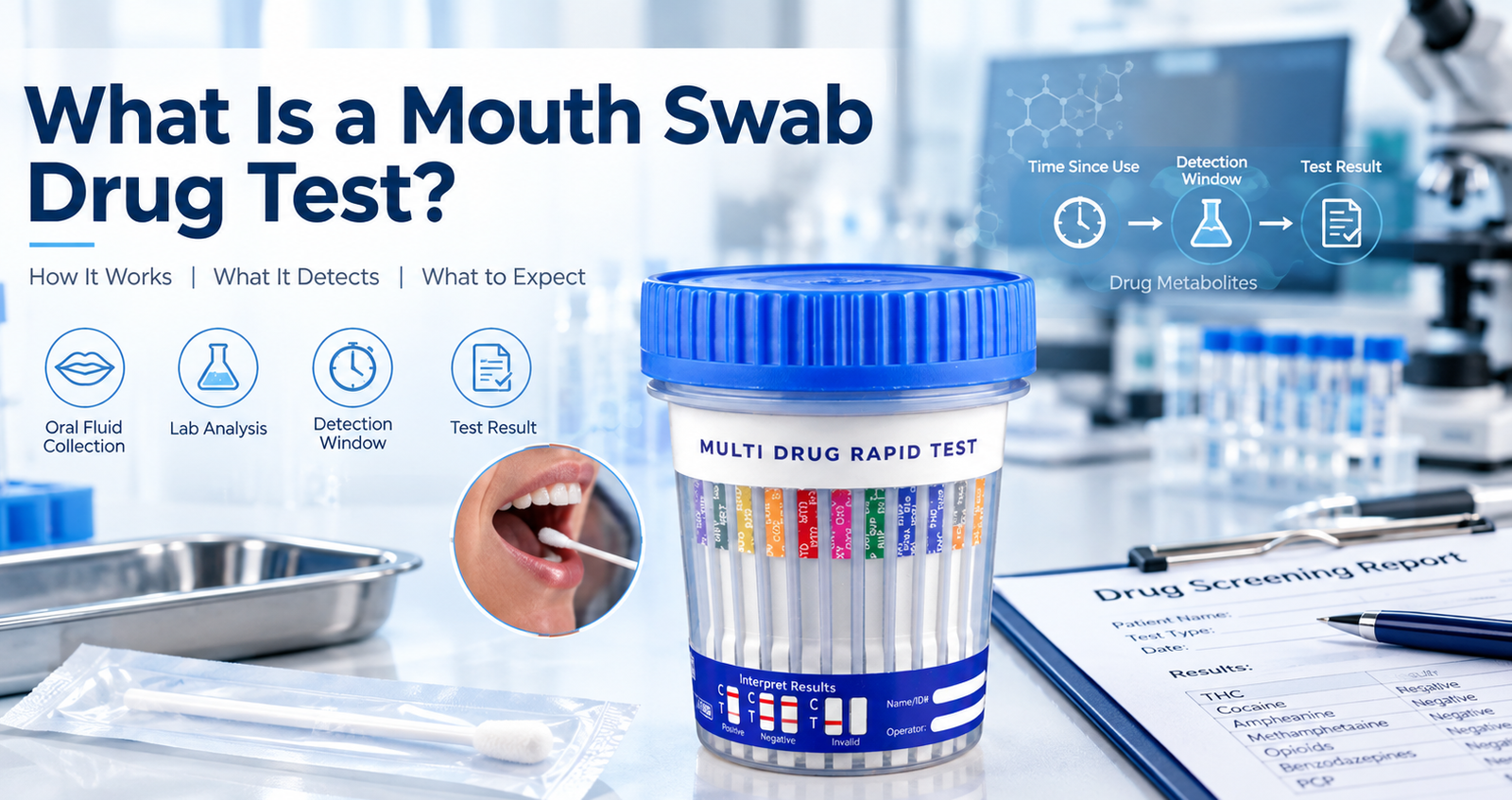
What Is a Mouth Swab Drug Test?
A mouth swab drug test collects oral fluid from inside the mouth and analyzes it for particular drugs or drug analytes.
You may see the same type of test described as:
- Mouth swab drug test
- Saliva drug test
- Oral fluid drug test
- Oral swab drug test
- Saliva screening
- Oral-fluid drug screening
- Rapid oral drug test
The terms are often used interchangeably, although individual products and testing programs can use different collection devices and testing panels.
Unlike urine testing, which can provide a longer detection period for some substances, oral-fluid testing is particularly useful for identifying more recent exposure. SAMHSA describes oral-fluid detection as generally shorter than urine detection, with the precise window depending on the drug.
How Do You Pass a Mouth Swab Drug Test?
The most dependable factor affecting whether a test detects a substance is whether the substance remains detectable at the time of collection.
If you have an upcoming test, the evidence-based approach is to:
- Avoid further use of substances that the test may detect.
- Find out what type of test and testing panel is being used, when that information is available.
- Understand that detection windows vary significantly between substances and individuals.
- Follow the collector’s instructions carefully.
- Don’t rely on products claiming to guarantee a negative result.
- Don’t attempt to alter, adulterate, or substitute the specimen.
There is no scientifically reliable way to promise that someone will test negative after recent use simply by brushing their teeth, drinking water, chewing gum, or using a particular mouthwash.
How Does a Mouth Swab Drug Test Work?
The basic process is straightforward.
1. Oral fluid is collected
A collection device is placed in the mouth, generally according to the manufacturer’s instructions. The device collects oral fluid from the mouth.
2. The specimen is screened
Depending on the testing program, the specimen may undergo an initial screening test.
3. The result is interpreted
A screening result may be reported as negative or may require additional testing depending on the program.
4. Laboratory confirmation may be performed
When required, a specimen can undergo more specific laboratory analysis.
Federal workplace programs have formal procedures governing oral-fluid collection and testing. SAMHSA states that federal workplace drug-testing programs can use oral fluid or urine, and specimens must be collected according to applicable procedures.
How Long Does a Mouth Swab Drug Test Detect Drugs?
There is no single detection window that applies to every drug or every person.
SAMHSA’s current educational overview states that oral-fluid detection can range from just minutes to up to about two days, depending on the drug. Its Medical Review Officer guidance also notes that oral-fluid detection is generally shorter than urine detection and gives a broad 5-to-48-hour range for drugs of abuse in general. These are general ranges, not guarantees for a particular individual or test.
The actual detection period can be affected by:
- Drug type
- Amount used
- Frequency of use
- Time since last use
- Route of administration
- Individual biological differences
- Oral-fluid characteristics
- Test cutoff
- Test sensitivity
- Collection procedure
- Testing technology
This is why statements such as “every drug disappears from saliva after 24 hours” are misleading.
What Drugs Can a Mouth Swab Test Detect?
The answer depends on the testing panel.
Oral-fluid testing can be configured to detect different groups of substances. Federal workplace testing, for example, includes categories such as:
- Marijuana/THC
- Cocaine
- Amphetamines
- Methamphetamine
- MDMA/MDA
- Opioids
- Phencyclidine (PCP)
Federal testing panels and requirements can change, so the panel used for a particular test should always be checked rather than assuming that every mouth swab tests for the same substances.
Commercial tests can also be offered in different configurations, such as:
- 5-panel
- 6-panel
- 10-panel
- 12-panel
- Other customized panels
A “12-panel” test, for example, does not necessarily contain exactly the same analytes as every other 12-panel product. Always check the manufacturer’s specifications.
What Determines Whether a Mouth Swab Test Is Positive?
A test result isn’t determined simply by asking:
“How long ago did the person use?”
Several variables can matter.
1. The substance
Different substances have different pharmacological and chemical properties.
2. Time since use
Recent exposure is particularly relevant for oral-fluid testing.
3. Frequency of use
Patterns of use can influence how long a substance or its relevant analytes remain detectable.
4. Dose
The amount used can affect concentrations, although dose alone cannot predict an individual test result.
5. Route of administration
How a substance enters the body can affect the appearance and concentration of drug analytes in oral fluid.
SAMHSA explains that drugs can enter oral fluid through diffusion from blood as well as deposition in the oral cavity following certain routes of administration.
6. Testing cutoff
A test doesn’t simply ask whether a molecule has ever been present.
Testing uses defined analytical thresholds.
For example, federal DOT oral-fluid testing has specified initial and confirmatory cutoff concentrations for particular analytes.
7. Testing method
Rapid screening and laboratory confirmation can use different analytical approaches.
Therefore, a result from one testing system should not automatically be assumed to be identical to a result from another.
Can You Pass a Mouth Swab Drug Test in 12 Hours?
This is one of the most common questions surrounding saliva testing.
The short answer:
There is no dependable 12-hour method that guarantees a negative mouth swab drug test after recent drug use.
Some substances may fall below a particular test’s detection threshold relatively quickly, while others can remain detectable longer.
The result depends on the substance, timing, testing method, cutoff, and other factors.
Be cautious of websites claiming that a specific drink, mouthwash, candy, gum, or household product can guarantee a negative result within 12 hours.
A guarantee is not scientifically justified.
Can You Pass a Mouth Swab Drug Test in 24 Hours?
Again, there is no universal 24-hour rule.
Some oral-fluid tests are designed to detect relatively recent exposure, but detection varies substantially by substance and test.
SAMHSA’s guidance specifically emphasizes that the detection window depends on the drug rather than providing one universal period for every substance.
So instead of asking:
“Is 24 hours enough?”
the more useful questions are:
- What substance is being tested?
- What testing panel is being used?
- When was the last exposure?
- What cutoff does the test use?
- Is this a rapid screen or laboratory test?
Can You Pass a Mouth Swab Drug Test in 48 Hours?
A 48-hour period may be relevant to the detection window for some oral-fluid tests, but it cannot be treated as a guaranteed clearance period.
SAMHSA’s current overview describes oral-fluid detection as potentially ranging from minutes to up to two days depending on the drug.
That doesn’t mean:
“48 hours = guaranteed negative.”
It means that the detection period is substance- and test-dependent.
Does Brushing Your Teeth Help You Pass a Mouth Swab Drug Test?
Good oral hygiene is beneficial for oral health, but brushing your teeth is not a reliable method for guaranteeing a negative drug test.
A mouth swab test isn’t simply looking for dirt or residue on the teeth.
Drug analytes can be present in oral fluid, and drugs can reach oral fluid through processes involving the bloodstream as well as direct deposition in the mouth.
Therefore:
Brushing your teeth ≠ removing all detectable drug analytes.
You should maintain normal oral hygiene, but don’t treat brushing as a guaranteed drug-test solution.
Does Mouthwash Help You Pass a Saliva Drug Test?
This is another popular internet claim.
There are products marketed specifically as:
- Detox mouthwash
- Drug-test mouthwash
- Cleansing rinse
- Saliva detox products
However, a product’s marketing claim is not the same thing as a guarantee that a drug test will be negative.
Temporary changes in the mouth do not necessarily mean that the underlying drug exposure is no longer detectable.
A regulated testing program can also have procedures designed to protect specimen integrity.
For example, DOT regulations provide procedures for oral-fluid specimen validity testing when there are concerns that a specimen has been altered or contains substances that interfere with analysis.
Does Chewing Gum Help Pass a Mouth Swab Drug Test?
Chewing gum is often promoted online as a way to “flush” or dilute substances in saliva.
There is no reliable basis for claiming that ordinary chewing gum guarantees a negative drug-test result.
It may change saliva production or the conditions inside the mouth, but that is not equivalent to eliminating drug analytes from the body or guaranteeing that the specimen will test negative.
Does Drinking Water Help Pass a Mouth Swab Drug Test?
Normal hydration is important for general health.
However, drinking excessive amounts of water is not a reliable method for eliminating drugs from oral fluid.
Oral-fluid testing is different from urine dilution.
Trying to consume excessive amounts of water can also be unsafe.
The goal should be normal hydration rather than attempting to manipulate a specimen.
Can Sour Candy Help You Pass a Mouth Swab Drug Test?
Sour candy is another frequently promoted “hack.”
The idea is generally based on changing saliva production or saliva chemistry.
That does not mean sour candy can reliably remove detectable drugs or guarantee a negative result.
Don’t confuse:
changing saliva flow
with
eliminating drug detection.
Can Hydrogen Peroxide Help You Pass a Mouth Swab Drug Test?
Hydrogen peroxide and other substances are sometimes promoted online as oral-fluid “adulterants.”
Using chemicals or other substances to manipulate a specimen is not a dependable strategy and may interfere with testing.
More importantly, deliberately altering a specimen can create additional testing problems.
For regulated testing programs, specimen integrity is part of the testing process. DOT regulations specifically address oral-fluid validity testing when adulteration or interference is suspected.
For safety reasons, don’t use chemical products in your mouth for the purpose of attempting to manipulate a drug test.
Can Detox Products Make a Mouth Swab Test Negative?
Be skeptical of products promising:
“Pass any saliva drug test.”
“Guaranteed negative in one hour.”
“100% detox.”
“Remove all drugs from saliva.”
These claims should not be treated as established scientific facts.
A product cannot change the fundamental fact that the test is looking for specific analytes above a defined analytical threshold.
The most important variables remain the substance, timing, biological factors, and testing characteristics.
What Is the Difference Between a Mouth Swab and Urine Drug Test?
Both tests can detect drugs, but they examine different specimens.
| Feature | Mouth Swab / Oral Fluid | Urine |
|---|---|---|
| Specimen | Oral fluid/saliva | Urine |
| Common purpose | Recent exposure screening | Drug/metabolite detection |
| Detection period | Generally shorter | Often longer for many substances |
| Collection | Oral collection device | Urine specimen |
| Collection monitoring | Often directly observed/monitored | Depends on program |
| Testing method | Rapid screen and/or laboratory testing | Rapid screen and/or laboratory testing |
| Cutoffs | Test-specific | Test-specific |
| Confirmation | May be required | May be required |
SAMHSA describes oral-fluid detection as generally shorter than urine detection, although the actual window varies by drug.
Why Do Employers Use Mouth Swab Drug Tests?
Oral-fluid testing can be useful because collection is relatively straightforward and does not require the same type of restroom-based specimen collection used for urine.
SAMHSA notes that oral fluid is an authorized specimen type in federal workplace testing programs, alongside urine.
Depending on the program, oral-fluid testing may be used for:
- Workplace testing
- Pre-employment testing
- Random testing
- Post-accident testing
- Reasonable-suspicion testing
- Return-to-duty testing
- Clinical testing
- Other drug-screening programs
The exact rules depend on the organization and jurisdiction.
What Happens During a Mouth Swab Drug Test?
The process can vary by device, but generally involves several stages.
Step 1: Identification and collection
The testing facility verifies the person being tested and prepares the collection process.
Step 2: Oral-fluid collection
A collection device is used according to the manufacturer’s procedure.
Step 3: Specimen handling
The specimen is handled according to the applicable testing program.
Step 4: Initial testing
The specimen may undergo an initial screen.
Step 5: Confirmation when required
A non-negative screening result may undergo additional laboratory analysis according to the applicable program.
For DOT testing, oral-fluid collection has detailed requirements concerning collection sites, personnel, equipment, specimen handling, and documentation.
Are Mouth Swab Drug Tests Accurate?
No drug-testing method should be described as perfect.
Accuracy depends on factors including:
- Test design
- Cutoff concentration
- Collection quality
- Timing
- Substance
- Testing methodology
- Laboratory procedures
- Confirmation methods
Rapid screening tests are designed to identify specimens that may contain target analytes.
Laboratory confirmation can provide more specific analytical identification.
For example, federal DOT rules establish separate initial and confirmatory cutoff concentrations for oral-fluid testing.
What Is a False Positive?
A false positive occurs when an initial test indicates the presence of a target substance even though the final determination does not confirm that substance at the required criteria.
This is one reason confirmation procedures matter.
Unexpected results should be interpreted according to the testing program’s rules rather than assuming that a preliminary screening result automatically represents the final laboratory conclusion.
What Is a False Negative?
A false negative occurs when a test fails to detect a substance that is actually present at a relevant level.
Possible contributors can include:
- Testing too early or too late relative to the detection window
- Concentration below the cutoff
- Test limitations
- Collection issues
- Analytical limitations
This is one reason it is inaccurate to describe any single drug test as infallible.
What If a Mouth Swab Drug Test Is Positive?
If you receive an unexpected positive result, don’t immediately assume that the preliminary result is the final determination.
Depending on the testing program, additional testing or laboratory confirmation may be performed.
For regulated workplace testing, formal laboratory and medical-review procedures may apply. SAMHSA’s workplace-testing resources describe procedures for specimen testing, review, and reporting.
If you are taking a legitimate prescription medication, keep appropriate medication information available and follow the testing program’s instructions for reporting it.
Can Secondhand Smoke Cause a Positive Mouth Swab Drug Test?
This is a common concern, particularly with cannabis.
Casual environmental exposure should not automatically be interpreted as equivalent to intentional drug use.
However, drug-test results depend on the substance, exposure conditions, collection method, cutoff, and testing methodology.
Therefore, it is better to avoid making absolute statements such as:
“Secondhand exposure can never cause a positive.”
or:
“Any exposure will cause a positive.”
The circumstances matter.
How Far Back Does a Saliva Drug Test Detect Drug Use?
There is no universal answer.
A useful general rule is:
Oral-fluid tests are generally better suited to detecting relatively recent exposure than long-term historical drug use.
SAMHSA’s current overview describes oral-fluid detection as ranging from minutes to up to approximately two days depending on the drug.
Individual results can differ.
That’s why online “exact timelines” should be treated as estimates rather than guarantees.
Mouth Swab Drug Test Myths vs. Facts
Myth: Drinking huge amounts of water guarantees a negative test.
Fact: Excessive water consumption does not reliably eliminate drug analytes from oral fluid and can be unsafe.
Myth: Mouthwash always removes drugs from saliva.
Fact: There is no reliable guarantee that mouthwash will produce a negative test after recent use.
Myth: Brushing your teeth guarantees a negative result.
Fact: Oral hygiene is healthy, but brushing does not guarantee that drug analytes will be below a test’s cutoff.
Myth: Chewing gum makes a test negative.
Fact: Gum can change saliva flow but cannot reliably guarantee a negative drug test.
Myth: Every mouth swab detects drugs for exactly 48 hours.
Fact: Detection windows vary by drug, test, cutoff, timing, and individual circumstances.
Myth: Every saliva drug test uses the same panel.
Fact: Testing panels differ between products and testing programs.
Myth: A rapid positive is always the final result.
Fact: Depending on the testing program, additional confirmation may be performed.
How to Prepare for a Mouth Swab Drug Test
If you have an upcoming test, focus on legitimate preparation rather than trying to manipulate the specimen.
1. Stop further exposure
If you are concerned about a drug test, avoiding further use is the most important controllable factor.
2. Understand the test
If your employer, healthcare provider, or testing program has provided information about the test, review it.
3. Follow collection instructions
Don’t eat, drink, smoke, vape, or use oral products immediately before collection unless the testing facility’s instructions allow them.
4. Maintain normal oral hygiene
Continue your normal brushing and oral-care routine.
5. Stay normally hydrated
Drink fluids normally rather than attempting extreme hydration.
6. Don’t use specimen adulterants
Trying to chemically alter an oral-fluid sample can create additional problems and may invalidate the test.
7. Keep medication information available
If you’re taking prescription or over-the-counter medications, follow the testing program’s instructions regarding disclosure.
Can an At-Home Saliva Drug Test Predict an Employer Drug Test?
An at-home oral-fluid test can provide useful preliminary information, but it should not automatically be treated as identical to an employer’s laboratory test.
Different products can use:
- Different drug panels
- Different cutoff concentrations
- Different collection devices
- Different analytical methods
- Different quality-control procedures
Therefore, a home test result is not a guarantee of what another testing program will report.
Mouth Swab Drug Test vs. At-Home Saliva Test
| Feature | At-Home Saliva Test | Formal Workplace Test |
|---|---|---|
| Collection | User-operated | Controlled collection |
| Testing panel | Product-dependent | Program-dependent |
| Cutoffs | Product-specific | Program-specific |
| Result | Often rapid | Rapid and/or laboratory |
| Confirmation | Depends on product | May be required |
| Chain of custody | Generally limited compared with regulated testing | Formal procedures may apply |
| Purpose | Preliminary information | Official testing decision |
For regulated programs, collection and laboratory requirements can be substantially more formal. DOT, for example, specifies requirements for oral-fluid collection sites and procedures.
What Should You Do If You Are Worried About an Upcoming Test?
If you’re worried because of recent use, don’t rely on internet “hacks” promising guaranteed results.
Instead:
- Learn what type of test is being administered.
- Determine what panel is being used if that information is available.
- Understand that oral-fluid testing generally focuses on recent exposure.
- Avoid additional exposure.
- Follow the collection instructions.
- Don’t attempt to manipulate the specimen.
- Ask the testing provider about the official process if you have procedural questions.
If the test is connected to employment, probation, court requirements, treatment, licensing, or another formal program, the applicable rules may be different.
Frequently Asked Questions
How do you pass a mouth swab drug test?
There is no guaranteed last-minute method. The most reliable factor is allowing sufficient time after stopping exposure for the relevant substance to fall below the test’s detection threshold. Detection varies by drug and testing method.
How long does a mouth swab drug test detect drugs?
Oral-fluid detection is generally shorter than urine detection, but the actual period depends on the substance and test. SAMHSA describes oral-fluid detection as ranging from minutes to approximately two days depending on the drug.
Can you pass a mouth swab drug test in 12 hours?
There is no dependable method that guarantees a negative result within 12 hours after recent use.
Can you pass a mouth swab in 24 hours?
Possibly depending on the substance and test, but 24 hours is not a universal clearance period.
Can you pass a mouth swab in 48 hours?
Some substances may fall outside an oral-fluid detection window within that period, while others may remain detectable. There is no universal 48-hour guarantee.
Does brushing your teeth help pass a saliva drug test?
Normal oral hygiene is healthy, but brushing does not guarantee that a drug test will be negative.
Does mouthwash help pass a mouth swab?
Mouthwash should not be considered a guaranteed way to eliminate drug detection.
Does chewing gum help pass a mouth swab?
Chewing gum can affect saliva production but does not guarantee a negative drug-test result.
Does drinking water help pass a mouth swab?
Normal hydration is appropriate, but excessive water consumption does not reliably remove drug analytes from oral fluid.
Is a mouth swab easier to pass than a urine test?
The tests have different detection characteristics. Oral-fluid testing generally has a shorter detection window than urine for many substances, but “easier” is too broad because the result depends on the drug, timing, test, and cutoff.
What drugs can a saliva test detect?
That depends on the test panel. Commonly tested categories can include THC, cocaine, amphetamines, methamphetamine, opioids, and PCP, among others. Federal workplace panels are defined separately from commercial panels.
Are saliva drug tests accurate?
They can provide useful drug screening when properly administered, but no testing method should be considered perfect. Test design, cutoff, collection, timing, and confirmation procedures all matter.
What happens after a positive saliva screening?
Depending on the testing program, additional laboratory confirmation or review may be performed. Formal workplace programs can have specific procedures governing this process.
What Actually Matters in a Mouth Swab Drug Test?
If you’re searching for how do you pass a mouth swab drug test, it’s easy to encounter claims about detox drinks, special mouthwashes, gum, candy, extreme hydration, or other quick fixes.
The more important reality is simpler:
Mouth swab tests are designed to detect recent drug exposure, and the detection window varies according to the substance and testing circumstances.
The major factors include:
- What substance was used
- How much was used
- How frequently it was used
- How long ago exposure occurred
- The testing panel
- The test’s cutoff
- The collection process
- The analytical method
- Whether laboratory confirmation is performed
SAMHSA’s current guidance emphasizes that oral-fluid detection windows vary by drug, while federal workplace programs establish specific procedures and analytical requirements for oral-fluid testing.
So rather than relying on an internet “hack,” the best way to understand a mouth swab drug test is to understand what the test detects, how oral fluid testing works, and why detection windows vary.




