

Copy Ready Sole Source Justification for Reagents for U.S. Labs
A reagent purchase qualifies for sole sourcing only when it meets one of the narrow noncompetitive grounds recognized under 2 CFR 200.320, such as a proprietary product, a sponsor mandate, or inadequate competition after a genuine search. Even then, you still owe reviewers a documented price reasonableness analysis under 2 CFR 200.324. Defensible reagent cases usually involve a proprietary clone, a sponsor-named product, or continuity needs for an ongoing longitudinal study.
TL;DR:
- A sole source justification for reagents must prove no functional alternative exists, not just a preference for a specific brand.
- Documentation needs to include precise technical specifications, a market research log, and evidence of price reasonableness, such as prior invoices or published prices.
- When suppliers are overseas, the search must include domestic distributors or resellers, and import/export requirements may influence justification if delays impact research continuity.
- Justifications citing incumbency or lower price alone are insufficient; they must meet one of the noncompetitive grounds under 2 CFR 200.320 with supporting facts.
- Completing and submitting an SSJ form with all required signatures, attachments, and clear factual basis early in the procurement process ensures compliance and reduces review delays.
Table of Contents
- What Is Sole Source Justification for Reagents, and How Does It Differ From Sole Brand?
- When Is a Sole Source Justification Required for Reagent Purchases?
- What Documentation Makes a Sole Source Justification Reagent Purchase Defensible?
- How Do You Document a Sole Source Justification for a Reagent?
- Reagent Scenarios: What Passes Review and What Doesn’t
- Common Mistakes That Trigger Audit Scrutiny
- Copy-Ready Sole Source Justification Checklist for Reagent Purchases
- Author and Brand Background
- Handling Sole Source Justifications When the Supplier Is Overseas
- How to Respond When an Auditor Questions Your Sole Source Justification
- Which Institutional Forms Need Signatures Before Approval?
- How to Research the Reagent Market Before Filing a Justification
- From Requisition to Approval: A Compliant Process Timeline
- Building the Habit of Early Documentation
- How Mayflowerbio Supports Reagent Sourcing and Documentation
- Where to Verify These Rules Before You File
- Sources
- FAQ
What Is Sole Source Justification for Reagents, and How Does It Differ From Sole Brand?
Sole source means only one supplier can provide the item at all. Sole brand, sometimes called sole preference, means a researcher wants a specific brand but functional equivalents exist from other vendors. That distinction decides whether your paperwork survives review.
Federal award recipients operate under the Uniform Guidance, and 2 CFR 200.320 sets the noncompetitive procurement standard institutions must satisfy. The Federal Acquisition Regulation offers a parallel framework federal contracting officers use, and many university policies borrow its documentation logic even though FAR does not directly bind grant recipients.
Why this matters in practice:
- A sole-brand claim (“we always use this vendor’s antibody”) gets rejected fast because competitors likely make something comparable.
- A true sole-source claim requires proof no functional alternative exists, not just a preference for one.
- Reviewers who see brand language without technical justification often send the request back before reading further.
When Is a Sole Source Justification Required for Reagent Purchases?
Most research institutions require a sole source justification (SSJ) once a purchase crosses a minimum dollar threshold, though the exact amount varies by institution and may be stricter than federal rules require. Grant-funded purchases almost always trigger the requirement regardless of dollar amount if the award terms specify competitive procurement.
Under Uniform Guidance, noncompetitive procurement is permitted on four grounds:
- Single source availability — the item is genuinely only available from one supplier, common with proprietary reagent chemistries or patented assay components.
- Public exigency or emergency — the need is so urgent that competitive solicitation would cause unacceptable delay, rare for routine reagent buys but relevant for time-sensitive clinical samples.
- Federal awarding agency or pass-through entity authorization — the sponsor explicitly approves noncompetitive procurement, often because the award itself names a required product.
- Inadequate competition after solicitation — you tried to compete the purchase and received no responsive bids, or only one qualified response came back.
Whichever ground applies, you still need a documented price reasonableness determination. That obligation doesn’t disappear just because competition wasn’t possible.
What Documentation Makes a Sole Source Justification Reagent Purchase Defensible?
A defensible SSJ functions as a technical defense, not a sales pitch. University procurement offices want specifics, and UW Finance Procurement Services frames this directly: you need to articulate the required specifications, explain why they’re critical to the scientific outcome, and show documented market research proving no other supplier meets them.
The core elements reviewers expect:
- Precise reagent identification. Catalog number, clone identifier, lot specifications, and why that exact specification matters to the experiment, not just “this antibody” or “this kit.”
- Explicit citation of the ground claimed. Name the specific 2 CFR provision or institutional policy section and state the factual basis tying your situation to it.
- A market research log. Who you contacted, what search terms you used, screenshots of catalog searches, and any vendor replies confirming no equivalent product exists.
- Price reasonableness evidence. Prior invoices for the same item, a published price list, or an independent cost estimate showing the price is fair.
- A conflict-of-interest statement and the required signatures from the principal investigator and procurement reviewer.
Pro Tip: Don’t let a principal investigator submit a justification written by the vendor’s sales representative. Reviewers flag vendor-drafted language almost immediately, and it invites deeper scrutiny even when the underlying claim is legitimate.
Skipping the price analysis is one of the most common failures. 2 CFR 200.324 requires a price or cost analysis for every procurement, sole source included, and reviewers check for it specifically because it’s so often missing.
How Do You Document a Sole Source Justification for a Reagent?
Build the SSJ around a simple structure, then attach the evidence that backs each claim.
- Memo header. Requisition number, date, requester name, department, and funding source (grant number if applicable).
- Item description. Full technical specification, catalog number, and quantity.
- Ground claimed. Cite the specific clause (2 CFR 200.320© or your institution’s equivalent) and state the factual basis in one clear paragraph.
- Market research summary. Reference the attached log rather than re-narrating it in the memo body.
- Price analysis. State the comparison method used and reference the attached evidence.
- Approvals. Signature lines for the PI, procurement officer, and, for higher dollar amounts, a research administration director.
Attachments to include, clearly labeled:
- Vendor correspondence confirming exclusivity or lack of equivalent product.
- Catalog screenshots from at least two or three alternative suppliers showing no functional match.
- Prior purchase invoices or a published price quote for the reasonableness determination.
- A brief technical memo from the PI explaining scientific necessity in plain, defensible language.
If you solicited bids and got no responsive offers, document that explicitly. Include the solicitation date, the vendors contacted, and the outcome. That paper trail is often what saves an SSJ during a grant audit years later. A worked example structure covering description, cost, ground, factual basis, and price determination gives requesters a reliable format to copy. Keep every SSJ and its attachments in the grant file for the full record retention period your institution requires, typically three years past award closeout.
Reagent Scenarios: What Passes Review and What Doesn’t
Some situations hold up under audit. Others collapse the moment a reviewer asks a follow-up question.
Defensible: a proprietary monoclonal antibody clone required by a validated assay. Document the specific clone identifier, cite the manufacturer’s exclusivity statement, and show your market search found no clone with equivalent binding specificity. Reference UCSF’s guidance on scientific continuity for the exact framing reviewers expect.
Defensible: a sponsor names the product in the award terms. Attach the award document itself. This is often the cleanest SSJ case because the paper trail already exists.
Defensible: continuity for a longitudinal study. If switching reagent lots or vendors mid-study would introduce a confound into years of existing data, document the original reagent’s role and the specific risk a substitution poses to data comparability.
Non-defensible: “we always buy from this vendor” or price-only arguments. Neither incumbency nor a lower price justifies skipping competition. Clemson University’s procurement guidance lists preference-based reasoning as a routine rejection cause, and reviewers see it constantly.
Common Mistakes That Trigger Audit Scrutiny
A handful of patterns account for most sole source justification failures, and they’re avoidable with a little discipline upfront.
- Vendor-drafted language. If the justification reads like marketing copy, reviewers assume the technical claims weren’t independently verified.
- Vague technical claims. “This is the best reagent for our needs” says nothing a reviewer can check. Specify the mechanism, the clone, the chemistry.
- Missing price analysis. This is the single most common gap, and it’s also the easiest to fix with a prior invoice or published price sheet.
- Conflating grounds. Don’t mix uniqueness and urgency in the same paragraph without separate evidence for each; UC Berkeley’s guidance specifically warns that reviewers see this conflation often and treat it as a sign the requester doesn’t understand the actual standard.
Pro Tip: Before routing an SSJ for signature, run it through a quick gut check: could someone outside your lab understand exactly why no other supplier works, based only on the memo and attachments? If not, it needs more specificity, not more adjectives.
Minimum documents to collect before approval: technical specification sheet, market research log, price comparison evidence, and signed conflict-of-interest statement.
Copy-Ready Sole Source Justification Checklist for Reagent Purchases
Attach this structure to a requisition and you’ll cut back-and-forth with procurement significantly.
Core fields every form needs:
- Item description and catalog number.
- Award or fund number the purchase draws from.
- Ground claimed, with the specific clause number (2 CFR 200.320©, for example).
- Price reasonableness evidence and method used.
- Market research log summary with a reference to the full attachment.
- Signature lines for PI, procurement reviewer, and department approver.
Formatting notes:
- Label every attachment with a short filename matching the memo reference (e.g., “Attachment A, Vendor Exclusivity Letter”).
- Write the factual basis paragraph in one to three sentences: “The assay requires clone [X], validated for [specific application]; no equivalent clone with matching binding affinity was identified in searches of three major reagent catalogs.”
- When only one supplier exists, acceptable price reasonableness sources include the vendor’s published catalog price, a prior purchase invoice for the same item, or an independent estimate from a comparable institution’s procurement office.
Author and Brand Background
This guide draws on federal procurement regulation and university sole source policy to give research administrators a reagent-specific reference…
Mayflowerbio proof points relevant to procurement documentation:
- Supplies antibodies and molecular biology reagents used across biomedical research programs.
-.
-. - Can provide specification sheets and validation data to support a market research log.
Handling Sole Source Justifications When the Supplier Is Overseas
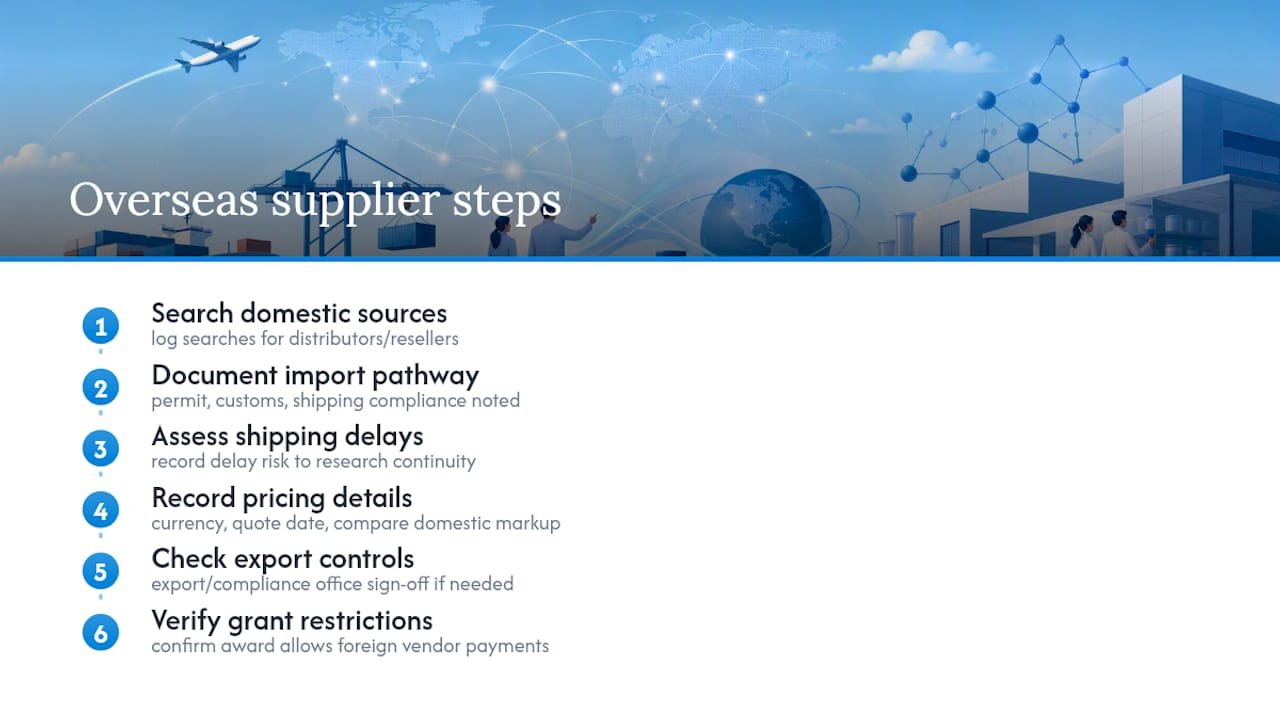
International suppliers add a documentation layer domestic sole source cases don’t require. If a proprietary reagent, antibody clone, or specialized enzyme is manufactured exclusively by a foreign company, your market research log needs to show you searched for domestic distributors or licensed resellers before concluding none exist.
Document the import pathway explicitly. Note whether the item requires an import permit, customs documentation, or compliance with shipping regulations for biological materials. Delays tied to international shipping can sometimes support a public exigency argument, but only if you can show the delay creates a genuine risk to research continuity, not just inconvenience.
Currency and pricing comparisons get trickier with overseas vendors. If the reasonableness determination relies on a foreign vendor’s price list, note the currency and the date of the quote, and if possible, compare it against a domestic distributor’s markup for the same product to show the price is still fair relative to the U.S. market. Some institutions require an additional sign-off from an export control or international compliance office when biological materials cross borders, particularly for reagents tied to select agents or dual-use research of concern. Check your institution’s export control policy before finalizing the SSJ.
Sponsor-funded projects sometimes complicate this further if award terms restrict foreign vendor payments. Confirm with your grants’ office whether the specific award allows payment to an international supplier before you route the justification for approval. Building that check into your process early avoids a rejected requisition after the market research is already done.
How to Respond When an Auditor Questions Your Sole Source Justification
Auditors typically challenge one of three things: the ground claimed, the adequacy of market research, or the price reasonableness determination. Prepare for each separately rather than treating the SSJ as a single monolithic defense.
If an auditor questions the ground claimed, point directly to the factual basis paragraph and the attached technical evidence, not just the clause number. A citation without supporting facts reads as an assumption, and auditors are trained to spot that gap immediately.
If the challenge targets market research adequacy, have the full log ready, including vendors contacted, dates, search terms used, and any responses received. The State Auditor’s Office in Washington notes that sole source findings are among the most common single audit findings, often because institutions document the conclusion but not the process that led to it. Showing your work matters more than the conclusion itself.
For price reasonableness pushback, have your comparison method documented in writing: prior invoice, published catalog price, or peer institution quote. If you used only one method, acknowledge that directly rather than implying a broader analysis occurred.
Stay factual and avoid defensiveness. An auditor’s question is usually a request for documentation you should already have on file, not an accusation. If a gap turns up, note it honestly and describe the corrective step going forward. Institutions that respond with a clear remediation plan generally fare better in follow-up reviews than those that argue the finding was unwarranted.
Which Institutional Forms Need Signatures Before Approval?
Most research institutions maintain a standardized sole source or single source request form, often paired with a conflict-of-interest statement like the one SUNY ESF publishes. Check your own procurement office’s website first. Many campuses post downloadable templates that already match their internal review workflow, which saves you from reformatting a generic document.
Signature requirements typically scale with dollar amount. A small purchase might only need the principal investigator and a department buyer. Above a certain threshold, often $10,000 or $25,000 depending on the institution, expect to add a procurement director or contracts officer signature, and grant-funded purchases usually require a research administration or sponsored programs office signoff as well.
The conflict-of-interest statement deserves particular attention. It asks the requester to affirm no personal or financial relationship exists with the vendor beyond the standard business relationship. Skipping this section, or leaving it vague, is a common reason forms get bounced back for revision.
Routing order matters too. Submit the SSJ before placing the order, not after. Institutions that allow after-the-fact justifications create an audit trail that looks like the purchase was made first and the paperwork was reverse-engineered to fit, which is exactly the pattern auditors are trained to catch. Build the signature routing into your lab’s ordering workflow so the PI knows to loop in procurement before contacting the vendor, not after a quote is already in hand.
How to Research the Reagent Market Before Filing a Justification
Effective market research for a reagent SSJ means documenting a genuine search, not just asserting one happened. Start with the two or three major scientific catalog aggregators researchers already use daily, and record the exact search terms entered, since a search for a specific clone name will return different results than a search for the target protein alone.
Screenshot the results pages showing either no matching product or products that lack the specific attribute your protocol requires, such as species reactivity, conjugate type, or validated application. If a competing product technically exists but performs differently in your specific assay, document that functional gap with a brief technical note explaining why the alternative doesn’t work, ideally from the PI or lab manager rather than a vendor representative.
Contact at least two or three alternative suppliers directly when a product category suggests competition might exist, even if you suspect it won’t. A vendor’s written confirmation that they don’t carry an equivalent product, or that their comparable product has a different specification, becomes strong supporting evidence. Save these email exchanges as PDF attachments rather than paraphrasing them in the memo.
For proprietary reagents tied to a specific manufacturer’s patented chemistry, an exclusivity letter from the manufacturer itself carries significant weight. Many manufacturers will provide this on request specifically because researchers need it for procurement compliance. Build a two or three week buffer into your ordering timeline to request one if your reagent falls into this category.
From Requisition to Approval: A Compliant Process Timeline
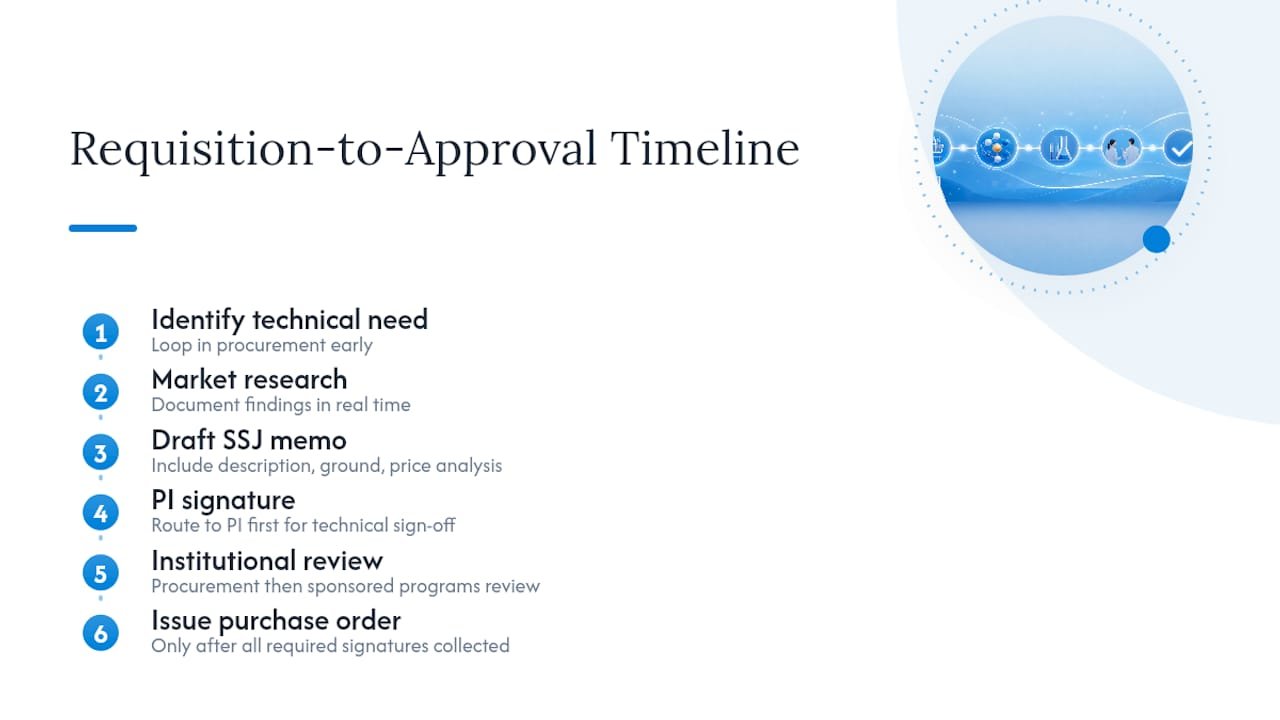
The process starts well before the requisition form, ideally when a PI first identifies that a specific reagent is required for a protocol. At that point, loop in procurement early rather than after a purchase order is already drafted. Early conversations let procurement flag threshold requirements and steer the PI toward the right ground before time gets spent on the wrong justification.
Once the technical need is confirmed, conduct market research and document it in real time rather than reconstructing it later from memory. Draft the SSJ memo using the structure covered earlier: description, ground claimed, factual basis, price analysis, and market research summary. Route it for PI signature first, since the PI is closest to the technical justification.
From there, procurement review checks the ground claimed against the evidence provided, confirms the price analysis is adequate, and verifies the conflict-of-interest statement is complete. If the grant fund is federal, sponsored programs or research administration typically reviews next, checking the SSJ against award terms for any restrictions on noncompetitive procurement.
Only after all required signatures are collected should the purchase order be issued. Institutions that build a standing checklist into their requisition system, flagging dollar thresholds automatically and routing to the correct approver, see fewer bounced forms and faster turnaround. The best practice here is treating the SSJ as a prerequisite gate in the ordering workflow, not a form filled out retroactively to explain a purchase that already happened.
Building the Habit of Early Documentation
Research momentum and procurement compliance don’t have to pull against each other, but they usually do when documentation gets treated as an afterthought. The strongest SSJs come from labs that loop procurement in before contacting a vendor, not after a quote arrives.
Careful documentation isn’t paperwork for its own sake. It protects the research from a disrupted supply chain and protects public funds from a finding that could jeopardize future award eligibility. Use the checklist in this guide as a starting point, and reach out to your procurement office early when a reagent purchase looks like it might need one.
— Alina
How Mayflowerbio Supports Reagent Sourcing and Documentation
If your sole source justification hinges on proving a reagent is genuinely unique, the paperwork is only as strong as the technical documentation behind it. Mayflowerbio supplies antibodies, molecular biology reagents, and specialized bioassay services including ion channel testing and patch clamp work, and can provide specification sheets, validation data, and vendor confirmation letters procurement offices ask for during SSJ review.
That kind of documentation is often the missing piece in a rejected justification, not the technical claim itself. If you’re assembling a market research log or need a manufacturer statement confirming a reagent’s unique specification, reach out through Mayflowerbio’s product catalog to request the supporting documents your procurement office needs before you submit. Getting that paperwork lined up early saves a second round of review.
Where to Verify These Rules Before You File
Start with 2 CFR 200.324 for the federal price reasonableness requirement, since that’s the section auditors cite most often when a sole source finding gets flagged. For the contracting-side parallel, FAR 13.501 outlines documentation expectations institutions managing federal contracts should know.
For template examples, UW Finance’s procurement guidance and the worked SSJ letter example from CASRAI both show the structure reviewers expect. Check your own institution’s procurement office, since many campuses set stricter dollar thresholds than federal rules require.
This article is general information, not a substitute for advice from a qualified financial advisor. Consult a qualified financial professional about your own circumstances before acting on anything here.
Sources
- Sole Source Purchasing — UW Finance Procurement Services
- 2 CFR § 200.324 — Procurement by non-federal entities (price reasonableness)
- Sole source justifications — a how-to guide (UC Berkeley supply chain)
FAQ
How do you justify a sole source purchase?
Cite the specific noncompetitive ground under 2 CFR 200.320, document the factual basis with technical specifications and market research showing no alternative exists, and include a price reasonableness determination under 2 CFR 200.324.
What is the rule of two in government contracting?
The rule of two generally requires contracting officers to set aside a procurement for small business competition when at least two qualified small businesses can perform the work at a fair price; it primarily applies to federal contracting rather than university grant-funded purchases.
What are some examples of sole source procurement for reagents?
Common defensible examples include a proprietary monoclonal antibody clone with no functional equivalent, a sponsor-named product in award terms, and reagent continuity needs for an ongoing longitudinal study.
What makes something a sole source product?
A sole source product is one that only a single supplier can provide, whether due to patented chemistry, exclusive manufacturing rights, or a genuine lack of functional alternatives, as distinct from a sole brand preference where competing options exist.
Can a scientific supplier provide documentation for a sole source justification?
Yes. Mayflowerbio can supply specification sheets, validation data, and vendor confirmation letters for its antibody and reagent lines to support a market research log or factual basis paragraph.




