

11 Enzyme Benchmark: Reverse Transcriptase Changes cDNA Yield for Labs
Pick your reverse transcriptase based on two properties above all others: thermostability and processivity. High-input, routine cDNA work forgives a lot, but structured RNA, long targets, and single-cell samples do not. For low-input and single-cell work, favor high-sensitivity, thermostable enzymes like Maxima H- or SuperScript IV; for standard RT-qPCR, a reliable MMLV-derived mix such as Mayflowerbio’s SOLIScript® RT cDNA synthesis MIX covers most routine workflows without over-engineering the reaction.
TL;DR:
- Enzymes with high thermostability and processivity are essential for structured RNA, long targets, and single-cell samples, where standard tools often fail.
- For low-input or single-cell experiments, Maxima H- and SuperScript IV outperform competitors in sensitivity and consistency, especially when combined with primer strategies that reduce secondary structure.
- Benchmarks show a wide variation in cDNA yield from 7.3% to over 124%, highlighting the importance of enzyme choice and reaction conditions for experiment success.
- Priming strategy, pre-incubation, and control reactions have a greater impact on results than some technical specs like RNase H status or maximum product length.
- Mayflowerbio offers reagents designed around these principles, simplifying enzyme selection and enhancing reproducibility across various RNA applications.
Table of Contents
- Quick Selector: Matching Your Experiment to the Right Reverse Transcriptase
- Why Thermostability, Processivity, and RNase H Status Actually Matter
- Which Reverse Transcriptase Fits Your Specific Application?
- Bench-Level Tips: Priming, Pre-Incubation, and Troubleshooting
- Mayflowerbio’s Role in Reverse Transcriptase Selection
- The Selection Charts Don’t Tell You Everything
- Get Reverse Transcription Reagents Built Around These Same Selection Criteria
- Sources
- FAQ
Quick Selector: Matching Your Experiment to the Right Reverse Transcriptase
Before you open a datasheet, figure out what your experiment actually punishes. A qPCR assay punishes inconsistency. A single-cell experiment punishes low sensitivity. A SELEX round punishes amplification bias. That’s the lens for reverse transcriptase screening, not brand loyalty or habit.
Here’s a working map from application to enzyme priority:
- Single-cell / ultra-low input: prioritize sensitivity and thermostability. Run at 50 to 55°C where the enzyme allows, pair with oligo(dT) plus a reduced-concentration random primer mix or a template-switching primer.
- Routine RT-qPCR: prioritize reproducibility and inhibitor tolerance over raw sensitivity. A one-step format with built-in RNase inhibitor simplifies the workflow and cuts pipetting error.
- Long amplicons (over 3 kb): prioritize processivity and check the manufacturer’s max product length claim, not just its advertised yield.
- Structured RNA (high GC, tight secondary structure): prioritize thermostability. Higher reaction temperatures relax secondary structure and improve primer hybridization.
- In vitro selections (SELEX and similar): prioritize minimal inter-library amplification bias over speed or cost.
- RNA-Seq library prep: prioritize template-switching activity and terminal transferase behavior for compatibility with common library kits.
A benchmarking comparison across 11 reverse transcriptases in low-input conditions found absolute cDNA yields ranging from 7.3% to 124.5% depending on the enzyme tested, with no correction for input amount or template. That is not a rounding error. It is the difference between an experiment that works and one that quietly fails without an obvious cause.
The tradeoffs run in predictable directions: sensitivity often costs more per reaction, thermostability sometimes trades against native RNase H activity, and one-step formats sacrifice a little flexibility for a lot of convenience. Always verify the vendor’s recommended reaction temperature and buffer composition before assuming two MMLV-based enzyme workflows behave the same way. They frequently don’t.
Why Thermostability, Processivity, and RNase H Status Actually Matter
Vendor selection charts throw a lot of terminology at you: Tm, processivity, strand displacement, RNase H minus. Each term maps to a real bench consequence, and reading them correctly is most of what separates a good reverse transcriptase selection from a lucky guess.
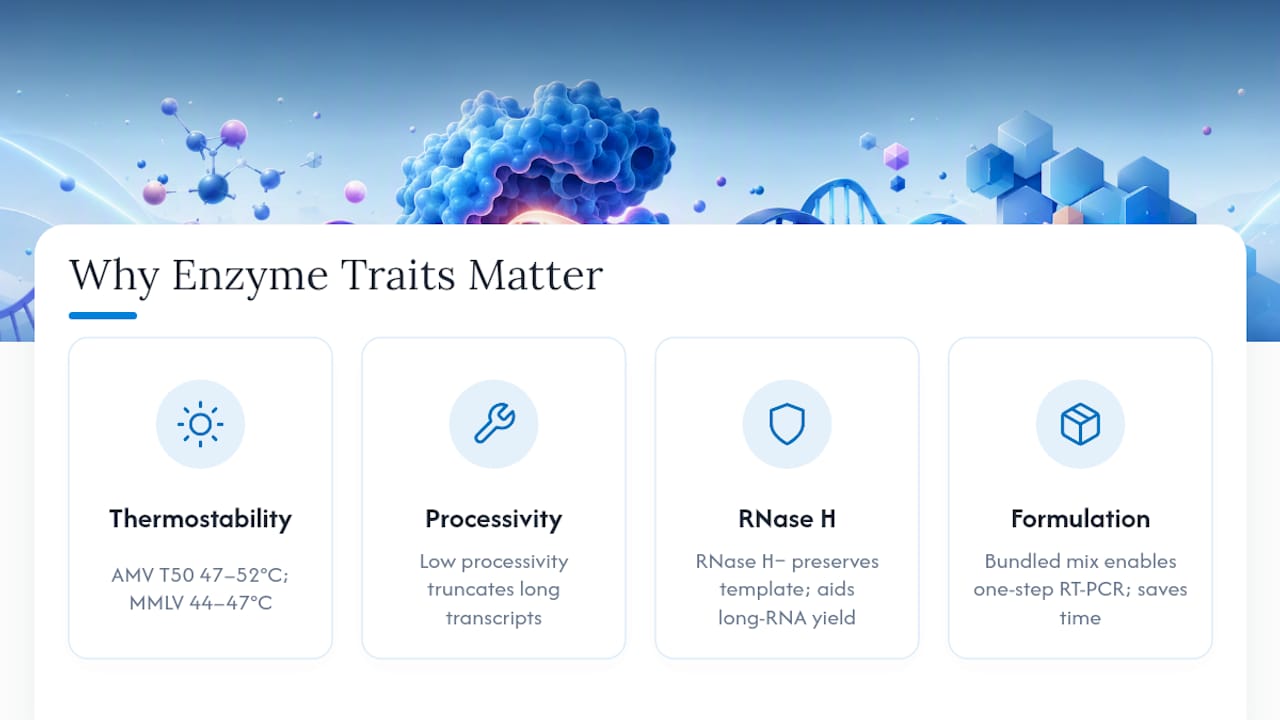
Thermostability determines how hot you can run the reverse transcription reaction. Cooler reactions (37 to 42°C) leave secondary structure intact in GC-rich or highly folded RNA, which stalls the enzyme mid-transcript. Thermostable enzymes tolerate 50 to 55°C or higher, which melts out hairpins and improves primer access. AMV-derived reverse transcriptases are intrinsically more thermally stable than MMLV-derived enzymes, with T50 values (the temperature at which activity drops by half over 10 minutes) around 47 to 52°C for AMV versus 44 to 47°C for MMLV, depending on whether template and primer are bound. That gap is why AMV enzymes historically handled structured templates better, even though engineered MMLV variants have closed much of that distance in newer formulations.
Processivity is how much cDNA an enzyme synthesizes before it falls off the template. Low processivity truncates long transcripts and biases coverage toward the 3’ end, a real problem for long amplicons and full-length transcript work. Check the datasheet’s max product length claim, and treat it skeptically if it isn’t backed by a gel image or sequencing data.
RNase H status affects whether the enzyme degrades the RNA template as it synthesizes the complementary strand. RNase H minus enzymes preserve more template, which usually improves yield on longer or more structured RNA. Interestingly, in a low-input single-cell benchmarking study, RNase H activity did not show a profound effect on outcome across the enzymes tested, suggesting that formulation and pre-incubation steps mattered more than this one biochemical trait in that context.
Template-switching and terminal transferase activity matter specifically for RNA-Seq. An enzyme with reliable terminal transferase activity adds a short non-templated tail at the 5’ end of the cDNA, which a template-switch oligo can then anneal to. That’s the mechanism behind full-length transcript capture in many single-cell RNA-Seq kits.
Formulation decides your workflow shape. A mix bundled with an RNase inhibitor and optimized buffer supports a true one-step RT-PCR, saving time and reducing contamination risk between steps. A bare enzyme without primers gives you more flexibility for custom priming strategies but adds a step.
Pro Tip: When comparing published benchmarking data, look past the headline “best performer” claim and check the coefficient of variation across replicates. An enzyme with slightly lower average yield but a tighter CV is often the safer choice for a quantitative assay, even if it loses on raw sensitivity.
Which Reverse Transcriptase Fits Your Specific Application?
Selection criteria shift once you’re staring at a real experiment instead of a spec sheet. Here’s how the traits above translate into application-specific choices.
Single-cell and low-input work rewards sensitivity above nearly everything else. The same benchmarking study identified Maxima H- and SuperScript IV as the top performers for sensitivity and reproducibility among 11 enzymes tested under low-input conditions, and switching from a lower-performing enzyme like SuperScript II to one of these two measurably increased positive reaction rates. If your library prep also needs template switching, factor that compatibility in before committing to a single enzyme for the whole workflow.
RT-qPCR is less about squeezing out maximum yield and more about consistency run after run. Formats bundling an RNase inhibitor and validated buffer reduce technical variance between plates, which matters more for a quantitative comparison across samples than absolute sensitivity does.
Long or highly structured templates need processivity paired with thermal tolerance. This is where AMV’s higher thermal stability historically gave it an edge, though modern engineered MMLV enzymes running at elevated temperatures now compete well on structured targets.
SELEX and other in vitro selection methods face a different enemy: amplification bias compounding across rounds. A SELEX-focused comparison found BST polymerase delivered excellent processivity and the least inter-library amplification bias compared with several reverse transcriptases tested, including SuperScript IV and ImProm-II. Enzyme choice is a primary driver of bias in iterative selection, so a low-bias, high-processivity option protects the fidelity of your enriched library across successive rounds.
RNA-Seq library prep depends on template-switch compatibility and dependable terminal transferase activity, alongside primer choice tuned to whether you need full transcriptome coverage or a targeted panel.
Bench-Level Tips: Priming, Pre-Incubation, and Troubleshooting
Getting the enzyme right solves half the problem. The other half is protocol execution.
- Choose your priming strategy deliberately. Oligo(dT) favors full-length mRNA capture but underperforms on degraded samples; random hexamers work broadly but dilute signal across the transcript; gene-specific primers boost sensitivity for a target region at the cost of generality. Reduced oligo(dT) concentration combined with random primers is common in single-cell protocols specifically because priming strategy has a gene-dependent effect on efficiency that a mixed approach can smooth out.
- Pre-incubate before adding enzyme. A brief primer-annealing step at elevated temperature, followed by controlled cooling, reduces secondary-structure interference before reverse transcription begins.
- Add carriers for low-input reactions. Carrier tRNA or PEG can meaningfully boost cDNA yield in low-input reactions; test the effect with spike-in controls before scaling to a full experiment.
- Run the right controls every time. Spike-in RNA, no-RT controls, and a known positive sample let you distinguish a failed reaction from a genuinely negative biological result.
- Troubleshoot systematically. Low yield often traces back to primer concentration or RNA quality; truncated products usually point to insufficient thermostability for the template’s structure.
Pro Tip: Keep a no-RT control on every plate, not just during method development. It’s the single fastest way to catch genomic DNA contamination before it corrupts a quantitative result.
Mayflowerbio’s Role in Reverse Transcriptase Selection
Mayflowerbio supplies cDNA synthesis reagents built around these same selection principles, including the SOLIScript® RT cDNA synthesis MIX for routine and low-input workflows. Formats vary by whether primers are pre-included, which matters if your protocol calls for a custom priming strategy. Backed by US-based technical support, the lineup extends into qPCR and RT-qPCR reagents for labs standardizing an entire quantitative pipeline on compatible chemistry.
The Selection Charts Don’t Tell You Everything
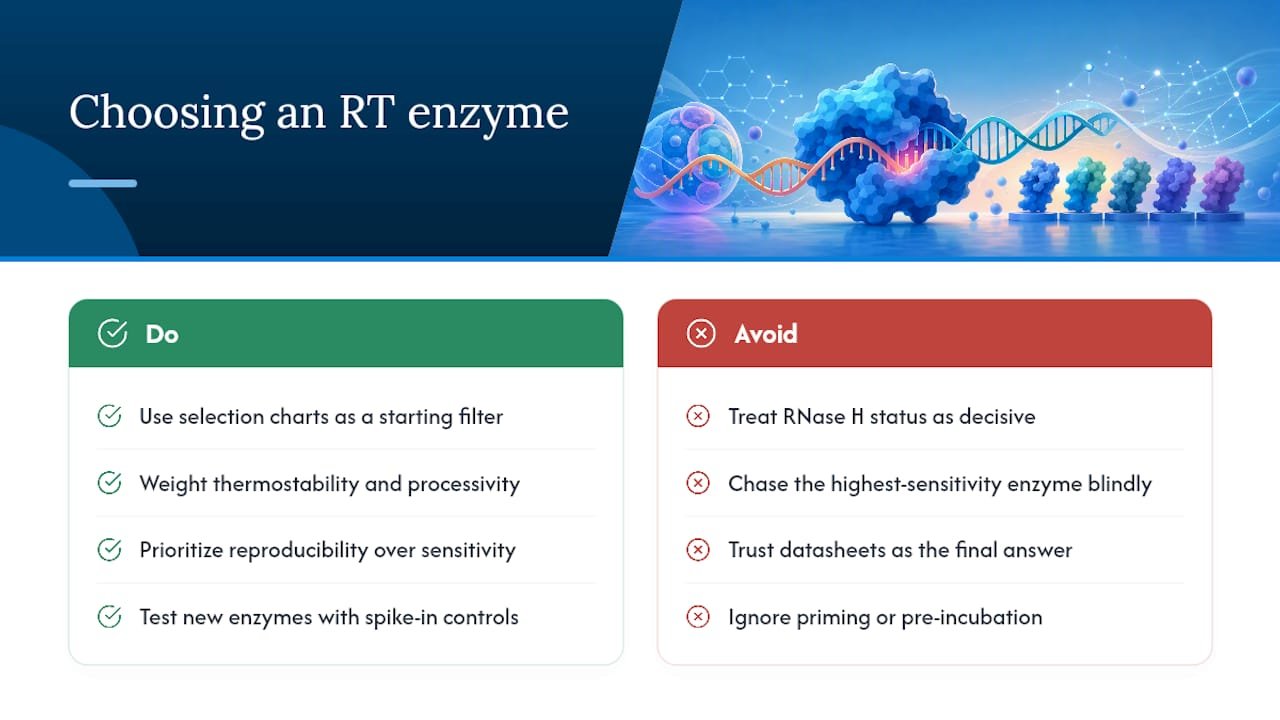
Vendor comparison charts are useful and consistently incomplete. They list Tm, RNase H status, and max product length as if those numbers translate directly into bench success, but the benchmarking data tells a messier story. RNase H status, treated as a major decision point on most selection charts, showed no profound effect in the single-cell comparison referenced above. Meanwhile, priming strategy and pre-incubation steps, which barely rate a footnote on most datasheets, moved the needle more than the chart’s headline specs suggested.
The conventional advice to “pick the most sensitive enzyme available” also falls short outside single-cell and low-input contexts. For routine RT-qPCR, reproducibility matters more than sensitivity, and chasing the highest-sensitivity enzyme on the market can actually introduce variance you don’t need. My take: read selection charts as a starting filter, not a final answer, and weight thermostability and processivity against your actual template and input amount before anything else. Test with spike-in controls before trusting a new enzyme on a real experiment. That single habit catches more failures than any datasheet comparison ever will.
— Alina
Get Reverse Transcription Reagents Built Around These Same Selection Criteria
Reading benchmarking papers and vendor datasheets takes time most labs don’t have between grant deadlines and bench work. Mayflowerbio built its molecular biology line so that the enzyme selection logic is already baked into the format, not something you have to reverse-engineer from a spec sheet.

The SOLIScript® RT cDNA synthesis MIX covers the routine and low-input cDNA synthesis workflows described above, and it sits alongside a full molecular biology reagent catalog for labs standardizing their PCR and RT-qPCR pipelines on compatible chemistry. If your workflow extends into functional validation, ion channel testing and patch clamp services are available for labs that need to pair transcript-level data with functional assays. Browse the cDNA synthesis product line to match a reagent format to your specific application, and reach out through the site for technical guidance from the US-based support team before you commit to a full experiment run.
FAQ
How Much Does a cDNA Synthesis Kit Cost?
Pricing varies by format, primer inclusion, and reaction scale, so there’s no single industry figure. Current pricing for Mayflowerbio’s SOLIScript® RT cDNA synthesis MIX and related reagents is available directly on the product page.
What Is Reverse Transcriptase and What Does It Do?
Reverse transcriptase is an enzyme that synthesizes complementary DNA (cDNA) from an RNA template, reversing the normal DNA-to-RNA transcription process. It’s the essential first step in RT-PCR, RT-qPCR, and RNA-Seq library prep, since standard DNA polymerases can’t use RNA as a template directly.
Does Reverse Transcriptase Synthesize DNA in the 5’ to 3’ Direction?
Yes. Reverse transcriptase synthesizes the new cDNA strand in the 5’ to 3’ direction, reading the RNA template 3’ to 5’, the same directionality rule that applies to DNA polymerases during replication.
What Is the Difference Between PCR and Reverse Transcription PCR?
Standard PCR amplifies an existing DNA template directly using a heat-stable DNA polymerase. Reverse transcription PCR (RT-PCR) adds a preliminary step where reverse transcriptase converts an RNA template into cDNA before that cDNA is amplified, which is necessary because DNA polymerases cannot read RNA.
Which Reverse Transcriptase Works Best for Single-Cell Experiments?
Benchmarking across 11 enzymes in low-input conditions identified Maxima H- and SuperScript IV as the top performers for sensitivity and reproducibility in single-cell equivalent samples. Thermostability and compatibility with template-switching primers are the two traits worth prioritizing alongside raw sensitivity for this application.




