
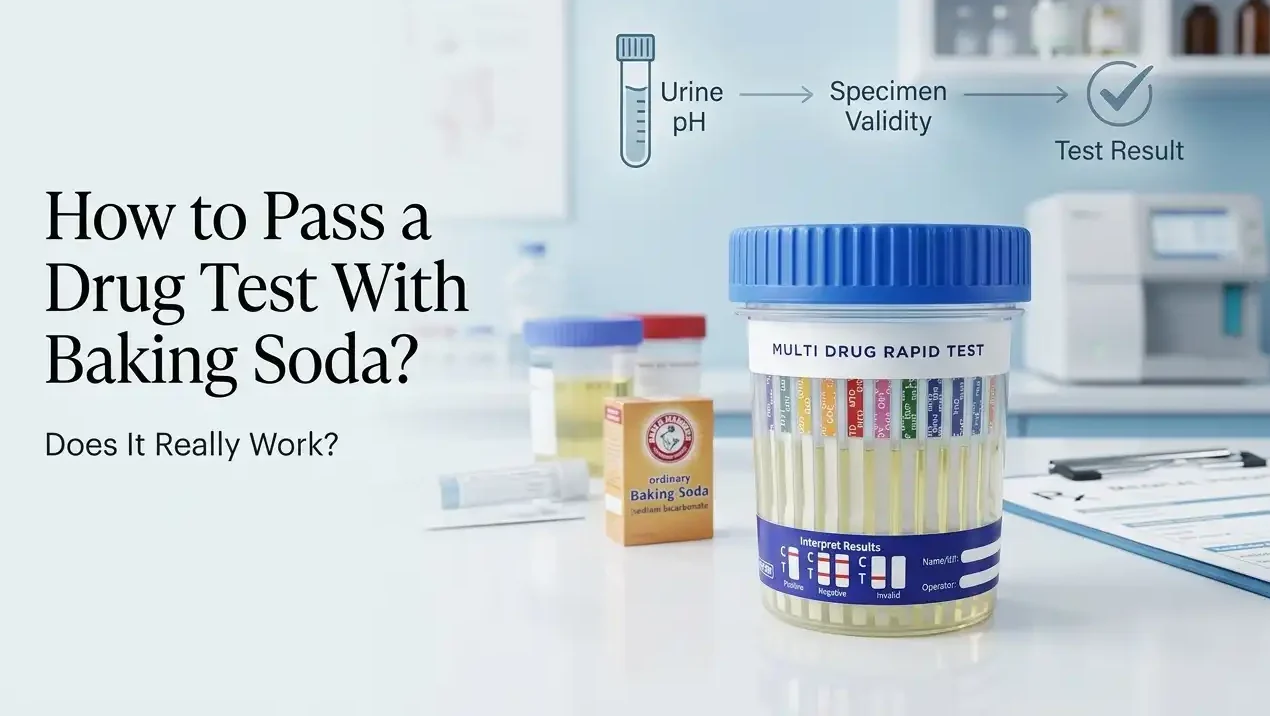
How to Pass a Drug Test With Baking Soda
If you are searching for how to pass a drug test with baking soda, you may have seen claims that drinking sodium bicarbonate can change your urine and help produce a negative result.
The short answer is no: baking soda is not a reliable or safe way to pass a drug test. Sodium bicarbonate can change urine chemistry, including urine pH, and urine pH can influence the renal handling of some substances. But changing urine pH does not reliably remove drug metabolites from the body or guarantee a negative drug-test result.
More importantly, taking excessive amounts of baking soda can cause sodium toxicity and metabolic alkalosis, potentially affecting the heart, kidneys, electrolytes, and nervous system.
This article explains where the baking-soda drug-test myth comes from, what actually happens to urine, how laboratories evaluate specimens, and why there is no safe baking-soda shortcut for drug testing
Does Baking Soda Help You Pass a Drug Test?
Baking soda does not reliably help someone pass a drug test.
The idea is based partly on real pharmacology: changing urine pH can affect how certain drugs are excreted by the kidneys. Research has demonstrated that urinary pH can influence the renal and systemic disposition of some weakly basic substances, including amphetamine-type drugs.
But that scientific observation is very different from proving that drinking baking soda will make a drug test negative.
A drug test can depend on:
- The substance being tested
- The amount used
- Frequency of use
- Time since use
- Individual metabolism
- The specimen being tested
- The laboratory method
- The assay cutoff
- The concentration of the drug or metabolite in the specimen
Urine testing also has specimen-validity procedures that can identify characteristics inconsistent with a normal specimen. SAMHSA materials describe validity testing involving measures such as creatinine, specific gravity, pH, and checks for adulteration.
So, baking soda should not be considered a detox method or a dependable way to obtain a negative drug-test result.
Why Do People Think Baking Soda Works?
The baking soda theory usually starts with urine pH.
Baking soda is sodium bicarbonate, an alkaline compound. When sodium bicarbonate is absorbed and processed by the body, it can increase alkalinity and change urine pH.
Because urine pH can influence the kidney’s handling of certain drugs, some people have taken that fact and turned it into a much broader claim:
“If baking soda changes urine pH, it can hide drugs from a urine test.”
That conclusion is not supported as a general method for passing drug tests.
The effect of urinary pH is drug-specific and pharmacologically complex. It does not mean that altering urine pH removes metabolites, reverses previous drug use, or guarantees that concentrations will fall below a laboratory cutoff. Research on amphetamine-type substances demonstrates that urinary pH can influence elimination, but that does not translate into a dependable drug-testing strategy.
What Is Baking Soda and What Does It Do?
Baking soda is the common name for sodium bicarbonate (NaHCO₃).
It has legitimate everyday and medical uses, including use as an ingredient in food and as an antacid in appropriate circumstances.
It is also an alkaline substance, which means it can influence acid-base chemistry.
When people consume excessive amounts, however, sodium bicarbonate can create significant physiological problems.
Poison Control notes that excessive sodium bicarbonate can cause sodium toxicity and systemic alkalosis, with potential effects involving the heart and kidneys.
That is an important distinction:
A substance being common in the kitchen does not mean large quantities are safe to consume.
How Drug Tests Actually Work
Drug tests are designed to identify particular drugs, their metabolites, or both, depending on the test and testing program.
Common specimen types include:
- Urine
- Oral fluid/saliva
- Blood
- Hair
Urine testing is widely used because urine can contain measurable drug metabolites after the body processes a substance.
A simplified pathway looks like this:
Drug enters the body → metabolism → drug/metabolites circulate → kidneys excrete substances → specimen collected → laboratory analysis
Changing the chemistry of urine at the final stage does not erase the drug exposure that occurred earlier.
Detection also depends on the particular substance, dose, metabolism, specimen type, and characteristics of the analytical method. NIDA materials note that urine detection windows vary according to factors including the drug, biological half-life, dose, time since administration, fluid intake, individual metabolism and excretion, and assay characteristics.
Can Baking Soda Remove Drug Metabolites?
No.
Baking soda does not function as a universal drug-metabolite remover.
Drug metabolites are generated through biological processes involving metabolism and elimination. Sodium bicarbonate does not simply dissolve those metabolites or make them disappear from the body.
The distinction is important:
Changing urine chemistry
is not the same as:
Removing drug metabolites from the body.
Even when urine pH affects the renal handling of a particular drug, that is not equivalent to eliminating all traces of the drug or its metabolites.
Does Baking Soda Change Urine pH?
Yes, sodium bicarbonate can affect acid-base balance and urinary pH.
But “can change urine pH” and “can reliably pass a drug test” are two completely different statements.
Research has demonstrated that changing urinary pH can influence the disposition and renal excretion of certain drugs. For example, studies of amphetamine-type substances have found measurable effects associated with urinary pH.
That doesn’t establish baking soda as a dependable method for drug-test preparation.
In fact, an abnormal specimen can attract additional scrutiny depending on the testing program.
Why Changing Urine pH Doesn’t Guarantee a Negative Test
There are several reasons.
1. Drug tests target specific analytes
A laboratory is not simply checking whether urine is acidic or alkaline.
The test is designed around particular substances or metabolites and predetermined analytical criteria.
2. Urine pH is only one characteristic
Specimen validity testing can evaluate other characteristics of urine, including:
- Creatinine
- Specific gravity
- pH
- Physical characteristics
- Possible adulteration
SAMHSA describes specimen-validity testing specifically as a way to determine whether urine has been diluted, adulterated, or substituted.
3. Different drugs behave differently
Urinary pH can have different effects depending on the chemical properties of the substance.
Research on amphetamine-type drugs demonstrates this clearly.
Therefore, there is no scientifically sound rule saying:
“Make your urine alkaline and every drug test will become negative.”
4. Other specimen types don’t depend on urine pH
If the testing program uses oral fluid or another specimen, changing urine pH is irrelevant to that specimen.
SAMHSA’s federal workplace program currently recognizes both urine and oral-fluid testing under its respective guidelines.
What Is Specimen Validity Testing?
Specimen validity testing (SVT) examines whether a urine sample has characteristics consistent with an authentic specimen.
This is an important part of understanding why home remedies such as baking soda are unreliable.
SAMHSA describes specimen-validity testing as including measurements that can identify dilution, adulteration, or substitution. Depending on the program and laboratory, testing can include:
- Creatinine concentration
- Specific gravity
- Urine pH
- Adulterant testing
- Other specimen biomarkers or characteristics
The exact procedures and reporting rules can vary according to the testing program.
Creatinine, Specific Gravity, and Urine pH
Creatinine
Creatinine is a normal waste product found in urine.
Laboratories can use creatinine concentration as one indicator when assessing specimen validity.
SAMHSA’s clinical drug-testing guidance describes creatinine testing and additional specific-gravity testing when creatinine is low.
Specific Gravity
Specific gravity provides information about the concentration of dissolved substances in urine.
It can be considered alongside creatinine and other specimen characteristics when evaluating whether a sample is unusually dilute.
Urine pH
Urine pH naturally varies.
However, unusually abnormal pH can be relevant to specimen validity. SAMHSA’s guidance notes that laboratories may identify specimens outside expected ranges as invalid and describes particularly extreme pH values as suggestive of adulteration.
This is one reason deliberately trying to manipulate urine chemistry is not a dependable strategy.
Can Baking Soda Work for a THC Drug Test?
Baking soda is not a reliable way to pass a THC drug test.
Cannabis testing can involve specific THC-related analytes, depending on the testing program and specimen.
The important point is that changing urine pH does not eliminate THC metabolites from the body.
THC detection can vary substantially depending on factors such as:
- Frequency of cannabis use
- Amount used
- Time since use
- Individual metabolism
- Specimen type
- Test sensitivity
- Laboratory cutoff
NIDA materials illustrate that drug detection windows can vary considerably and that marijuana metabolites can remain detectable longer in people with heavy or chronic use than after isolated exposure.
Therefore, there is no scientifically reliable baking-soda formula that guarantees a negative THC test.
Can Baking Soda Work for Amphetamine or Methamphetamine Tests?
This is where the underlying pharmacology becomes particularly interesting.
Urinary pH can affect the renal handling of certain weak-base drugs, including amphetamine-type substances.
Research has demonstrated that changes in urinary pH can alter renal excretion and systemic disposition of amphetamine and methamphetamine.
But this does not mean that baking soda provides a predictable way to manipulate a drug test.
The relationship depends on:
- The specific drug
- Drug concentration
- Metabolites
- Urinary pH
- Kidney function
- Time since exposure
- Individual pharmacokinetics
- Testing method
A scientific effect on drug pharmacokinetics should not be confused with a reliable test-passing method.
What About Cocaine, Opioids, and Other Drugs?
The same basic principle applies.
There is no universal baking-soda method for:
- Cocaine
- Opioids
- Benzodiazepines
- Amphetamines
- Methamphetamine
- THC
- MDMA
- Other substances
Each drug has its own pharmacokinetic characteristics and detection profile.
A laboratory may also test for a specific drug or metabolite using an analytical method designed for that substance.
SAMHSA’s federal workplace program, for example, specifies particular drug categories and uses specimen-validity testing as part of urine testing.
Does Baking Soda Work With Blood, Saliva, or Hair Tests?
Changing urine pH cannot make a blood, oral-fluid, or hair test negative.
These specimen types measure different biological matrices.
Urine
Primarily reflects substances and metabolites being eliminated through urine.
Oral fluid
Can provide information about recent exposure and is analyzed using oral-fluid testing procedures.
Blood
Measures substances or metabolites circulating in blood at the time of collection.
Hair
Provides a longer-term historical window for certain testing applications.
The precise detection period varies by substance and testing method.
The important takeaway is:
Baking soda’s effect on urine chemistry cannot be used as a universal strategy for other specimen types.
Is Drinking Baking Soda for a Drug Test Dangerous?
Yes, consuming excessive amounts can be dangerous.
This is one of the most important reasons not to experiment with baking soda as a drug-test remedy.
Excess sodium bicarbonate can disrupt the body’s acid-base and electrolyte balance.
Potential complications can include:
- Nausea
- Vomiting
- Abdominal discomfort
- Sodium toxicity
- Metabolic alkalosis
- Electrolyte abnormalities
- Muscle problems
- Effects on the heart
- Effects on kidney function
- Neurological complications
Poison Control specifically warns that excessive sodium bicarbonate can cause sodium toxicity and body-wide alkalosis and can affect organs including the heart and kidneys.
The risk becomes particularly concerning when someone consumes an excessive amount because they believe that a larger quantity will produce a stronger effect.
More baking soda does not make the method safer or more reliable.
Why Do Some People Say the Baking Soda Trick Worked?
Anecdotal reports can be misleading.
Suppose someone consumes baking soda before a drug test and receives a negative result.
That does not prove the baking soda caused the result.
Several other explanations are possible:
The person was already below the cutoff
A drug or metabolite may naturally have fallen below the laboratory’s reporting threshold.
Enough time had passed
Drug concentrations change as the body metabolizes and eliminates substances.
Individual metabolism was different
People do not eliminate every drug at exactly the same rate.
The test did not target the substance
A particular drug may not have been included in the testing panel.
The anecdote lacks a control
There is usually no way to know what the result would have been without the baking soda.
This is one reason personal stories should not be treated as scientific evidence.
How Long Do Drugs Stay Detectable?
There is no single detection window for every drug or every person.
Detection depends on factors such as:
- Drug type
- Dose
- Frequency of use
- Time since last use
- Metabolism
- Half-life
- Route of administration
- Specimen type
- Laboratory cutoff
- Testing method
- Individual physiology
For example, NIDA educational material provides different urine detection windows for different substances and notes that marijuana metabolites can remain detectable longer with heavy or chronic use.
This is why articles promising that a specific drink or household ingredient will “flush” every drug out within a fixed number of hours are misleading.
What Actually Determines a Drug-Test Result?
A drug-test result is influenced by several interacting factors.
1. The substance
Different drugs have different pharmacokinetic properties.
2. The dose
Greater exposure can affect the amount and duration of detectable analyte.
3. Frequency of use
Repeated use can produce different detection patterns from a single exposure.
4. Time
Time allows the body to metabolize and eliminate substances.
5. Individual physiology
Metabolism and renal excretion vary between people.
6. Specimen type
Urine, oral fluid, blood, and hair have different characteristics.
7. Test methodology
Different analytical methods have different characteristics and cutoffs.
8. Specimen validity
For urine testing, characteristics such as creatinine, specific gravity, and pH may be evaluated.
This is why there is no universal household ingredient that guarantees a negative result.
Baking Soda Drug-Test Myths vs. Facts
| Myth | Fact |
|---|---|
| Baking soda guarantees a negative drug test | It does not |
| Baking soda removes drug metabolites | It does not reliably remove metabolites |
| Baking soda works for every drug | Drug pharmacology differs substantially |
| Baking soda works for every test type | Urine pH does not control blood or oral-fluid testing |
| More baking soda makes the method more effective | Excessive consumption can be dangerous |
| Changing urine pH means drugs are gone | Urine chemistry and drug clearance are different processes |
| A person who passed after using baking soda proves it works | An anecdote cannot establish causation |
| Baking soda is a harmless detox method | Excessive sodium bicarbonate can cause serious toxicity |
Baking Soda vs. Time: What Matters More?
The body’s natural metabolism and elimination processes are central to drug clearance.
There is no scientifically established baking-soda shortcut that overrides those processes.
Research on drug detection emphasizes the importance of factors such as half-life, dose, metabolism, excretion, specimen type, and assay characteristics.
For someone preparing for a legitimate drug test, the safest approach is not to experiment with large amounts of baking soda or other unverified substances.
If the test is related to prescribed medication, a medical condition, employment, probation, or another formal program, it can also be useful to understand the testing procedure and disclose legitimate prescription or medical information through the appropriate process.
What If You Are Worried You Will Test Positive?
If you believe a drug test may be positive, attempting to chemically manipulate the specimen can create additional complications.
Instead:
- Review what substances the test is designed to detect.
- Keep records of legitimate prescriptions when appropriate.
- Follow the collection instructions provided by the testing program.
- Do not consume excessive baking soda or other unverified substances.
- Ask the testing provider about the applicable process if you have questions about the result.
- If you are concerned about substance use itself, consider speaking with a healthcare professional.
The specific procedures and consequences of a drug-test result vary by testing program and jurisdiction.
Frequently Asked Questions
Can baking soda help you pass a drug test?
No. Baking soda is not a reliable or safe way to produce a negative drug-test result. Although sodium bicarbonate can alter urine pH, that does not reliably eliminate drug metabolites.
Does baking soda detox your urine?
No. Baking soda does not function as a proven detoxification treatment for drug metabolites.
Does baking soda change urine pH?
Yes. Sodium bicarbonate is alkaline and can affect acid-base balance and urine chemistry. However, changing urine pH does not guarantee a negative drug test.
Can baking soda help with a THC drug test?
There is no reliable evidence that baking soda can eliminate THC metabolites or guarantee a negative THC test.
Can baking soda help with an amphetamine drug test?
Urinary pH can influence the renal handling of amphetamine-type drugs, but this does not make baking soda a predictable or safe drug-testing strategy.
Does baking soda work for a saliva drug test?
Changing urine pH does not make an oral-fluid drug test negative. Oral-fluid testing uses a different specimen and testing process.
Does baking soda work for a blood drug test?
No. Baking soda’s effects on urine chemistry cannot be used as a reliable method for changing a blood-test result.
Can baking soda affect a hair drug test?
Changing urine pH does not affect hair testing. Hair analysis involves a different biological matrix and analytical process.
Can baking soda cause a false negative?
It should not be relied upon to produce a false negative. Drug-test outcomes depend on the specific analyte, specimen, testing method, concentration, and cutoff.
Can drinking too much baking soda be dangerous?
Yes. Excessive sodium bicarbonate can cause sodium toxicity and metabolic alkalosis and may affect the heart, kidneys, and other body systems.
Is there a safe amount of baking soda to take to pass a drug test?
There is no recommended amount of baking soda for the purpose of trying to alter a drug-test result. Consuming excessive amounts can be dangerous.
Does changing urine pH remove drugs from your body?
No. Changing urine pH is not the same thing as eliminating drugs or metabolites from the body.
Why do laboratories check urine pH?
Urine pH is one characteristic that can be evaluated during specimen-validity testing. Laboratories may use it together with other measurements to identify unusual or potentially invalid specimens.
What are creatinine and specific gravity?
Creatinine is a normal urinary waste product, while specific gravity provides information about urine concentration. Both can be used as part of specimen-validity assessment.
How long do drugs stay detectable?
Detection times vary by drug, dose, frequency of use, metabolism, specimen type, testing method, and cutoff. There is no universal number of hours or days that applies to everyone.
Does Baking Soda Help You Pass a Drug Test?
No. Baking soda is not a reliable or safe way to pass a drug test.
The claim comes from a real pharmacological observation: urinary pH can influence the renal handling of some substances. But that fact has been stretched into a claim that drinking baking soda can reliably make drug tests negative. The evidence does not support that conclusion.
Modern urine-testing programs can also evaluate specimen characteristics such as creatinine, specific gravity, and pH, making deliberate changes to urine chemistry an unreliable strategy.
Most importantly, consuming excessive baking soda can cause serious medical problems, including sodium toxicity and metabolic alkalosis.
The result of a drug test ultimately depends on the substance, metabolism, time since exposure, specimen type, analytical method, and applicable cutoff—not on a guaranteed household “detox” ingredient.
If you are facing a drug test, don’t risk your health by consuming large quantities of baking soda.




