
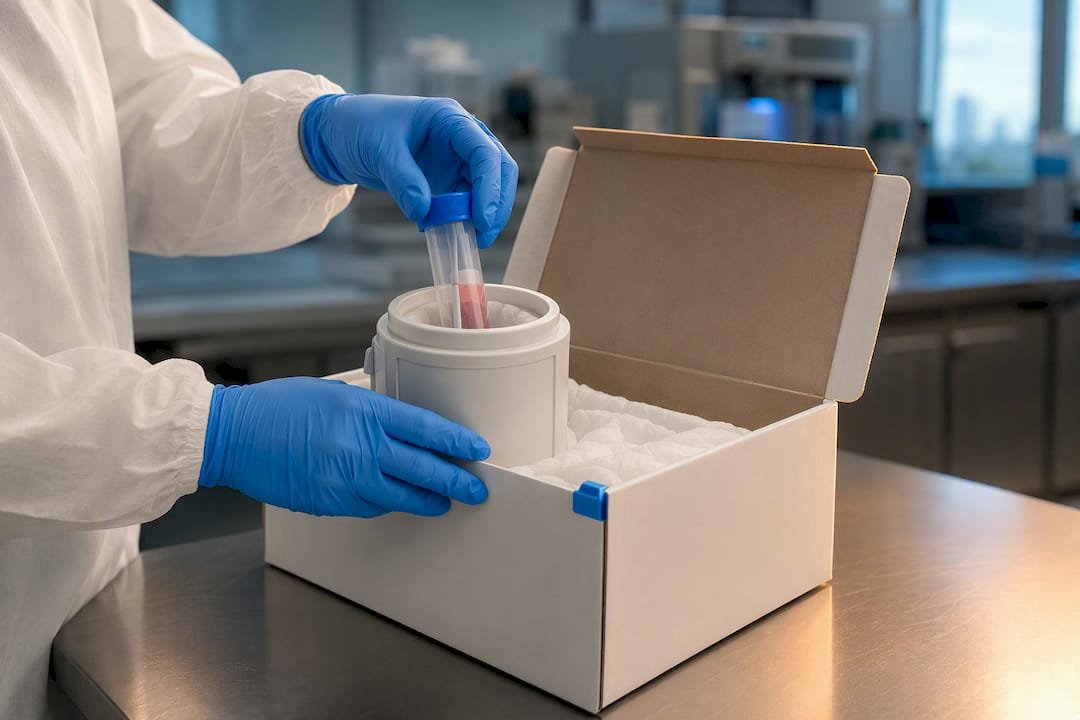
Pass Carrier Checks: UN3373 Packaging for Lab Shippers (95 kPa)
UN3373 (Biological substance, Category B) shipments require triple packaging under 49 CFR §173.199 and IATA Packing Instruction 650. Liquids moving by air must withstand a 95 kPa internal pressure differential, primary receptacles cap out at 1 liter, and total liquid volume per outer package tops out at 4 liters for air shipments. Dry ice, when used, sits outside the secondary packaging and gets its own UN1845 Class 9 marking.
TL;DR:
- Air shipments of UN3373 require primary receptacles to withstand at least 95 kPa pressure differential and a maximum volume of 1 liter per container.
- Proper marking includes a visible UN3373 diamond mark and the shipping name “Biological Substance, Category B,” with additional labels for dry ice or other hazards.
- The triple-pack structure must be assembled with secure sealing, individual wrapping, appropriate absorbent material, and strict immobilization of contents.
- Carrier acceptance often depends on confirming compliance with IATA PI650 standards and verifying packaging, documentation, and labeling before tendering.
- Training records and documentation of packaging performance are essential to demonstrate regulatory compliance and prevent shipment rejections or legal violations.
Table of Contents
- What Counts as UN3373 and When to Classify a Specimen as Category B
- The Regulatory Baseline: What §173.199 and IATA PI650 Actually Require
- Air Transport Practicals: Carrier Acceptance and Paperwork That Prevents Refusals
- Assembling a Compliant UN3373 Package Step by Step
- Marking, Labeling, and Paperwork the Carrier Will Check
- Temperature Control: Dry Ice and Cold-Chain Specimens
- Where Shipments Fail: Common Mistakes and a Release Checklist
- Who’s Accountable: Training and Record-Keeping That Hold Up
- Supplies That Support Compliant Packing, From Mayflowerbio
- Sources
- FAQ
What Counts as UN3373 and When to Classify a Specimen as Category B
Category B covers infectious substances that don’t meet the criteria for Category A (the substances capable of causing permanent disability or fatal disease in otherwise healthy people or animals). Most routine diagnostic work falls into Category B: nasopharyngeal swabs, blood draws for standard panels, urine or serum samples heading to a reference lab. Exempt human specimens are a third bucket entirely, covering samples with minimal likelihood of containing pathogens, and they follow a lighter packaging standard than UN3373.
Getting this classification wrong has real consequences. Ship a Category A pathogen under UN3373 rules and you’ve violated federal hazmat law. Overclassify a low-risk specimen as Category A and you’ve paid for packaging and paperwork you didn’t need.
- Category A: capable of causing serious or fatal disease; requires UN2814/UN2900 packaging, a stricter standard than UN3373
- Category B: routine diagnostic and clinical specimens; this is where UN3373 packaging requirements apply
- Exempt specimens: minimal infection risk (most routine blood chemistry, for example); follow basic triple-packaging good practice without full UN3373 marking
When in doubt about a specimen’s risk profile, classify conservatively and consult your biosafety officer before packing.
The Regulatory Baseline: What §173.199 and IATA PI650 Actually Require
Every UN3373 shipment starts with triple packaging: a primary receptacle holding the specimen, a secondary packaging layer around it, and a rigid outer packaging enclosing both. This structure isn’t optional, and it isn’t negotiable based on shipment size or urgency.
For air shipments, the pressure requirement is where a lot of labs stumble. The primary receptacle or the secondary packaging (not necessarily both) must be capable of withstanding a pressure differential of not less than 95 kPa without leaking, a spec written directly into §173.199. This matters because cargo holds experience pressure changes that ground transport never sees.
Quick Reference: The Numbers That Matter
Air shipments cap primary receptacles at 1 liter of liquid and 4 liters total per outer packaging, per PHMSA’s 95 kPa and volume limits. Solid specimens and swabs in transport media aren’t bound by the same liquid-volume math, though transport media volume still counts if it’s a liquid.
Outer packaging strength standards borrow from general hazmat packaging rules: it must survive a 1.2 meter drop test in the orientation most likely to cause damage, and rigid outer packagings need a minimum external dimension of at least 100 mm to prevent accidental mailing as ordinary parcels.
- Triple pack structure: primary, secondary, rigid outer
- 95 kPa pressure differential for liquid primary/secondary layers on air shipments
- 1 L max per primary receptacle; 4 L max total per outer packaging for air transport
- Minimum 100 mm outer dimension; 1.2 meter drop-test performance expected
Air Transport Practicals: Carrier Acceptance and Paperwork That Prevents Refusals
Domestic carriers routinely expect IATA PI650 conformity even when the Hazardous Materials Regulations technically permit alternative compliance paths. IATA PI650 has become the operational default because it aligns with ICAO Technical Instructions that every international carrier already follows, and matching that standard saves you from a counter-agent rejection at drop off.
- Confirm which layer carries the 95 kPa rating. Manufacturers sometimes rate only the primary receptacle; verify the specification sheet names the actual layer tested.
- Prepare the air waybill or consignment note completely. Include the proper shipping name, UN number, and a 24 hour emergency contact who can speak to the shipment’s contents.
- Itemize the contents inside the outer package. CDC guidance recommends a packing list that survives inside the box, separate from the external paperwork, in case the outer documentation gets separated in transit.
- Call the carrier before tendering, not after. FAA guidance notes that ground-approved packaging frequently gets rejected at air cargo counters, and some carriers add restrictions beyond the federal minimum.
Passenger baggage is its own trap. FAA’s PackSafe program is explicit that diagnostic test kits and biological samples generally aren’t permitted in carry-on or checked luggage, so a courier hand-carrying specimens needs cargo or expedited freight, not a boarding pass.
Assembling a Compliant UN3373 Package Step by Step
Building the package correctly the first time beats troubleshooting a rejected shipment at the loading dock. Here’s the sequence that holds up under carrier scrutiny.
- Select and seal the primary receptacle. Use a leakproof container rated for your specimen type, keep liquid volume under 1 liter, and confirm the closure is secured with tape or a positive seal, not just a friction-fit lid.
- Wrap or separate multiple primary receptacles. Each vial needs individual wrapping or a divider so contact between containers can’t cause breakage during transit.
- Add secondary packaging with absorbent material. Pack enough absorbent to soak up the entire liquid contents of the primary receptacle if it leaks, positioned so it actually contacts the receptacle rather than sitting loose in a corner.
- Immobilize everything inside the secondary layer. Cushioning material should prevent shifting; a package that rattles when shaken has already failed this step.
- Choose a rigid outer packaging. Confirm it meets the minimum 100 mm dimension and has cushioning between the secondary packaging and the outer wall.
- Run a pre-tender visual check. Look for concealed marks, verify the outer box is intact, and confirm nothing shifts when you tilt the package.
Pro Tip: Keep a labeled sample of your standard packing configuration on the bench next to your SOP binder. New staff copy what they see faster than they read what they’re told, and a physical reference cuts training time on the triple-pack sequence significantly.
Overpacks (a larger container holding multiple compliant UN3373 packages) are allowed, but every mark and label from the inner packages must be reproduced on the overpack itself, or visible through it.
Marking, Labeling, and Paperwork the Carrier Will Check
The outer packaging needs the UN3373 diamond mark alongside the proper shipping name “Biological Substance, Category B,” printed in letters at least 6 mm high per PI650 sizing guidance. Skip either element and expect a hold at acceptance.
- Proper shipping name plus the UN3373 diamond, both visible without opening the package
- Name and telephone number of a person responsible for the shipment, reachable during transit hours
- An itemized contents list inside the outer packaging, matching CDC’s recommended practice
- Separate UN1845 Class 9 marking and label when dry ice is present, distinct from and in addition to the UN3373 mark
- Biohazard symbols where your specimen type or institutional policy requires them, applied to the primary or secondary layer as appropriate
If you’re using an overpack, every one of these marks has to survive the trip visible, either printed directly on the overpack or through a clear window.
Temperature Control: Dry Ice and Cold-Chain Specimens
Refrigerated specimens typically travel at 2 to 8°C, while frozen specimens need ≤ minus 20°C, and the refrigerant choice has to match what your specimen stability data actually supports rather than habit. Dry ice introduces a second hazard class entirely. It goes outside the secondary packaging, inside the outer packaging, with venting that lets carbon dioxide gas escape so pressure doesn’t build inside a sealed box, a detail confirmed in PHMSA’s Category B packaging guidance.
- Dry ice mass in kilograms must appear on the outer package alongside the UN1845 Class 9 marking
- Never pack dry ice inside the secondary packaging layer, only between secondary packaging and the outer wall
- Confirm the outer packaging design permits CO2 venting; a fully sealed box risks pressure buildup or rupture
- Validate that your cold chain doesn’t compromise the primary receptacle’s seal integrity, since extreme cold can make some plastics brittle
Where Shipments Fail: Common Mistakes and a Release Checklist
The most frequent failure point isn’t the paperwork, it’s the interface between layers. PHMSA’s packaging poster points to vials that shift and puncture the secondary packaging, absorbent material that’s present but placed wrong, and overpacks that hide required marks from carrier inspection.
- Using ground-rated packaging for a shipment that actually travels by air, then getting refused at the counter
- Insufficient absorbent material sized for a partial leak instead of the full receptacle volume
- Vials packed loose enough to move and puncture surrounding layers during handling
- Overpacks that conceal the UN3373 mark or shipping name without reproducing it externally
| Checklist item | What to verify |
|---|---|
| Classification | Category B confirmed, not exempt or Category A |
| Pressure capability | 95 kPa rating documented if shipping liquids by air |
| Absorbent capacity | Sized to full primary receptacle volume |
| Immobilization | No movement when package is tilted or shaken |
| Marking visibility | UN3373 diamond and shipping name unobstructed |
| Carrier confirmation | Acceptance confirmed before tendering |
Run this list before every tender, and most rejections never happen in the first place.
Who’s Accountable: Training and Record-Keeping That Hold Up
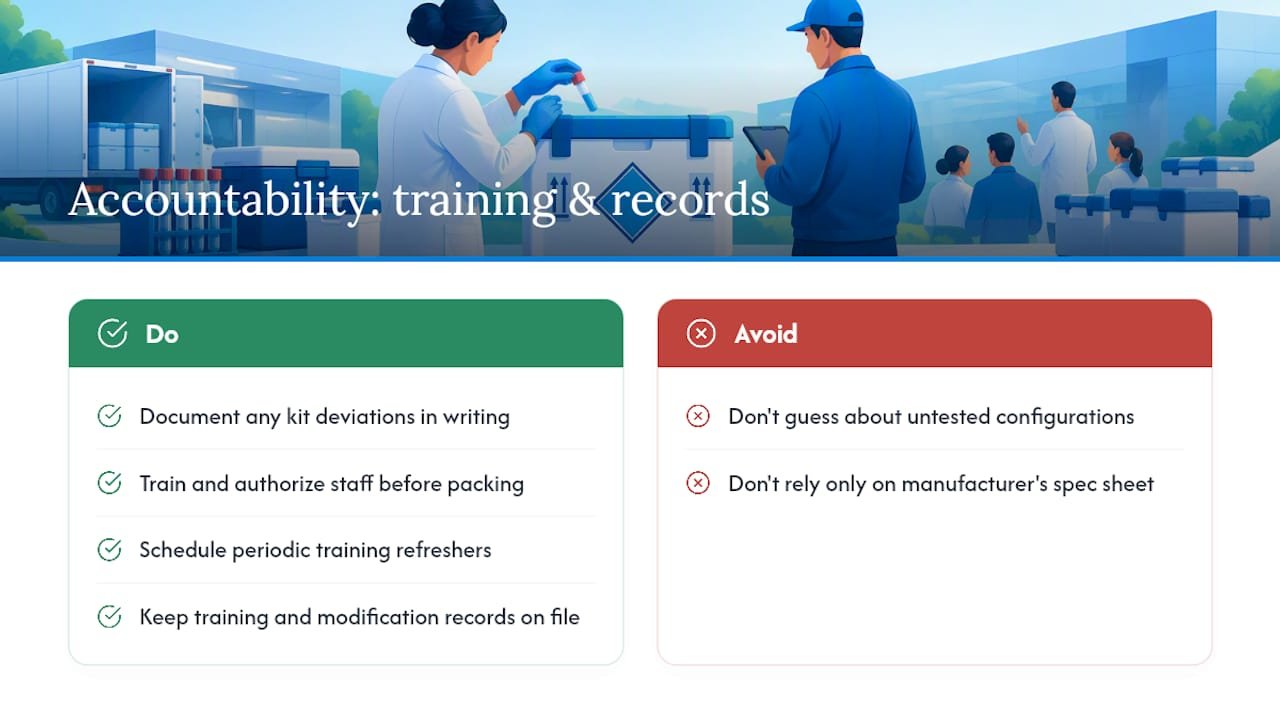
The shipper carries responsibility for the packaging configuration actually used, not just what the manufacturer’s spec sheet claims. PHMSA interpretation letters make clear that demonstrating drop-test and pressure capability falls on whoever ships the package, and any deviation from a standard kit configuration should be documented in writing.
Federal hazmat rules require employers to train and authorize personnel before they pack or offer UN3373 shipments, and that training needs periodic refreshers, not a one time onboarding session. Keep training records and any packaging-modification documentation on file. When a configuration falls outside what your kit manufacturer tested, a quick call to PHMSA or your carrier’s dangerous goods desk beats guessing, and digital record systems built for calibration and compliance documentation can make that paper trail easier to maintain over time.
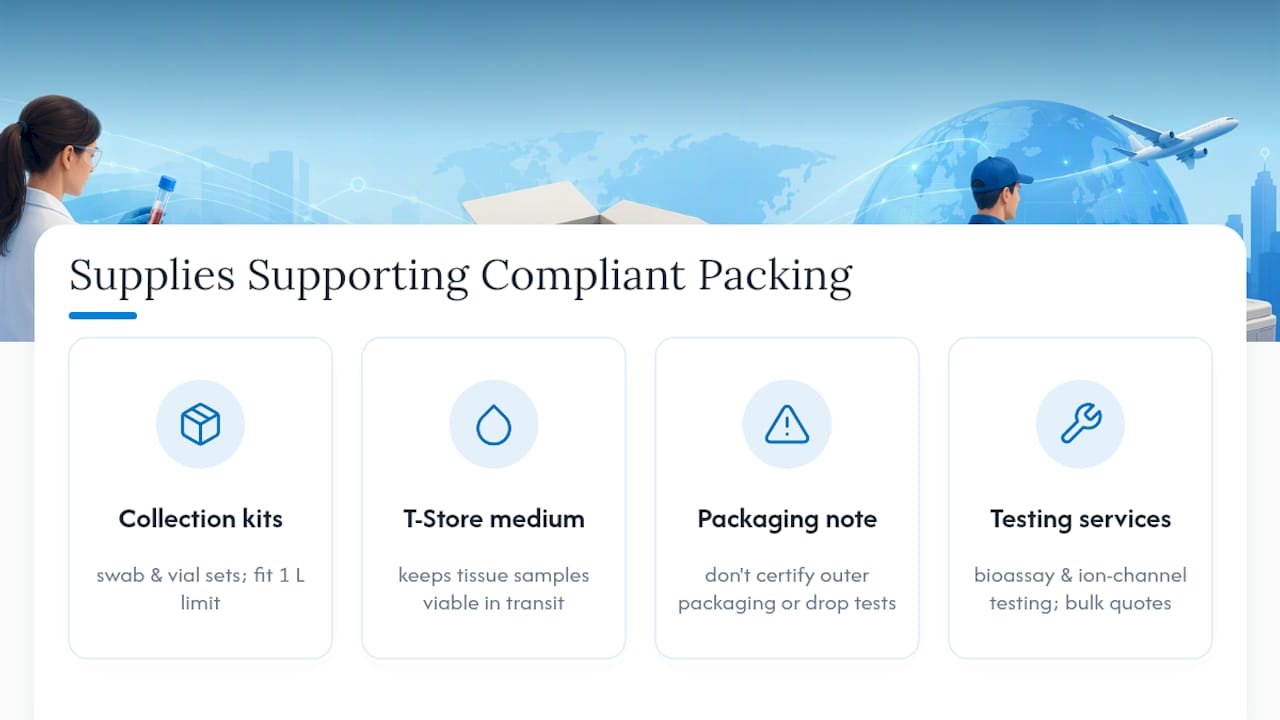
Supplies That Support Compliant Packing, From Mayflowerbio
Getting the regulations right is half the job. The other half is having primary receptacles and transport media that actually hold up to the packing sequence described above. Mayflowerbio stocks sample collection kits built for labs handling routine diagnostic specimens, including swab and vial sets with viral transport media sized to fit within standard 1 liter primary-receptacle limits.
For labs managing tissue specimens that need stable transport conditions, T-Store tissue storage and transportation medium is formulated to keep samples viable between collection and lab receipt. None of these products certify your outer packaging or replace a drop test. What they do is give you a sealed, leakproof starting point so the rest of your triple-pack assembly isn’t fighting a bad primary container from the start.
If your lab also runs cell-based or ion channel work alongside diagnostic sample shipping, Mayflowerbio’s bioassay and ion channel testing services cover that side of the bench too. Reach out through the product catalog for bulk supply quotes or technical questions about matching a receptacle to your specimen type.
This article is general information, not a substitute for advice from a qualified doctor. Consult a qualified healthcare professional about your own circumstances before acting on anything here.
Sources
- 173.199 | PHMSA
- Specimen packing and shipping guidance, CDC
- PackSafe / How to ship (FAA)
- IATA PI650 PDF
FAQ
What Are the Basic Packaging Requirements for UN3373?
UN3373 shipments need triple packaging: a leakproof primary receptacle, absorbent secondary packaging, and a rigid outer box. Air shipments of liquids additionally need a 95 kPa pressure rating and must respect the 1 liter primary and 4 liter outer packaging limits.
Is UN3373 Considered Dangerous Goods?
Yes, UN3373 (Biological Substance, Category B) is a regulated hazardous material under 49 CFR §173.199 and IATA’s Dangerous Goods Regulations, even though it’s a lower-risk category than infectious substances capable of causing severe disease. It still requires specific marking, packaging, and shipper training.
What Are the UN Packaging Standards for Biological Substances?
UN packaging standards for UN3373 require a triple-pack system meeting performance criteria including drop-test resistance and, for air shipments, the 95 kPa pressure differential specified in PHMSA’s regulations. Outer packaging must also meet a minimum 100 mm external dimension.
Do Ground Shipments Follow the Same Rules as Air Shipments?
Ground shipments still require triple packaging, but the 95 kPa pressure test and the strict 1 L/4 L volume limits are specific to air transport under IATA PI650. Packaging built to air standards will satisfy ground requirements, but the reverse isn’t guaranteed.
What Should I Do If a Package Arrives Damaged or Leaking?
Isolate the package immediately, avoid direct contact, and follow your lab’s biosafety spill procedure before opening it further. Document the damage with photos and notify the shipper and carrier, since PHMSA interpretation guidance treats packaging failures as reportable events requiring documentation.
Does Mayflowerbio Sell UN3373-Compliant Packaging?
Mayflowerbio supplies sample collection kits, vials, and transport media that support compliant packing, including swab and VTM kits sized for standard primary receptacle limits. Current pricing and availability are listed on the product pages.




