
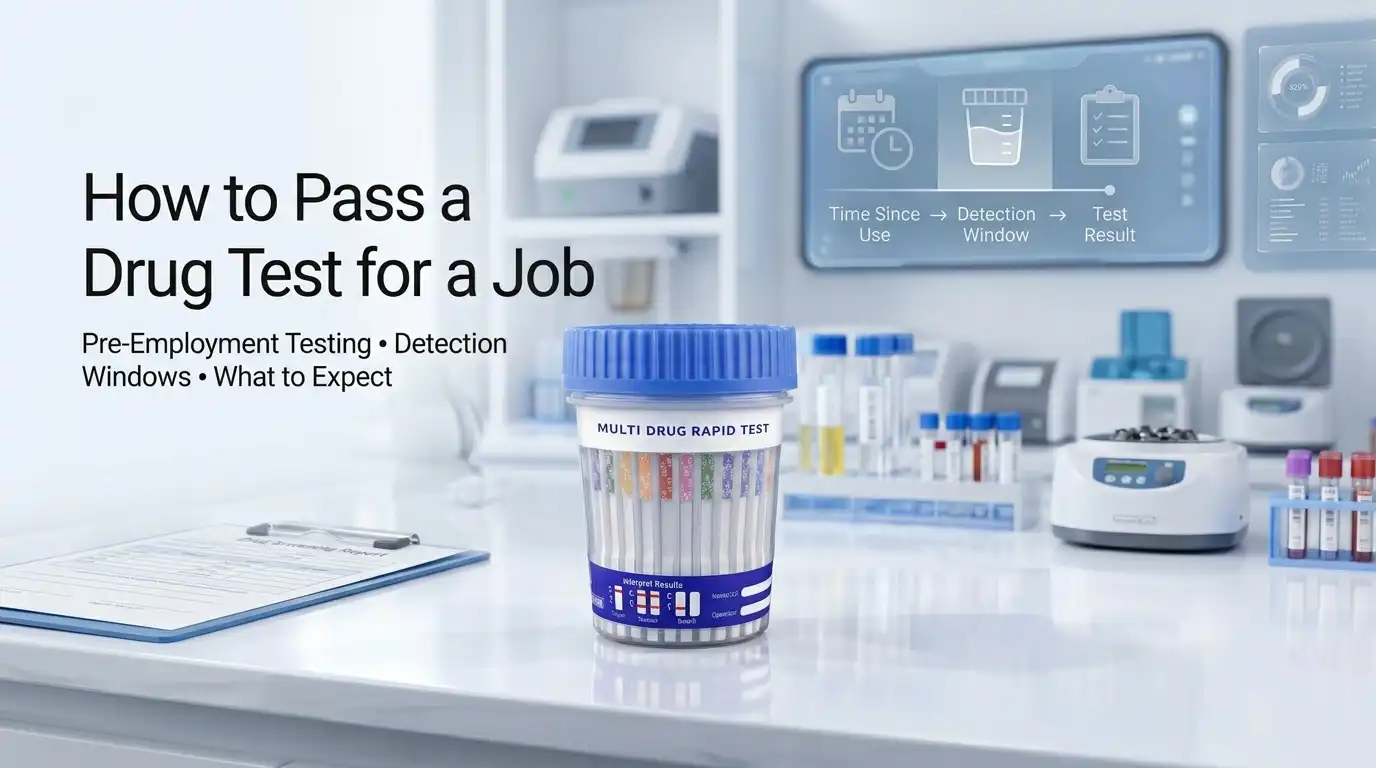
How to Pass a Drug Test for a Job
A pre-employment drug test can be stressful, especially when you do not know what type of test your employer uses, what substances are included, or how long a drug or its metabolites may remain detectable.
The most important thing to understand is that there is no reliable last-minute method that can guarantee a negative drug-test result. Detection depends on the substance, amount and frequency of use, time since last use, individual metabolism, specimen type, laboratory cutoff, and testing method. Urine, oral-fluid, hair, and blood testing can produce very different detection windows.
The safest approach is to understand the testing process, avoid further exposure to the substance, follow the collection instructions, maintain normal hydration, disclose legitimate prescription information when appropriate, and understand what happens if a screening result requires additional review.
Important: Employment drug-testing rules vary by employer, industry, state, and country. Federal/DOT procedures discussed below apply specifically to programs covered by those rules and should not be assumed to apply to every private employer.
What Is a Pre-Employment Drug Test?
A pre-employment drug test is a screening performed as part of an employer’s hiring process. Depending on the employer and applicable rules, testing may occur before employment, after a conditional offer, randomly during employment, following an incident, or under another company policy.
Workplace drug-testing programs can test for illicit drugs, certain prescription drugs, alcohol, or specific drug metabolites. The substances included in a panel depend on the testing program rather than one universal list.
For federal workplace programs, the Department of Health and Human Services (HHS) establishes scientific and technical guidelines for drug testing, while other workplace programs may operate under different requirements.
How Does a Drug Test for a Job Work?
Although procedures differ between employers and testing programs, a typical laboratory-based drug test follows a general process:
- The employer orders the test.
- You receive collection instructions.
- A specimen is collected at an authorized collection location.
- The specimen is labeled and secured.
- The laboratory performs the appropriate testing.
- A screening result may lead to additional confirmation testing when required.
- An MRO may review certain results, particularly in programs that use Medical Review Officers.
- The appropriate result or status is reported to the employer or designated recipient.
Federal workplace programs use documented collection and chain-of-custody procedures. For example, federal urine collections use split specimens, with a primary specimen and a retained split specimen.
This is why trying to manipulate or substitute a specimen can create additional problems rather than solving the underlying issue.
What Types of Drug Tests Do Employers Use?
Employers can use different specimen types depending on their testing program.
1. Urine Drug Test
Urine testing is one of the most common forms of drug screening.
Urine tests generally look for drugs or their metabolites rather than simply measuring whether the original drug is still present.
For example, cannabis urine testing commonly targets a metabolite associated with THC, while cocaine screening generally targets benzoylecgonine.
Urine testing can identify exposure over a longer period than some tests, particularly for substances that produce metabolites that remain detectable after the drug itself has left the bloodstream.
2. Oral Fluid or Saliva Drug Test
Oral-fluid testing uses saliva collected from the mouth.
It is useful when a testing program is interested in relatively recent drug exposure. Scientific reviews also note that oral-fluid detection differs from urine detection and that the two specimen types should not be treated as interchangeable.
For federal workplace programs, HHS currently authorizes both urine and oral-fluid specimen collection under its Mandatory Guidelines.
3. Hair Drug Test
Hair testing can provide a substantially longer historical window than urine or oral fluid.
A commonly discussed window is approximately 90 days, although the actual interpretation depends on the hair sample, laboratory method, drug, and testing circumstances.
Hair testing does not mean that a person is impaired at the time of testing. It provides information about drug exposure over a longer historical period.
4. Blood Drug Test
Blood testing is less commonly used for routine employment screening than urine testing.
Blood generally provides a shorter window for many substances because it measures substances or metabolites circulating in the bloodstream rather than primarily relying on metabolites that have been excreted into urine.
The appropriate specimen depends on the purpose of the testing program.
How Long Do Drugs Stay in Your System for a Job Drug Test?
There is no universal number of days that applies to everyone.
Detection depends on:
- The substance
- Dose
- Frequency of use
- Time since last use
- Route of administration
- Individual metabolism
- Kidney and liver function
- Specimen type
- Laboratory cutoff
- Testing method
- Whether the test detects the parent drug or a metabolite
Published clinical references give broad ranges rather than a guaranteed expiration date. For example, urine detection can range from a few days for many substances to weeks or longer for some patterns of cannabis or other long-term exposure.
Approximate examples for urine testing
| Substance | Approximate urine detection range* |
|---|---|
| Amphetamine/methamphetamine | Around 1–4 days |
| Cocaine/metabolite | Around 1–4 days in many situations |
| Codeine/morphine | Around 1–3 days |
| Fentanyl | Often around 1–3 days, but varies |
| Benzodiazepines | Several days; some long-acting drugs can persist longer |
| Cannabis/THC | About 1–3 days after infrequent use, with substantially longer windows possible with chronic use |
*These are general reference ranges, not predictions for an individual test. Detection can vary considerably with the drug, use pattern, cutoff, and test method.
For cannabis in particular, chronic or heavy use can produce much longer urine detection than occasional use.
How to Prepare for a Pre-Employment Drug Test
If you have a job drug test coming up, focus on the parts of the process you can actually control.
1. Stop Further Drug Exposure
If you are concerned about a future drug test, avoiding further exposure gives your body time to metabolize and eliminate drugs and their metabolites naturally.
There is no dependable product that can instantly remove previously stored metabolites from your body.
The amount of time required varies by substance and individual.
2. Follow the Testing Instructions
Read the employer’s or collection facility’s instructions carefully.
Follow requirements concerning:
- Identification
- Appointment time
- Collection location
- Prescription information
- Required documentation
- Specimen collection
- Forms and paperwork
Do not intentionally alter, substitute, adulterate, or otherwise manipulate a specimen.
3. Maintain Normal Hydration
Normal hydration is appropriate.
However, drinking excessive amounts of water does not reliably remove drug metabolites.
Instead, excessive fluid intake can produce an unusually dilute urine specimen. Specimen validity testing may identify abnormal characteristics, and certain workplace programs have specific procedures for handling dilute results.
For example, DOT regulations specify particular procedures for negative-dilute specimens depending on creatinine concentration.
So the goal should be normal hydration, not water loading.
Does Drinking Water Help You Pass a Drug Test?
This is one of the most common questions surrounding employment drug testing.
Water is important for normal hydration, but drinking large quantities immediately before testing does not eliminate drug metabolites from your body.
Instead, excessive fluid intake can reduce the concentration of substances and normal urinary markers.
Laboratories can evaluate specimen characteristics such as:
- Creatinine
- Specific gravity
- pH
- Other validity markers
The purpose of these checks is to help determine whether the specimen is consistent with a valid human specimen.
SAMHSA’s current MRO guidance discusses specimen validity issues involving creatinine, specific gravity, pH, and other markers.
Drink normally. Do not rely on excessive water consumption as a way to defeat a drug test.
Do Detox Drinks Help You Pass a Job Drug Test?
Detox drinks are widely marketed online as products that can cleanse or flush drugs from the body.
However, a detox drink cannot reliably guarantee that a laboratory drug test will be negative.
A product may change urine concentration or temporarily affect other characteristics without actually eliminating the drug or metabolite responsible for the result.
Some products can also create health risks when used excessively or combined with large amounts of water, diuretics, supplements, or other substances.
For an employment test, the more useful question is not:
“What can temporarily mask a result?”
It is:
“Has enough time passed for the substance and its metabolites to fall below the laboratory’s applicable detection threshold?”
Can Exercise Help You Pass a Drug Test?
Exercise is often promoted online as a rapid way to eliminate THC or other drugs.
The reality is more complicated.
Exercise supports general health and normal metabolism, but it does not provide a predictable way to eliminate drug metabolites before a scheduled test.
For cannabis, THC is highly lipid-soluble and can have a substantially longer detection period in people with repeated or heavy use.
Therefore, exercise should not be treated as a guaranteed drug-test-clearing method.
Can You Pass a Drug Test If You Recently Used Cannabis?
It depends.
The most important factors include:
- How recently cannabis was used
- Whether use was occasional or frequent
- The specimen being tested
- The laboratory’s cutoff
- Individual metabolism
- The specific testing method
Urine testing may detect cannabis metabolites considerably longer than blood or oral fluid in some circumstances.
Published clinical references report approximately 1–3 days for infrequent cannabis use, while chronic use can produce detection periods of 30 days or longer.
These figures should not be interpreted as a guarantee that a person will test negative after a particular number of days.
What Is THC-COOH?
When discussing marijuana drug testing, you will often see the term THC-COOH.
THC-COOH is a metabolite produced when the body processes THC.
This distinction matters because a urine cannabis test is not necessarily asking:
“Is active THC currently making this person impaired?”
Instead, many urine tests are designed to identify a cannabis metabolite.
Consequently, a positive urine result should not automatically be interpreted as proof that someone is currently intoxicated or impaired.
What Drugs Can Show Up on a Job Drug Test?
There is no single universal employment drug-test panel.
Depending on the testing program, panels can include substances such as:
- Marijuana/THC
- Cocaine
- Amphetamines
- Methamphetamine
- Opioids
- Opiates
- PCP
- Benzodiazepines
- Barbiturates
- Fentanyl
- Oxycodone
- Methadone
- Buprenorphine
Federal testing programs have specific authorized panels and cutoff requirements, while non-federal employers can use different panels depending on their program and applicable law.
Never assume that a “5-panel,” “10-panel,” “12-panel,” or other panel is identical across every provider. Always check the actual test panel.
What Is a Drug-Test Cutoff?
A cutoff concentration is a laboratory threshold used to interpret whether a drug or metabolite meets the criteria for a particular screening or confirmation result.
This is one reason why detection windows cannot be reduced to a simple number of days.
For example, the same person could potentially have different detection outcomes depending on:
- The specimen
- The drug being measured
- The analytical method
- The cutoff
- Time since exposure
Scientific literature specifically notes that detection time can vary according to the cutoff used.
What Is Specimen Validity Testing?
Specimen validity testing (SVT) evaluates whether a urine specimen has characteristics consistent with a valid sample.
Depending on the testing program, laboratories may examine factors including:
Creatinine
Creatinine is a normal substance found in urine and can help evaluate specimen concentration.
Specific Gravity
Specific gravity provides information about urine concentration.
pH
Urine normally has a broad physiological pH range. Abnormally extreme values can indicate a problem with the specimen.
Adulteration
Laboratories may test for evidence of substances or conditions that interfere with drug testing.
SAMHSA’s MRO guidance explains that laboratories have specific criteria for reporting certain invalid, adulterated, or substituted specimens.
This is another reason why trying to manipulate urine chemistry is not a dependable way to obtain a negative result.
What Happens If a Drug Screen Is Positive?
A preliminary or screening result is not necessarily the same thing as the final reported result.
Many laboratory testing programs use an initial screening process followed by more specific confirmatory analysis when required.
Modern confirmatory testing can use highly specific analytical techniques such as:
- GC-MS
- LC-MS/MS
- Other mass-spectrometry-based methods
Scientific literature describes immunoassays as common initial screening techniques and mass spectrometry as a method used for confirmation.
This additional testing helps reduce the possibility that an unexpected screening result is incorrectly interpreted as definitive.
What Does an MRO Do?
A Medical Review Officer (MRO) is a physician responsible for reviewing certain drug-test results within applicable workplace testing programs.
The MRO’s role can include reviewing:
- Laboratory results
- Relevant medical information
- Prescription medications
- Legitimate medical explanations
- Testing documentation
SAMHSA publishes specific MRO guidance for federal workplace drug-testing programs.
If you take a medication that could be relevant to a drug-test result, keep appropriate prescription and medical documentation available.
An important point is that not every negative drug test results in an MRO phone call. MRO involvement depends on the testing program and the type of result requiring review.
What If You Take Prescription Medication?
A prescription medication does not automatically mean that you will fail a workplace drug test.
However, some medications or their metabolites may be relevant to laboratory testing.
If a result requires medical review, the MRO may evaluate whether there is a legitimate medical explanation.
Keep information such as:
- Prescription name
- Prescribing physician
- Pharmacy information
- Prescription documentation
- Relevant medical records
available if requested.
Do not stop a medically necessary prescription simply because you have a drug test unless your own healthcare professional tells you to do so.
What Is a Split Specimen?
A split specimen is one specimen divided into separate containers.
The primary specimen is tested first, while the second portion is retained for potential additional testing under applicable rules.
For example, DOT urine collections are split into a primary specimen and a split specimen.
Under DOT regulations, if an MRO notifies an employee of a verified positive result or certain refusal-to-test circumstances, the employee generally has 72 hours from notification to request testing of the split specimen.
The exact procedure depends on the applicable testing program.
What Happens If a Drug Test Is Dilute?
A dilute specimen does not automatically mean that the person used drugs.
It means the specimen had characteristics indicating unusually low concentration under the applicable laboratory criteria.
What happens next depends on:
- The testing program
- Whether the result was negative or positive
- Creatinine concentration
- Applicable regulations
- Employer policy
DOT regulations contain specific procedures for negative-dilute and positive-dilute results.
Therefore, trying to drink huge quantities of water before a urine test can create a result that requires additional action rather than helping.
Can Home Drug Tests Help Before a Job Drug Test?
An at-home drug test can be useful as a preliminary screening tool.
It may help you understand whether a particular substance is detectable at the test’s stated cutoff.
However, an at-home test should not be treated as an exact prediction of an employer’s laboratory result.
Differences can include:
- Cutoff concentrations
- Test sensitivity
- Specimen collection
- Test panel
- Laboratory methodology
- Confirmation procedures
- Specimen validity testing
A home test can therefore provide information, but it does not guarantee what a workplace laboratory will report.
Common Drug-Test Myths
Myth 1: Drinking huge amounts of water guarantees a negative result
False.
Excessive water can dilute urine and may trigger specimen-validity concerns.
Myth 2: Detox drinks remove all drug metabolites
Not reliably.
There is no dependable beverage that guarantees elimination of previously stored drug metabolites before a laboratory test.
Myth 3: Exercise guarantees that THC will leave your body faster
False.
Exercise is beneficial for general health but cannot reliably predict when a cannabis test will become negative.
Myth 4: All drugs remain detectable for the same amount of time
False.
Different drugs have very different pharmacokinetics and detection windows.
Myth 5: A home test and laboratory test are identical
False.
They can use different methods, cutoffs and procedures.
Myth 6: A positive screening result always means final positive
Not necessarily.
Depending on the program, additional confirmation and/or medical review may be required.
Myth 7: A prescription automatically means you will fail
False.
A legitimate prescription can be relevant to medical review and interpretation of a result.
Myth 8: You can guarantee a negative test by using someone else’s urine
No.
Specimen substitution is prohibited in many testing programs and can trigger specimen-validity procedures or other consequences.
What Should You Avoid Before a Job Drug Test?
Avoid relying on:
- Extreme water consumption
- Unverified detox products
- Unregulated supplements
- Diuretics
- Chemical adulterants
- Specimen substitution
- Synthetic urine
- Attempts to alter urine pH
- Deliberate manipulation of creatinine or specific gravity
- Internet “guaranteed pass” methods
These approaches do not remove the underlying drug metabolites from the body and can create additional testing or validity problems.
What If You Know You May Test Positive?
If you believe a recent exposure could produce a positive result, the most useful steps are generally:
- Do not continue using the substance.
- Do not attempt to adulterate or substitute the specimen.
- Understand which test the employer ordered.
- Review the employer’s testing instructions.
- Keep legitimate prescription information available.
- Follow the collection process exactly.
- If contacted by an MRO, respond promptly and provide requested medical information.
The appropriate legal rights and employer obligations depend on the jurisdiction and testing program.
What Happens If You Fail a Pre-Employment Drug Test?
There is no single outcome for every job applicant.
Possible consequences depend on:
- Employer policy
- State or local law
- Industry
- Job type
- Whether the position is safety-sensitive
- Whether the test is governed by federal regulations
- Whether the result is confirmed
- Whether an MRO review changes the interpretation
A federal or DOT-regulated test should not be assumed to follow the same procedure as an ordinary private-employer test.
If you receive a result you believe is incorrect, review the documentation and applicable procedures promptly.
Employment Drug Testing and Medical Marijuana
Cannabis laws and employment protections vary substantially by jurisdiction.
A medical marijuana authorization does not automatically guarantee that an employer must ignore a positive cannabis test.
Some jurisdictions provide employment protections in particular circumstances, while others permit employers broader discretion.
Therefore, if medical cannabis is relevant to your situation, check the law applicable to your location and the employer’s written policy rather than relying on a general internet claim.
How to Improve Your Chances of a Legitimate Negative Result
There is no guaranteed last-minute solution, but several sensible steps can reduce avoidable problems.
Before the test:
- Stop further drug exposure.
- Learn what type of specimen will be collected.
- Review the test panel if it is provided.
- Follow the collection instructions.
- Maintain normal hydration.
- Continue prescribed medication unless your healthcare professional instructs otherwise.
- Keep prescription documentation available.
- Avoid unverified detox products.
- Do not attempt to manipulate your specimen.
- If appropriate, use a home test for informational purposes rather than treating it as a guarantee.
The key factor remains time since exposure combined with the substance, use pattern, specimen type, cutoff, and testing methodology.
Urine vs. Oral Fluid vs. Hair vs. Blood
| Feature | Urine | Oral Fluid | Hair | Blood |
|---|---|---|---|---|
| Common workplace use | Common | Increasingly used in some programs | Used in some programs | Less common |
| Detection pattern | Often days to weeks depending on substance/use | Generally more recent exposure | Longer historical window | Generally shorter |
| Collection | Urine specimen | Mouth swab | Hair sample | Blood draw |
| Invasive? | No | No | No | Yes |
| Can detect metabolites? | Yes | Yes | Yes | Yes |
| Same result as another specimen? | No | No | No | No |
Federal HHS programs currently authorize urine and oral fluid specimen collection; other employers may use different testing arrangements.
How Accurate Are Employment Drug Tests?
Modern laboratory drug testing can be highly specific, particularly when an appropriate confirmation method is used.
However, no test should be interpreted without considering:
- The substance tested
- The specimen
- Cutoff
- Screening methodology
- Confirmation methodology
- Medication history
- Specimen validity
- Collection procedures
This is why professional laboratory testing involves more than simply looking for a visible line on a rapid test.
Frequently Asked Questions
How do I pass a drug test for a job?
The most reliable approach is to avoid further drug exposure and allow sufficient time for the body to metabolize and eliminate the substance. There is no guaranteed detox drink, supplement, or last-minute trick that can ensure a negative laboratory result.
What is the most common employment drug test?
Urine testing is widely used for workplace drug screening, although oral fluid and other specimen types are also used depending on the employer and testing program.
How long do drugs stay in your urine?
It depends on the substance, dose, frequency of use, metabolism, cutoff, and testing method. Some drugs may be detectable for only a few days, while cannabis after chronic use and certain other substances can remain detectable considerably longer.
Does drinking water help pass a drug test?
Normal hydration is appropriate, but excessive water consumption does not remove drug metabolites and can produce a dilute specimen.
Do detox drinks work for employment drug tests?
They cannot reliably guarantee a negative result. They may alter urine concentration without eliminating the underlying metabolites.
Can exercise help pass a THC drug test?
Exercise supports general health but does not provide a reliable way to predict or guarantee a negative THC test.
Can prescription drugs cause a positive drug test?
Some medications can be relevant to screening or confirmation results. If a result requires medical review, prescription information can help the MRO evaluate a legitimate medical explanation.
Does an MRO call if you pass a drug test?
Usually, an MRO’s involvement depends on the result and testing program. A routine negative result does not necessarily require an MRO to contact the donor.
What happens after a positive drug screen?
Depending on the testing program, a screening result may require confirmation and/or MRO review before the final result is reported.
What is a dilute drug test?
A dilute result means the specimen has unusually low concentration under the applicable validity criteria. Employer and laboratory procedures determine what happens next.
Can a home drug test predict an employment drug test?
It can provide preliminary information, but it cannot guarantee the outcome of a laboratory employment test because the tests can differ in cutoff, methodology, panel and specimen-validity procedures.
How far back can a hair drug test detect drugs?
Hair testing is commonly associated with a historical window of approximately 90 days, although the actual interpretation depends on the specimen and laboratory methodology.
Can marijuana show up on a job drug test?
Yes. Cannabis/THC may be included in an employment drug-testing panel. Whether it is tested depends on the employer and testing program.
Can CBD cause a positive drug test?
Some CBD products can contain THC. Because product composition can vary, using CBD does not guarantee that a THC drug test will be negative.
What should I do if I have a prescription for a drug detected by testing?
Do not stop prescribed medication without medical advice. Keep legitimate prescription information available and follow the testing program’s instructions if an MRO requests documentation.
Final Takeaway: What Actually Works?
If you are searching for how to pass a drug test for a job, the most important point is that there is no universal trick that guarantees a negative result.
The outcome depends primarily on:
Substance → Amount/Frequency of Use → Time Since Use → Metabolism → Specimen Type → Laboratory Cutoff → Testing Method
Urine, oral fluid, hair, and blood tests have different detection characteristics. Employment tests can also include specimen-validity checks and, where applicable, confirmation testing and Medical Review Officer review.
Instead of relying on water loading, detox drinks, synthetic urine, adulterants, or other internet “quick fixes,” focus on understanding the test, avoiding further exposure, maintaining normal hydration, following collection instructions, and providing legitimate prescription information when required.
For an employment drug test, time and the body’s natural elimination processes matter far more than any supposed overnight detox method.




