
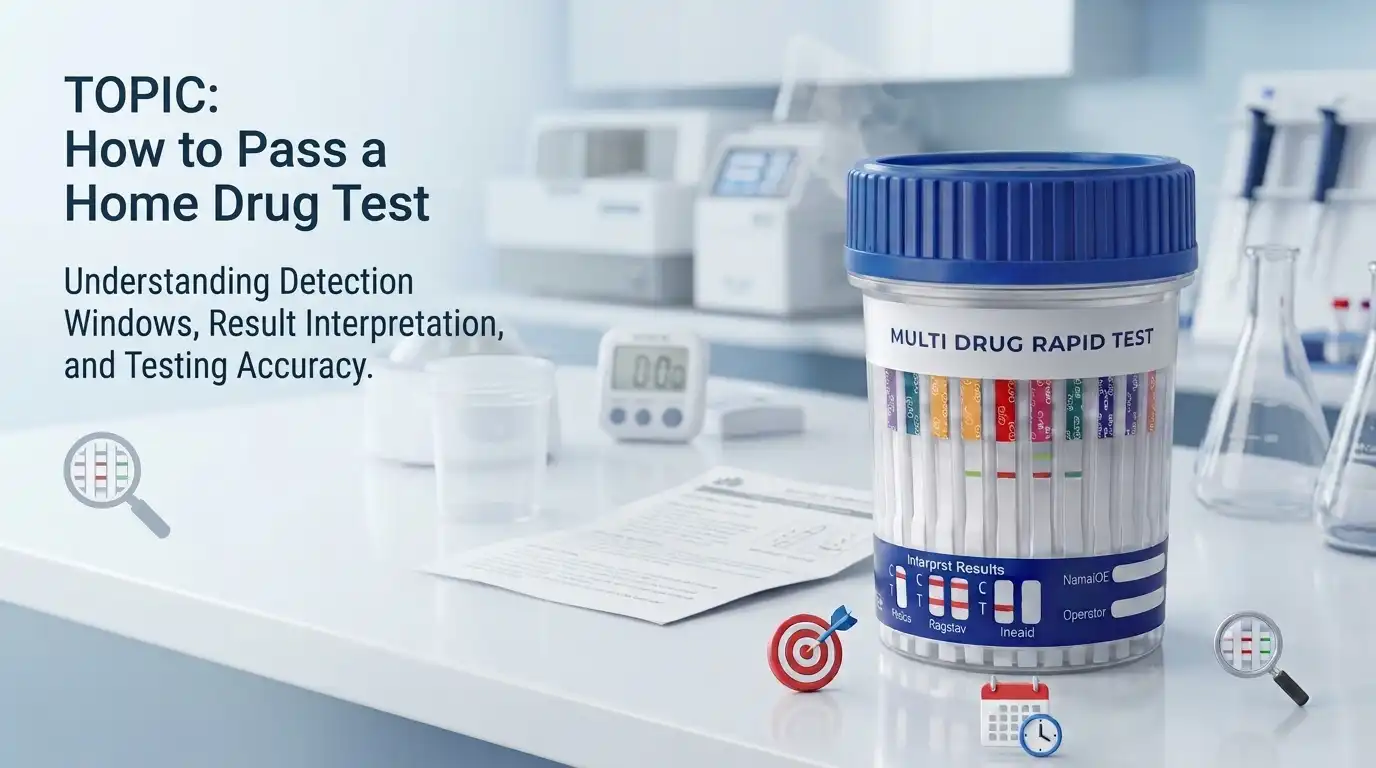
How to Pass a Home Drug Test:
If you are searching for how to pass a home drug test, it is important to understand what a home drug test actually measures and what can influence the result. At-home drug tests are designed to screen urine, saliva, or another specimen for specific drugs or their metabolites. The result can depend on the substance being tested, how frequently it was used, the detection window, the test’s cutoff level, and whether the test was performed correctly.
There is no reliable instant method that can guarantee a negative drug test. Drinking excessive amounts of water, using unproven detox products, or adding substances to a specimen can create unreliable or invalid results and may carry health risks.
For the most dependable result, use an appropriate home drug test according to the manufacturer’s instructions and understand its limitations. This guide explains how home drug tests work, what affects detection, how to improve testing accuracy, how to interpret results, and what to do if a result is unexpected.
What Does It Mean to Pass a Home Drug Test?
A home drug test generally reports whether a specific drug or drug metabolite is detected at or above the test’s cutoff level.
A negative result generally means the targeted substance was not detected at or above that cutoff at the time of testing. It does not necessarily mean that the person has never used the substance or that every possible drug is absent from the body.
A home drug test can only detect the substances included in its specific panel.
For example, a multi-panel test may screen for several drug classes, while a single-panel test may focus on one substance. A 12-panel drug test can screen for multiple specified substances simultaneously, but the exact drugs included depend on the particular product configuration.
Several factors can influence the result:
- The type of drug being tested
- The amount and frequency of use
- Individual metabolism
- The specimen being tested
- The drug’s detection window
- The test’s cutoff concentration
- Test sensitivity
- Sample collection
- Storage conditions
- Correct use of the test
- Timing of result interpretation
Understanding these factors is much more useful than relying on online claims about quick ways to “beat” a drug test.
How Do Home Drug Tests Work?
Most rapid home drug tests use an immunoassay to screen for specific drugs or their metabolites.
The specimen interacts with components inside the test device. Depending on the test design, the reaction produces lines or another visual result that the user compares with the manufacturer’s interpretation guide.
The most common home drug-testing formats include urine and oral-fluid tests.
Urine Drug Tests
Urine is one of the most commonly used specimens for drug screening.
Home urine drug tests are available as:
- Drug test strips
- Dip cards
- Multi-panel cards
- Drug test cups
- Integrated testing cups
A urine test may screen for substances such as THC metabolites, cocaine metabolites, amphetamines, methamphetamine, opioids, PCP, benzodiazepines, methadone, oxycodone, or other drug classes depending on the panel.
The exact substances detected should always be checked on the product label.
Saliva Drug Tests
Saliva tests, also called oral-fluid drug tests, use a swab to collect a sample from inside the mouth.
They are useful for testing recent drug exposure, but their detection characteristics differ from urine testing. A substance that is detectable in urine may not have the same detection window in saliva.
Hair Drug Testing
Hair testing can provide a longer historical detection window than many urine or saliva tests. However, hair testing is generally performed through specialized laboratory procedures rather than the typical rapid home drug-test cup.
Blood Drug Testing
Blood testing can detect substances in the bloodstream but is rarely performed as a typical at-home drug screening method. It generally requires professional collection and laboratory analysis.
What Determines a Home Drug Test Result?
If you want to understand how to pass a home drug test, you first need to understand why a test becomes positive or negative.
1. The Drug Being Tested
Different drugs are processed differently by the body.
Many urine drug tests detect drug metabolites rather than the original drug itself. A metabolite can remain detectable after the effects of the substance have disappeared.
This means that feeling normal does not necessarily mean that a drug metabolite is no longer detectable.
2. Frequency of Use
How frequently a substance is used can affect its detection period.
Someone who uses a substance occasionally may have a different detection window from someone who uses it frequently or chronically.
There is therefore no universal number of days that guarantees a negative result for everyone.
3. Individual Metabolism
The body processes drugs through various metabolic pathways.
Factors affecting metabolism can include individual physiology, frequency of use, amount consumed, and other circumstances.
However, metabolism cannot be used to accurately predict the exact time when a particular person’s test will become negative.
4. Detection Window
The detection window is the period during which a drug or metabolite may be detected by a particular testing method.
Detection windows vary according to:
- Drug
- Dose
- Frequency of use
- Specimen type
- Test sensitivity
- Cutoff level
- Individual factors
This is why online statements such as “every drug leaves your system in three days” are misleading.
5. Cutoff Level
A drug test uses a cutoff concentration to determine how a result is classified.
If the concentration of the targeted drug or metabolite is below the cutoff, the screening result may be negative. If it reaches or exceeds the applicable cutoff, the screening result may be positive.
The cutoff is a testing threshold. It should not be interpreted as a measurement of intoxication or impairment.
How Long Do Drugs Stay Detectable?
One of the most common questions associated with how to pass a home drug test is how long a drug remains detectable.
There is no single detection period that applies to every person.
For urine testing, detection can vary considerably depending on the substance, frequency of use, test cutoff, metabolism, and other factors.
Commonly tested substances include:
| Drug or drug class | Detection considerations |
|---|---|
| THC | Detection can vary substantially with frequency of use |
| Cocaine | Usually detected through cocaine metabolites |
| Amphetamines | Detection depends on substance and individual factors |
| Methamphetamine | Detection varies with use and testing conditions |
| Opioids | Detection depends on the specific opioid |
| Benzodiazepines | Detection varies between medications |
| PCP | Can have a longer urine detection period |
| Methadone | Requires a test that specifically includes methadone |
| Oxycodone | Requires an appropriate oxycodone assay |
| Barbiturates | Detection varies according to the specific drug |
These are general testing considerations rather than guarantees for an individual.
How Long Does THC Stay Detectable?
THC is one of the most commonly discussed substances in urine drug testing.
Urine tests generally detect THC metabolites, rather than determining whether a person is currently intoxicated.
Occasional and frequent cannabis use can produce significantly different detection periods. The specific test’s cutoff also matters.
Therefore, a statement such as “THC always leaves the urine after X days” should not be treated as universally accurate.
Can Drinking Water Help You Pass a Home Drug Test?
Drinking normal amounts of water is part of maintaining hydration, but consuming excessive amounts of water is not a reliable way to eliminate drug metabolites.
Large quantities of fluid can dilute urine.
A diluted specimen may have unusually low concentrations of substances and may also have abnormal specimen characteristics. In laboratory testing, characteristics such as creatinine and specific gravity can be evaluated as part of specimen validity testing.
Excessive water consumption can also be dangerous because it can cause severe electrolyte disturbances and, in extreme cases, water intoxication.
For that reason, attempting to force a negative drug-test result by consuming excessive amounts of water is not a dependable or safe strategy.
Do Detox Drinks Help You Pass a Drug Test?
Detox drinks are widely marketed online as products that can “clean” the body before a drug test.
However, marketing claims should not be confused with a guaranteed testing outcome.
A drink may affect hydration or urination without actually eliminating the drug metabolites that a screening test is designed to detect.
There is no universally reliable detox drink that guarantees a negative home drug test regardless of the drug, detection window, cutoff, or individual circumstances.
Some detox products may also contain ingredients that can cause side effects or interact with medications.
Can Baking Soda Help You Pass a Drug Test?
Baking soda is frequently mentioned online as a supposed home remedy for drug testing.
There is no reliable scientific basis for treating baking soda as a guaranteed way to remove drug metabolites or produce a negative drug test.
Consuming excessive amounts of baking soda can also cause serious health problems, including electrolyte and acid-base disturbances.
It should not be relied upon as a method for changing a drug-test result.
What About Synthetic Urine and Adulterants?
Some websites promote synthetic urine, specimen substitution, or adulterants as ways to manipulate drug-test results.
These approaches do not make a test more accurate.
An adulterant can interfere with the testing process, while substituted specimens may be identified through specimen-validity procedures.
Depending on the testing situation, attempting to manipulate a specimen may also violate workplace, treatment, legal, or organizational requirements.
If the purpose of testing is to obtain reliable information, the appropriate approach is to provide the specimen specified by the test and follow the manufacturer’s collection instructions.
How to Get the Most Accurate Home Drug Test Result
If you are concerned about the result of a home drug test, focus on proper testing technique rather than unverified methods.
1. Choose the Correct Test
First, determine which substances you need to test for.
A single-panel drug test detects a particular drug or drug class, while a multi-panel test can screen for multiple substances.
Do not assume that all 10-panel, 12-panel, or 15-panel tests contain the same drug configuration.
Always review the product’s specifications.
2. Check the Expiration Date
Before using the test, check the expiration date printed on the packaging.
Do not use a test that is expired, damaged, improperly stored, or has compromised packaging.
3. Read the Instructions
Different drug-test cups and strips can have different procedures.
Read the manufacturer’s instructions before collecting your specimen.
Pay attention to:
- Required specimen
- Minimum sample level
- Testing procedure
- Activation instructions
- Result-reading time
- Interpretation criteria
- Storage requirements
4. Collect the Specimen Correctly
For a urine drug test, collect the sample according to the test’s instructions.
Avoid contamination and do not add substances to the specimen.
For an oral-fluid test, follow the instructions regarding swab placement and collection.
Incorrect collection can produce an unreliable result.
5. Follow the Required Timing
Most rapid drug tests have a specific period in which the result should be interpreted.
Reading a test too early may not allow the reaction to complete.
Reading it too late can also make the result difficult or impossible to interpret correctly.
Always use the manufacturer’s stated result window.
How to Read a Home Drug Test
Correct interpretation is just as important as correct specimen collection.
Different drug-test devices can use different result formats, so always follow the instructions supplied with your specific product.
Negative Result
A negative result generally means the targeted drug or metabolite was not detected at or above the test’s cutoff.
It does not necessarily mean that no drug is present at all.
Presumptive Positive Result
A presumptive positive screening result indicates that the test has detected the targeted drug or metabolite at a level consistent with the test’s screening threshold.
Because home screening tests can produce false-positive results, an unexpected positive may require laboratory confirmation.
Invalid Result
An invalid test does not provide a valid negative or positive result.
Possible reasons can include:
- Incorrect procedure
- Insufficient specimen
- Damaged test
- Expired test
- Failure of the control indicator
- Incorrect interpretation time
An invalid result should not simply be treated as negative.
What Does a Faint Line Mean on a Drug Test?
A faint line can cause confusion because drug-test designs differ.
Some competitive immunoassay tests interpret the presence of a visible test line as negative, even if the line is faint.
However, this is not a universal rule for every drug test.
The correct interpretation depends on the specific device and its manufacturer’s instructions.
Never use the interpretation rules from one drug-test brand to interpret another brand.
How Accurate Are Home Drug Tests?
Home drug tests can provide useful preliminary screening information, but no test should be treated as infallible.
Accuracy depends on factors such as:
- Test design
- Drug being tested
- Cutoff level
- Specimen quality
- Sample collection
- Test storage
- Expiration date
- User technique
- Interpretation
False Positives
A false positive occurs when a screening test indicates the presence of a drug when confirmatory testing does not establish the expected drug or metabolite.
Certain medications and other substances can sometimes interfere with immunoassay screening.
An unexpected positive should therefore be evaluated carefully.
False Negatives
A false negative occurs when a test reports a negative result even though the targeted substance is present.
Possible reasons include:
- The drug is not included in the panel.
- The concentration is below the cutoff.
- The test was performed incorrectly.
- The test was used outside its intended conditions.
- The sample was collected outside the relevant detection period.
- The device was expired or damaged.
Home Drug Test vs. Laboratory Drug Test
A home drug test and a laboratory drug test serve different purposes.
| Feature | Home Drug Test | Laboratory Testing |
|---|---|---|
| Main purpose | Preliminary screening | Screening and/or confirmation |
| Location | Home or point of care | Laboratory or professional setting |
| Result speed | Usually rapid | May take longer |
| Testing method | Often immunoassay | May use more specific analytical methods |
| User involvement | Usually high | Professional procedures may be used |
| Confirmation | May require separate testing | Can include confirmatory analysis |
More specific laboratory methods can include GC-MS and LC-MS/MS, depending on the laboratory and testing program.
If a home test produces an unexpected positive and the result has important consequences, laboratory confirmation can provide additional information.
Can Medications Cause a False Positive?
Certain medications can interfere with some drug-screening assays.
This does not mean that every medication will cause a false positive. The potential for interference depends on the specific medication and the assay being used.
If you take prescription or over-the-counter medications:
- Keep a list of what you take.
- Do not stop prescribed medication because of a drug test.
- Review unexpected results with a healthcare professional.
- Consider appropriate confirmation testing when necessary.
A screening result alone may not establish exactly which substance caused the reaction.
What Should You Do After a Positive Home Drug Test?
If your home drug test produces an unexpected positive result, do not immediately assume that the result proves drug use.
Instead:
Review the test instructions
Make sure the test was performed and interpreted correctly.
Confirm the test panel
Check that the device actually tests for the substance you are concerned about.
Review medications
Consider whether prescription or over-the-counter medications could be relevant.
Consider laboratory confirmation
If the result affects employment, medical treatment, legal matters, or another important decision, seek appropriate laboratory confirmation.
Discuss the result with a professional
A healthcare professional can help you determine what additional testing or evaluation may be appropriate.
What If the Home Drug Test Is Negative?
A negative result generally means the targeted substance was not detected at or above the test’s cutoff at the time the specimen was tested.
However, a negative result does not prove that:
- Every drug is absent
- The test detects every possible substance
- The person has never used the substance
- The substance could not have been used outside the test’s detection window
- The test is appropriate for every testing purpose
If the result conflicts with other information, professional confirmation may be appropriate.
How to Choose a Home Drug Test
When choosing a home drug test, look beyond the number of panels.
Consider:
Drug panel
Check exactly which drugs or drug classes the test detects.
Specimen type
Determine whether the test uses urine or oral fluid.
Cutoff levels
Review the manufacturer’s specifications where available.
Test format
Options may include:
- Drug test strips
- Dip cards
- Multi-panel cards
- Drug test cups
- Oral swabs
Intended use
Consider whether the test is intended for personal screening, workplace-related preparation, clinical use, or another purpose.
Regulatory information
Review the product’s labeling and applicable regulatory status rather than relying solely on marketing language.
Why Multi-Panel Drug Tests Are Useful
A multi-panel drug test can screen for several substances using one specimen.
This can be useful when you need broader screening rather than testing for only one drug.
For example, a 12-panel urine drug test can provide screening for multiple specified drug classes at the same time.
However, panel count does not automatically tell you which drugs are included.
Always review the individual product configuration.
Frequently Asked Questions
What is the best way to pass a home drug test?
There is no guaranteed instant method for producing a negative result. The result depends on the drug, detection window, cutoff level, specimen, and test characteristics. The best way to obtain a reliable result is to use the correct test and follow its instructions.
Can drinking water make a drug test negative?
Excessive water can dilute urine but does not reliably remove drug metabolites. It can also make a specimen unsuitable for interpretation and can be dangerous when consumed in excessive amounts.
Do detox drinks guarantee a negative drug test?
No. Detox drinks cannot guarantee a negative result. Their effects and claims vary, and some products may carry health risks.
Does baking soda help pass a drug test?
Baking soda is not a reliable method for eliminating drug metabolites or guaranteeing a negative result. Excessive consumption can be harmful.
How accurate is a home urine drug test?
Accuracy varies according to the specific device, drug, cutoff, specimen, storage, and testing procedure. Home tests are generally screening tools, and unexpected positive results may require confirmation.
Can a home drug test be wrong?
Yes. False-positive and false-negative results can occur. Incorrect collection, improper storage, expired tests, cross-reactivity, cutoff levels, and other factors can affect results.
What does a negative drug test mean?
It generally means the targeted substance was not detected at or above the test’s cutoff. It does not mean that every possible drug is absent.
What does a positive drug test mean?
It generally means the screening test detected a signal consistent with the targeted substance at or above its cutoff. An unexpected positive may require laboratory confirmation.
What does an invalid drug test mean?
It means the test did not produce a valid result according to its instructions. An invalid test should not be interpreted as negative.
How long does THC stay detectable?
The detection period varies considerably depending on frequency of use, individual factors, specimen type, and the test’s cutoff. There is no universal number of days that applies to everyone.
Can medications affect drug-test results?
Yes. Certain medications can interfere with some screening assays. Unexpected results should be reviewed carefully and may require confirmatory testing.
Is a home drug test the same as a laboratory drug test?
No. Home tests generally provide preliminary screening, while laboratory testing can use more specific analytical methods and professional testing procedures.
Can a 12-panel drug test detect every drug?
No. A 12-panel test detects the specific substances included in its configuration. Different manufacturers can offer different combinations, so check the product’s drug list before purchasing.
Final Thoughts
If you are searching for how to pass a home drug test, the most important thing to understand is that there is no guaranteed shortcut for producing a negative result.
A home drug test responds to the presence of specific drugs or metabolites according to its test design and cutoff level. Detection depends on factors such as the substance, frequency of use, metabolism, specimen type, detection window, and test sensitivity.
Trying to manipulate a specimen with excessive fluids, baking soda, adulterants, or other unverified methods can produce unreliable results and may create additional health or testing problems.
For the most meaningful result, choose a test that detects the substances you need to screen for, check the expiration date, follow the collection instructions, observe the correct testing period, and interpret the result according to the manufacturer’s guidelines.
If a home screening result is unexpected or could have significant medical, employment, or legal consequences, consider appropriate laboratory confirmation.
12PanelNow offers a range of home drug-testing products, including multi-panel urine drug test cups and other rapid screening formats. Understanding the panel configuration, specimen type, and test instructions can help you choose the right testing option for your needs.




