
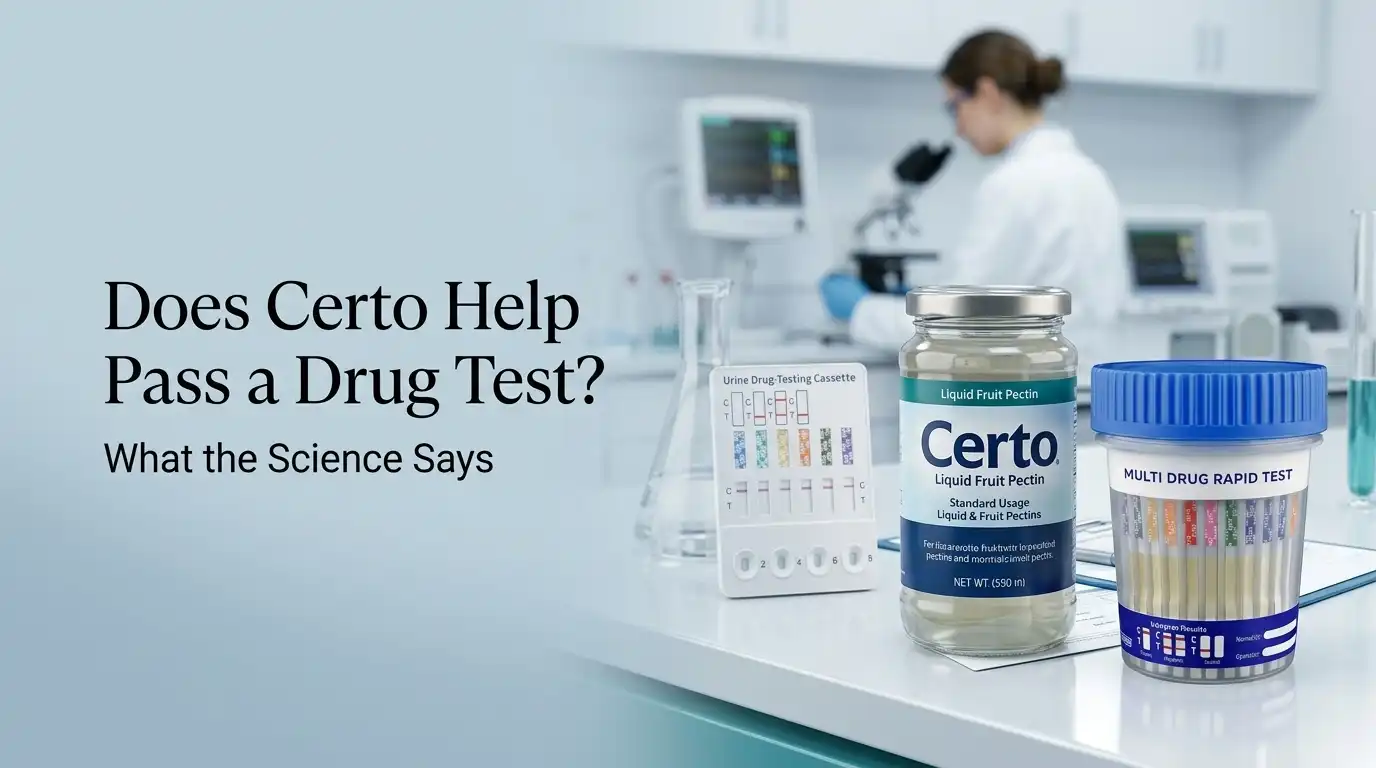
Does Certo Help Pass a Drug Test?
If you have searched for ways to pass a drug test, you may have come across the Certo method. The idea is simple: Certo is a liquid fruit-pectin product, and online discussions claim that consuming it before a urine drug test can somehow keep drug metabolites from appearing in urine.
But does Certo actually help you pass a drug test?
There is no good clinical evidence showing that Certo reliably lowers urinary drug-metabolite concentrations enough to produce a negative drug-test result. Certo contains pectin, a type of soluble fiber with legitimate effects in the digestive system, including interactions with bile acids. However, the leap from those established effects to the claim that Certo can reliably change a drug-test result has not been demonstrated in controlled human research.
The distinction is important: the biology of pectin is real, but the Certo drug-test claim remains unproven.
This article explains what Certo is, why people believe it works, what is actually known about pectin and drug metabolites, how urine drug testing works, and why anecdotal reports should not be treated as proof.
Quick Answer: Does Certo Help Pass a Drug Test?
Certo should not be considered a proven or reliable way to pass a drug test.
Certo is a fruit-pectin product used primarily as a food ingredient. The FDA lists pectin among substances used in food for functions including thickening, stabilizing, texturizing and related purposes.
The online Certo theory generally focuses on THC metabolites, particularly the metabolite measured in urine after cannabis exposure. The theory suggests that pectin could interact with bile acids or compounds in the gastrointestinal tract and somehow reduce the amount of metabolite ultimately appearing in urine.
There is an important scientific gap, however:
Evidence that pectin can affect bile-acid handling does not establish that Certo can reliably remove or conceal drug metabolites from a urine specimen.
Research supports biological effects of soluble fibers such as pectin on bile-acid and cholesterol metabolism. But that is different from demonstrating that Certo changes the outcome of a drug-screening test.
What Is Certo?
Certo is a liquid fruit-pectin product.
Pectin is a naturally occurring polysaccharide and a form of soluble dietary fiber. In food applications, pectin can form viscous gels, which is why pectin-containing products are commonly associated with jams, jellies and preserves.
The FDA’s food-substance database identifies pectin as a substance used for functions including:
- stabilizing
- thickening
- texturizing
- emulsifying
- flavor-related applications
That is very different from being a pharmaceutical drug-detoxification agent.
There is no reason to confuse a legitimate food ingredient with a medically established drug-test detoxification treatment.
Why Do People Think Certo Helps Pass a Drug Test?
The Certo drug-test theory developed primarily through internet forums, cannabis communities and anecdotal reports.
The basic idea usually goes something like this:
Certo → pectin → digestive tract → interaction with bile/metabolites → less metabolite in urine
The theory is especially associated with cannabis and THC rather than every possible drug.
This distinction matters.
A theory about THC metabolites cannot automatically be generalized to:
- cocaine metabolites
- amphetamine metabolites
- opioid metabolites
- PCP
- benzodiazepines
- other substances
Different drugs have different pharmacokinetics, metabolites, distribution patterns and elimination pathways.
How Is the Certo Method Supposed to Work?
The explanation commonly given online involves pectin, bile acids, THC metabolites and enterohepatic circulation.
There is legitimate biology behind part of this explanation.
Soluble fibers can interact with bile acids in the gastrointestinal tract. Research has investigated how pectin and other dietary fibers can affect bile-acid handling and cholesterol metabolism.
Some research suggests that viscous dietary fibers can interfere with the movement or reabsorption of bile acids in the intestine, increasing their elimination through feces.
That leads to the hypothesis behind the Certo method:
- Cannabis is metabolized by the body.
- Some cannabis metabolites are eliminated through different routes.
- Some compounds associated with metabolism can interact with the gastrointestinal and biliary systems.
- Pectin can affect gastrointestinal contents and bile-acid handling.
- Therefore, proponents speculate that pectin might redirect some metabolites away from urine.
The problem is step five.
The missing evidence
Showing that pectin interacts with bile acids does not prove that pectin can intercept enough THC metabolite to change a drug-test result.
In fact, scientific reviews emphasize that the interaction between different soluble fibers and bile acids is complex and depends on fiber structure, viscosity and other factors. Some experimental work has not demonstrated permanent molecular binding between purified pectin and bile acids.
So the Certo theory should be described as a hypothesis, not as an established drug-testing mechanism.
Does Pectin Really Affect Bile Acids?
Yes—but this is where context is critical.
Pectin is a soluble fiber, and dietary-fiber research has found effects on bile-acid and cholesterol metabolism.
For example, research has shown that dietary pectin can increase fecal bile-acid and steroid excretion in certain circumstances.
Other research describes soluble fibers as capable of creating a viscous intestinal environment that can affect bile-acid movement and cholesterol absorption.
These are legitimate physiological effects.
However:
Pectin affecting bile acids ≠ Certo passing a drug test.
Those are two different scientific questions.
The first asks:
Does dietary pectin affect gastrointestinal or bile-acid physiology?
There is evidence that it can.
The second asks:
Does consuming Certo reliably lower urinary drug metabolites enough to change a drug-test result?
That specific claim has not been established by comparable clinical evidence.
Does Certo Remove THC From the Body?
There is no good evidence that Certo detoxifies or eliminates THC metabolites from the body in the way online advertisements and anecdotal claims sometimes suggest.
This distinction is particularly important because urine drug tests generally do not simply look for the original psychoactive compound.
For federal workplace urine testing, SAMHSA identifies delta-9-tetrahydrocannabinol-9-carboxylic acid (THCC) as the marijuana analyte reported in urine testing.
In other words, the relevant question isn’t simply:
“Is THC still in my body?”
The testing question is more specific:
Is the target drug or metabolite present in the specimen at or above the applicable testing criteria?
That’s why a food ingredient cannot reasonably be assumed to “clean” a person simply because it changes digestion or bowel movements.
Does Certo Lower THC Metabolites in Urine?
This is the central question.
There is not sufficient clinical evidence to establish that Certo reliably lowers urinary THC-metabolite concentrations below a drug-test cutoff.
The evidence commonly cited in support of Certo falls into several categories:
1. Pectin research
There is legitimate research on pectin, including its effects on:
- soluble fiber physiology
- bile acids
- cholesterol metabolism
- gastrointestinal processes
But these studies generally aren’t testing whether Certo changes drug-test results.
2. Online testimonials
People post stories saying they used Certo and subsequently received a negative result.
These accounts cannot determine whether Certo caused the result.
A person may have:
- already been below the test’s cutoff
- had naturally declining metabolite concentrations
- received a negative result for another reason
- used an at-home screening test with a particular cutoff
- experienced a result that does not generalize to another testing method
3. Anecdotal experiments
Individual experiments can be interesting, but they are not equivalent to controlled clinical research.
Without controlling variables such as:
- baseline metabolite concentration
- time since exposure
- frequency of use
- test sensitivity
- specimen concentration
- laboratory methodology
it is impossible to confidently attribute a negative result to Certo.
Certo: What Is Known vs. What Is Claimed?
A useful way to understand the controversy is to separate established information from speculation.
| Claim | Evidence status |
|---|---|
| Certo contains fruit pectin | Established |
| Pectin is a soluble fiber | Established |
| Pectin can affect gastrointestinal processes | Established |
| Soluble fibers can influence bile-acid handling | Supported by research |
| People online use Certo before drug tests | Well documented |
| Pectin can affect bile-acid elimination | Supported in research |
| Pectin reliably removes THC metabolites from the body | Not established |
| Certo reliably lowers urinary drug metabolites | Not established |
| Certo guarantees a negative drug test | No scientific basis |
| Certo is an approved drug-test detoxification treatment | No |
This distinction is more scientifically useful than simply calling Certo a “detox” or saying that every anecdotal report is false.
Does Certo Work for Marijuana or THC Drug Tests?
Most of the Certo discussion concerns cannabis urine testing.
That’s because THC and its metabolites have distinctive pharmacokinetic characteristics, and cannabis metabolites can remain detectable in urine for substantially longer than the parent drug remains in the bloodstream.
Historical NIDA material, for example, documents that marijuana metabolites can remain detectable in urine longer than in blood and can persist for weeks in frequent users.
This is one reason the Certo theory focuses heavily on THC.
But the existence of a longer detection period doesn’t establish that pectin can safely or reliably shorten it.
Why THC Testing Is More Complicated Than “Flushing THC”
A urine drug test isn’t measuring whether someone has a certain amount of “dirty urine.”
It is analyzing a biological specimen for specific target compounds or metabolites.
For cannabis, federal workplace urine testing identifies a specific marijuana metabolite as the urine analyte.
That means several variables matter:
- the substance used
- the metabolite being tested
- time since exposure
- frequency of exposure
- individual metabolism
- amount and potency of exposure
- specimen concentration
- laboratory methodology
- applicable cutoff criteria
This is why a generalized “detox” claim is scientifically weak.
Does Certo Work for Drugs Other Than THC?
There is even less reason to assume that Certo works universally across different drug classes.
Different substances have different:
- metabolic pathways
- metabolites
- half-lives
- tissue distribution
- protein binding
- routes of elimination
- urine concentrations
A mechanism proposed specifically around THC and bile-related physiology cannot simply be applied to every drug.
For example, a claim about cannabis metabolites does not automatically demonstrate an effect on:
- cocaine metabolites
- amphetamines
- opioids
- PCP
- benzodiazepines
Therefore, “Certo works for drug tests” is a much broader claim than the available evidence supports.
Does Certo Work for a Urine Drug Test?
A urine drug test is designed to identify specific drugs or metabolites in urine according to the testing method being used.
Federal workplace testing provides a useful example of how structured this process can be.
SAMHSA explains that federal workplace testing uses HHS-certified laboratories, and urine specimens can undergo specimen-validity testing in addition to drug testing.
That means a laboratory isn’t necessarily asking only:
“Is the drug metabolite below the cutoff?”
It may also evaluate whether the specimen itself is consistent with normal urine.
This is important when evaluating online detox claims.
What Is Specimen Validity Testing?
Specimen Validity Testing (SVT) evaluates whether a urine specimen is consistent with normal human urine and can identify issues such as dilution, adulteration or substitution.
Under DOT rules, laboratories conduct validity testing as part of the urine-testing process.
Depending on the testing framework, laboratories may evaluate:
- creatinine
- specific gravity
- pH
- oxidizing adulterants
- abnormal physical characteristics
- other indicators of specimen validity
DOT regulations specifically require creatinine measurement on primary urine specimens and require specific-gravity testing when creatinine is below 20 mg/dL.
What Does “Dilute” Mean on a Drug Test?
A dilute specimen is urine with unusually low concentration markers.
Under DOT’s current Part 40 criteria, a urine specimen is considered dilute when creatinine is at least 2 mg/dL but below 20 mg/dL and specific gravity is above 1.0010 but below 1.0030.
This matters because some online Certo discussions focus heavily on consuming large quantities of fluids.
But dilution isn’t equivalent to detoxification.
A diluted specimen can have lower concentrations of substances simply because there is more fluid relative to the measured compounds. That doesn’t mean the underlying metabolites have been removed from the body.
What Happens if a Drug-Test Sample Is Dilute?
The exact consequences depend on the testing program.
For federally regulated DOT testing, a negative-dilute result can require or permit another collection depending on the creatinine concentration. DOT regulations specify immediate direct-observation recollection for certain negative-dilute results.
SAMHSA also explains that federal workplace programs use specimen-validity testing and report negative-dilute results as a distinct category.
Therefore, a negative-looking result is not necessarily the end of the testing process.
This is one reason online claims that rely solely on a single home-test result should be interpreted cautiously.
At-Home Drug Tests vs. Laboratory Drug Tests
Another important distinction is the difference between an at-home screening test and a laboratory test.
An at-home urine test may use an immunoassay to screen for a particular drug or metabolite.
Laboratory testing can involve a more extensive analytical and validity-testing process.
SAMHSA states that HHS-certified laboratories conduct federal workplace testing and that specimens requiring additional testing can be forwarded to certified laboratories.
Therefore, a person’s experience with an inexpensive home test should not automatically be treated as evidence about what will happen with:
- a workplace laboratory test
- a DOT test
- a probation test
- a clinical test
- another manufacturer’s test
- a test with different cutoffs
The testing method matters.
Does Certo Work Because It Dilutes Urine?
Some online explanations attribute reported Certo “success” primarily to the large amount of fluid commonly consumed alongside the method rather than to pectin itself.
There is a reasonable reason to distinguish these mechanisms.
Dilution changes urine concentration.
Pectin is a dietary fiber with gastrointestinal effects.
Those are completely different biological processes.
Even if someone’s urine concentration changes after consuming a large volume of fluid, that doesn’t demonstrate that Certo removed the drug metabolite.
It is also important that laboratories can evaluate specimen concentration and validity. DOT regulations explicitly require validity testing and define criteria for dilute specimens.
Can Certo Permanently Detox the Body?
No reliable evidence establishes Certo as a permanent detoxification treatment for drug metabolites.
A “detox” product can be marketed as though it physically removes toxins from the body, but drug metabolism is more complicated than that.
The body uses organs and physiological pathways to metabolize and eliminate substances.
For a drug-test result, what matters is the relationship between:
Exposure → metabolism → metabolite formation → distribution → elimination → specimen concentration → analytical cutoff
Changing one part of that system does not automatically eliminate the substance from the body.
How Long Does the Certo Effect Last?
Online Certo instructions frequently claim a temporary “window” lasting several hours.
However, there is no well-established clinical evidence defining a reliable Certo drug-test window.
Claims such as:
- “3 hours”
- “4 hours”
- “5 hours”
- “6 hours”
should therefore not be presented as scientifically established Certo pharmacology.
The duration of detectable drug metabolites is influenced by the substance, exposure pattern, metabolism and testing method—not by a universally established Certo countdown.
Does Certo Work for Heavy Cannabis Users?
It would be particularly inappropriate to assume that Certo can reliably overcome the biological complexity associated with frequent or long-term cannabis exposure.
THC metabolites can remain detectable in urine for extended periods, particularly after repeated exposure. NIDA material documents that urinary marijuana metabolites may remain detectable substantially longer than blood concentrations, including for weeks in frequent users.
A food-based fiber product has not been demonstrated to reliably eliminate that reservoir of metabolites.
Therefore, claims such as:
“Certo works for everyone, even heavy users”
are not supported by adequate evidence.
Is Certo the Same as Sure-Jell?
Certo and Sure-Jell are both associated with fruit pectin products, which is why they frequently appear together in online drug-test discussions.
The important point for this article, however, is not the packaging.
Changing the brand of a fruit-pectin food product doesn’t create clinical evidence that pectin can reliably alter a drug-test result.
The question remains:
Has fruit pectin been demonstrated in controlled human research to reliably reduce urinary drug metabolites enough to change a drug-test result?
The evidence does not establish that.
What About the Stories From People Who Say Certo Worked?
Anecdotes shouldn’t simply be dismissed.
They are useful for understanding why the claim became popular.
But an anecdote cannot determine causation.
Imagine someone reports:
“I used Certo and my test was negative.”
That tells us that the two events occurred together.
It doesn’t establish that:
Certo caused the negative result.
The person may already have been below the testing threshold.
Other variables may have contributed.
The testing method may have differed.
The timing since cannabis exposure may have been longer than assumed.
The person may have been using a test with a different analytical cutoff.
This is why controlled research is necessary.
Why Anecdotal Success Can Be Misleading
Several common reasoning problems can make online detox methods appear more effective than they are.
Confirmation bias
Someone who believes Certo works may interpret a negative test as proof that the method caused it.
Survivorship bias
People who believe a method succeeded may be more likely to post about it than people who failed.
Confounding variables
The person may have stopped using cannabis days or weeks earlier.
Different tests
A home immunoassay and laboratory testing are not necessarily equivalent.
Baseline concentration
Two people can have very different metabolite concentrations despite reporting similar use.
For these reasons, testimonials are useful evidence of belief and experience, but weak evidence of clinical effectiveness.
Certo Drug Test Myths vs. Facts
Myth: Certo is a drug detox product.
Fact: Certo is a fruit-pectin food product. Pectin has established food and physiological uses, but that does not make it an approved drug-test detoxification treatment.
Myth: Pectin traps all THC metabolites.
Fact: Pectin can affect gastrointestinal and bile-acid processes, but that does not establish that it captures enough THC metabolites to reliably change a urine drug-test result.
Myth: Certo guarantees a negative drug test.
Fact: There is no scientific basis for a guarantee.
Myth: A negative home test proves Certo works.
Fact: A home-test result cannot establish causation or predict every laboratory testing situation.
Myth: Certo permanently removes THC from the body.
Fact: There is no established evidence that Certo permanently clears THC metabolites from the body.
Myth: More Certo means a better result.
Fact: Increasing consumption does not create evidence of effectiveness and may increase the potential for gastrointestinal problems or other adverse effects.
What Are the Risks of the Certo Method?
Certo itself is a food product, but using a food product in unusually large amounts or combining it with excessive fluid intake is a different matter.
Large amounts of soluble fiber can cause gastrointestinal symptoms such as:
- bloating
- abdominal discomfort
- gas
- diarrhea
The broader concern comes from online protocols that combine large quantities of fluid with multiple ingredients.
Drinking excessive amounts of water over a short period can cause hyponatremia, a potentially serious condition in which blood sodium becomes dangerously low.
Symptoms can include:
- headache
- nausea
- confusion
- weakness
- seizures in severe cases
For that reason, intentionally consuming extreme quantities of fluid to manipulate a urine sample is not a safe strategy.
What About Creatine and Vitamin B?
Online Certo discussions often mention creatine and B vitamins.
These ingredients are commonly discussed because people attempting the method are concerned about the appearance or concentration of urine.
That does not mean they prove Certo works.
Creatinine and specific gravity are legitimate components of specimen-validity assessment. DOT regulations require laboratories to evaluate these markers under specified circumstances.
Vitamin supplementation similarly does not demonstrate that drug metabolites have been removed.
It is therefore important to distinguish:
Changing the characteristics of a urine specimen
from
eliminating the drug metabolite from the body.
They are not the same thing.
Does Certo Show Up on a Drug Test?
Certo itself is not the drug analyte that standard drug tests are designed to detect.
A urine drug test is generally looking for particular drugs or metabolites rather than asking whether someone consumed fruit pectin.
However, that doesn’t mean consuming Certo guarantees a negative result.
The test’s target analytes, cutoff criteria and specimen validity procedures still determine how the specimen is evaluated.
What Actually Determines a Drug-Test Result?
A drug-test result can depend on several variables.
The substance
Different drugs produce different metabolites.
Amount and frequency of exposure
Repeated exposure can result in different detection patterns than isolated exposure.
Time
Drug concentrations generally change as the body metabolizes and eliminates compounds.
Individual physiology
Metabolism and elimination vary between individuals.
Specimen type
Urine, oral fluid and other specimen types provide different windows and measure different analytes.
Test methodology
Immunoassay screening and laboratory confirmation are not identical processes.
Cutoff concentration
A test uses defined analytical decision points.
DOT regulations define a cutoff as the analytical value used to determine a result or whether further testing is required.
Why There Is No Universal “Drug Detox” Shortcut
Drug testing is not simply a test of whether a substance exists somewhere in the body.
The analytical question is usually much more specific:
Is a particular drug or metabolite present in the specimen at a concentration that meets the applicable testing criteria?
That is why claims about “flushing toxins” can be misleading.
The body doesn’t have a single universal “toxins” compartment that can be emptied with one food ingredient.
Different substances behave differently.
What Should You Do If You Have an Upcoming Drug Test?
If you have an upcoming drug test, the most reliable approach is to understand what type of test you are actually taking and what rules apply to it, rather than relying on an unproven detox method.
For workplace testing, the testing program may specify:
- specimen type
- substances tested
- collection procedures
- laboratory requirements
- confirmation procedures
- medical review
- specimen-validity testing
SAMHSA provides current federal workplace drug-testing resources and explains the role of HHS-certified laboratories and Medical Review Officers.
If you take prescription medications or have a medical issue that could affect testing, provide accurate information to the appropriate medical or testing professional.
Does Certo Help Pass a Drug Test?
Certo is not a scientifically established method for passing a drug test.
The reason the claim sounds plausible is that pectin really does have biological effects. Soluble fibers can affect digestion and bile-acid handling, and pectin has been studied extensively in nutrition and metabolic research.
But that evidence does not demonstrate that Certo:
- permanently removes THC metabolites,
- reliably lowers drug metabolites in urine,
- creates a predictable drug-test window,
- guarantees a negative test, or
- works across different drug classes and testing methods.
The strongest conclusion supported by the available evidence is therefore:
Certo is a fruit-pectin product with legitimate dietary uses, but its reputation as a reliable drug-test detox method is based primarily on an unproven hypothesis and anecdotal reports rather than strong clinical evidence.
Urine drug testing can also include specimen-validity procedures that evaluate whether a sample is consistent with normal urine. Federal workplace and DOT programs have specific requirements for handling dilute, adulterated, substituted and invalid specimens.
So if you’re wondering “Does Certo help pass a drug test?”, the evidence-based answer is there is not enough evidence to consider it a reliable method.
Frequently Asked Questions
Does Certo really help pass a drug test?
There is no good clinical evidence establishing that Certo reliably produces a negative drug-test result. The claim is primarily based on an online theory involving fruit pectin and anecdotal reports.
Does Certo detox THC?
Certo has not been established as a reliable treatment for removing THC metabolites from the body. Pectin can affect gastrointestinal and bile-acid physiology, but that is not the same as proven THC detoxification.
Does Certo work for a urine drug test?
There is insufficient evidence to conclude that Certo reliably changes urine drug-test results. Urine testing evaluates specific drugs or metabolites and may also include specimen-validity testing.
How does the Certo drug-test theory work?
The theory proposes that pectin could affect the gastrointestinal handling of compounds associated with THC metabolism, potentially changing how some metabolites are eliminated. The proposed mechanism has not been established as a reliable drug-testing intervention.
How long does Certo work for a drug test?
Online sources frequently claim that Certo creates a temporary window lasting several hours, but there is no well-established clinical evidence supporting a predictable Certo-specific drug-test window.
Does Certo work for drugs other than marijuana?
There is no strong evidence establishing Certo as a reliable method for any broad range of drugs. A theory concerning THC metabolites should not automatically be generalized to other substances.
Is Certo the same as Sure-Jell?
They are both associated with fruit pectin products, which is why both names appear in online Certo drug-test discussions. The brand name does not establish drug-test effectiveness.
Can Certo cause a false-negative drug test?
There is insufficient evidence to conclude that Certo reliably causes false-negative drug-test results. A negative result can have many explanations, including the person’s actual metabolite concentration and the characteristics of the test used.
Can drinking too much water cause a diluted drug test?
Yes. Excessive fluid intake can produce unusually dilute urine. Federal testing rules use markers such as creatinine and specific gravity to identify dilute specimens.
Is a negative-dilute result the same as a normal negative result?
No. In federally regulated testing, a negative-dilute result is separately reported and can lead to additional collection requirements depending on the specimen’s creatinine concentration and applicable rules.




