
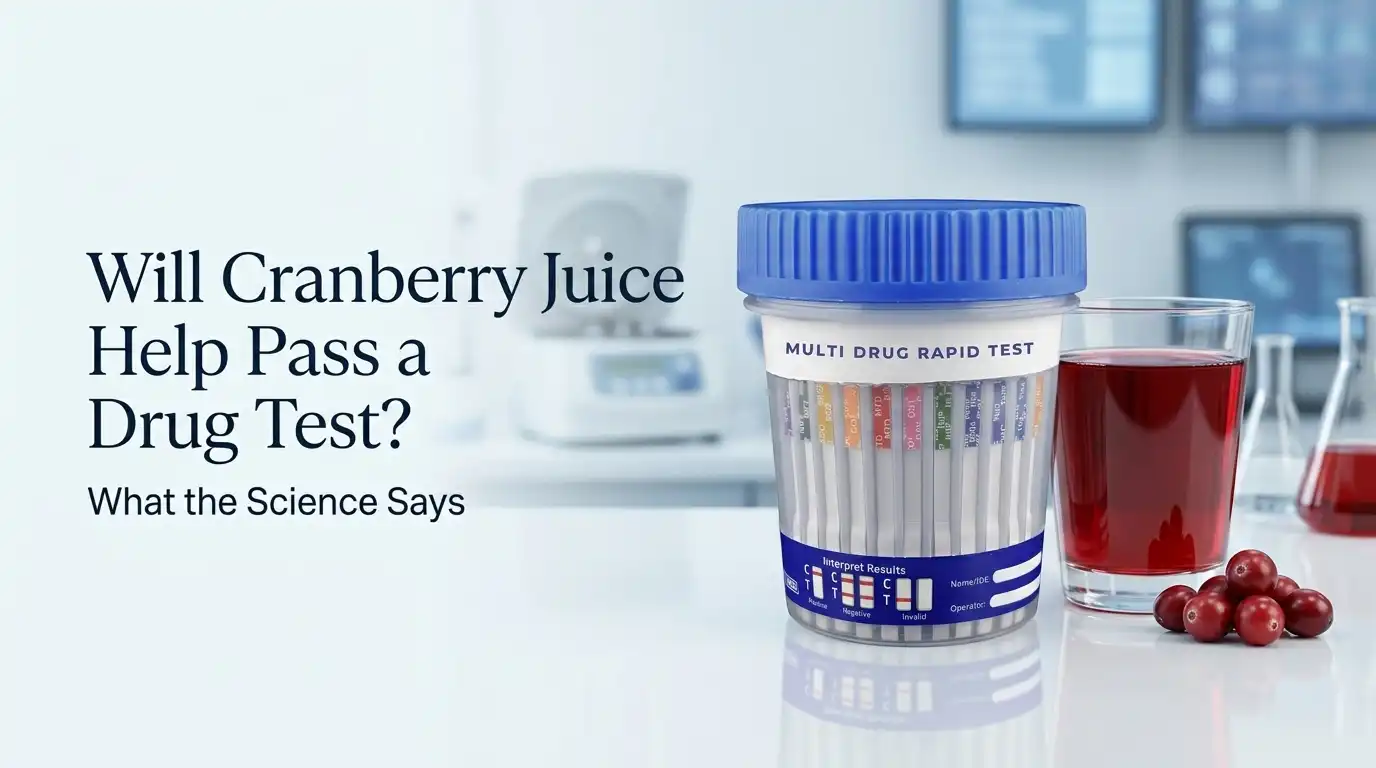
Will Cranberry Juice Help Pass a Drug Test? What the Science Says
If you are wondering, “Will cranberry juice help pass a drug test?”, the short answer is no—not reliably. Cranberry juice is not a proven way to remove drug metabolites, shorten a drug’s detection window, or guarantee a negative drug-test result.
The idea probably comes from cranberry juice’s association with urinary health and the belief that drinking more fluids can “flush” substances from urine. But a drug test is not simply checking whether urine looks clear or whether someone urinates frequently. Depending on the test, laboratories analyze specific drugs or metabolites and may also evaluate whether a urine specimen is valid.
Cranberry products do have legitimate uses and have been studied mainly in relation to urinary tract health. The National Center for Complementary and Integrative Health notes that cranberry may reduce the risk of recurrent UTIs in some women, although the evidence is limited and inconsistent. That is different from demonstrating that cranberry juice can eliminate drug metabolites.
This article explains what cranberry juice actually does, why the drug-test myth persists, how urine drug testing works, what dilution means, and what factors really determine drug-test detection.
Does Cranberry Juice Help You Pass a Drug Test?
Cranberry juice is not a reliable method for passing a drug test.
Drinking cranberry juice does not give the body a special ability to remove drug metabolites before a laboratory can detect them. Drug elimination depends on the substance involved, its metabolites, dose, frequency of use, individual metabolism, specimen type, testing method, and the laboratory’s cutoff levels.
Cranberry juice should therefore not be confused with a drug “detox.”
Even if drinking a large quantity of a beverage changes urine volume or concentration temporarily, that does not mean the underlying drug metabolites have disappeared.
For urine testing, laboratories can also perform specimen validity testing to identify unusually dilute, adulterated, or substituted specimens. SAMHSA describes creatinine and specific gravity as important measures used in evaluating urine specimen validity.
Why Do People Think Cranberry Juice Works for Drug Tests?
The cranberry juice myth likely comes from several ideas being combined together.
First, cranberry products have long been associated with urinary tract health. Cranberries contain compounds called proanthocyanidins (PACs), which are thought to contribute to effects related to bacterial adhesion in the urinary tract. However, research into cranberry concerns urinary-health outcomes—not the elimination of recreational or prescription drug metabolites for drug testing.
Second, people often assume that increased urination means faster drug elimination.
That is not necessarily true.
The kidneys continuously filter blood and produce urine, but drug clearance involves biochemical processes that depend on the particular substance and its metabolites. Producing more urine does not automatically mean the body has metabolized a drug faster.
Third, there is a widespread belief that making urine more diluted can hide drug metabolites. While urine concentration can affect the concentration of an analyte in a specimen, laboratories can evaluate specimen validity, and dilution does not reliably transform a positive specimen into a legitimate negative result.
How Does a Urine Drug Test Work?
A urine drug test is designed to identify specific substances or their metabolites in a urine specimen.
When the body processes a drug, it may transform the original compound into one or more metabolites. Depending on the drug and the testing method, the laboratory may target the parent compound, a metabolite, or a particular analyte associated with the drug.
A simplified process looks like this:
Drug enters the body → drug is absorbed → drug is metabolized → metabolites are produced → metabolites are eliminated → laboratory analyzes the specimen
The important point is that cranberry juice does not simply “erase” those metabolites.
Federal workplace drug-testing procedures illustrate how specific this process can be. SAMHSA explains that urine testing uses initial and, when required, confirmatory testing, with defined cutoff concentrations and specimen-validity requirements.
What Does Cranberry Juice Actually Do?
Cranberry juice is primarily a food and beverage rather than a drug-testing treatment.
Cranberry products have been researched for urinary tract health, particularly the prevention of recurrent UTIs in some populations. NCCIH says cranberry may reduce the risk of recurrent symptomatic UTIs in some women, but the evidence remains limited and inconsistent.
Cranberry juice also contains naturally occurring compounds that can appear in urine after consumption. Research has demonstrated measurable changes in the urinary metabolome following cranberry juice consumption.
None of this establishes that cranberry juice can:
- destroy drug metabolites
- neutralize THC metabolites
- remove cocaine metabolites
- eliminate amphetamine metabolites
- accelerate drug clearance enough to beat a test
- guarantee a negative urine test
- change a laboratory cutoff
- prevent confirmatory testing
Its effects on urinary chemistry should not be confused with detoxification from drugs.
Can Cranberry Juice Flush Drugs Out of Your Urine?
The word “flush” can be misleading.
Your kidneys naturally remove many substances from the bloodstream through urine, but the rate at which a drug and its metabolites leave the body depends on biological processes that vary by substance.
Drinking a beverage does not necessarily make those processes happen substantially faster.
For example, if someone consumes a drug that is metabolized into a detectable compound, the body must process and eliminate that compound. Simply increasing fluid intake does not necessarily destroy the metabolite.
This is why urinating more often is not equivalent to eliminating drugs faster.
Cranberry juice may change urine composition or contribute to fluid intake, but that should not be interpreted as a method for clearing drug metabolites before a test.
Does Cranberry Juice Dilute Urine?
Any substantial increase in fluid intake can potentially affect urine concentration.
However, dilution is not the same as detoxification.
A diluted urine specimen contains less concentrated urinary material. In laboratory drug testing, specimen validity procedures can examine markers such as creatinine and specific gravity to determine whether the urine is unusually dilute.
SAMHSA’s clinical drug-testing guidance explains that creatinine is a normal constituent of urine and that specimens with low creatinine may undergo additional specific-gravity evaluation.
For federally regulated workplace testing, current SAMHSA guidance defines specific criteria for reporting specimens as dilute based on creatinine and specific gravity.
So even if urine becomes less concentrated, that does not mean a person has successfully removed the drug from their body.
What Is Creatinine in a Drug Test?
Creatinine is a normal waste product associated with muscle metabolism that is excreted in urine.
It is useful in drug testing because urine normally contains a measurable concentration of creatinine. An unusually low concentration can indicate that the specimen is highly dilute.
SAMHSA’s clinical guidance states that when urine creatinine is below 20 mg/dL, specific gravity may be evaluated as part of specimen-validity testing.
This is important because a drug test is not necessarily just:
Drug detected = positive
or
Drug not detected = negative
Laboratories may also assess whether the specimen itself meets validity requirements.
What Is Specific Gravity in a Drug Test?
Specific gravity describes the concentration of dissolved substances in urine relative to water.
It is another measurement that can help laboratories evaluate whether urine is unusually dilute.
When creatinine is unusually low, specific gravity can provide additional information about specimen concentration. SAMHSA’s guidance describes specific-gravity testing as part of specimen-validity evaluation in appropriate circumstances.
This is one reason why simply drinking large quantities of a beverage should not be viewed as a dependable way to alter a drug-test result.
What Happens If a Urine Sample Is Dilute?
A dilute specimen does not automatically mean the same thing in every testing program.
The precise reporting and follow-up procedures depend on the testing program and applicable rules.
For federally regulated workplace testing, SAMHSA defines specific criteria for dilute specimens using creatinine and specific gravity measurements. Laboratories can report results in combination with specimen-validity findings.
A dilute specimen can therefore lead to additional administrative or testing procedures rather than providing the straightforward negative result someone may have expected.
This distinction is important:
Dilute urine ≠ drug-free urine
and
Dilution ≠ detoxification
Can Cranberry Juice Help Pass a THC Drug Test?
Cranberry juice is not a proven method for passing a THC drug test.
Cannabis testing can involve specific THC-related analytes. In federal urine testing, the reported urinary compound is delta-9-tetrahydrocannabinol-9-carboxylic acid (THCC), while federal oral-fluid testing targets delta-9-THC.
Whether THC-related compounds remain detectable depends on factors such as:
- frequency of cannabis use
- amount used
- time since use
- individual metabolism
- specimen type
- laboratory method
- applicable cutoff concentration
Cranberry juice does not provide a reliable mechanism for eliminating THC metabolites from the body.
Can Cranberry Juice Help With Other Drugs?
The same basic principle applies to other drug classes.
Cranberry juice does not selectively destroy:
- cocaine metabolites
- amphetamine or methamphetamine metabolites
- opioid-related analytes
- benzodiazepine-related analytes
- PCP
- THC metabolites
Different drugs have different pharmacokinetic characteristics and detection windows, so it is inaccurate to treat all drug tests as though they detect the same substance in the same way.
Federal workplace testing currently includes specified drug categories, and testing programs can have additional requirements depending on the setting.
The specific panel matters.
A substance that is not included in a particular test panel may not be tested for, while a substance specifically included in the panel may be detected according to that test’s analytical requirements.
Does Cranberry Juice Speed Up Drug Metabolism?
There is no established basis for treating cranberry juice as a drug-metabolism accelerator that can reliably shorten a drug’s detection window.
Drug metabolism involves biochemical pathways, many of which occur in the liver. The resulting compounds may then be eliminated through urine or other routes.
The important distinction is:
Hydration can affect urine concentration.
But:
Hydration does not automatically accelerate the metabolic breakdown of every drug.
And:
Cranberry juice does not provide a dependable shortcut through those biological processes.
Cranberry Juice vs. Water for a Drug Test
People sometimes ask whether cranberry juice works better than water.
Neither should be considered a reliable method for manipulating a drug-test result.
Cranberry juice and water are different beverages with different compositions, but adding more fluid to the body does not mean that a drug’s metabolites will disappear.
Excessive fluid intake can also produce an unusually dilute urine specimen. Federal drug-testing guidance specifically incorporates creatinine and specific gravity into specimen-validity determinations.
The more useful distinction is:
| Question | Cranberry Juice | Water |
|---|---|---|
| Provides fluid | Yes | Yes |
| Supports ordinary hydration | Yes | Yes |
| Proven to remove drug metabolites | No | No |
| Proven to shorten drug detection windows | No | No |
| Can excessive intake contribute to dilute urine? | Yes | Yes |
| Guaranteed to produce a negative drug test | No | No |
Can Cranberry Pills or Cranberry Supplements Help Pass a Drug Test?
Cranberry pills, capsules, extracts, and concentrated cranberry products should not be treated as drug-test detox products.
Cranberry supplements are primarily marketed for nutritional or urinary-health purposes. NCCIH notes that cranberry products have been studied for recurrent UTI prevention and that processing can affect the concentration of compounds such as proanthocyanidins.
There is no reason to assume that a concentrated cranberry supplement can remove drug metabolites simply because it contains more cranberry compounds.
More cranberry does not equal faster drug clearance.
Does Cranberry Juice Cause a False Negative Drug Test?
Cranberry juice should not be relied upon to produce a false-negative drug test.
A negative result depends on the analyte being below the applicable cutoff while the specimen also meets the relevant validity requirements.
SAMHSA’s MRO guidance describes a negative urine result in federal testing in relation to applicable initial or confirmatory cutoffs and acceptable specimen-validity results.
Therefore, the idea that cranberry juice can simply “hide” drug metabolites does not reflect how modern drug testing is structured.
Does Cranberry Juice Cause a False Positive Drug Test?
Cranberry juice is not generally considered a standard explanation for a positive drug-test result.
If an initial screening result is unexpected, laboratories may use more specific confirmatory testing depending on the testing program and circumstances.
In federal workplace testing, confirmatory testing uses a separate aliquot and a more specific testing method when required before a laboratory reports certain positive results.
If you take prescription or over-the-counter medications and receive an unexpected result, the appropriate response is to provide accurate medication information through the testing program’s established process.
How Long Do Drugs Stay Detectable in Urine?
There is no single detection window that applies to every drug or every person.
Detection depends on several variables, including:
- the substance tested
- the specific metabolite
- dose
- frequency of use
- repeated versus occasional use
- individual metabolism
- specimen type
- testing method
- cutoff concentration
- time since use
This is why statements such as “cranberry juice will clear drugs in 24 hours” are misleading.
The body does not eliminate every drug on the same schedule.
A urine test can also differ substantially from an oral-fluid, blood, or hair test because each specimen type has different characteristics and detection patterns.
What Actually Determines a Drug-Test Result?
A drug-test result is influenced by the interaction of the substance, the person, the specimen, and the analytical method.
The drug or drug class
Different substances have different metabolic pathways.
The dose and frequency of use
Repeated exposure can produce different detection patterns from a single exposure.
Time since use
The amount of time between drug exposure and specimen collection is an important factor.
Metabolism and elimination
The body must process and eliminate the drug and its metabolites through normal physiological pathways.
Specimen type
Urine and oral fluid, for example, are not interchangeable testing specimens. Federal workplace programs currently authorize both urine and oral fluid under separate guidelines.
Laboratory cutoff
Testing programs use defined cutoff concentrations for particular analytes.
Specimen validity
For urine testing, laboratories may assess characteristics such as creatinine and specific gravity to determine whether a specimen is unusually dilute or otherwise unsuitable.
Why “Detox” Drinks and Home Remedies Are Often Misunderstood
Cranberry juice is just one example of a broader category of drug-test myths.
Other commonly discussed approaches include:
- detox drinks
- herbal teas
- cranberry supplements
- excessive water
- vitamins
- vinegar
- baking soda
- niacin
- special diets
- exercise immediately before testing
The problem is that these approaches often confuse urine concentration with drug elimination.
Changing how much water is present in urine does not necessarily change how quickly the body metabolizes the drug.
Some extreme approaches can also create health risks.
For example, excessive fluid consumption can result in dangerously low blood sodium levels, while very large quantities of acidic or sugary beverages may cause gastrointestinal problems.
Can Drinking Too Much Cranberry Juice Be Harmful?
Cranberry products are generally considered safe when consumed normally, but more is not necessarily better.
NCCIH reports that very large amounts of cranberry can cause stomach upset and diarrhea. It also notes conflicting evidence concerning interactions between cranberry and the anticoagulant warfarin.
For that reason, drinking unusually large amounts of cranberry juice simply because a drug test is approaching is not a sensible health strategy.
Cranberry juice should be consumed as a food or beverage, not as a substitute for medical treatment or as a guaranteed drug-testing solution.
What Should You Do If You Are Worried About a Drug Test?
If you have an upcoming drug test and are concerned about the result, understand the testing requirements rather than relying on internet detox claims.
Useful questions include:
- What specimen type is being collected?
- What drug panel is being used?
- Is the test a screening test or laboratory test?
- Are confirmatory tests used?
- What are the applicable cutoff levels?
- Is specimen validity testing performed?
- Are prescription medications relevant to the testing process?
- Is the testing program subject to federal, state, workplace, court, or other rules?
For federally regulated workplace testing, SAMHSA provides current resources covering specimen collection, testing laboratories, authorized panels, specimen validity, and Medical Review Officer procedures.
If you have a medical concern about a prescription medication or a drug-test result, discuss it with an appropriate healthcare professional or the medical professional responsible for the testing process.
Frequently Asked Questions About Cranberry Juice and Drug Tests
Will cranberry juice help pass a drug test?
No. Cranberry juice is not a proven or reliable way to pass a drug test. It does not eliminate drug metabolites or reliably shorten their detection window.
Does cranberry juice flush drugs out of your system?
No. Cranberry juice should not be considered a drug detoxifier. Drug elimination depends on the substance, metabolism, dose, frequency of use, time, and other factors.
Does cranberry juice help pass a urine drug test?
There is no established evidence that cranberry juice can reliably produce a negative urine drug-test result. Urine testing can detect specific drugs or metabolites and may also include specimen-validity testing.
Can cranberry juice mask drug metabolites?
Cranberry juice does not chemically mask drug metabolites in a reliable way. Changes in urine concentration should not be confused with removal of the metabolites themselves.
Does drinking cranberry juice before a drug test work?
Drinking cranberry juice before a test is not a reliable strategy for changing the result. The timing of cranberry juice consumption does not override the biological processes involved in drug metabolism and elimination.
Can cranberry juice help pass a THC drug test?
No. Cranberry juice is not a proven method for removing THC-related metabolites from the body or shortening their detection window.
Does cranberry juice dilute urine?
Fluid intake can affect urine concentration, but cranberry juice should not be viewed as a dependable urine-dilution strategy. Excessively dilute urine can be identified through specimen-validity measurements in applicable testing programs.
Can cranberry juice cause a false-negative drug test?
Cranberry juice should not be relied upon to cause a false-negative result. Drug testing uses defined analytical targets and cutoff concentrations, and urine testing may also evaluate specimen validity.
Can cranberry juice cause a false-positive drug test?
Cranberry juice is not a standard explanation for a positive drug test. Unexpected screening results may be evaluated using more specific confirmatory testing depending on the testing program.
Are cranberry pills better than cranberry juice for drug testing?
No. There is no established reason to consider cranberry pills or cranberry extracts a reliable way to pass a drug test.
Is cranberry juice a detox drink?
Cranberry juice is sometimes marketed or discussed as a “detox” beverage, but that marketing concept should not be confused with scientifically established drug clearance. Cranberry has been studied primarily for urinary-health applications, particularly recurrent UTI prevention.
Does cranberry juice remove THC from urine?
There is no established evidence that cranberry juice removes THC metabolites from urine or reliably changes a THC drug-test result.
How long does cranberry juice stay in your system?
Cranberry juice itself is processed like a food or beverage, and its constituents can be metabolized and excreted. This is different from asking how long a drug remains detectable in urine. The presence of cranberry-related metabolites in urine does not mean drug metabolites have been eliminated.
What is the most important factor in drug detection?
There is no single factor. Drug identity, dose, frequency of use, time since use, metabolism, specimen type, analytical method, and cutoff concentration can all affect detection.
Cranberry Juice and Drug Tests: Myth vs. Fact
| Myth | Fact |
|---|---|
| Cranberry juice removes drugs from urine | It does not reliably eliminate drug metabolites |
| Cranberry juice guarantees a negative test | No beverage guarantees a negative result |
| More cranberry juice means faster detox | More consumption does not equal faster drug metabolism |
| Cranberry juice can erase THC metabolites | There is no established evidence that it does |
| Diluting urine means the drug is gone | Dilution changes concentration; it does not necessarily remove the underlying drug metabolite |
| Cranberry pills work better than juice | There is no established drug-testing benefit |
| Cranberry juice is a proven detox treatment | Cranberry is primarily studied for other uses, including urinary-health applications |
| A dilute urine sample automatically means negative | Specimen validity and drug-test results are separate considerations |
The Bottom Line: Will Cranberry Juice Help Pass a Drug Test?
Cranberry juice is not a reliable way to pass a drug test.
Its association with urinary health has contributed to the popular belief that it can “flush” drugs from the body, but urinary health and drug clearance are two different things. Cranberry products have been studied for potential prevention of recurrent UTIs, while drug testing focuses on specific drugs or metabolites and, in many urine-testing programs, specimen validity.
Cranberry juice may contribute to ordinary fluid intake, but that does not mean it can eliminate drug metabolites, shorten detection windows, or guarantee a negative test.
For urine testing, factors such as drug type, metabolites, time since use, frequency of use, metabolism, specimen type, cutoff levels, and specimen validity are much more relevant to understanding a test result than whether someone drank cranberry juice.
The simplest takeaway is:
Cranberry juice may be a beverage associated with urinary health, but it is not a proven drug-test detox or a dependable way to pass a drug screening.




