
Scale Exosome Yield Up to 20× with 3D Culture and TFF→SEC for Labs
The most reliable way to raise usable exosome output combines a 3D or bioreactor upstream culture with a tangential flow filtration (TFF) to size exclusion chromatography (SEC) downstream pipeline, adding small-molecule stimulation or genetic tweaks as adjuncts. Reported gains range from roughly 2 times to 20 times depending on the method combination, but every gain has to clear MISEV2023 identity and potency checks before it counts as usable material, not just a higher particle count.
TL;DR:
- Switching to 3D microcarrier or vertical-wheel bioreactor culture can increase exosome secretion per cell by roughly 2.5 to 5.5 times, with some 3D systems achieving up to 20 times higher total output.
- Pairing TFF with SEC downstream improves recovery by about fivefold compared to ultracentrifugation alone, with combined strategies reaching up to 20-fold overall yield enhancement.
- Small-molecule stimulation, such as norepinephrine or forskolin, can boost exosome secretion two to three times, but effects vary depending on cell type and need validation.
- Total production gains are only meaningful when accompanied by identity, purity, and potency checks, as high particle counts can include debris and lipoprotein contamination.
- Prioritize upstream culture improvements before downstream purification upgrades, since better culture methods increase the amount of exosomes available for recovery.
Table of Contents
- Which strategies to try first
- Upstream methods that change how much a cell secretes
- Choosing a downstream concentration and purification pipeline
- Balancing yield against usable purity
- A step-by-step workflow for testing a yield change
- Resources that shorten the path from method to validated material
- What actually moves the needle first
- Turning higher yield into validated, usable exosomes
- Sources
- FAQ
Which strategies to try first
Not every lever costs the same in time, money, or regulatory risk. Before committing lab budget to a bioreactor overhaul, it helps to rank options by effort versus payoff.
- Switch to 3D culture: Moving from 2D flasks to microcarrier-based or vertical-wheel bioreactor systems increased EV secretion per cell by roughly 2.5 to 5.5 times in mesenchymal stromal cell work, with reproducible output across 0.1 liter to 0.5 liter systems.
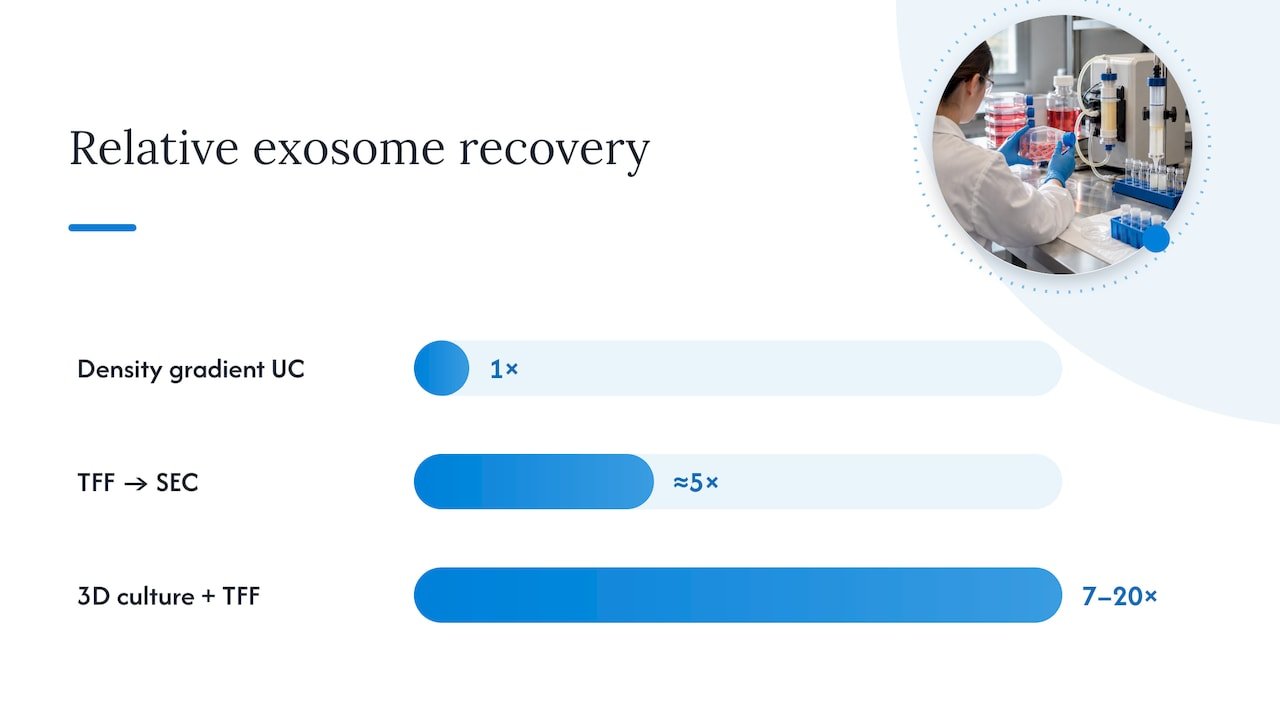
- Add TFF before SEC: This downstream pairing produced about 5 times higher recovery than density gradient ultracentrifugation alone.
- Screen small molecules in parallel: Compounds like norepinephrine and forskolin can boost secretion without a full process redesign, though effects vary by cell type.
- Adapt to serum-free medium early: Required for any clinical-grade target, but it needs a gradual transition to avoid a viability hit that masks real gains.
Research-stage work can tolerate more experimentation with stimulation and genetic tools. Anything headed toward a clinical dose should prioritize the 3D-plus-TFF/SEC combination first, since it scales and reports consistently across studies.
Upstream methods that change how much a cell secretes
Cell source and passage number set the ceiling before any process change matters. Late-passage cells tend toward senescence, which quietly cuts vesicle output even when culture conditions look fine. A quick viability and morphology check before scaling up avoids wasting a bioreactor run on tired cells.
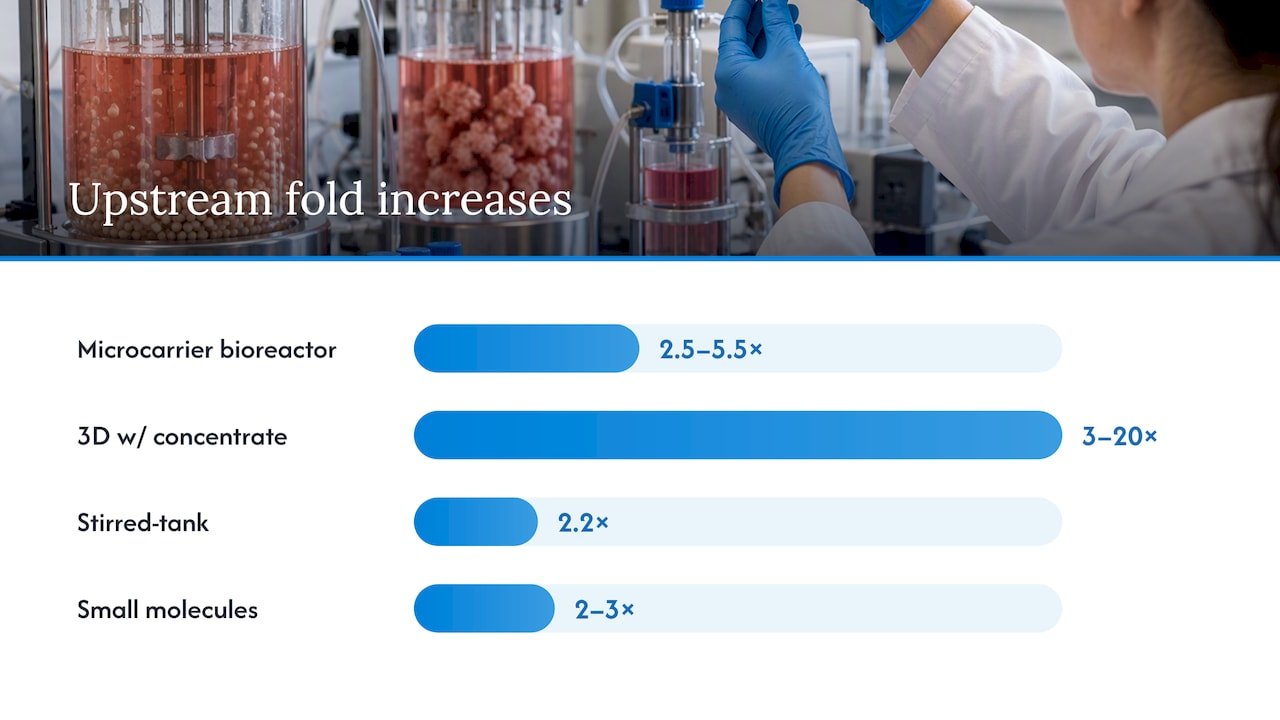
Culture format is the biggest upstream lever available. Vertical-wheel and other microcarrier bioreactor systems increased EV secretion per cell by 2.5 to 5.5 times over standard 2D flasks, with some 3D systems reporting 3 to 20 times higher total output once paired with a concentration step. Hollow-fiber and stirred-tank formats add perfusion, which keeps nutrient and waste gradients from stalling secretion during longer runs. Stirred-tank cultivation alone showed a 2.2-fold yield increase over static conditions.
- Shear matters both ways: Moderate mechanical stimulation upregulates biogenesis genes, but excessive RPM can damage cells and vesicles alike.
- Small molecules add a modest layer: Norepinephrine, forskolin, and hypoxia mimetics have produced roughly 2 to 3 times higher secretion in mesenchymal stromal cells, though effects are cell-type dependent and need a potency check, not just a particle count.
- Genetic overexpression is powerful but translationally heavier: Rab27a, CD9, and HIF-1α overexpression can push biogenesis further, but each modification adds regulatory complexity for any clinical-facing program.
Pro Tip: Track Rab27a/b and CD63 expression alongside particle counts. A yield increase without a matching rise in these biogenesis markers is a sign of debris, not more exosomes.
Choosing a downstream concentration and purification pipeline
Upstream gains mean little if the downstream step throws away vesicles or drags in contaminants. Ultracentrifugation is the most familiar method but pellets aggregate and co-isolates proteins, and its recovery lags behind newer combinations. Density gradient ultracentrifugation improves purity but is slow and hard to scale past small batch sizes.
TFF followed by SEC changes that math. This pairing gave about 5 times higher recovery than density gradient ultracentrifugation, and separate work on microcarrier 3D culture combined with TFF reported 7 to 20 times higher yield over 2D culture along with improved activity in potency assays. TFF’s gentler shear profile compared to pelleting centrifugation likely explains part of that gap.
- Membrane molecular weight cutoff (MWCO): A 300 to 500 kDa cutoff is common for exosome-scale retention while letting smaller proteins pass through.
- Flow rate and transmembrane pressure: Keep both moderate. Aggressive settings introduce the same shear damage a bioreactor can, just at the filtration stage.
- Buffer choice: Isotonic buffers compatible with downstream assays avoid an extra dialysis step later.
- Immunoaffinity capture: Reserve this for high-specificity analytical work, since its cost and throughput limits make it impractical for bulk processing.
- Precipitation kits: Acceptable for quick research-grade screening, but MISEV2023 specifically cautions against relying on them for therapeutic-grade material.
Balancing yield against usable purity
A higher particle count is worthless if it comes bundled with protein aggregates and lipoprotein contamination that swamp the real signal. MISEV2023 frames this directly: report identity, purity, and potency together, and treat particle count as a secondary metric behind biological activity.
Practical acceptance gates worth setting before scaling any protocol:
- Nanoparticle tracking analysis (NTA): confirms particle concentration and size distribution in the expected 30 to 150 nanometer exosome range.
- Positive marker presence: CD9, CD63, CD81, or TSG101 on Western blot confirms exosomal identity.
- Negative marker absence: albumin or apolipoprotein signal flags protein or lipoprotein carryover from serum or precipitation steps.
- Potency readout: a functional assay relevant to the intended application, since bulk activity assays can look unchanged even when cargo composition has shifted.
A fixed-bed bioreactor and serum-free combination reported a 16-fold increase in exosome yield per cell, with a total harvest of 2.6×10^14 particles at roughly 61.5% TFF recovery, illustrating how far upstream and downstream gains can stack when both are optimized together.
When a high-yield run fails these gates, the fix is usually downstream, not upstream: add a polishing SEC step rather than pushing the bioreactor harder.
A step-by-step workflow for testing a yield change
- Define the goal. Exploratory work tolerates looser QC; a clinical-facing target needs serum-free adaptation and full MISEV2023 documentation from day one.
- Select cell line and passage range, confirming viability and morphology before scale-up.
- Choose the culture format, matching microcarrier or hollow-fiber bioreactor scale to the target volume, and set a harvest cadence rather than a single endpoint collection.
- Run TFF at a controlled flow rate, then polish with SEC using a buffer compatible with downstream assays.
- Apply the QC gates: NTA particle count and size, marker Western blots, negative marker screening, and a potency readout.
- Document everything: passage number, culture duration, TFF/SEC parameters, and all QC results for reproducibility.
Resources that shorten the path from method to validated material
Mayflower Bioscience carries isolation kits built for TFF and SEC-style workflows, detection reagents for marker confirmation, and an NTA size profiling service for particle characterization. Purified exosomes are also available as reference material for benchmarking a new protocol against known-good product.
What actually moves the needle first
If resources are limited, test the 3D or bioreactor culture switch before touching downstream purification. Upstream gains compound through every later step, while a purification upgrade only recovers what the culture already made. Once yield looks solid, put the next dollar into TFF and SEC rather than more upstream tinkering, since recovery losses there are often larger than anything left on the table in the bioreactor. The field would benefit from more labs reporting full MISEV-aligned QC alongside fold-change numbers instead of particle counts alone.
— Alina
Turning higher yield into validated, usable exosomes
Running these experiments in-house takes more than a protocol. It takes marker-confirmed reagents and characterization data you can trust when a reviewer asks how you know your yield increase is real exosomes and not debris.

Mayflower Bioscience’s exosome isolation and detection product lines map directly to the TFF, SEC, and marker-confirmation steps described above, and the NTA size profiling service handles the particle-sizing step without requiring in-house instrumentation. For imaging-based QC such as TEM sample checks, Wevision’s microscope range is worth a look. Contact Mayflower Bioscience’s technical support team to match a kit or service to your current protocol, or browse the full product catalog to compare options directly.
This article is general information, not a substitute for advice from a qualified doctor. Consult a qualified healthcare professional about your own circumstances before acting on anything here.
Sources
- PubMed record (2023) — TFF and bioreactor data
- MISEV2023 — Minimal information for studies of extracellular vesicles
- Upscaling human mesenchymal stromal cell production in a vertical-wheel bioreactor (PMC10087597)
FAQ
Are exosomes actually effective for therapeutic use?
Effectiveness depends heavily on the application and how the exosomes were characterized, not just how many particles were produced. MISEV2023 recommends pairing any effectiveness claim with identity and potency assays rather than particle count alone.
How often should exosome doses be administered?
Dosing frequency is set by the specific clinical protocol and target condition, and there is no single interval that applies across applications. Reported clinical trial doses have ranged from roughly 0.5×10^11 to 1.4×10^11 exosomes per patient per administration, which shows the scale involved rather than a fixed schedule.
Can exosomes cause or contribute to cancer?
This depends on the exosome source and application context, and it is not something a general answer can resolve safely. Any question about oncogenic risk for a specific product or use case should go to a qualified researcher or clinician reviewing that exact material and protocol.
Can exosomes help with hair loss?
Some early research has explored exosome applications in hair-related contexts, but the sources reviewed here focus on production and characterization methods, not clinical hair loss outcomes. Readers looking for that specific claim should check a dedicated clinical study rather than infer it from yield-optimization literature.
What yield increase is realistic when combining upstream and downstream improvements?
Combining a 3D or bioreactor culture with a TFF-to-SEC downstream pipeline has produced reported increases from roughly 2.5 to 5.5 times per cell upstream and up to 20 times total output in some 3D-plus-TFF studies. The exact number depends heavily on cell type, culture format, and how purification is run, so any protocol change should be validated against MISEV2023-aligned QC before the gain is treated as real.




