

Six Viral Vector Enhancers: Why Cell Health Beats Peak Transduction
For sensitive or translation-aware work, protamine sulfate, Vectofusin-1, retronectin, and LentiBOOST-protamine combinations offer the best balance of transduction efficiency and cell health. Polybrene remains effective but shows dose-dependent toxicity in primary cells, so we recommend limiting it to non-sensitive, proof-of-concept cultures with strict concentration caps. Whatever you choose, run a titration and viability check before committing to a protocol.
TL;DR:
- Polybrene can impair proliferation and differentiation in mesenchymal stem cells and harm T cells at commonly used 1 to 8 micrograms per milliliter.
- Protamine sulfate has been tolerated at 50 to 100 micrograms per milliliter without severe viability effects, but titrate because acceptable doses vary by cell type.
- For CAR T manufacturing, retronectin paired with spinoculation offers a lower toxicity route to strong T cell transduction, though it requires a coating step.
- A 6 hour exposure often preserves most gains from 24 hours while reducing long term proliferation deficits; validate the trade off for each cell type.
- LentiBOOST and protamine can match or exceed polybrene’s transduction efficiency with lower toxicity, but monitor vector copy number against clinical thresholds.
Table of Contents
- Overview of Enhancer Classes and What Drives Their Safety Profile
- Dose, Toxicity, and the Studies Behind Safer Alternatives
- A Lab-Ready Checklist for Safer Enhancer Use
- Matching the Enhancer to Your Cell Type and Downstream Goal
- Why We Prioritize Cell Health Over Headline Transduction Numbers
- Sourcing Safer Enhancers and Protocol Support From Mayflower Bioscience
- FAQ
- Sources
Overview of Enhancer Classes and What Drives Their Safety Profile
Transduction enhancers work through a handful of distinct mechanisms, and understanding which one applies tells you a lot about expected toxicity. Polybrene (hexadimethrine bromide) and protamine sulfate are both polycations: they neutralize the electrostatic repulsion between the negatively charged viral envelope and the cell membrane, pulling virus into closer contact. Vectofusin-1 is a cationic peptide that self-assembles into nanofibrils, promoting both adhesion and membrane fusion steps of entry. Retronectin is a recombinant fibronectin fragment that works by co-localizing virus and target cells on a coated surface rather than acting as a soluble additive. Spinoculation is a purely physical method, centrifuging virus onto cells to increase contact without added chemistry. LentiBOOST is a poloxamer-based formulation typically paired with a low-dose polycation to boost uptake while limiting toxicity.
These mechanisms translate into different handling requirements and safety trade-offs:
- Polybrene is used in soluble form at low microgram-per-milliliter concentrations but accumulates toxicity with dose and exposure time.
- Protamine sulfate is also soluble and generally tolerated at higher concentrations than polybrene before viability drops.
- Vectofusin-1 is a soluble, ready-to-use additive compatible with automated closed systems.
- Retronectin requires plate or bag coating before cell addition, adding a manufacturing step but avoiding systemic cell exposure to free peptide.
- Spinoculation adds no chemical exposure at all, though it requires centrifugation equipment and standardized protocols.
- LentiBOOST is typically combined with protamine rather than used alone, and is manufactured to GMP-compatible standards.
The practical trade-off across all of these is efficacy versus cell health: soluble polycations are easy to pipette and scale but carry the most direct cytotoxic risk, while coating-based and physical methods add labor but tend to spare the target population.
Dose, Toxicity, and the Studies Behind Safer Alternatives
The numbers matter more than the mechanism when you are deciding what goes into a sensitive culture. Polybrene’s cytotoxicity is well documented: in vitro studies report reduced proliferation and impaired differentiation in mesenchymal stem cells, along with increased cytotoxicity in T cells, at the 1 to 8 microgram-per-milliliter range commonly used for transduction, with effects worsening at higher exposures.
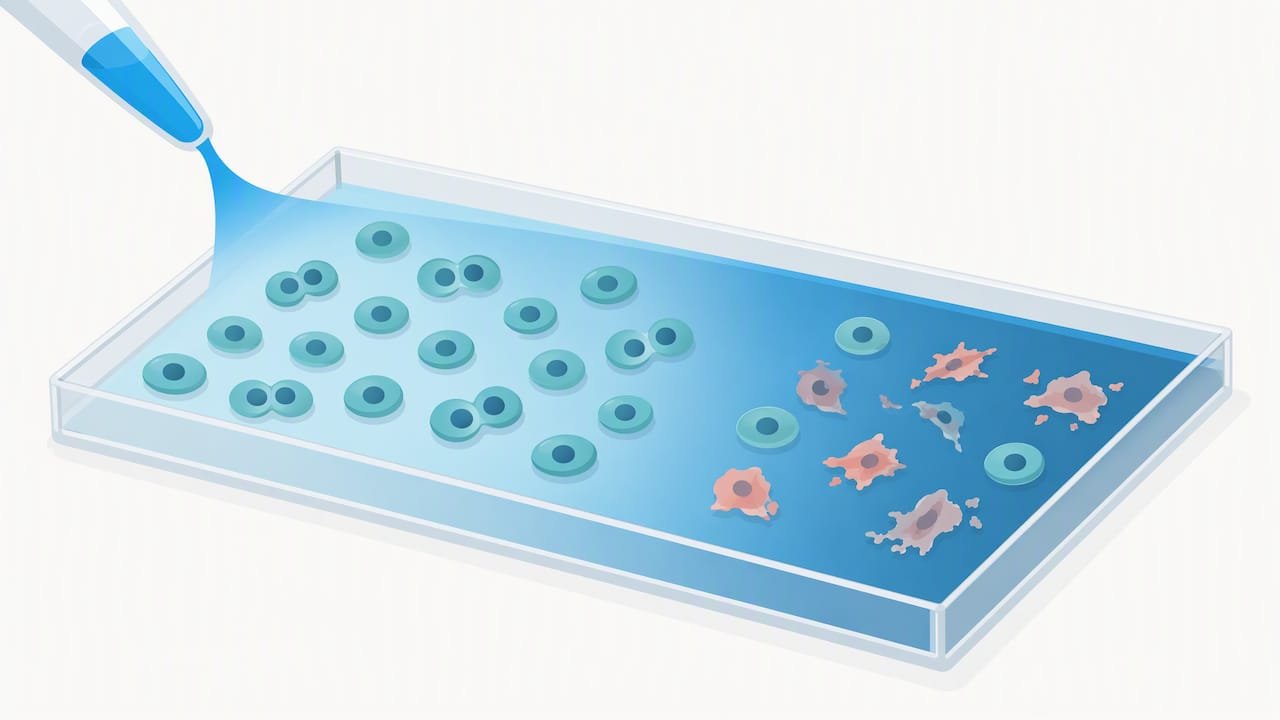
Protamine sulfate has repeatedly shown better tolerability at comparable or higher doses. Research on protamine as a transduction enhancer documents tolerability at concentrations up to 50 to 100 micrograms per milliliter without severe effects on viability, supporting its long-standing use as a lower-toxicity alternative to polybrene.
Peptide and coating-based approaches push the safety margin further:
- Vectofusin-1 studies report strong enhancement of lentiviral transduction in difficult-to-transduce primary cells, including HSCs and certain T cell populations, with no significant impact on viability or expansion, and compatibility with automated, closed-system manufacturing.
- Retronectin combined with spinoculation produces strong T cell transduction with less cytotoxicity than polybrene-based protocols, and comparative work shows improved proliferation and phenotype outcomes relevant to CAR-T manufacturing, despite the added coating step.
- LentiBOOST combined with protamine sulfate can match or exceed polybrene’s transduction efficiency in mesenchymal stem cells while showing negligible toxicity, though the same research flags that enhancer combinations can raise vector copy number per cell, which needs monitoring against recommended clinical thresholds.
None of this means polybrene has no place in a protocol. It remains a reasonable choice for non-sensitive, high-throughput screening where cell expansion and long-term phenotype are not endpoints, as long as dose and exposure time stay controlled.
A Lab-Ready Checklist for Safer Enhancer Use
Turning this evidence into bench practice comes down to titration discipline and consistent monitoring rather than a single magic reagent.
- Titrate before you commit. Run a dose-response series starting below the literature’s lowest reported effective concentration and include an enhancer-free control.
- Check viability and function at multiple timepoints. Six hours and 24 hours catch acute toxicity; 72 hours and 7 to 14 days catch proliferation and phenotype drift that an early snapshot misses.
- Pair viability assays with a functional readout. Flow-based phenotyping, colony-forming assays, or differentiation assays tell you more than a live/dead stain alone.
- Track vector copy number when combining enhancers. LentiBOOST and protamine combinations can increase VCN per cell, so measure it rather than assume efficiency gains are free.
- Match handling to format. Soluble additives like polybrene, protamine, and Vectofusin-1 need precise pipetting and timed washout; coating-based retronectin needs consistent plate or bag preparation before cells go in.
- Document every change. Record lot numbers, concentrations, exposure times, and cell passage for each enhancer switch, especially once a protocol is heading toward a translational or GMP endpoint.
Pro Tip: Shortening enhancer exposure from 24 hours to 6 hours often preserves most of the transduction gain while meaningfully reducing long-term proliferation deficits, but validate the trade-off for your specific cell type before locking it into a protocol.
Matching the Enhancer to Your Cell Type and Downstream Goal
Cell sensitivity should drive the decision more than convenience. As a rough ordering, mesenchymal stem cells tend to show the clearest polycation sensitivity, hematopoietic stem cells sit in the middle, and T cells are often the most tolerant of standard enhancers, though all three benefit from a gentler option when expansion or phenotype matters downstream.
- For CAR-T manufacturing, retronectin with spinoculation remains a strong default given its track record in clinical-style protocols, even with the added coating step.
- For HSCs, Vectofusin-1 or protamine sulfate are reasonable first choices, balancing transduction efficiency with minimal impact on self-renewal capacity.
- For MSCs, avoid polybrene where possible, or restrict it to brief, low-dose exposures if no alternative is available.
- For GMP-bound or automation-dependent workflows, Vectofusin-1 and LentiBOOST are the more compatible options given their closed-system and manufacturability profiles.
- Consider LentiBOOST plus protamine when you need efficiency gains beyond a single soluble additive, but budget for vector copy number monitoring as part of the protocol, not as an afterthought.
The right call depends on what you are optimizing for: if the endpoint is a single transduction percentage, the calculus looks different than if the endpoint is a cell product that needs to retain function for months.
Why We Prioritize Cell Health Over Headline Transduction Numbers
The most common mistake we see in enhancer selection is chasing the highest reported transduction percentage without asking what that number cost the cells. A reagent that boosts uptake by a few points while compromising proliferation or phenotype is a poor trade once you look past the first readout. The practical priority, especially as a protocol moves toward translational relevance, is preserving long-term function, not maximizing a single endpoint. Document every enhancer change along the way: the switch that looked harmless at the bench is often the one a reviewer asks about later.
— Alina
Sourcing Safer Enhancers and Protocol Support From Mayflower Bioscience
We offer reagents suitable for safer transduction protocols, including protamine sulfate and Vectofusin-1, along with lentiviral expression systems designed for primary and sensitive cell work, supported by technical assistance for labs adapting protocols to different cell types or scales.

- Browse our viral transduction and bioprocessing line for enhancer and lentiviral reagent options.
- Check lentiviral expression systems for protocol-specific technical details.
- Reach our technical support team directly through the product catalog to talk through a protocol adaptation before you order.
FAQ
Is polybrene safe to use for all primary cell transduction?
Polybrene works well for many standard cell lines, but it shows dose-dependent cytotoxicity in sensitive primary cells such as MSCs and T cells at commonly used concentrations. For sensitive or translational work, protamine sulfate, Vectofusin-1, or retronectin are generally better tolerated alternatives.
What concentration of protamine sulfate is considered safe?
Published work shows protamine sulfate can be tolerated at concentrations up to 50 to 100 micrograms per milliliter without severe effects on cell viability in many contexts. Exact tolerable doses still vary by cell type, so a small titration is worth running before scaling up.
Does Vectofusin-1 affect T cell viability or expansion?
Studies on Vectofusin-1 report no significant impact on the viability or expansion of T cells during lentiviral transduction, which is part of why it fits automated, closed-system manufacturing. It also performs well in other difficult-to-transduce primary cells, including HSCs.
Can combining LentiBOOST with protamine increase vector copy number risk?
Yes: research on LentiBOOST and protamine combinations shows they can match or exceed polybrene’s transduction efficiency with lower toxicity, but higher enhancer doses in combination can raise vector copy number per cell. Monitoring VCN against established thresholds is a necessary part of using these combinations, not an optional check.
Is retronectin still relevant given newer soluble enhancers?
Retronectin remains relevant, particularly for clinical and automated manufacturing workflows where its coating-based approach supports strong transduction with lower cytotoxicity than polybrene. It requires more preparation than a soluble additive, which is why many labs pair it with spinoculation for CAR-T applications specifically.
Sources
- Polybrene toxicity studies (PubMed entry)
- Protamine sulfate as a transduction enhancer (PubMed entry)
- Vectofusin-1 transduction studies (PubMed entry)
- Spinoculation and retronectin enhance gene transduction in primary T cells (PMC)




