
From Single Cells to 100,000: Low Input ChIP Workflow for Labs
For chromatin work on roughly 10,000 cells, ChIPmentation or HT-ChIPmentation are the most reliable choices for many histone marks, while CUT&Tag or CUT&RUN suit single cells and ultra-low samples when your target antibody performs well in those formats. Results generally improve once you reach 100,000 cells, and ULI-NChIP or optimized native ChIP can still deliver usable histone maps from about 1,000 to 100,000 cells depending on the mark. Every one of these approaches trades something: antibody dependency, added sequencing depth, or a higher duplicate rate as input drops.
TL;DR:
- ChIPmentation and HT-ChIPmentation can generate usable histone modification data from as few as 10,000 cells, with HT-ChIPmentation maintaining higher complexity at around 2,500 cells.
- CUT&Tag and CUT&RUN provide high signal-to-noise ratios at very low inputs, working effectively from 2 million reads for histone marks and suitable for single-cell or rare sample profiling.
- Low-input work benefits from methods that reduce purification steps, with careful antibody validation and pilot sequencing essential to prevent material loss and optimize data quality.
Table of Contents
- Why low input chip work is hard and how modern methods fix it
- ChIPmentation and HT-ChIPmentation for tagmentation-based low input work
- CUT&Tag and CUT&RUN for single cells and ultra-low samples
- ULI-NChIP and native MNase methods for histone-focused low input work
- A practical checklist for antibody, sample, and quality control decisions
- How Mayflowerbio supports low input chip workflows
- Deciding when to optimize in-house versus when to pivot
- Get antibodies and technical support for your low input project
- Key protocol papers and guidelines worth reading in full
- Sources
- FAQ
Why low input chip work is hard and how modern methods fix it
Standard chromatin immunoprecipitation was built for millions of cells, and most of its material loss happens in three places: crosslinking and shearing chromatin, the immunoprecipitation itself, and the repeated cleanup steps between IP and library prep. Each purification column or bead wash recovers less DNA than it started with, and by the time a low-input sample reaches sequencing, there may not be enough unique fragments left to call peaks reliably.
The conceptual fix behind every method covered here is the same: touch the sample less. On-bead tagmentation, for instance, skips the traditional ligation-based library prep and its associated cleanups by fragmenting and tagging DNA while it is still bound to the antibody-coated beads. Enzyme-tethering methods go further, generating sequencing-ready fragments only at the sites where the antibody has actually bound, which lowers background noise and cuts the amount of nonspecific DNA that needs to be filtered out downstream.
These design choices ripple into everything else you plan for the experiment:
- Fewer purification steps mean less DNA lost between chromatin prep and finished library.
- Lower background from targeted tagging reduces the sequencing depth needed to see a clean signal.
- Methods that generate adapters in situ shorten the workflow, which matters when a sample cannot be split or repeated.
- The method you pick determines whether your bottleneck is antibody performance, PCR duplication, or raw input mass.
None of this eliminates the core challenge of low-input work. It just moves where you have to be careful. Choosing a method means choosing which failure mode you are willing to manage: an antibody that will not perform at low mass, a library that duplicates itself into uselessness, or a sample that never survives handling to begin with. The sections below break down each family of methods against that lens.
ChIPmentation and HT-ChIPmentation for tagmentation-based low input work
ChIPmentation replaces standard library prep with tagmentation performed directly on bead-bound chromatin. A hyperactive transposase inserts sequencing adapters straight into the immunoprecipitated DNA while it sits on the beads, which removes the need for end repair, adapter ligation, and the DNA purification steps that usually follow immunoprecipitation. The method was described as accurate and robust enough to generate usable histone-mark libraries from as few as 10,000 cells, with performance holding across a fairly wide range of transposase concentrations.
Statistic: ChIPmentation has been shown to produce successful sequencing libraries from 10,000 cells for several histone marks, a fraction of the input that classic ChIP-seq protocols require. That figure matters most for histone marks, which are abundant and broadly distributed across chromatin, and less for transcription factors, which bind fewer sites and are harder to capture at low mass.
HT-ChIPmentation extends the same principle by removing DNA purification prior to library amplification entirely. That change preserves library complexity at inputs where standard ChIPmentation starts to lose ground, with reports of maintained unique read fractions above 75% down to roughly 2,500 cell equivalents for some histone marks. The elimination of a purification step also shortens the protocol enough to fit into a single day, which matters when a clinical or field sample cannot wait for a multi-day workflow.
Both methods share the same strengths and the same failure points:
- Fewer purification steps cut the material loss that kills most low-input experiments before sequencing even starts.
- Speed and cost improve because tagmentation-based library prep needs fewer reagents and less bench time than ligation-based prep.
- Transcription factor targets often still need more starting material. Low-abundance TFs can require over 100,000 cells even with a tagmentation workflow.
- Duplicate rates rise as input falls, so pilot sequencing before committing a full run is worth the extra week.
- Antibody quality remains decisive. No amount of protocol optimization compensates for an antibody that does not enrich cleanly at low mass.
In practice, labs adopting either protocol should minimize the number of tube transfers between crosslinking and tagmentation, titrate transposase concentration against a known-good chromatin prep before touching precious samples, and always run an input control alongside the tagmented IP sample so background can be subtracted cleanly during analysis.
CUT&Tag and CUT&RUN for single cells and ultra-low samples
CUT&Tag and CUT&RUN work by tethering an enzyme, a transposase for CUT&Tag or a nuclease for CUT&RUN, directly to the antibody bound at a chromatin site. Instead of immunoprecipitating chromatin fragments after the fact, the enzyme is activated in situ and cuts or tags DNA only where the antibody has already attached. That single change removes most of the nonspecific background that plagues traditional ChIP, because DNA that was never bound by the antibody is never released into the reaction.
The practical payoff shows up in sequencing depth. Because the signal-to-noise ratio starts out higher, CUT&Tag experiments have shown clear, reproducible signal from as few as 2 to 8 million mapped reads for many histone marks, a fraction of the 20 million or more reads standard ChIP-seq often needs to reach comparable resolution.
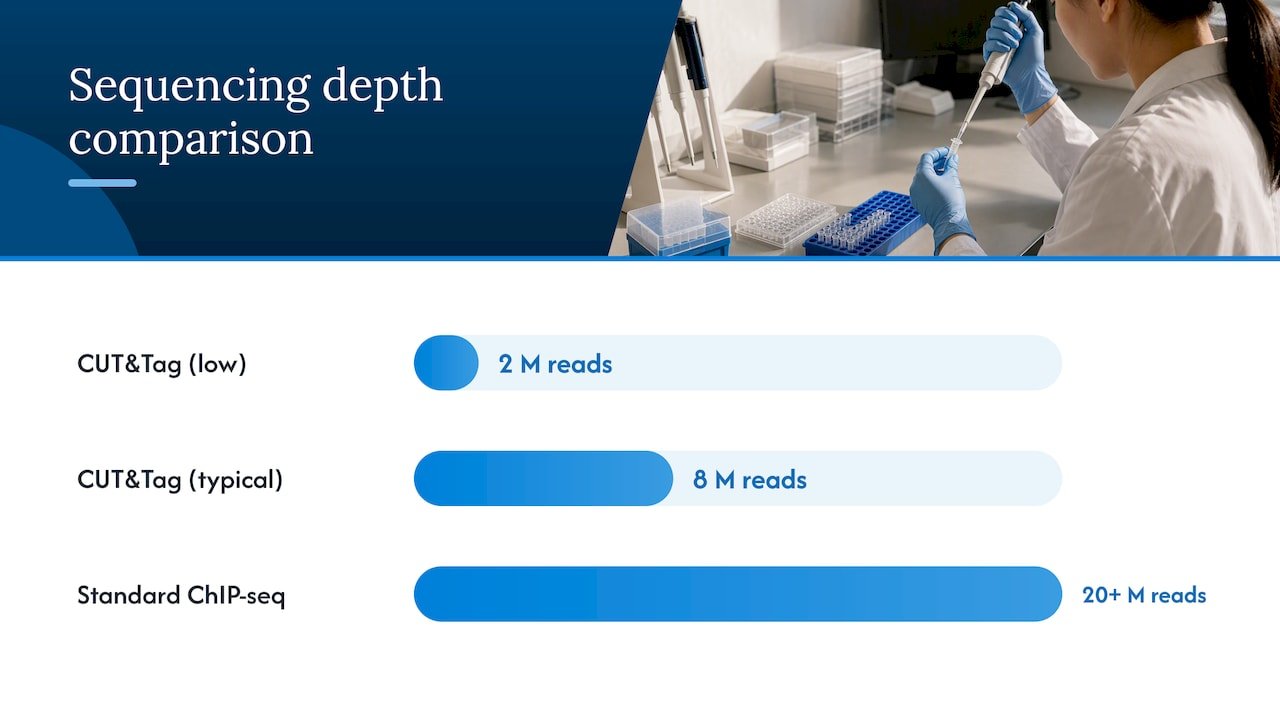
Statistic: Enzyme-tethering methods like CUT&Tag have demonstrated strong signal with 2 to 8 million mapped reads, where equivalent ChIP-seq experiments have required substantially deeper sequencing to resolve the same marks. That gap translates directly into lower sequencing costs per sample, which matters when you are running many small biopsies rather than one large pooled sample.
Where these methods fit best:
- Single-cell or near-single-cell chromatin profiling, where there is no realistic path to a traditional ChIP protocol.
- Tiny biopsies or rare cell populations isolated by flow sorting or microdissection.
- Low-abundance tissues where repeated sampling is not an option.
- Targets with well-validated antibodies known to perform in native, non-crosslinked conditions, since CUT&Tag and CUT&RUN are typically run on live or lightly fixed nuclei rather than heavily crosslinked chromatin.
Before committing a full sequencing run, plan a pilot at low depth, somewhere in the low millions of reads, and check fragment size distribution and duplicate rate before scaling up. Multiplexing several small samples on one sequencing lane is a reasonable way to stretch a limited budget, provided each sample carries a distinct index and you have enough reads per sample to call peaks with confidence. Antibody compatibility is the real gatekeeper here: an antibody that works beautifully in a crosslinked ChIP context does not always tether an enzyme efficiently in the native conditions these methods require.
ULI-NChIP and native MNase methods for histone-focused low input work
ULI-NChIP, short for ultra-low-input native chromatin immunoprecipitation, digests chromatin with micrococcal nuclease rather than shearing it by sonication, then carries out immunoprecipitation under native, non-crosslinked conditions. The gentler digestion and the absence of crosslinking chemistry preserve chromatin structure in a way that some antibodies, particularly those raised against histone modifications, recognize more efficiently than they would in a crosslinked or tagmentation-based context.
Reported performance for ULI-NChIP spans a wide range depending on the target and sample type, with high-quality histone maps produced from inputs as low as 1,000 cells up to 1,000,000 cells in different published applications. That range is wider than what tagmentation-based methods typically claim, but it comes with a caveat: results depend heavily on how carefully the nuclei are isolated and how precisely the MNase digestion is titrated for that particular sample type.
Key points to weigh before choosing a native approach:
- ULI-NChIP performs well for many histone marks but is generally less suitable for transcription factors, which often need the stronger crosslinking that native protocols deliberately avoid.
- Digestion conditions need per-sample optimization. Over-digestion fragments chromatin too finely, while under-digestion leaves fragments too large for clean sequencing library prep.
- Nuclei handling matters more here than in crosslinked protocols, since native chromatin is more fragile and more prone to degradation during extended processing.
- Native ChIP is often the better default when the mark of interest has a well-characterized, high-affinity antibody that has already been validated in non-crosslinked conditions.
Choose ULI-NChIP or an optimized native protocol when your target is a histone modification, your antibody has a track record in native conditions, and your sample falls somewhere in the low thousands to low hundreds of thousands of cells. Reach for a tagmentation or enzyme-tethering method instead when the antibody’s native performance is unproven, or when the sample is smaller than a few thousand cells and speed matters more than flexibility.
A practical checklist for antibody, sample, and quality control decisions
Getting usable data from a small sample comes down to a handful of decisions made early, not fixed later. Work through these in roughly this order:
- Validate the antibody for your input range, not just for the target. Peptide array testing, a dilution titration against a known-positive control, and spike-in controls all reveal whether an antibody that works at 1 million cells will still work at 10,000.
- Minimize tube transfers below 10,000 cells. Every transfer between tubes costs material. Carrier chromatin or fully on-bead processing from lysis through library prep reduces losses that add up fast at this scale.
- Manage PCR cycles carefully. Over-amplification manufactures duplicate reads that look like signal but are not. Using unique molecular identifiers lets you distinguish true duplicates from PCR artifacts during analysis.
- Track library complexity metrics before committing to deep sequencing. A quick, shallow pilot run tells you whether a sample is worth sequencing at full depth or needs to be reprocessed.
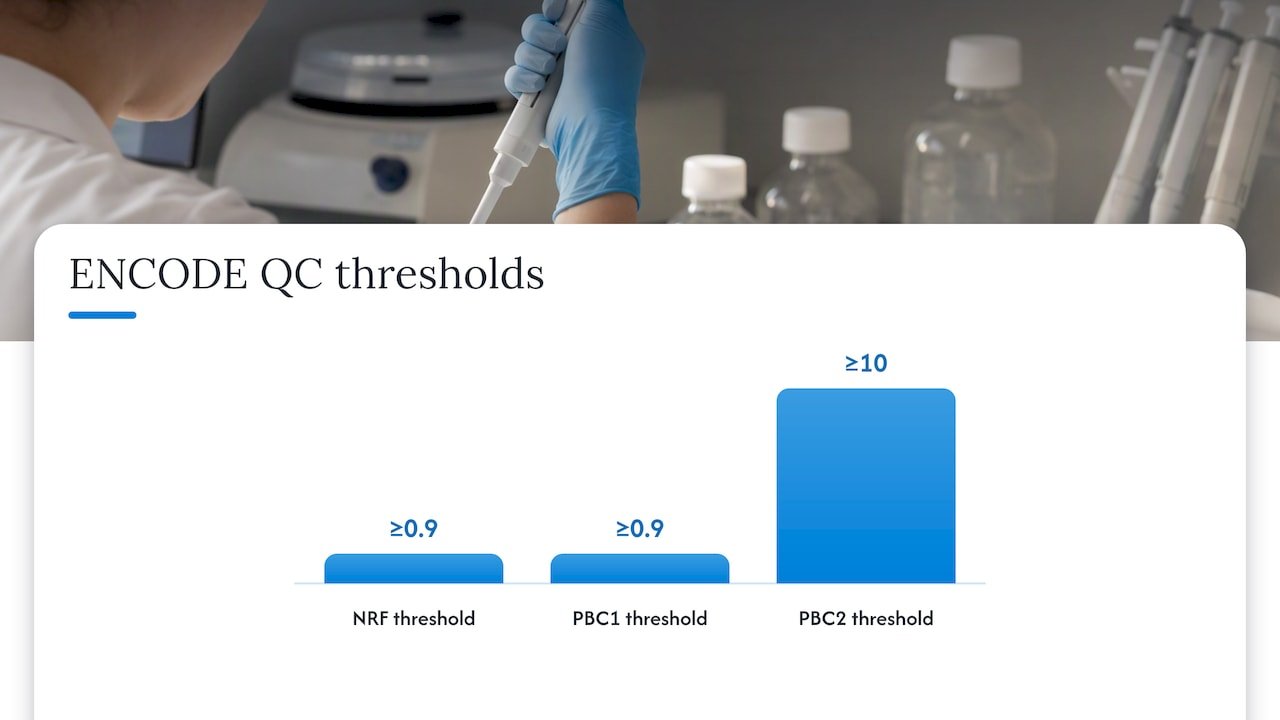
- Record ENCODE quality metrics for every run. Non-Redundant Fraction above 0.9, PCR bottlenecking coefficient 1 above 0.9, and PBC2 above 10 are the thresholds that separate a usable library from one that needs to be redone. FRiP and IDR remain the standard checks for enrichment quality and reproducibility across replicates.
When a metric fails, the fix usually points back to an earlier step rather than the sequencing itself. Low NRF or a failing PBC score generally means the library was over-amplified or the input was too low for the number of PCR cycles run. Low FRiP often traces back to antibody performance rather than the sequencing depth chosen. Duplicate and unmapped read rates climb as input falls, so budgeting for a pilot sequencing run before a full-depth run is rarely wasted effort.
Pro Tip: Run a shallow pilot sequencing lane on every new low-input sample type before committing to full depth. It costs a fraction of a full run and tells you whether the problem is the antibody, the input mass, or the library prep, before you have spent your entire sample finding out the hard way.
How Mayflowerbio supports low input chip workflows
Laboratory suppliers provide antibodies, reagents, and consumables that support chromatin profiling workflows, including antibody products relevant to histone marks and transcription factor targets used across the ChIPmentation, HT-ChIPmentation, CUT&Tag, and ULI-NChIP methods described above. Accurate input quantification matters as much as the immunoprecipitation itself, and Mayflowerbio’s cell counting products help confirm cell numbers before a precious sample goes into any low-input protocol.
For labs working with rare or limited material more broadly, extraction methods built around sample-limited inputs, such as those used in exosome isolation workflows, follow the same logic that governs low-input chromatin work: fewer transfers, tighter quality control, and validated reagents at every step.
Researchers who need lot-specific antibody validation data, a datasheet for a specific catalog number, or a technical consultation on matching an antibody to a low-input protocol can reach Mayflowerbio’s team directly through the antibody product pages or the site’s contact form. Requesting that data before starting a low-input run is a reasonable step for any lab working with a sample that cannot be repeated.
Deciding when to optimize in-house versus when to pivot
Optimizing a low-input protocol in-house makes sense when you have more than one sample of the same type coming, because the time spent titrating antibody concentration or MNase digestion pays off across repeated runs. It makes far less sense for a single irreplaceable biopsy, where a failed optimization run means the sample is gone.
The real cost comparison is rarely reagents versus reagents. It is reagent and optimization time against sequencing cost, and sequencing is usually the smaller number. A week spent re-optimizing tagmentation concentration on a sample you cannot replace is a worse trade than paying for deeper sequencing on a first attempt and using the data to decide whether a second round is worth it.
Watch for the signals that say it is time to change approach rather than keep tuning: consistently low FRiP scores across repeated attempts with a validated antibody, or duplication rates that stay high no matter how much you reduce PCR cycles. Both usually mean the input mass or the method, not the technique, is the limiting factor.
— Alina
Get antibodies and technical support for your low input project
If you are planning a low-input chromatin experiment, sourcing a well-validated antibody matters more than almost any other decision you will make. Mayflowerbio’s antibody catalog covers targets used across histone-mark and transcription-factor profiling, and the team can provide lot-specific validation data on request for researchers planning to run ChIPmentation, CUT&Tag, or native ChIP protocols on limited material.

For labs also running cell biology work alongside chromatin profiling, the cell biology product line covers counting, separation, and karyotyping needs from the same source. Reach out through the antibody and reagent catalog to request datasheets or speak with the technical team before your next low-input run.
Key protocol papers and guidelines worth reading in full
The recommendations above are drawn from a small set of protocol papers and guideline pages worth reading directly if you are designing a new low-input experiment. The ChIPmentation paper covers the original tagmentation-on-bead method and its input limits. The HT-ChIPmentation paper details the purification-free variant and its complexity gains at very low input. The CUT&Tag paper explains the enzyme-tethering mechanism and its sequencing depth advantages. The ULI-NChIP paper lays out the native MNase-based protocol for rare cell populations. The low cell number ChIP-seq review quantifies how sensitivity and duplicate rates change as input drops. Finally, the ENCODE quality metrics page defines the NRF, PBC, and related thresholds referenced throughout this guide, and is worth bookmarking for any lab running chromatin sequencing regularly.
Sources
- ChIPmentation: fast, robust, low-input ChIP-seq for histones and transcription factors
- ENCODE quality metrics
FAQ
What is low input bulk RNA sequencing?
Low input bulk RNA sequencing refers to RNA-seq protocols optimized to generate transcriptome data from small numbers of cells, typically using modified library prep chemistries that reduce material loss during purification. It addresses a parallel challenge to low-input ChIP but profiles gene expression rather than protein-DNA binding, and the two are often run on split portions of the same rare sample.
What is ChIP-qPCR and how is it used?
ChIP-qPCR combines chromatin immunoprecipitation with quantitative PCR to measure enrichment of a specific DNA region after IP, rather than sequencing the entire genome. It is commonly used to validate antibody performance or confirm binding at a known site before committing a low-input sample to a full ChIP-seq or CUT&Tag experiment.
Can ChIP-seq detect DNA methylation?
Standard ChIP-seq does not directly detect DNA methylation, since it profiles protein binding and histone modifications rather than cytosine methylation status. Methylation is typically assessed with dedicated methods such as bisulfite sequencing, though some labs combine ChIP with methylation-specific techniques to study the relationship between the two marks.
What are the disadvantages of ChIP-seq?
Standard ChIP-seq requires 1 to 20 million cells for reliable results, which makes it impractical for many rare cell populations or small biopsies. It also involves multiple purification steps that cause material loss, and low-input runs tend to show higher duplicate and unmapped read rates, which reduce the usable data from an already limited sample.
How many cells do I need for CUT&Tag versus ChIPmentation?
CUT&Tag is typically used down to single cells or very small populations, while ChIPmentation has demonstrated reliable results from around 10,000 cells for many histone marks. The right choice depends as much on antibody compatibility with each method’s chemistry as on raw cell number.




