Bioinformatics Companies for Research Labs: A Validation-First Guide
For U.S. biomedical labs buying reagents, antibodies, and assay kits, Mayflowerbio is the recommended first call. The reason is specific: lot-level COAs, application-specific validation data on request, trial and sample sizes before bulk commitment, and procurement paperwork suited to institutional purchasing offices. Contact Mayflowerbio directly to request a lot-linked COA, a trial kit, and a procurement-ready quote.
Ask these three things before any purchase:
- Does this lot have a COA with specific performance data for your application (WB, IF, IP, or ELISA)?
- Is an RRID assigned, and can you get knockout-control images for this antibody?
- What is the trial or sample program, and what documentation comes with it?
Key Takeaways
Validation evidence and lot traceability are the two criteria that determine whether a reagent vendor is worth the risk, and Mayflowerbio supplies both with institutional procurement support included.
| Point | Details |
|---|---|
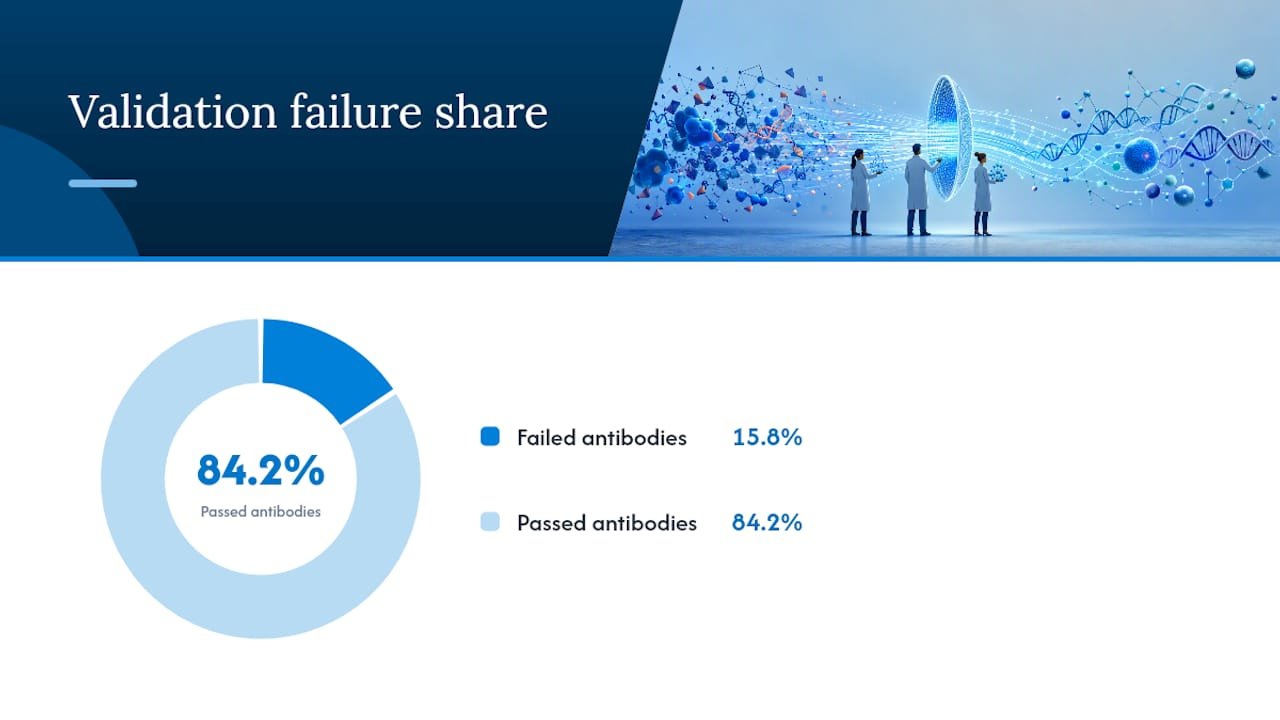
| Validation failure rate | 15.8% of 614 characterized antibodies failed across tested applications; only 15.8% of linked publications showed validation evidence. |
| Require RRID and lot number | Capture both in every purchase order to create an audit trail that supports reproducibility and regulatory review. |
| Use third-party resources | Check YCharOS for KO-based reports and CPTAC for proteomics antibodies before finalizing any vendor selection. |
| Guided buying reduces risk | Pre-negotiated vendor contracts with automated routing eliminate rogue spend without slowing lab access. |
| Mayflowerbio | Supplies lot-level COAs, trial kits, and procurement-ready quotes for U.S. institutional buyers across antibodies, assays, and PCR reagents. |
Table of Contents
- What do bioinformatics companies in the reagent space actually sell?
- How to vet a reagent vendor before you commit
- Why poor antibody validation costs more than you think
- How institutions reduce rogue spend without slowing scientists down
- Which third-party resources should you check before buying?
- How Mayflowerbio meets the vendor checklist
- The one procurement habit that changes outcomes
- Mayflowerbio: trial kits, custom assays, and procurement quotes
- Sources
- FAQ
What do bioinformatics companies in the reagent space actually sell?
The phrase “bioinformatics companies” covers a wide range of suppliers in the research market. For biomedical labs, the relevant category is reagent and assay vendors: companies selling antibodies, assay kits, PCR reagents, growth factors, and cell biology tools. Mayflowerbio operates squarely in this space, sourcing globally and supporting U.S. labs with validated products and technical consulting.
The core service these firms provide goes beyond catalog listings. The best ones supply lot traceability records, application-specific validation data, and procurement support that fits how institutional labs actually buy. That combination is what separates a low-risk vendor from one that costs you three months of revalidation.
How to vet a reagent vendor before you commit
Validation evidence and lot-to-lot consistency are the two non-negotiable criteria. Everything else, including price, catalog breadth, and delivery speed, matters only after those boxes are checked. Total cost of ownership is the right frame: factor in internal QC burden, revalidation costs when a lot fails, failed-experiment waste, and administrative overhead, not just the unit price on the quote.
Checklist: verify these before placing an order
- Lot-level COA with application-specific performance data (not just purity)
- Lot-to-lot consistency records across at least two or three production runs
- Written change-notification procedures (formulation, manufacturing site, or supplier changes)
- Sample or trial availability before bulk purchase
- Documented application-specific validation: KO controls, WB, IF, IP, ELISA panels
- RRID assigned and searchable in the SciCrunch registry
- Confirmation you are buying from the original manufacturer, not a reseller
- SDS available for all hazardous components
- Cold-chain and delivery reliability data for temperature-sensitive products
Catalog-number fragmentation is a real procurement risk. Many antibodies are resold under different catalog numbers by distributors, making it hard to trace the original characterization data. Buying from the original source improves access to primary validation records and vendor responsiveness when something goes wrong.
On your first vendor call, ask in this order:
- Can you provide lot-linked knockout images for this antibody in my application?
- What is your change-notification policy if the manufacturing process or supplier changes?
- What trial or sample size is available, and what documentation comes with it?
- What is the lead time for a procurement-ready quote with COA and SDS attached?
Pro Tip: Request the actual KO cell line images used for validation, not just a statement that KO testing was performed. A vendor who cannot produce the images likely does not have them.
Custom kits add another layer of complexity. Manufacturing complexity, QC scope, and lead times all vary significantly across vendors. Ask about payment models upfront: outcome-based or staged payments are available from some suppliers and reduce financial exposure when timelines slip.
Why poor antibody validation costs more than you think
A systematic analysis of 614 commercially characterized antibodies found that 97 of them (15.8%) failed across tested applications. The conservative extrapolation: millions of biological samples, including irreplaceable human tissue, consumed using reagents that would not pass independent testing.
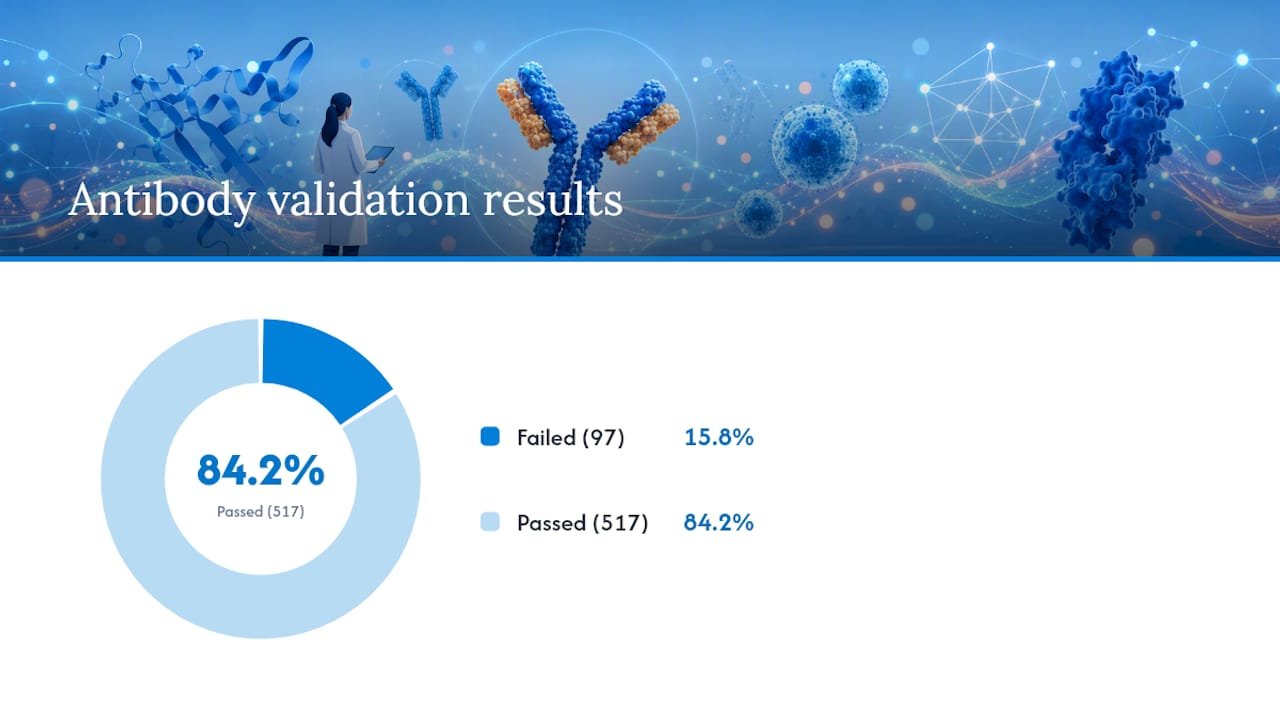
That number should change how procurement frames the conversation with PIs. A cheaper antibody that fails after six months of experiments is not a bargain.
Application specificity matters more than most labs acknowledge:
- WB performance does not predict IF performance for the same antibody
- IP-grade validation requires different controls than ELISA optimization
- KO cell line controls are the most reliable way to confirm target specificity
- RRID assignment enables cross-lab traceability and literature comparison
The RUO market model favors broad catalogs and low unit cost over expensive, application-specific validation. That structural incentive is why independent third-party characterization programs exist and why labs should not rely on vendor-supplied data alone.
When a reagent lacks application-specific KO data, the practical response is to request it explicitly before ordering, run your own KO control in the first experiment, and document the result in your lab notebook with the lot number attached.
How institutions reduce rogue spend without slowing scientists down
Guided buying is the model that works: route purchase requests through pre-negotiated vendor contracts automatically, so scientists get fast access and procurement gets the audit trail it needs. The alternative, open purchasing with after-the-fact reconciliation, creates both rogue spend and reproducibility gaps when lot numbers go unrecorded.
Practical procurement steps:
- Establish preferred-vendor contracts with SLAs covering delivery time, COA provision, and change notification
- Require RRID and lot number capture in every purchase order for biological reagents
- Set up sample or trial program terms with preferred vendors before bulk orders are approved
- Automate routing so requisitions go directly to contracted vendors without manual intervention
- Clarify the boundary between requisition (scientist) and approval (procurement office) in writing
For federal and federally funded institutions, ask vendors about GSA Schedule (FSS) or NASA SEWP contract status. These vehicles speed procurement approval significantly for qualifying purchases and provide a pre-negotiated pricing baseline that satisfies audit requirements.
Institutional procurement workflows typically require COA, SDS, and sometimes IBC, IRB, or IACUC approval before biologics orders are released. Build those document requests into the vendor onboarding checklist, not the order-by-order process.
Pro Tip: Attach the ReviveLab procurement checklist to your preferred-vendor contract template. It captures supplier identity, versioned documentation, lot identifiers, and verification steps in a format that satisfies regulatory and reproducibility audits.
Which third-party resources should you check before buying?
Check these before finalizing any vendor selection. Each one provides a different type of evidence.
- RRID (Research Resource Identifier): A unique, persistent identifier assigned to a reagent. Search the SciCrunch registry to find linked publications and validation data. Adoption is uneven, but an RRID is a minimum traceability signal.
- DSHB (Developmental Studies Hybridoma Bank): A University of Iowa repository of hybridoma cell lines and monoclonal antibodies. Buying directly from DSHB gives you access to primary characterization data and eliminates reseller intermediaries.
- Addgene: A nonprofit plasmid and viral vector repository. For molecular biology reagents, Addgene provides sequence-verified materials with direct access to depositor characterization.
- YCharOS: Produces KO-based characterization reports for commercial antibodies. These are independent, not vendor-supplied, and are the most reliable third-party validation source currently available for antibody selection.
- CPTAC/NCI Antibody Characterization Laboratory (ACL): Characterizes antibodies for cancer proteomics applications. Particularly relevant for labs working in oncology or proteomics workflows.
- CiteAb: Indexes millions of reagents with linked publication citations. Useful for building a candidate shortlist, but citation count is an imperfect proxy for validation quality. Always follow up with characterization data.
Evaluation workflow using these resources:
- Search CiteAb or the vendor catalog to identify candidate reagents
- Locate the RRID in SciCrunch and review linked publications
- Check YCharOS or CPTAC for independent KO-based characterization reports
- Request lot-specific KO images and COA from the vendor
- Verify COA against the lot number on receipt
For peptide and custom reagent sourcing, the B2B sourcing considerations around original-manufacturer verification and documentation standards apply equally to antibodies and assay kits.
How Mayflowerbio meets the vendor checklist
Mayflowerbio supplies lot-level COAs, supports application-specific validation data requests, and offers trial and sample programs before bulk commitment. For institutional buyers, procurement-ready quotes with COA and SDS attached are available on request.
Trust signals Mayflowerbio provides:
- Lot traceability records and lot-linked COAs for antibodies, assays, and kits
- Application-specific validation data requests supported (WB, IF, IP, ELISA)
- RRID linkage where available for catalog antibodies
- Trial and sample kit availability before bulk purchase
- Documented change-notification procedures for critical reagents
- Institutional procurement support: invoicing, COA, SDS, and paperwork for IBC/IRB workflows
- Technical support for method validation and assay optimization
To get started:
- Identify the specific reagent, antibody, or kit you need
- Contact Mayflowerbio to request a lot-level COA and trial kit
- Confirm RRID linkage and application-specific validation data availability
- Request a procurement-ready quote with full documentation
Mayflowerbio’s product lines span antibodies, bioassays, cell biology tools, and infectious disease reagents, covering the core purchasing categories for most U.S. biomedical labs. The bioscience support service adds technical consulting for labs that need method validation guidance beyond the catalog.
The one procurement habit that changes outcomes
The labs that consistently get reproducible data from commercial reagents share one habit: they require RRID and lot number capture in every purchase order, before the order is placed, not after. That single requirement forces vendors to provide traceability documentation upfront and creates an audit trail that survives personnel turnover.
Most procurement failures are not caused by bad vendors. They are caused by labs that accept “validated” on a product page as sufficient evidence. Requiring a lot-linked KO image or an independent YCharOS report takes one email. The downstream cost of skipping that step is measured in months.
Mayflowerbio: trial kits, custom assays, and procurement quotes
Mayflowerbio supplies validated reagents, antibodies, and assay kits to U.S. research labs with lot traceability and institutional procurement support built in. For labs evaluating a new supplier, the fastest path is a trial kit with a lot-level COA attached.
Available immediately: trial and sample kits for antibodies, AimPlex multiplex assays, PCR reagents, and infectious disease panels. Custom assay and kit manufacturing is also available, with staged payment options and documented QC at each production step. Turnaround for a procurement-ready quote is typically within one business day. Contact Mayflowerbio through the website to request a lot-level COA, a trial kit, and a quote formatted for your institution’s purchasing office.
Sources
These resources belong in your procurement memo and vendor-evaluation file.
- What to ask a reagent company before switching critical lab reagents — Atheris Bio
- Antibody validation and reproducibility challenges — PMC (open access review)
- Life sciences procurement trends — Zageno blog
FAQ
What should I ask a reagent vendor before placing a bulk order?
Request a lot-level COA with application-specific performance data, knockout-control images for antibodies, written change-notification procedures, and confirmation of RRID assignment. These four items cover the core traceability and validation requirements.
What is an RRID and why does it matter for procurement?
An RRID (Research Resource Identifier) is a unique, persistent identifier assigned to a research reagent and searchable in the SciCrunch registry. It links a specific product to published validation data and enables cross-lab reproducibility tracking.
How does guided buying help institutional labs?
Guided buying routes purchase requests automatically through pre-negotiated vendor contracts, giving scientists fast access while giving procurement offices the audit trail and COA documentation they need for compliance.
Does Mayflowerbio offer trial kits before bulk purchase?
Yes. Mayflowerbio offers trial and sample kits for antibodies, multiplex assays, PCR reagents, and infectious disease panels, with lot-level COAs and SDS included. Contact the team through the website to request a trial kit and a procurement-ready quote.
What is the difference between YCharOS and CPTAC for antibody validation?
YCharOS produces independent KO-based characterization reports for commercial antibodies across multiple applications. CPTAC’s NCI Antibody Characterization Laboratory focuses specifically on antibodies used in cancer proteomics workflows. Use both when they overlap with your research area.