San Diego Biotech: Guide for Researchers, Investors, and Job Seekers
San Diego is one of the United States’ most productive biotech hubs, anchored by UC San Diego, Scripps Research, the Salk Institute, and a dense network of translational companies that spans genomics, cell and gene therapy, diagnostics, and biologics. According to Biocom’s 2026 Life Science Economic Impact Report, the region directly employed 61,866 life science workers and generated $55.2 billion in economic output in 2025. Whether you are scouting employers, evaluating investment targets, or planning a lab relocation, the shortlist and analysis below cover every major player and the structural forces that keep them here.
Top entities to know:
- Illumina — global leader in genomic sequencing platforms, with R&D and manufacturing in San Diego
- Neurocrine Biosciences — clinical-stage neurology and endocrine therapeutics with marketed products
- Dexcom — continuous glucose monitoring devices, major local engineering employer
- Halozyme — drug delivery technology (ENHANZE) licensed across multiple large pharma partners
- UC San Diego / Scripps Research / Salk Institute / Sanford Burnham Prebys — the academic core that feeds spinouts and talent
- Element Biosciences — fast-growing next-generation sequencing startup with recent capital raises
- Poseida Therapeutics — cell and gene therapy with CAR-T and non-viral gene editing programs
This guide covers the company comparison, ecosystem history, funding metrics, hiring channels, due diligence frameworks, and practical setup costs for every audience listed above.
Key Takeaways
San Diego’s biotech sector is one of the most productive life science clusters in the United States, with 61,866 direct employees and $55.2 billion in economic output in 2025, but the 2026 funding environment demands more capital discipline from founders and more diligence from investors.
| Point | Details |
|---|---|
| Economic scale | San Diego generated $55.2B in life science economic output and employed 61,866 workers in 2025. |
| Funding pressure | Q2 2026 VC totals hit $804M, one of the decade’s lowest quarters; early-stage programs face tighter refinancing conditions. |
| Real estate opportunity | Vacancy reached a high level in Q1 2026 and asking rents fell, creating a genuine tenant’s market for lab space. |
| Job seekers | Use BIOCOM’s job board, company career pages, and CONNECT networking events; process development and regulatory roles are in highest demand. |
| Mayflowerbio | Supplies San Diego labs with antibodies, bioassays, and molecular biology reagents; contact for sourcing support and IND-stage assay validation. |
Table of Contents
- What biotech companies are based in San Diego?
- Why does San Diego have so many biotech companies?
- Where do San Diego biotech labs and companies cluster?
- What does the San Diego biotech funding environment look like?
- How do researchers and job seekers find work in San Diego biotech?
- How should investors and partners evaluate San Diego biotechs?
- What does setting up or expanding a lab in San Diego actually cost?
- What the San Diego biotech cluster actually feels like from the inside
- Mayflowerbio supports San Diego labs with research-grade reagents and assays
- Sources
- FAQ
What biotech companies are based in San Diego?
San Diego’s life sciences sector spans large-cap public companies, mid-size clinical-stage biotechs, and a steady stream of well-funded startups. The table below covers the region’s most notable players across subsectors. Large employers like Illumina, Thermo Fisher Scientific, Maravai LifeSciences, Dexcom, and Exact Sciences combine R&D with manufacturing, creating broad hiring demand across both research and production roles.
Additional companies in the ecosystem:
- TriLink BioTechnologies (part of Maravai LifeSciences): mRNA synthesis reagents and custom oligonucleotides, widely used in mRNA therapeutics manufacturing
- Gossamer Bio, Heron Therapeutics, Capricor Therapeutics: smaller public biotechs with active clinical programs and local hiring in clinical operations and regulatory affairs
- Janux Therapeutics, Erasca, Kura Oncology: oncology-focused mid-stage companies with growing R&D teams in La Jolla and central San Diego
Where to find career pages and investor news: Most public companies maintain dedicated careers portals (search “[Company] careers”). BIOCOM’s job board aggregates postings across the region, and company SEC filings (10-K, 8-K) are the fastest route to investor news and pipeline updates.
Why does San Diego have so many biotech companies?
The short answer: a 50-year compounding effect of federal research dollars, entrepreneurial recycling, and two organizations that made it unusually easy to turn lab discoveries into companies.
The cluster’s origin traces to the late 1960s and 1970s. Linkabit, a defense-communications firm founded in 1968, seeded a generation of San Diego engineers who later moved into life sciences. Hybritech, founded in 1978 by UC San Diego researchers, became the region’s first major biotech success, and its acquisition by Eli Lilly produced a cohort of experienced executives who reinvested locally rather than relocating. That pattern, founders and executives staying in San Diego to start or fund the next company, is what researchers at Global CONNECT and UC San Diego describe as the engine behind the cluster’s self-reinforcing growth.
The academic anchors on Torrey Pines Mesa are the other half of the equation. UC San Diego, Scripps Research, the Salk Institute, and Sanford Burnham Prebys operate within a few miles of each other, enabling the kind of cross-campus collaboration that rarely happens when institutions are spread across a metro area. Faculty spinouts, postdoctoral alumni founding companies, and shared instrumentation cores all flow from that proximity.
- UC San Diego: flagship research university with medical school, engineering, and pharmacy programs; major NIH grant recipient and the region’s largest single source of spinout companies
- Scripps Research: independent research institute focused on chemistry, immunology, and neuroscience; home to multiple Nobel laureates and a deep pipeline of drug discovery programs
- Salk Institute: structural biology, genomics, and cancer biology; known for foundational science that translates into licensing deals and spinouts
- Sanford Burnham Prebys: cancer, neuroscience, and rare disease research with a dedicated drug discovery center and NCI designation
Federal competitive R&D grants to these institutions have been a critical long-term driver of cluster growth, sustaining a critical mass of researchers whose work eventually reaches the private sector. BIOCOM, the regional life science trade association, provides advocacy, workforce programs, and supply chain resources. CONNECT, originally a UCSD program, offers entrepreneur mentoring, investor introductions, and shared services that meaningfully reduce the time from lab to company formation.
Where do San Diego biotech labs and companies cluster?
Geography matters in San Diego biotech. The region’s lab space is concentrated in a handful of submarkets, each with a distinct character.
- La Jolla / Torrey Pines Mesa: the original and still the most prestigious submarket. UC San Diego, Scripps Research, Salk, and Sanford Burnham Prebys anchor the north end. The Mesa hosts Illumina’s headquarters, Neurocrine Biosciences, and dozens of smaller biotechs that want proximity to academic collaborators. Lab rents here are typically at a premium to the broader market.
- Sorrento Valley / Sorrento Mesa: the highest-density commercial biotech zone in the county. Hundreds of companies ranging from early-stage startups to mid-size CDMOs occupy multi-tenant lab buildings. Maravai LifeSciences, BPS Bioscience, and numerous CROs operate here. The submarket benefits from good freeway access and a large inventory of multi-tenant wet-lab space.
- UTC / Governor Drive corridor: a secondary cluster with a mix of medical device companies, diagnostics firms, and service providers. Dexcom’s campus anchors the area. Lab space here tends to be slightly more affordable than the Mesa.
- 56 Corridor / Del Mar Heights: an emerging zone attracting newer companies priced out of La Jolla. Several VC-backed startups have taken space here in the past two years, drawn by newer buildings and more flexible lease terms.
According to the NMRK Q1 2026 San Diego life science market report, core life science inventory grew from 11.7 million square feet in 2016 to 22.2 million square feet in 2026. For tenants, that is genuinely good news: landlords are offering free rent, tenant improvement allowances, and shorter initial terms that were unthinkable two years ago.
Incubators and shared infrastructure worth knowing:
- CONNECT’s Springboard program: mentoring and investor access for early-stage life science companies
- Janssen Labs (La Jolla): no-strings-attached lab space for early-stage biotechs, with access to J&J scientific resources
- Torrey Pines Mesa core facilities: shared instrumentation (cryo-EM, flow cytometry, genomics cores) accessible to both academic and industry users through UCSD’s core facility network
- EvoNexus: a nonprofit incubator with life science and tech programs, offering subsidized space and mentoring
Pro Tip: If you are signing a new lease in 2026, the tenant’s market is real but time-limited. Negotiate tenant improvement allowances upfront and tie lease commencement to your build-out completion date, not the landlord’s delivery date. Wet-lab fit-outs routinely take 6–9 months longer than office build-outs due to HVAC, plumbing, and permitting complexity.
What does the San Diego biotech funding environment look like?
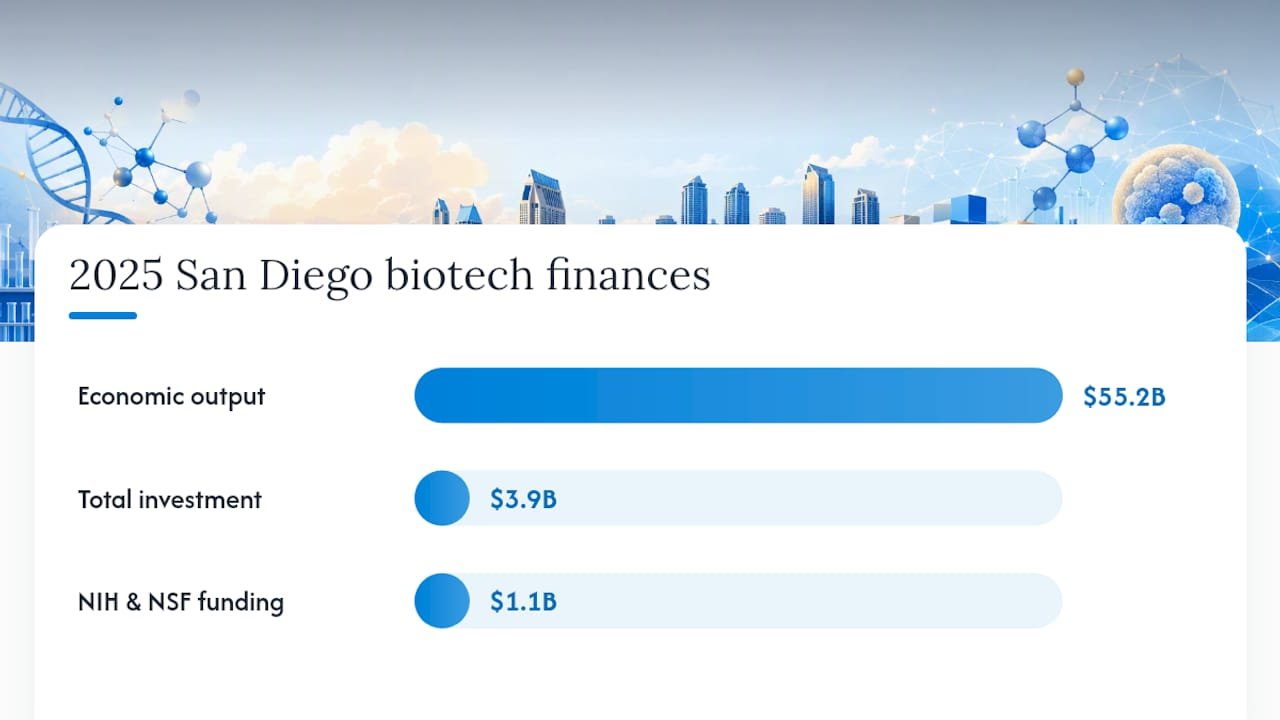
The headline numbers from 2025 are strong. San Diego’s life science sector generated $55.2 billion in economic output, employed 61,866 workers directly, attracted $3.9 billion in total investment, and secured more than $1.1 billion in NIH and NSF funding, per Biocom’s 2026 Economic Impact Report.
The 2026 picture is more complicated. Q2 2026 VC funding for San Diego startups totaled $804 million, one of the lowest quarterly totals of the past decade. That figure raises a real question about near-term runway for early-stage programs. Companies that raised Series A or B rounds in 2022 and 2023 at high valuations are now facing a tighter refinancing environment.
What this means in practice:
- Early-stage founders should plan for longer fundraising timelines and consider milestone-based tranching rather than large upfront rounds
- Strategic partnerships with large pharma (Pfizer, Bristol Myers Squibb, and others with local R&D presence) are increasingly attractive as a capital-efficient alternative to pure VC financing
- NIH and NSF grant funding remains a reliable non-dilutive source; SBIR/STTR programs are particularly relevant for San Diego’s many small biotechs with academic roots
- The real estate correction creates an indirect benefit: lower occupancy costs extend runway for companies that are renegotiating leases or signing new ones
Investors active in the San Diego market include both dedicated life science funds (Versant Ventures, Avalon Ventures, and Domain Associates have long histories in the region) and crossover funds that participate in later-stage private rounds ahead of IPOs. Deal structures increasingly favor tranched financing tied to clinical or regulatory milestones rather than large single closes.
How do researchers and job seekers find work in San Diego biotech?
San Diego’s biotech job market is large and specialized enough that generic job boards are rarely the most efficient starting point.
Primary job search channels:
- Company career pages: the most direct route. Illumina, Neurocrine Biosciences, Dexcom, Halozyme, and Crinetics Pharmaceuticals all maintain active postings. Set up alerts on their career portals directly.
- BIOCOM job board: aggregates postings from member companies across the region; particularly strong for mid-size and smaller companies that do not advertise widely
- UCSD and Scripps Research tech transfer / alumni networks: postdoctoral alumni networks at both institutions are active channels for R&D scientist roles
- LinkedIn: effective for San Diego biotech given the density of hiring managers and recruiters who are active on the platform locally
- Local recruiting firms: firms specializing in life sciences (Talencio, Bioforce Group, and similar) maintain relationships with companies that hire confidentially or fill roles before posting publicly
Roles in highest demand across the region:
- Process development and bioprocess engineers (driven by CDMO growth and cell/gene therapy scale-up)
- R&D scientists in molecular biology, cell biology, and immunology
- Regulatory affairs specialists (IND, BLA, 510(k) experience)
- Clinical operations managers and CRAs
- Computational biologists and data scientists (AI-driven drug discovery companies like Iambic Therapeutics are actively hiring)
- Quality assurance and GMP compliance specialists
Salary ranges in San Diego’s biotech sector are competitive with the Bay Area for most R&D roles, though slightly below for software-adjacent positions. The cost of living differential versus San Francisco is meaningful for mid-career scientists choosing between the two markets.
Quick checklist for applicants:
- Tailor your resume to the specific subsector (genomics, cell therapy, diagnostics) rather than using a generic life science CV
- Highlight any experience with regulated environments (GMP, GLP, GCP) even at the academic level
- Attend BIOCOM and CONNECT events: a significant fraction of San Diego biotech hires happen through warm introductions at local networking events
- Check whether target companies have active IND filings or recent clinical trial registrations (ClinicalTrials.gov) as a proxy for near-term hiring activity
How should investors and partners evaluate San Diego biotechs?
San Diego companies have shifted toward disciplined company building: earlier discovery-first formation has matured into teams designing partner-ready data packages and clearer capital strategies. That shift makes due diligence more tractable, but it also raises the bar for what investors should expect to see at first meeting.
Sequential due diligence checklist:
- Team and repeat founders: has the leadership team taken a program through IND or beyond? San Diego has a deep bench of experienced operators; a first-time team with no advisors who have done it before is a yellow flag.
- Data-package readiness: is the CMC story coherent? Are GLP tox studies designed or completed? Is the IND pathway clear? Companies that cannot answer these questions at Series A are behind the curve for the current market.
- Capital runway and partnership optionality: how many quarters of runway does the current raise provide, and is there a credible path to a strategic partnership or licensing deal that does not require another large equity raise?
- IP and license scope: is the core IP owned or exclusively licensed? Are there field-of-use restrictions that limit the commercial opportunity? Check the original university license agreement if the company is a spinout.
- Clinical trial design and regulatory path: is the Phase 1/2 design powered to generate a meaningful signal, or is it a dose-escalation study with no clear go/no-go criteria? Regulatory path clarity (FDA pre-IND meeting minutes, breakthrough therapy designation, fast track) is a meaningful differentiator.
Questions to ask in meetings:
- What does your go-to-partner strategy look like, and which large pharma companies have you already had conversations with?
- What are your top three technical risks, and what experiments would de-risk each one?
- How was the valuation for this round set, and what milestones justify the next step up?
Red flags specific to the San Diego market:
- Companies that cite the cluster’s prestige as a substitute for a coherent data package
- Overly complex capital structures with multiple tranches of convertible notes at different caps
- Teams that have not engaged with CONNECT or BIOCOM, which often signals limited local network depth
Valuation patterns in San Diego tend toward tranched rounds with milestone-based unlocks, particularly for cell and gene therapy programs where manufacturing scale-up costs are high. Strategic investors (large pharma with local R&D presence) often participate in Series B and C rounds as a precursor to option-to-acquire or co-development agreements.
What does setting up or expanding a lab in San Diego actually cost?
Realistic timelines and cost expectations prevent the most common planning mistakes.
Estimated timeline from decision to operational lab:
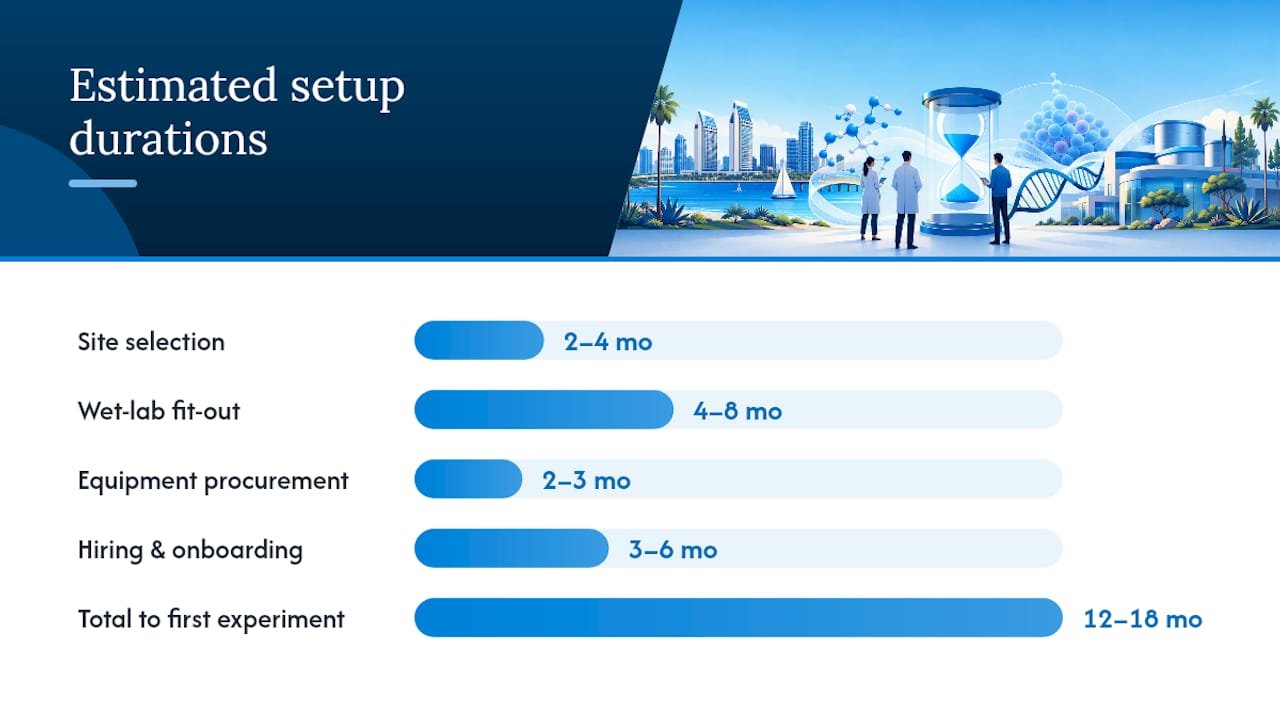
- Site selection and lease negotiation: 2–4 months (faster in the current tenant’s market)
- Permitting and design: 2–3 months (concurrent with lease execution where possible)
- Wet-lab fit-out and construction: 4–8 months depending on scope
- Equipment procurement and installation: 2–3 months (some lead times for specialized equipment are longer)
- Hiring and onboarding core team: 3–6 months for senior R&D roles
- Total from decision to first experiment: 12–18 months is realistic for a ground-up lab build
Key cost drivers:
- Lab rent: asking rents at $5.30/SF NNN in Q1 2026 per NMRK, with landlords offering meaningful TI allowances in the current market
- Wet-lab fit-out: $150–$300/SF is a common range for basic to mid-complexity wet lab, depending on HVAC requirements, number of fume hoods, and biosafety level
- Utilities: upgraded HVAC for BSL-2 or BSL-3 environments adds meaningfully to monthly operating costs; budget for this separately from base rent
- Permitting and zoning: San Diego County has multiple jurisdictions (City of San Diego, unincorporated county, Carlsbad, La Jolla) with different permitting timelines; La Jolla and Torrey Pines Mesa permits can take longer due to coastal commission review
- Talent costs: senior R&D scientists command $120,000–$180,000+ in base salary; process development engineers and regulatory specialists are similarly priced
Operational pitfalls and mitigations:
- Sublease opportunities from companies that over-built in 2023–2024 can cut fit-out costs significantly; look for spaces with existing lab infrastructure
- Partnering with a core lab or incubator (Janssen Labs, EvoNexus) for the first 12–18 months avoids the full build-out cost while the team validates its first data package
- Negotiate lease commencement tied to substantial completion of TI work, not landlord delivery, to avoid paying rent on an unusable space
Pro Tip: In the current market, ask for a landlord-funded TI allowance of $80–$120/SF before committing to any base rent concession. A higher TI allowance is often worth more than a few months of free rent, particularly for wet-lab builds where fit-out costs dominate.
How was this company list compiled?
Selection criteria: Companies were included based on verified San Diego headquarters or significant campus presence, active operations (R&D, manufacturing, or clinical activity) as of mid-2026, and public evidence of hiring activity or recent financing. The list draws on Biocom’s 2026 Economic Impact Report, company SEC filings and press releases, UCSD institutional pages, NMRK market data, and career page verification.
Primary data sources:
- Biocom 2026 Life Science Economic Impact Report (employment, economic output, investment figures)
- NMRK Q1 2026 San Diego Life Science Market Report (real estate metrics)
- UC San Diego CMM institutional pages (academic anchor profiles)
- Global CONNECT / UC San Diego Biotechnology Cluster Project analysis (cluster history)
- Company 10-K filings and press releases (pipeline, headcount, financial status)
- GetBiobrief Q2 2026 funding brief (VC totals)
Data cutoff: Mid-2026. Pipeline status, funding rounds, and headcount figures change frequently; verify current status via company investor relations pages and SEC EDGAR before making investment or hiring decisions.
Limitations: Private company data (headcount, exact funding) is often estimated or self-reported. Several early-stage companies on the list have limited public disclosure; their inclusion reflects verified San Diego presence and active operations rather than comprehensive financial data.
What the San Diego biotech cluster actually feels like from the inside
San Diego’s most underappreciated quality is not its science, which is genuinely world-class, but its density of experienced operators who are willing to help the next company. The “incubator without walls” description is accurate: it is common for a founder to get introductions to three potential CMOs, two clinical advisors, and a term sheet introduction within 90 days of arriving in La Jolla, simply by showing up at CONNECT events and being specific about what they need.
What has changed in 2026 is the capital discipline. The weak VC quarter is not just a funding story; it is forcing companies to be more honest earlier about their go-to-partner strategy. Teams that previously raised on the strength of a compelling scientific narrative are now expected to show a coherent CMC plan, a realistic regulatory timeline, and at least one large pharma conversation before a Series B closes. That is a healthier standard, even if it is uncomfortable for programs that were designed around a discovery-first model.
The hiring market reflects the same dynamic. Senior R&D talent is available in a way it was not in 2021 and 2022, partly because several mid-size companies have reduced headcount after pipeline setbacks. For well-funded startups, this is an unusual window to hire experienced scientists who would not have considered an early-stage role two years ago.
Mayflowerbio supports San Diego labs with research-grade reagents and assays
San Diego researchers running drug discovery, cell biology, and molecular biology programs need reagent supply that keeps pace with their experimental velocity. Mayflowerbio offers a curated catalog of research antibodies, bioassays and multiplex assay kits, PCR and qPCR reagents, growth factors, and bioprocessing tools sourced globally and shipped from a U.S.-based operation.
For labs scaling up in San Diego, whether you are validating an assay panel for an IND package or sourcing antibodies for a new target, Mayflowerbio’s technical support team can help you identify the right products and build a sourcing checklist matched to your program stage. The impact of single reagents on research output is often underestimated until a supply disruption stalls a critical experiment. Contact Mayflowerbio directly through the product pages to request availability, pricing, or a sourcing consultation for your lab’s specific needs.
Sources
- Biocom’s 2026 Life Science Economic Impact Report
- Biotechnology Cluster Project — San Diego analysis (Global CONNECT / UC San Diego)
- Research in San Diego (UC San Diego CMM)
- 1Q26 San Diego California life science market report (NMRK)
- 11 Biggest Biotech Companies in San Diego (WeWillCure)
FAQ
What biotech companies are based in San Diego?
San Diego hosts a large and diverse number of life science companies, including large public firms like Illumina, Neurocrine Biosciences, Dexcom, Halozyme, and Maravai LifeSciences, alongside hundreds of clinical-stage and early-stage biotechs spanning genomics, cell therapy, oncology, and diagnostics.
Is San Diego good for biotech careers?
San Diego has a significant biotech job market with tens of thousands of direct life science employees and active hiring across R&D, process development, regulatory affairs, and clinical operations roles at companies of every size.
Why does San Diego have so many biotech companies?
The cluster traces to Hybritech’s founding in 1978 and the subsequent recycling of executive talent and capital into new companies, accelerated by intermediary organizations CONNECT and BIOCOM and sustained by the proximity of UC San Diego, Scripps Research, the Salk Institute, and Sanford Burnham Prebys on the Torrey Pines Mesa.
What is the funding environment for San Diego biotech in 2026?
Q2 2026 VC funding totaled $804 million, one of the lowest quarterly figures of the past decade, pushing companies toward milestone-based financing, strategic partnerships with large pharma, and non-dilutive NIH/NSF grant funding to extend runway.
Who are the largest biotech employers in San Diego?
Illumina, Thermo Fisher Scientific, Dexcom, Neurocrine Biosciences, and Bristol Myers Squibb are among the region’s largest life science employers, each combining R&D with manufacturing or commercial operations and hiring across a broad range of scientific and operational roles.