Biotech Startups to Watch in 2026: A Curated Shortlist
The hottest biotech startups in 2026 cluster into five sectors: AI-native drug discovery, cell and gene therapy, synthetic biology, point-of-care diagnostics, and platform tools that make lab work faster and cheaper. Among the companies worth tracking right now: Orna Therapeutics (RNA platform innovation), ElevateBio (cell and gene therapy manufacturing), Mammoth Biosciences (CRISPR diagnostics), Pivot Bio (agricultural synthetic biology), Be Biopharma (translational cell therapy), and Arbor Biotech (engineered biologic platforms).
- Orna Therapeutics — circular RNA platform with therapeutic breadth beyond traditional mRNA.
- ElevateBio — manufacturing infrastructure that de-risks cell and gene therapy scale-up.
- Mammoth Biosciences — CRISPR-based diagnostics pushing toward point-of-care applications.
- Pivot Bio — commercial-stage synthetic biology with real farm deployments.
- Be Biopharma — clinical-stage cell therapy work featured in 2026 funder roundups.
- Arbor Biotech — engineered biologic platform cited in global innovation lists.
- Trilobio — lab automation aimed at accelerating experimental throughput.
- Pairwise — gene-edited crops bridging synthetic biology and agriculture.
These picks lean on three public signals: NIH SBIR/STTR grant awards, Y Combinator’s biotech directory, and Crunchbase funding data — three sources that, together, catch a startup long before it shows up in a press release.
Key Takeaways
Public grant activity, documented pipeline depth, and named commercial hires predict a biotech startup’s vendor readiness more reliably than funding headlines alone.
| Point | Details |
|---|---|
| Track grants, not just rounds | NIH SBIR/STTR awards signal documented budget and research direction months before VC news. |
| Watch for pipeline narrowing | Startups backed by highly active specialist VCs show an IPO success rate near 2.8% versus 23% for diversified-VC-backed peers. |
| Use multiple discovery sources | Combine Y Combinator’s directory, Crunchbase, and conference abstracts for full coverage. |
| Evaluate on fundamentals | Check founder track record, IP defensibility, regulatory engagement, and runway before trusting a startup’s momentum. |
| Source reagents from a global, centralized supplier | Mayflowerbio provides multiplex assays and PCR reagents suited to startups scaling discovery and diagnostics workflows. |
Table of Contents
- Which Biotech Startups Should You Watch in 2026?
- How We Picked This Shortlist
- Where Can You Track Biotech Startups Continuously?
- What Should You Check Before Trusting a Biotech Startup?
- What Sectors and Technologies Will Define Biotech Startups in 2026?
- Why Public Grants Predict Vendor Demand Better Than Funding Rounds
- Sources
- FAQ
Which Biotech Startups Should You Watch in 2026?
Anyone tracking biotech startups this year is really tracking five overlapping bets: computational drug discovery, next-generation cell and gene therapy, synthetic biology applied outside pharma, cheaper diagnostics, and the unglamorous tools layer that keeps all of it running. The companies below aren’t ranked by size or funding alone. Each earned a spot because of a specific technical or commercial signal: a grant award, a partnership, a manufacturing deal, or a clear jump from academic finding to a marketable platform.
Some of these are still pre-seed teams operating out of a shared lab bench. Others are already running Series B rounds and building out commercial teams. That range is the point. A useful shortlist for 2026 has to include both the six-person team that just landed an SBIR Phase I grant and the 200-person company negotiating a manufacturing deal with a pharma partner.
| Company | What They Do | Stage | Notable Tech | Why to Watch |
|---|---|---|---|---|
| Orna Therapeutics | RNA-based therapeutics platform | Clinical stage | Circular RNA (oRNA) technology | Platform flexibility across multiple disease areas |
| ElevateBio | Cell and gene therapy development/manufacturing | Growth stage | Integrated CDMO plus R&D model | Partnerships across multiple gene therapy programs |
| Mammoth Biosciences | CRISPR diagnostics and tools | Series C+ | CRISPR-based detection platform | Point-of-care diagnostic applications gaining traction |
| Pivot Bio | Agricultural synthetic biology | Commercial stage | Nitrogen-fixing microbial products | Real farm deployments replacing synthetic fertilizer |
| Be Biopharma | Engineered B-cell medicines | Clinical stage | B-cell engineering platform | Featured in 2026 funded-startup lists |
| Arbor Biotech | Engineered biologic platform | Series A/B | Precision genome editing tools | Highlighted in global innovation roundups |
| Abogen Biosciences | Novel therapeutic platform (Asia-based) | Growth stage | mRNA and related modality work | Regional innovation leader in Asia-Pacific biotech |
| Trilobio | Lab automation | Seed/Series A | Robotic experimentation platform | Speeds iteration cycles for wet-lab science |
| Pairwise | Gene-edited agricultural products | Growth stage | CRISPR-edited crop traits | Commercial produce already reaching consumers |
| Nature’s Fynd | Fermentation-based protein platform | Growth stage | Fungi-based protein production | Alternative protein platform with manufacturing scale |
Orna Therapeutics stands out for circular RNA chemistry that sidesteps some stability issues linear mRNA constructs face, giving it a broader therapeutic reach than a single-indication biotech. ElevateBio built its name by becoming the manufacturing backbone other cell and gene therapy startups lean on instead of building their own facilities from scratch, a model that’s proven durable through funding cycles. Check its funding trajectory on Crunchbase before assuming its manufacturing partnerships translate to near-term vendor demand.
Mammoth Biosciences keeps showing up in diagnostics conversations because CRISPR-based detection has a real shot at point-of-care deployment, not just lab-based testing. Pivot Bio is the rare synthetic biology company with actual revenue from farmers replacing synthetic nitrogen fertilizer with microbial products, which matters because so much of synthetic biology is still pre-revenue.
Be Biopharma and Arbor Biotech both surface in 2026 sector roundups for translational and platform work, respectively. Neither has the manufacturing scale of ElevateBio yet, but both show the kind of technical differentiation that tends to attract strategic partnerships before a company is household-name big. Abogen Biosciences, based in Asia, is worth tracking if your interest extends past the Boston/Bay Area axis, since its platform work has drawn attention in international innovation lists.
Two names worth flagging for anyone building assay or lab-tool watch lists: Trilobio, which automates wet-lab experimentation in a way that could reshape how startups scale R&D without scaling headcount, and Pairwise, whose gene-edited produce is already sitting on grocery shelves. Round out the sector view with Nature’s Fynd, whose fermentation-based protein platform sits at the intersection of synthetic biology and food science.
How We Picked This Shortlist
This list draws from four primary sources: the Y Combinator biotech directory, Crunchbase funding records, NIH RePORTER and the SBIR/STTR award database, and sector roundups including Fundraise Insider’s biotech coverage.
Selection criteria weighted four signals over simple funding size:
- Recent funding or grant activity (a closed round, an SBIR Phase I/II award, or a named strategic investor).
- Technical milestones such as an IND filing, first clinical readout, or a published platform validation.
- Strategic partnerships, especially manufacturing or distribution deals with larger pharma or agtech players.
- Geographic cluster signals, since a startup embedded in an active hub tends to have easier access to talent and follow-on capital.
Pro Tip: Bookmark your Crunchbase and NIH RePORTER searches rather than rebuilding them each time. Startup funding data shifts fast enough that a saved search from three months ago is already stale.
All company data reflects public information as of 2026. Startups without active US or accessible international operations, or without a verifiable funding/grant record, were excluded.
Where Can You Track Biotech Startups Continuously?
A one-time shortlist goes stale fast. Real tracking means building a repeatable workflow across a handful of sources, each catching a different stage of a company’s life.
NIH RePORTER and the SBIR/STTR database are the earliest signal you’ll find. A startup that just landed a Phase I SBIR grant is telling you, in writing, exactly what it’s working on and roughly how much non-dilutive budget it has to spend over the next 6 to 12 months. That’s a documented research direction months before any press release.
The Y Combinator biotech directory catches accelerator-backed teams, often pre-seed or seed stage, before they’ve built a public profile elsewhere. Crunchbase picks up where grant databases leave off: funding rounds, investor names, and hiring data that hint at commercial readiness. Benchling, while primarily a lab informatics platform rather than a discovery tool, is worth noting because so many of these startups run their R&D data through it, making Benchling’s own case studies and customer lists a quiet secondary source for spotting active biotechs.
A workable weekly routine looks like this:
- Run a saved Crunchbase search filtered to biotech, sorted by most recent funding date.
- Check NIH RePORTER for new SBIR/STTR awards in your therapeutic or platform area of interest.
- Scan conference abstract lists (JPM Healthcare, SLAS, BIO International) for startups presenting new data.
- Set a Google Alert for “Series A” plus your niche term, and another for relevant founder names on preprint servers.
- Watch job boards for commercial hires. A startup posting for a VP of Business Development or Head of Commercial is telling you it expects to need vendors soon.
That last point matters more than it sounds. A life-science lead generation playbook found that funding events paired with senior commercial hires open a window of roughly 6 to 12 months where a startup is actively evaluating vendors and partners. Miss that window and you’re competing for attention with five other suppliers who got there first.
Pro Tip: Match the funding date to a buying window, not the announcement date. Startups often close a round weeks before the press release goes out. If you wait for the news cycle, you’re already behind teams monitoring Crunchbase directly.
What Should You Check Before Trusting a Biotech Startup?
A startup’s website can say almost anything. What actually predicts whether a biotech is worth your attention, your time, or your inventory comes down to a shorter list of hard signals.
Start with the team. Scientific founders with a track record of publications or prior successful spinouts (the kind of teams that come out of programs like Stanford’s SPARK) tend to execute more predictably than founders assembled purely around a business plan. Then look at pipeline depth: a company betting everything on one lead asset carries dramatically more risk than one with two or three programs at different stages, because a single clinical failure can end a single-asset company overnight.
Check the IP position, not just whether patents exist but whether they’re defensible and non-overlapping with larger incumbents. Confirm there’s a credible regulatory path (has the company talked with the FDA, or is it guessing at what “clinical stage” even means for its modality). And look at funding runway. A startup that raised a Series A eighteen months ago with no announced extension may be running on fumes.
Checklist: evaluating a biotech startup
- Scientific founders with a verifiable publication or prior venture record
- Multiple pipeline assets, not a single-shot bet
- Clear, defensible IP position
- Documented regulatory engagement or plan
- At least 12 to 18 months of disclosed or estimated runway
- Named strategic partnerships (manufacturing, distribution, co-development)
- Recent commercial hiring activity signaling near-term vendor need
One failure mode deserves special attention: VC activism. Research on venture-backed biotechs found that startups backed by specialist, highly active VCs saw nearly 11% less IPO underpricing but an IPO success rate around 2.8%, compared with roughly 23% for startups backed by more diversified investors. Active VCs tend to narrow a portfolio’s focus early, concentrating resources on a lead program. That can sharpen execution, but it also means a single asset’s failure carries outsized risk for the whole company. Watch for startups that pivoted from three programs to one after a board reshuffle. It’s a pattern, not a coincidence.
What Sectors and Technologies Will Define Biotech Startups in 2026?
The center of gravity in the biotech sector has shifted noticeably toward a handful of technical themes:
- AI-native drug discovery — computational platforms designing candidates before a single wet-lab experiment runs.
- Cell and gene therapy — still capital-intensive, but manufacturing partners like ElevateBio are lowering the barrier to entry for smaller teams.
- Synthetic biology beyond pharma — Pivot Bio and Pairwise show the sector’s commercial reach into agriculture and food.
- Point-of-care diagnostics — CRISPR-based tools like Mammoth Biosciences’ platform pushing testing out of centralized labs.
- Platform tools — multiplex assays, reagent innovation, and lab automation (Trilobio) quietly enabling every other category.
Geographically, Boston and the Bay Area remain dominant, but clusters in San Diego, Research Triangle in North Carolina, and international hubs feeding into companies like Abogen Biosciences are drawing real capital and talent. If you’re a vendor or scout focused only on traditional coastal hubs, you’re missing a growing share of active projects.
Regulatory shifts, particularly around AI-assisted discovery tools and accelerated pathways for gene therapies, are already shaping how startups plan their clinical timelines. That’s a factor worth tracking, not a separate legal deep dive.
Why Public Grants Predict Vendor Demand Better Than Funding Rounds
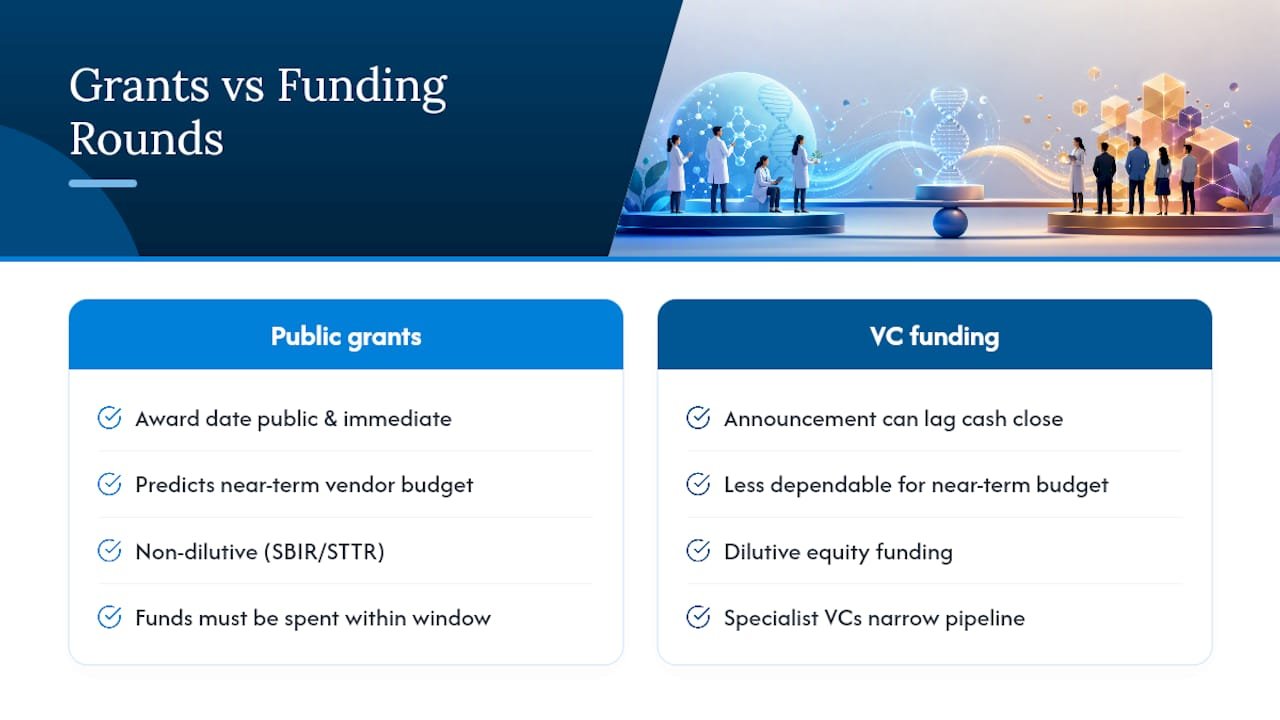
VC activism creates a structural tension worth understanding before you read too much into a funding round alone. Specialist VCs that take an active board role tend to narrow a startup’s pipeline early, which can sharpen focus but leaves the company exposed if its lead program stumbles. The IPO success rate gap tied to this pattern, roughly 2.8% versus 23% for diversified-VC-backed startups, is a real cost of that concentration.
Public grants tell a cleaner story; for guidance on obtaining these resources, see the Breast Cancer Research Funding: A Researcher’s Guide. An SBIR or STTR award is non-dilutive money tied to a specific, documented research plan, and it has to be spent within a defined window. Unlike a funding round announcement, which can lag the actual cash close by weeks, a grant award date is public and immediate. That makes it one of the more dependable predictors of near-term budget for reagents, assays, or contract services.
Pro Tip: Set your outreach clock to the grant award date, not the eventual publication or press mention. A Phase I SBIR award typically means budget is already allocated and needs to be spent within months, not years.
Publisher perspective: why we compiled this list and how to use it
We built this shortlist the way we’d want a vendor or scout to build one: starting from public, verifiable signals instead of press-release hype. Mayflowerbio works daily with labs standing up new assays and reagent workflows, and that vantage point makes one thing obvious. The startups worth watching aren’t always the loudest ones; they’re the ones with a documented grant, a real partnership, or a pipeline that survived a board reshuffle intact. This list reflects data as of 2026 and will age. Use the methodology above, not just the names, to build your own updated shortlist every quarter.
If You Support Biotech R&D, Here’s How Mayflowerbio Helps
Every startup on this list eventually needs the same unglamorous thing: reliable reagents, antibodies, and assay tools that don’t introduce variability into already-fragile early data. Mayflowerbio sources globally and centralizes support from one US-based team, which matters when a startup on a tight runway can’t afford a shipment delay or a batch inconsistency.
If your lab is scaling a discovery or diagnostics program, multiplex assay tools can cut down the number of individual tests needed per sample, which matters when budget and sample volume are both limited. For teams doing PCR-based validation work, browse PCR reagents built for the sensitivity thresholds startups need at IND-enabling stages. Reach out through the site to talk through your specific workflow and get a quote.
Sources
For ongoing discovery, keep these bookmarked: NIH RePORTER and the SBIR/STTR database, the Y Combinator biotech directory, a saved Crunchbase search filtered by funding stage and sector, and Fundraise Insider’s biotech startup roundups. Add conference abstract trackers for major biotech and pharma conferences, and set alerts filtered for funding type, new hires in commercial roles, and IND or clinical milestone announcements. Those three filters catch the signals that actually predict near-term vendor demand.
- SBIR/STTR funding opportunities | NIH Seed
- How does venture capital shape biotech innovation? | ProMarket
FAQ
What Is the Failure Rate of Biotech Startups?
Biotech carries substantial risk by design. Research on VC-backed biotechs found IPO success rates as low as roughly 2.8% for startups backed by highly active specialist VCs, versus about 23% for those backed by diversified investors, a gap tied largely to pipeline concentration risk.
What Are Some Promising Biotech Startups for 2026?
Companies drawing attention in 2026 include Orna Therapeutics for RNA platform work, ElevateBio for cell and gene therapy manufacturing, Mammoth Biosciences for CRISPR diagnostics, and Pivot Bio for commercial-stage synthetic biology in agriculture.
What Are the Top Biotech Companies to Track?
There’s no single definitive list, but based on funding signals, partnerships, and technical milestones, ElevateBio, Orna Therapeutics, Mammoth Biosciences, Arbor Biotech, and Pivot Bio are among the notable startups to watch for 2026 tracking.
Where Should I Start Looking for New Biotech Startups?
Start with the Y Combinator biotech directory for early-stage, accelerator-backed teams, then cross-reference with Crunchbase for funding history and NIH RePORTER for grant-backed research directions.
How Do Vendors Know When a Startup Is Ready to Buy?
A recent funding close or grant award combined with a new commercial hire, such as a VP of Business Development, typically opens a 6 to 12 month window when a startup is actively evaluating vendors and suppliers.