14 Practical Steps to Run BSL-2 Viral Assays in U.S. Labs
Yes, many viral assays can run safely at BSL-2, but only when they’re non-propagative and backed by a documented risk assessment, IBC approval, Class II biosafety cabinets, correct PPE, and validated decontamination. Propagation, live-virus culture, and aerosol-generating steps push most protocols into BSL-2+ or BSL-3 territory. The determining factor is never the virus alone. It’s the procedure applied to it.
TL;DR:
- Viral assays that involve propagation, live-virus culture, or aerosol generation require at least BSL-2+ or BSL-3 containment measures, not standard BSL-2 protocols.
- Proper use of a certified Class II biosafety cabinet during aerosol-generating steps, sealed centrifuge rotors, and strict access controls are essential to meet BSL-2 compliance standards.
- Risk assessments must be comprehensive, updated regularly, and address every stage of the procedure, including specific organism behavior and downstream impacts, to gain IBC approval.
- Routine disinfection with freshly prepared sodium hypochlorite, careful spill response, and proper waste handling are critical to prevent contamination and exposure risks.
- Handling live viruses or viral vectors with replication competence requires stricter controls, with escalation triggered by high titers, large working volumes, or aerosol risk factors.
Table of Contents
- Getting BSL2 Viral Assays Right From the Start
- Building the Risk Assessment Your IBC Will Actually Approve
- Equipment and Facility Controls That Actually Prevent Exposure
- PPE and Work Practices for Aerosol-Generating Steps
- Disinfection, Spill Response, and Waste That Won’t Come Back to Bite You
- When BSL-2 Isn’t Enough: The Escalation Decision Matrix
- Viral Vectors and Animal Work: What Changes the Rules
- A Copy-Ready Checklist for Running the Assay
- What I’ve Learned Auditing BSL-2 Viral Assay Labs
- How suppliers support safer BSL-2 viral work
- Where This Guidance Comes From
- Sources
- FAQ
Getting BSL2 Viral Assays Right From the Start
Biosafety Level 2 covers agents that pose a moderate hazard through ingestion, mucous membrane exposure, or percutaneous injury, but manageable enough for diagnostic and research work when core controls are in place. Most PCR-based detection, sequencing, and inactivated-sample handling for common respiratory and bloodborne viruses fit comfortably here. The CDC’s laboratory biosafety guidance for SARS-CoV-2 makes this explicit: BSL-2 facilities, practices, and procedures support the bulk of diagnostic and research activity involving that virus, though a specific list of activities demands heightened controls and specialized PPE.
The baseline requirements aren’t complicated, but they’re non-negotiable. BSL-2 criteria call for restricted lab access when recombinant materials are in use, mandatory personnel training before anyone touches a sample, daily surface decontamination, and an absolute ban on mouth pipetting. Any step that generates aerosols, from vortexing to pipetting under pressure, has to happen inside a certified Class II biosafety cabinet.
Here’s what separates a compliant BSL-2 setup from one that only looks compliant on paper:
- Class II BSC use for aerosol-generating steps. Not just “available in the room,” but actually used for pipetting, vortexing, and sample prep.
- Sealed centrifuge rotors. Open-bucket centrifugation of infectious material is a common shortcut that shouldn’t happen.
- Restricted access during active work. Doors closed, signage posted, unauthorized personnel kept out while recombinant or infectious material is in play.
- Daily surface decontamination. Benches wiped down at the start and end of each work session, not just when something spills.
- Specimen storage and inventory logs. Locked or access-controlled freezers with a running log of what’s stored, when, and by whom.
Before you run your first assay, verify three things a surprise inspection would check first: your BSC’s certification date (annual certification is standard practice), whether your centrifuge rotors actually seal, and whether your SOPs are physically accessible at the bench, not buried in a shared drive nobody opens. Labs fail audits on these basics far more often than on anything exotic.
Building the Risk Assessment Your IBC Will Actually Approve
Your Institutional Biosafety Committee reviews the procedure, not just the organism. A risk assessment that lists the agent and stops there gets sent back. What IBCs want to see is how the agent behaves at every volume, in every cell line, and through every downstream step your protocol actually uses.
The WHO Laboratory Biosafety Manual frames risk assessment as the foundational requirement for determining containment level, not a formality that follows it. That assessment isn’t a document you file once. It’s one you revisit every time a variable changes: a new cell line, a scaled-up volume, a switched detection method. Treat it as a living document, because institutional biosafety officers report that stale risk assessments are the single most common failure point in BSL-2 viral research, according to guidance compiled for institutional biosafety officers.
A submission that moves through IBC review quickly usually covers these items in order:
- Agent identification and classification, including risk group and any published containment recommendations specific to that virus or vector.
- Step-by-step procedure description, from specimen receipt through waste disposal, not a summary.
- Aerosol risk assessment for each step, flagging anything involving centrifugation, sonication, or vigorous pipetting.
- Engineering controls in place, naming the specific BSC model, certification status, and any supplemental controls.
- PPE requirements per step, since aerosol-generating steps often need more than the lab’s baseline PPE.
- Waste and spill response plan, including disinfectant choice and contact time.
- Personnel training and competency records, showing everyone on the protocol has been trained on this specific procedure, not just general lab safety.
Submit that list with specifics filled in, not placeholders, and most IBCs move faster because they’re not chasing you for missing information.
Equipment and Facility Controls That Actually Prevent Exposure
A biosafety cabinet only protects you if it’s used correctly, which is where a lot of otherwise careful labs slip. Institutional guidance on viral vector work points to a specific, common failure: air grille obstruction from overloading the cabinet with supplies, arms, and equipment, which disrupts the laminar airflow that makes the BSC effective in the first place. A cabinet crammed with pipette boxes, tube racks, and a laptop isn’t containing anything properly.
Certify your Class II BSC annually at minimum, and arrange re-certification any time the unit is moved or serviced. Keep the certification sticker visible and dated. What you keep inside the cabinet matters as much as the cabinet itself:
- Only the materials needed for that specific run, nothing stored permanently inside.
- No paperwork, phones, or loose items that block the air grilles.
- A dedicated waste container inside the cabinet for pipette tips and used consumables.
- Nothing placed directly over the front grille, where it disrupts the airflow curtain.
Centrifugation of infectious or recombinant material needs aerosol-tight rotors, and rotor loading and unloading should happen inside the BSC whenever the sample carries meaningful risk. Wipe rotors and buckets down with a validated disinfectant before removing them from the cabinet, and transport samples between areas in sealed, secondary leak-proof containers, a practice specifically recommended in the LSUHSC Viral Vector Biosafety Reference Guide.
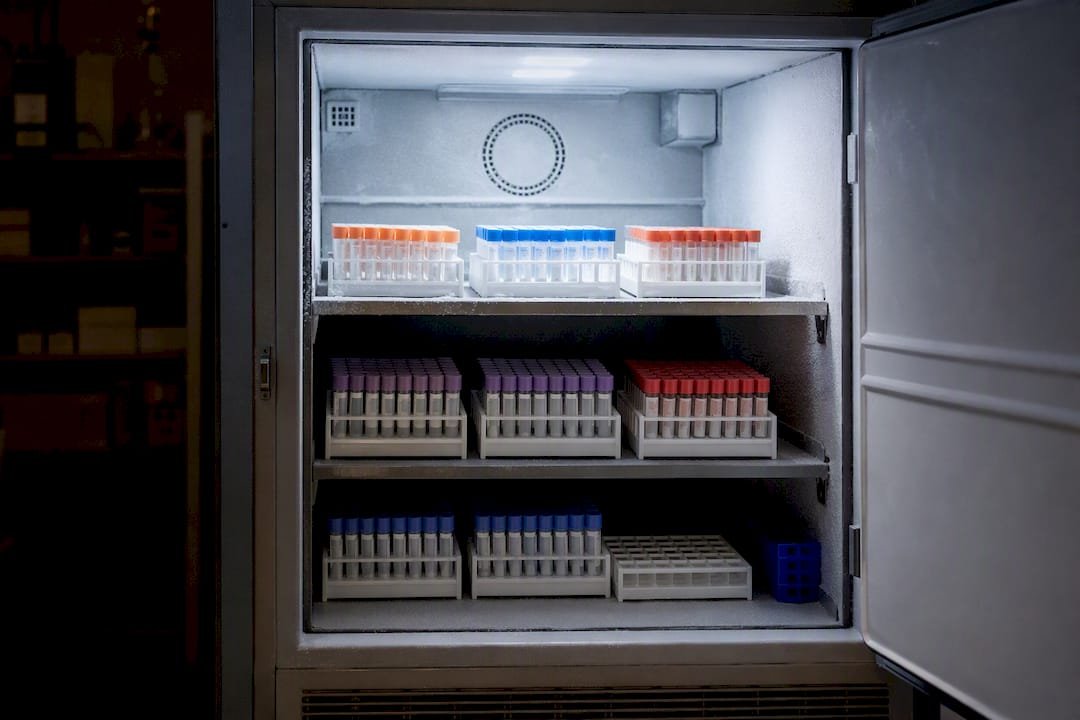
Specimen storage deserves its own protocol. A dedicated freezer or shelf, separate from general lab stock, with a sign-out log tracking who accessed what and when, closes the gap between “we have a policy” and “we can prove it happened.”
PPE and Work Practices for Aerosol-Generating Steps
Baseline BSL-2 PPE is straightforward: a lab coat that stays in the lab, gloves rated for the work, and eye protection. That covers routine sample handling, plate reading, and most bench work involving inactivated or non-propagative material.
Aerosol-generating procedures change the calculation. When your protocol involves open-vessel centrifugation risk, sonication, or any step the UTHealth SARS-CoV-2 lab guidance flags as BSL-2+, enhanced PPE comes into play: N95 or higher respiratory protection, a face shield in addition to standard eye protection, fluid-resistant gowns, and double gloving for extended manipulation.
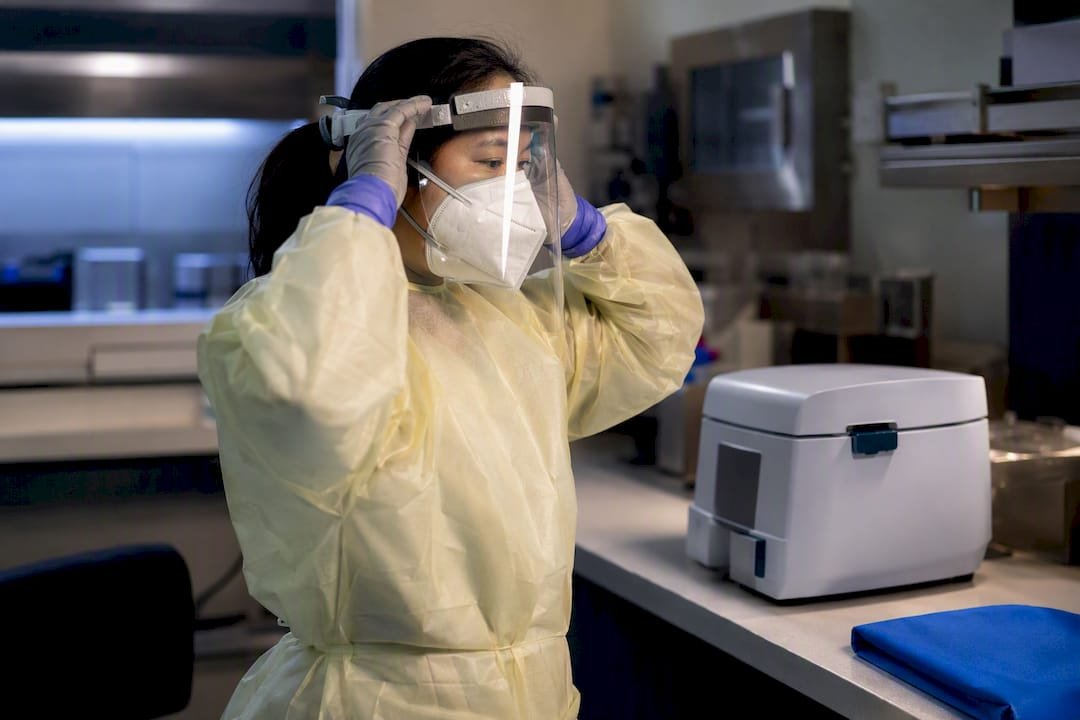
Pro Tip: Fit-test your N95 before you need it in an emergency, not during one. Annual fit testing paired with documented training records is exactly what an auditor asks to see first, and scrambling to prove compliance after an incident is a much worse position than having the paperwork ready.
A workable donning and doffing sequence keeps contamination from following you out of the BSC area:
- Don PPE in a fixed order every time: gown, then respiratory protection, then eye protection, then gloves.
- Minimize what enters the cabinet with you so doffing doesn’t require touching contaminated surfaces to retrieve items.
- Doff in reverse order, treating gloves as the most contaminated item and removing them last, hands washed immediately after.
- Never carry gloved hands to your face, phone, or door handles between the bench and the sink.
Respiratory protection isn’t optional theater for anything the risk assessment flags as aerosol-generating. Document fit testing dates, training completion, and the specific respirator model assigned to each person. That documentation is what turns “we follow the protocol” into something you can actually demonstrate.
Disinfection, Spill Response, and Waste That Won’t Come Back to Bite You
Freshly prepared 1:10 household bleach, giving 0.5% sodium hypochlorite, is the default disinfectant recommended across institutional viral vector guidance for most enveloped and non-enveloped viruses researchers encounter at BSL-2. The catch: alcohol-based disinfectants don’t reliably inactivate adenovirus or some pseudotyped and AAV preparations. If your protocol involves either, alcohol alone is not an acceptable primary disinfectant, and your SOP needs to name sodium hypochlorite or another institutionally validated agent instead.
A spill involving infectious or recombinant viral material follows a fixed sequence, and skipping steps under pressure is how exposures happen:
- Evacuate the immediate area and, if aerosols are plausible, allow settling time (commonly 30 minutes) before reentry.
- Don enhanced PPE before approaching the spill, including respiratory protection if aerosol generation was likely.
- Apply disinfectant generously, covering the spill perimeter first, then the center, and observe the required contact time, typically 10 to 30 minutes depending on the agent and disinfectant concentration.
- Wipe and collect materials from the outside edges inward to avoid spreading contamination.
- Bag and label waste immediately, treating everything used in cleanup as biohazardous.
Waste streams split into two paths: solids that go through autoclave validation, and liquids that need chemical inactivation before drain disposal, if drain disposal is even permitted under your institution’s environmental health policy. Material shipped off-site for disposal or analysis needs UN3373 packaging and labeling where the shipment qualifies as a biological substance, category B.
One detail that trips up newer researchers: bleach solution loses potency within hours of dilution. A bottle mixed on Monday and used Thursday isn’t providing the concentration your SOP assumes, so mix fresh and date the container every time.
When BSL-2 Isn’t Enough: The Escalation Decision Matrix
The agent doesn’t decide your containment level on its own. The procedure does, and the WHO’s risk-based containment framework is built entirely around that principle: non-propagative work can often stay at standard BSL-2, while propagation of the same virus frequently needs heightened measures.
Here’s how that plays out across common assay categories:
- Non-propagative NAAT and PCR-based detection. Standard BSL-2 with routine controls. This covers the majority of diagnostic viral testing, since the sample is inactivated or the target nucleic acid is extracted before amplification.
- Sequencing of inactivated or extracted material. Also standard BSL-2, provided the inactivation step is validated and documented, not assumed.
- Work with inactivated samples for downstream assays like ELISA or multiplex panels. BSL-2 with standard PPE, assuming inactivation is confirmed rather than presumed.
- Live virus culture and propagation. Frequently requires BSL-2+ or BSL-3 depending on the specific agent; check institutional and CDC-specific guidance for that virus.
- Viral neutralization assays using live virus. UTHealth guidance explicitly lists this among activities needing enhanced controls, since it combines live virus with manipulation steps.
- Live-cell sorting of infected cells. Aerosol risk from the sorter itself pushes this toward BSL-2+ regardless of the virus’s baseline classification.
- Concentration of virus from culture supernatant or environmental samples like wastewater. Concentration steps increase both titer and aerosol risk simultaneously, a combination that routinely triggers escalation.
- In vivo infection studies. These move into ABSL considerations layered on top of whatever BSL tier the agent requires, discussed further below.
Three practical thresholds tend to trigger escalation even when the base agent is well-characterized: working volumes large enough that a spill can’t be fully contained by the BSC, titers high enough that a small exposure carries meaningful infectious dose, and any step your risk assessment can’t rule out as aerosol-generating. When any one of those three is true, the conversation with your IBC shifts from “how do we do this safely at BSL-2” to “does this need BSL-2+ or BSL-3.”
Viral Vectors and Animal Work: What Changes the Rules
Replication competence is the single biggest variable in vector work, and it’s also the one researchers most often assume rather than confirm. A replication-incompetent lentiviral or AAV vector, particularly one built on a third or fourth-generation packaging system, carries substantially lower containment burden than a replication-competent construct carrying the same transgene. The LSUHSC reference guide is direct on this point: replication-competent assays demand stricter controls and documented testing for replication competence before any animal work proceeds, not after.
Vector-specific containment isn’t uniform, and the GWU quick-reference guide breaks this down by family:
- AAV vectors typically default to BSL-2, with disinfectant selection depending on serotype and construct.
- Lentiviral vectors default to BSL-2 for replication-incompetent constructs, escalating if replication competence testing hasn’t cleared the batch.
- Adenoviral vectors need sodium hypochlorite rather than alcohol, given known resistance in this family.
- VSV-based vectors carry their own containment notes tied to the specific pseudotype in use.
Animal work adds a timing dimension most bench-only protocols never encounter. Institutions commonly require animals to remain under ABSL-2 housing for a defined period after vector administration, commonly 72 hours to 7 days depending on the vector and the institution’s own policy, before the animal can be downgraded to standard housing. That window affects facility scheduling and waste stream planning well before dosing day, so build it into your protocol timeline rather than discovering it after animals are already dosed.
A Copy-Ready Checklist for Running the Assay
A protocol that reads well on paper still needs a checklist that survives contact with an actual bench. Here’s one structured around the three phases every run actually has.
- Pre-run: confirm IBC approval is current for this exact protocol version, not an earlier iteration.
- Verify training records for every person touching the sample, including any recent hires or rotating students.
- Check BSC certification date and confirm airflow is functioning before the first sample goes in.
- Prepare fresh disinfectant at the correct concentration, dated and labeled.
- Set up specimen inventory logging before samples arrive, not retroactively.
- During-run: follow the fixed BSC workflow, loading only what’s needed for that session.
- Maintain PPE discipline throughout, re-donning gloves after any break in the sequence.
- Track samples in real time, logging tube IDs as they move through each step rather than reconstructing the chain afterward.
- Minimize aerosol-generating steps to the fewest necessary, batching them inside the BSC where possible.
- Handle rotors and sealed containers per the loading and wipe-down procedure established earlier.
- Post-run: decontaminate all surfaces and equipment before removing PPE.
- Package and label waste immediately, sorting autoclave-eligible solids from liquid waste requiring inactivation.
- File any incident report the same day, while details are still fresh.
- Update the risk assessment and logs if anything about the run deviated from the written protocol.
| Phase | Primary risk | Key control |
|---|---|---|
| Pre-run | Outdated approvals or untrained personnel | Current IBC approval and training records checked |
| During-run | Aerosol exposure during manipulation | BSC workflow discipline and PPE sequence |
| Post-run | Contaminated waste or incomplete records | Validated disinfectant and same-day documentation |
What I’ve Learned Auditing BSL-2 Viral Assay Labs
The labs that run into trouble aren’t usually cutting corners deliberately. They’re running on a risk assessment written for a protocol that’s since changed twice, relying on alcohol wipes because that’s what’s on the shelf, or working in a BSC so full of supplies the airflow can’t do its job. None of these show up as violations until something goes wrong, and by then it’s too late to ask whether the paperwork matched reality.
What separates an audit-ready lab from one that merely feels compliant is documentation that would survive a surprise walkthrough: BSC certification stickers with current dates, training records tied to the specific protocol version in use, and disinfectant prep logs showing when solutions were mixed, not just that a bottle exists. If you can’t produce a date on demand, an auditor will assume the answer is worse than it probably is.
The instinct to treat containment level as fixed once you’ve decided it is the mistake I’d flag first. It isn’t. Every scale-up, every new cell line, every switch in detection chemistry is a reason to reopen the risk assessment, not a footnote to add later.
— Alina
How suppliers support safer BSL-2 viral work
Sourcing the right reagents shouldn’t be the weak link in an otherwise tight protocol. Mayflowerbio carries decontamination solutions like SBCleaner peptide decontamination solution alongside a catalog of infectious disease reagents built for the assay types this article covers, from NAAT-based detection to neutralization work.

For labs running vector-based work, the viral transduction and bioprocessing line supports protocols where replication competence and cell-line compatibility drive reagent choice. If your assay panel is expanding beyond single-target detection, the AimPlex multiplex assay kits let you consolidate multiple viral targets into one workflow, cutting down the number of separate handling steps your BSC needs to accommodate. Mayflowerbio’s team offers technical support for protocol questions and reagent selection, and inquiries about specific containment or workflow needs can go through the contact and product pages directly. If you’re evaluating reagent options for an upcoming study, start by browsing the infectious disease research catalog and reaching out with your specific assay design.
Where This Guidance Comes From
The CDC’s SARS-CoV-2 laboratory guidance anchors the aerosol-risk and decontamination recommendations throughout this article. The WHO Laboratory Biosafety Manual supplies the procedure-based containment logic behind the escalation decisions. LSUHSC’s Viral Vector Biosafety Reference Guide and GWU’s vector quick-reference table provide the vector-specific containment and disinfectant tables cited above. Consult your institutional biosafety manual and IBC directly for approvals specific to your protocol.
This article is general information, not a substitute for advice from a qualified doctor. Consult a qualified healthcare professional about your own circumstances before acting on anything here.
Sources
- Laboratory Biosafety Guidelines for working with SARS-CoV-2 (CDC)
- Viral Vector Biosafety Reference Guide (LSUHSC)
- WHO Laboratory biosafety manual (4th ed.)
FAQ
Are there BSL-3 or BSL-4 labs in the United States?
Yes. The United States operates numerous registered BSL-3 facilities across academic, government, and commercial institutions, along with a small number of BSL-4 labs handling the highest-risk agents, though exact facility counts change as registrations are added or retired.
What’s the difference between BSL-1, BSL-2, BSL-3, and BSL-4?
Each level reflects escalating containment for agents of increasing risk: BSL-1 covers agents unlikely to cause disease in healthy adults, BSL-2 covers moderate-risk agents requiring BSCs and restricted access, BSL-3 covers agents that can cause serious or lethal disease via inhalation and requires controlled airflow and additional PPE, and BSL-4 covers the highest-risk agents with no available treatment, requiring maximum containment suits or cabinet lines.
What BSL level is required for COVID-19 work?
Most diagnostic and non-propagative research work with SARS-CoV-2 can be performed at BSL-2 with standard controls, but propagation, viral isolation, and concentration steps require BSL-2+ or higher, according to CDC guidance.
What are examples of BSL-2 organisms?
Common BSL-2 agents include HIV, hepatitis B and C viruses, influenza viruses, and Salmonella species, all classified as moderate hazard agents manageable with standard BSL-2 engineering controls and PPE.
Can I run viral vector research at BSL-2?
Most replication-incompetent viral vectors, including third and fourth-generation lentiviral systems and many AAV constructs, can be handled at BSL-2 following IBC approval, though replication-competent constructs typically require stricter controls and documented competence testing first.