
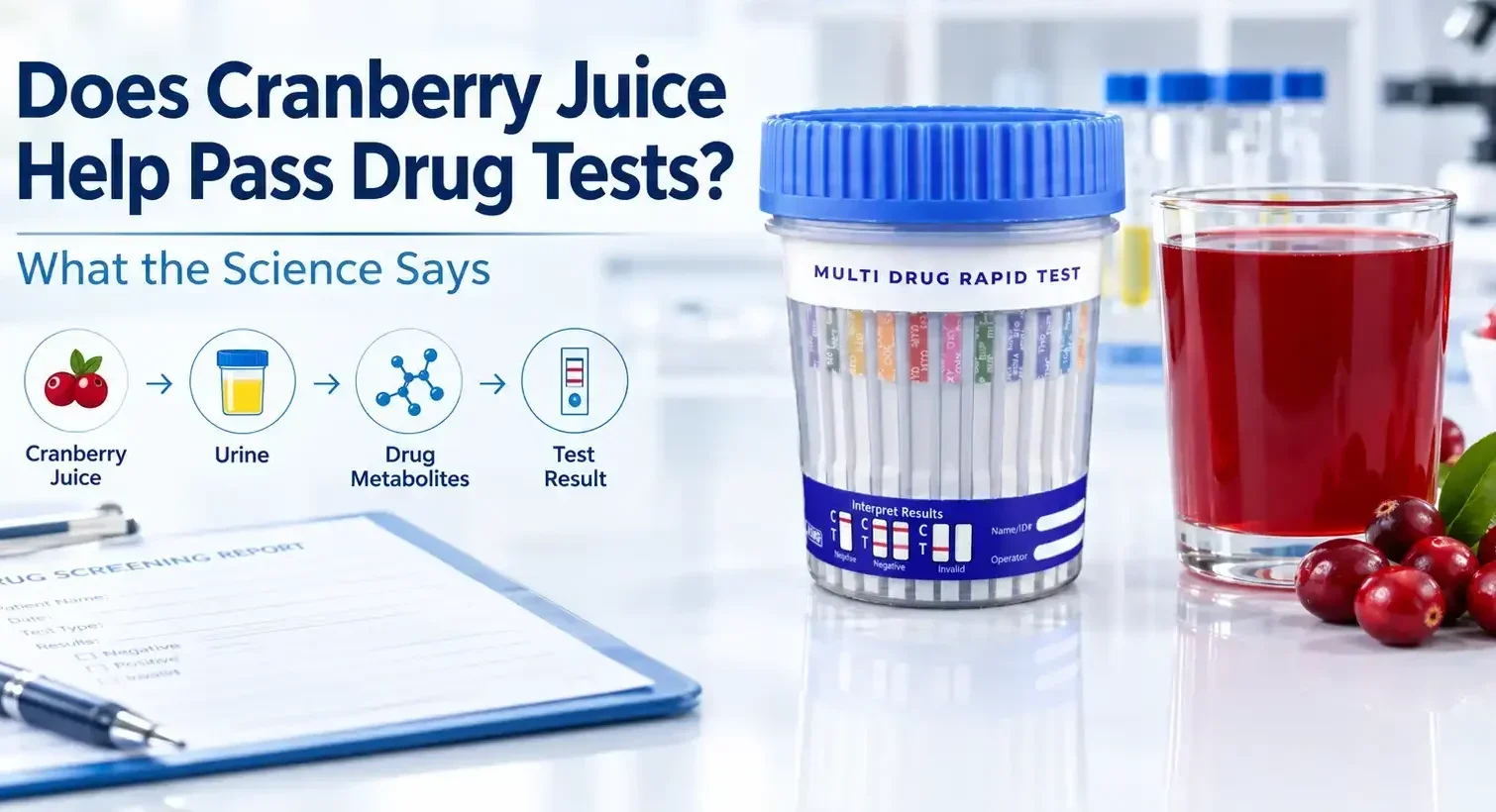
Does Cranberry Juice Help Pass Drug Tests?
No. Cranberry juice has not been shown to reliably remove drug metabolites from the body or make a positive drug test negative.
The idea that cranberry juice can help someone pass a drug test probably comes from its association with urinary health and the belief that drinking more fluids can “flush” unwanted substances from the body. However, urinating more often is not the same as eliminating drug metabolites faster.
Cranberry products have been studied primarily for urinary-tract health, particularly the possible prevention of recurrent urinary tract infections (UTIs). The National Center for Complementary and Integrative Health (NCCIH) notes that cranberry may reduce the risk of recurrent UTIs in some women, although the evidence is limited and inconsistent. This research does not establish cranberry juice as a method for clearing drugs from the body.
To understand why, it helps to look at what a drug test actually measures.
How Drug Tests Work
A drug test does not simply ask whether you recently drank something or how frequently you urinate. It looks for specific drugs or drug metabolites in a biological specimen.
A metabolite is a substance produced when the body processes a drug. Depending on the substance and the type of test, testing may look for the original drug, a metabolite, or both.
Common specimen types include:
- Urine
- Blood
- Oral fluid (saliva)
- Hair
Urine testing is particularly common because urine can contain detectable drug metabolites after the parent drug has been metabolized and eliminated.
Federal workplace drug-testing programs, for example, use defined testing procedures and specimen-validity measures for urine specimens.
The basic process
The overall process can involve:
Drug use → metabolism → drug/metabolite formation → elimination → specimen collection → laboratory analysis
Cranberry juice does not have an established mechanism that simply interrupts this process and removes drug metabolites before testing.
Why Do People Think Cranberry Juice Works?
The cranberry juice drug-test myth has several possible sources.
One is the general idea that certain drinks can “clean” the urinary system. Cranberry is strongly associated with bladder and urinary health, so it is easy to see how that reputation could become confused with drug detoxification.
Another misconception is:
More urine = fewer drug metabolites = negative drug test.
That isn’t necessarily true.
Increasing the amount of fluid in the body can affect urine concentration, but it does not mean the body has suddenly metabolized and eliminated all of the drug metabolites.
This distinction is extremely important.
Urine dilution is not the same as drug elimination
Imagine that a urine specimen contains a measurable concentration of a drug metabolite.
Adding more water to the body’s fluid intake can potentially make urine less concentrated. But the underlying metabolites may still be present in the body.
That’s very different from actually speeding up the biochemical processes responsible for metabolizing and eliminating the substance.
What Does Cranberry Juice Actually Do?
Cranberry is a fruit that contains compounds including proanthocyanidins (PACs).
Cranberry products have been researched primarily in relation to urinary-tract health. NCCIH explains that cranberry may help prevent some recurrent UTIs, potentially because compounds in cranberries can interfere with bacterial attachment to the bladder wall. However, cranberry isn’t recommended as a treatment for an existing UTI.
That is a very different biological process from removing drug metabolites.
Cranberry juice and drug metabolism are different things
There is no good evidence that drinking cranberry juice:
- Breaks down THC metabolites
- Removes cocaine metabolites
- Removes amphetamine metabolites
- Removes opioid metabolites
- Accelerates the body’s overall drug clearance enough to reliably change a drug-test result
- Masks every type of drug metabolite
- Guarantees a negative urine drug test
So while cranberry may have a role in urinary health, that doesn’t make it a drug-test detoxification method.
Does Cranberry Juice Clean Your Urine?
No—not in the sense required to reliably change a drug-test result.
“Clean urine” is a phrase commonly used online, but urine isn’t simply a container of toxins that can be washed clean by a particular beverage.
The kidneys continuously filter blood and produce urine. Drug metabolites can be eliminated through normal physiological processes, but the rate at which this happens depends on many factors.
These can include:
- The substance involved
- Dose
- Frequency of use
- Time since use
- Individual metabolism
- How the substance is processed by the body
- The specimen being tested
- The laboratory’s analytical method
- The test’s cutoff criteria
A beverage cannot be assumed to override all of these variables.
Does Cranberry Juice Help With a Urine Drug Test?
There is no reliable evidence that cranberry juice can make a urine drug test negative when the relevant drug or metabolite remains above the test’s reporting threshold.
This is particularly important because urine drug testing can involve both drug analysis and specimen-validity testing.
SAMHSA describes specimen-validity testing as a way to identify urine specimens that may be diluted, adulterated, or substituted. Measures can include characteristics such as creatinine and specific gravity.
Therefore, trying to influence a test simply by consuming unusually large amounts of fluid is not equivalent to actually clearing the substance from the body.
Can Cranberry Juice Dilute Urine?
The more accurate way to describe this is:
Large amounts of fluid can produce more dilute urine, but cranberry juice itself is not a proven drug-test dilution method.
Urine concentration naturally changes throughout the day based on factors such as fluid intake and normal physiology.
Laboratories can evaluate urine concentration and specimen validity.
Creatinine
Creatinine is a normal substance found in urine. Very low creatinine can be one indicator that a specimen is unusually dilute.
Specific gravity
Specific gravity provides information about the concentration of dissolved substances in urine.
SAMHSA materials describe creatinine and specific gravity as measures that can be used in evaluating urine specimens for dilution and other validity concerns.
Why this matters
A laboratory doesn’t necessarily interpret a highly diluted specimen as proof that no drug metabolites are present.
Depending on the testing program and laboratory findings, a specimen can be reported as dilute or otherwise require additional action.
SAMHSA’s guidance also distinguishes a negative drug result from a specimen that has validity concerns.
What Is a Dilute Urine Sample?
A dilute urine specimen is a specimen with unusually low concentration of certain urine components.
Dilution can occur for different reasons, including unusually high fluid intake, and it isn’t automatically evidence that someone deliberately manipulated a specimen.
This is important because urine concentration varies naturally.
A dilute specimen also doesn’t necessarily mean that the underlying drug-testing question has been answered.
For example:
Negative + acceptable specimen validity
is different from:
Negative + dilute specimen
The exact consequences of a dilute result depend on the testing program and its rules.
Does Cranberry Juice Help With a THC Drug Test?
Cranberry juice has not been proven to eliminate THC metabolites quickly enough to reliably change a THC drug-test result.
THC is processed by the body into metabolites, including THC-COOH, which can be detected in certain types of testing.
How long cannabis-related compounds remain detectable varies considerably.
Important factors include:
- Frequency of cannabis use
- Amount used
- Time since last use
- Individual metabolism
- Test type
- Test sensitivity
- Laboratory cutoff
This is why there is no single number that accurately describes the detection window for every person.
Drinking cranberry juice does not eliminate these variables.
Can Cranberry Juice Mask Drug Metabolites?
There is no reliable evidence that cranberry juice chemically masks drug metabolites in a standard drug test.
A common misconception is that the acidity of cranberry juice can somehow interfere with laboratory drug testing.
That’s not a dependable mechanism for producing a negative test.
Modern drug-testing methods are designed to identify specific drug analytes or metabolites. Initial testing can be followed by more specific laboratory analysis when required. SAMHSA materials describe immunoassay screening and confirmatory testing procedures used in drug-testing programs.
The acidity of a beverage should not be confused with chemically destroying a drug metabolite in the body.
Does Cranberry Juice Work for Blood, Saliva, or Hair Drug Tests?
There is also no evidence that cranberry juice provides a reliable way to pass these other testing methods.
Blood drug tests
Blood testing measures substances in the bloodstream. Detection characteristics differ from urine testing, and cranberry juice doesn’t provide a proven way to eliminate target compounds on demand.
Oral fluid or saliva tests
Oral-fluid testing examines a different specimen from urine and has its own analytical procedures and detection characteristics.
Drinking cranberry juice does not provide a reliable method for removing drug-related analytes from an oral-fluid test.
Hair drug tests
Hair testing works differently again. It can provide a longer-term record of exposure to certain substances than many urine tests.
Cranberry juice cannot “wash” drug metabolites out of hair.
The key point
A drink cannot be treated as a universal solution for different types of drug tests.
Each specimen type has different biology, collection procedures, detection characteristics, and laboratory methods.
Does Cranberry Juice Speed Up Drug Metabolism?
There is no established evidence that cranberry juice meaningfully accelerates the metabolism of drugs for the purpose of passing a drug test.
Drug metabolism involves complex biochemical processes, many of which occur in the liver.
The body then eliminates substances and their metabolites through pathways that can involve the kidneys, urine, feces, and other routes.
The speed of this process varies by substance and individual.
Simply increasing urine output does not mean that the liver has suddenly metabolized a substance faster.
This is one of the biggest misunderstandings behind the cranberry juice drug-test myth.
Cranberry Juice vs. Water for a Drug Test
People sometimes ask whether cranberry juice is better than water before a drug test.
The important distinction is that neither beverage should be presented as a proven method for rapidly clearing drug metabolites from the body.
Water is essential for normal hydration, and adequate hydration is important for health. But excessive fluid consumption can produce abnormally dilute urine.
Cranberry juice adds its own nutritional components and, depending on the product, can contain substantial amounts of sugar.
There is no good reason to assume that cranberry juice has a special drug-clearing advantage over ordinary fluids.
How Long Do Drug Metabolites Stay Detectable?
There is no universal “drug test detox time.”
Detection depends on multiple variables.
Factors that influence detection include:
1. The substance
Different drugs produce different metabolites and have different pharmacokinetic properties.
2. Frequency of use
Someone who uses a substance occasionally can have a different detection pattern from someone who uses it frequently.
3. Amount used
Dose can influence the amount of substance and metabolites available for detection.
4. Time since use
As time passes, substances are generally metabolized and eliminated, but the exact timeline varies.
5. Individual biology
Metabolism and elimination can vary substantially between individuals.
6. Specimen type
Urine, blood, oral fluid, and hair have different detection characteristics.
7. Test method
Different analytical methods and cutoff levels can affect whether a substance is reported.
For these reasons, online claims promising that a particular juice can clear drugs within a specific number of hours should be treated cautiously.
Does Cranberry Juice Detox Your System?
The word “detox” is often used loosely online.
Your body already has physiological systems responsible for processing and eliminating substances, including the liver and kidneys.
Cranberry juice should not be confused with a medically established treatment that rapidly removes recreational drugs or their metabolites.
Cranberry products may have other health-related uses. NCCIH’s review focuses primarily on urinary-tract health and notes that evidence for preventing recurrent UTIs is limited and inconsistent.
That evidence should not be extended into a claim that cranberry juice detoxifies drug metabolites.
Cranberry Juice and Urinary Health
This distinction deserves attention because it explains where much of the confusion comes from.
Cranberries contain proanthocyanidins, which have been studied for their potential effect on bacterial adhesion in the urinary tract.
According to NCCIH, cranberry products may reduce the risk of symptomatic recurrent UTIs in some women, although study results aren’t completely consistent. Cranberry isn’t recommended as a treatment for an existing UTI.
So:
| Cranberry-related claim | What the evidence says |
|---|---|
| Cranberry can support urinary health | Some evidence, particularly around recurrent UTI prevention |
| Cranberry treats an existing UTI | Not recommended as a replacement for treatment |
| Cranberry removes drug metabolites | Not established |
| Cranberry guarantees a negative drug test | No |
| Cranberry speeds drug metabolism | Not established |
| Cranberry can reliably mask THC | No reliable evidence |
This is the key distinction your readers need to understand.
Common Myths About Cranberry Juice and Drug Tests
Myth 1: Cranberry juice flushes drugs out of your body
Fact: Cranberry juice has not been shown to reliably accelerate the elimination of drug metabolites.
Myth 2: Cranberry juice makes urine “clean”
Fact: Urine concentration can change with fluid intake, but dilution is not equivalent to removing drug metabolites.
Myth 3: Cranberry juice can guarantee a negative drug test
Fact: No cranberry product can guarantee a negative result.
Myth 4: Cranberry juice destroys THC metabolites
Fact: There is no established evidence that drinking cranberry juice destroys THC metabolites in the body.
Myth 5: More cranberry juice means faster detox
Fact: Consuming more does not establish a faster drug-clearance process.
Myth 6: Cranberry juice changes every type of drug test
Fact: Urine, blood, oral fluid, and hair testing use different specimens and have different detection characteristics.
What About Cranberry Concentrate or Cranberry Pills?
Another common question is whether concentrated cranberry products work better than ordinary cranberry juice.
There is no established evidence that cranberry concentrate or cranberry supplements can reliably clear drug metabolites or produce a negative drug-test result.
In fact, cranberry products can differ substantially in their composition.
NCCIH notes that processing can affect the concentration of cranberry compounds such as proanthocyanidins.
Therefore, it would be incorrect to assume:
more concentrated cranberry = faster drug clearance.
Those are two separate concepts.
Can Drinking Too Much Cranberry Juice Be Harmful?
Cranberry juice isn’t automatically dangerous, but consuming very large amounts isn’t a good drug-testing strategy—and there is no established benefit to doing so.
NCCIH reports that large amounts of cranberry can cause gastrointestinal symptoms such as stomach upset and diarrhea. It also notes conflicting evidence concerning interactions with the blood thinner warfarin.
Depending on the product, cranberry juice can also contain significant amounts of added sugar.
If you take prescription medications, especially anticoagulants such as warfarin, discuss cranberry products with your healthcare professional.
What Actually Determines a Drug-Test Result?
Rather than focusing on a particular beverage, it is more useful to understand the factors that influence testing.
Substance
Different substances have different metabolic pathways.
Dose and frequency
The amount and frequency of use can affect how much of a substance and its metabolites are present.
Time
Time is an important factor in natural drug elimination.
Individual metabolism
People don’t all process substances at identical rates.
Specimen type
Urine, blood, oral fluid, and hair testing provide different windows and analytical information.
Laboratory cutoff
A test result is interpreted according to the analytical and reporting criteria used by the particular testing program.
Specimen validity
For urine testing, laboratories may assess whether the specimen has characteristics consistent with an acceptable human urine sample. Measures can include creatinine and specific gravity.
How to Prepare for a Drug Test Responsibly
There isn’t a scientifically established juice or beverage that can guarantee a negative drug test.
If you have an upcoming test, the most responsible approach is to avoid relying on internet “detox” claims or products that promise instant results.
Instead:
- Follow the instructions provided by the testing organization.
- Maintain normal hydration rather than intentionally overhydrating.
- Don’t assume cranberry juice or another beverage can remove drug metabolites.
- Be aware that detection windows vary considerably.
- If you have questions about a medication or legitimate prescription, discuss it with your healthcare provider or the appropriate testing professional.
- If the test is part of medical treatment or substance-use care, be open with your healthcare professional about relevant medications and substances.
Frequently Asked Questions
Does cranberry juice help pass drug tests?
No. Cranberry juice has not been scientifically established as a reliable way to eliminate drug metabolites or produce a negative drug-test result.
Does cranberry juice help you pass a urine drug test?
There is no reliable evidence that cranberry juice can turn a positive urine drug test into a negative one. Large amounts of fluid can affect urine concentration, but dilution is not the same as eliminating drug metabolites.
Can cranberry juice mask drugs in urine?
Cranberry juice isn’t a proven masking agent. Drug-testing laboratories can also perform specimen-validity checks on urine samples.
Does cranberry juice help with a THC drug test?
No reliable evidence shows that cranberry juice rapidly eliminates THC metabolites or reliably changes the outcome of a THC drug test.
Does cranberry juice clean your urine?
Cranberry juice may be associated with urinary health, but “cleaning” urine of drug metabolites is not an established effect of cranberry juice.
Does cranberry juice speed up drug metabolism?
There is no established evidence that cranberry juice meaningfully accelerates drug metabolism enough to affect a drug-test result.
Can cranberry juice cause a dilute urine sample?
Large amounts of fluid can contribute to dilute urine. However, whether a specimen is classified as dilute depends on the specimen’s characteristics and the testing program’s criteria. SAMHSA describes measures including creatinine and specific gravity in urine specimen validity testing.
Does cranberry juice work for blood drug tests?
There is no established evidence that cranberry juice can reliably remove substances from blood quickly enough to change a blood drug-test result.
Does cranberry juice work for saliva drug tests?
Cranberry juice is not a scientifically established method for changing the outcome of an oral-fluid drug test.
Does cranberry juice work for hair drug tests?
No. Drinking cranberry juice does not provide a reliable way to remove drug-related compounds from hair.
Is cranberry juice a detox drink?
Cranberry juice can be part of a normal diet, and cranberry products have been studied for urinary health. But it should not be described as a proven drug-detoxification treatment.
Is cranberry juice good for urinary health?
Cranberry products may help reduce the risk of recurrent UTIs in some women, although the evidence is limited and inconsistent. They are not recommended as a treatment for an existing UTI.
Is cranberry juice better than water for passing a drug test?
There is no evidence that cranberry juice provides a reliable drug-testing advantage over water. Neither should be treated as a proven way to rapidly clear drug metabolites.
Does Cranberry Juice Help Pass Drug Tests?
Cranberry juice does not have a scientifically established ability to make someone pass a drug test.
Its reputation comes largely from its association with urinary health and the misconception that increasing urination automatically removes drug metabolites faster.
The important distinction is:
Urinary health ≠ drug detoxification.
Urine dilution ≠ metabolite elimination.
Cranberry juice ≠ a guaranteed negative drug test.
Cranberry products may have a role in urinary-tract health, particularly in relation to recurrent UTI prevention for certain populations, but that evidence should not be interpreted as evidence that cranberry juice clears THC, cocaine, opioids, amphetamines, or other drug metabolites from the body.
Drug-test results depend on the substance, metabolism, time since use, individual factors, specimen type, testing method, and laboratory criteria. For urine testing, specimen-validity measures can also help laboratories identify unusually dilute or otherwise unsuitable specimens.
So if you’re wondering, “Does cranberry juice help pass drug tests?” the evidence-based answer is no—not reliably, and not because it can somehow flush drug metabolites out of your system.




