
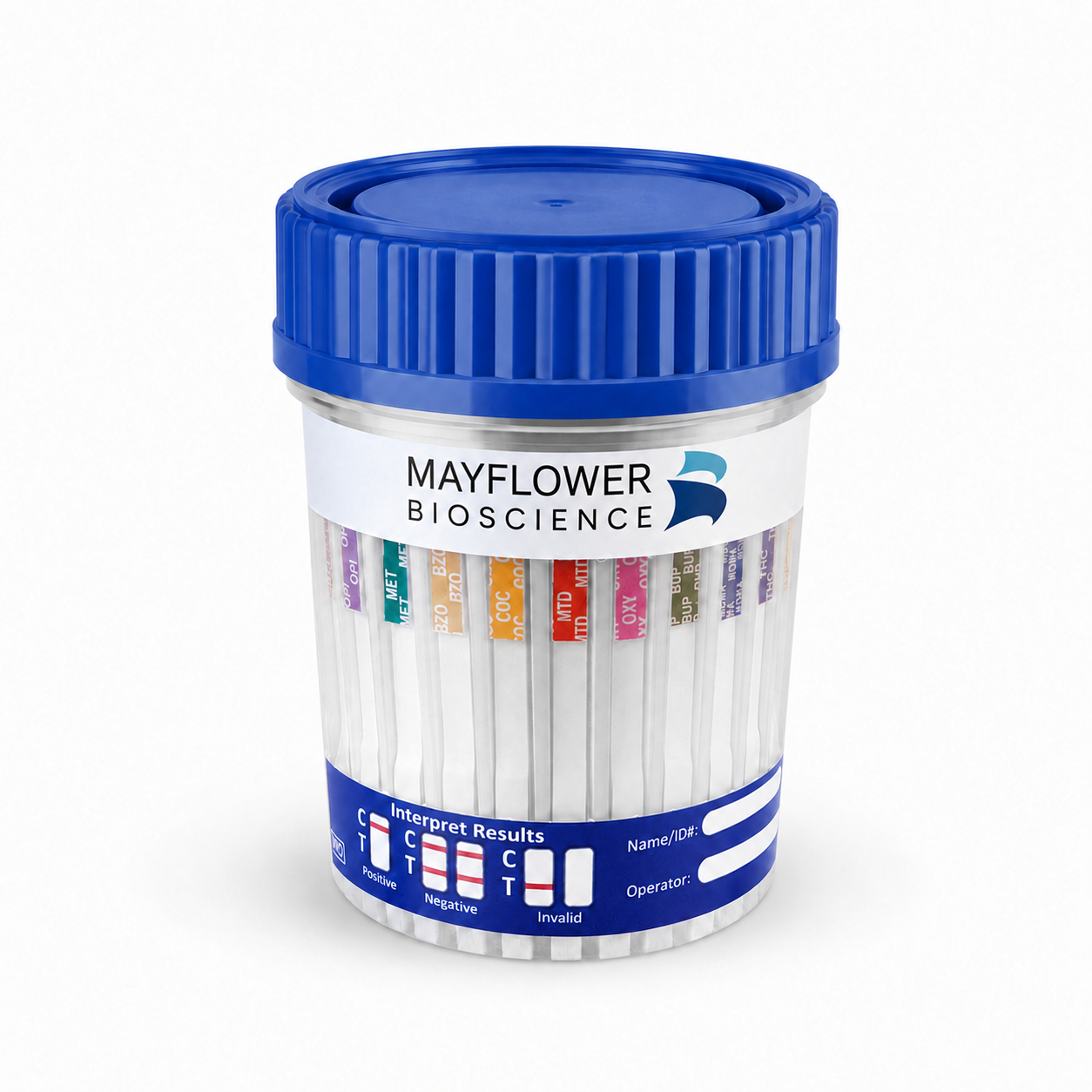
An ETG alcohol panel detects ethyl glucuronide, a direct metabolite of ethanol, revealing alcohol consumption up to about 80 hours after drinking — far beyond the few hours a breathalyzer covers. For abstinence monitoring, probation, treatment programs, and workplace alcohol policies, ETG is the standard for rapid urine alcohol screening. MayFlower supplies ETG-inclusive cups in 12, 14, and 16 panel configurations. See how this fits into our complete line of wholesale drug test supplies.
12 Panel Drug Test Cup with Alcohol, ETG & Fentanyl (120ml) — pairs ETG alcohol with fentanyl detection, 5-minute results, temperature strip. View the 12 panel cup.
14 Panel Drug Test Cup with PCP, ETG & Fentanyl — forensic-use configuration with ETG, fentanyl, and PCP for justice-system programs. View the 14 panel cup.
16 Panel Drug Test with Kratom, Alcohol, ETG, TCA & Fentanyl — ETG alongside kratom, TCA, and fentanyl for maximum coverage. View the 16 panel cup.
Our ETG panels use a 300 ng/mL cutoff. Detection windows vary by consumption and individual factors, but ETG can typically be detected up to about 80 hours after alcohol use — making it far more useful for abstinence monitoring than tests that only capture the last few hours.
Probation and court-ordered abstinence monitoring; substance-use treatment and sober living programs; workplace alcohol policies; family and dependency proceedings. ETG screening works best as part of a panel — paired with drug analytes — so alcohol and drug use are assessed in one collection.
Volume pricing, free shipping on 100+ cups, and same-day dispatch from US stock. See wholesale terms.
An ETG test detects ethyl glucuronide, a direct metabolite your body produces after drinking alcohol. Because ETG remains in urine long after ethanol itself is gone, ETG testing extends the alcohol detection window to up to about 80 hours — the standard tool for abstinence monitoring in courts, treatment, and probation programs.
ETG is typically detectable for up to about 80 hours after drinking, depending on the amount consumed, individual metabolism, and the test cutoff. Heavy drinking is detectable longer than a single drink. This window is why ETG — not a breathalyzer — is used to verify several days of abstinence.
MayFlower cups use an ETG cutoff of 300 ng/mL, a threshold chosen to identify genuine alcohol consumption while reducing the chance that incidental exposure (for example hand sanitizer or mouthwash) triggers a positive. Programs with zero-tolerance policies sometimes confirm low-level ETG positives with laboratory LC-MS/MS testing.
Incidental exposure can produce low levels of ETG, which is exactly why cutoff selection and confirmation policies matter. A 300 ng/mL cutoff screens out most incidental exposure while still detecting drinking. When a result is disputed or carries serious consequences, accredited laboratories confirm ETG quantitatively by LC-MS/MS.
Drug courts and DUI programs verifying court-ordered abstinence, probation and parole departments, inpatient and outpatient addiction treatment, transplant and liver programs, family courts, and safety-sensitive employers. Any program where ‘did not drink this weekend’ must be verified objectively uses ETG. See the ETG alcohol drug test cups collection.
A breathalyzer measures alcohol present in the body right now — a window of hours. An ETG urine test measures a metabolite that documents drinking over the past several days. Programs use breath tests for immediate impairment checks and ETG cups for abstinence compliance over time.
Yes. ETG is integrated into multi-panel cups — the 12 panel cup with ETG and fentanyl, the 14 panel cup, and the 16 panel cup — so one collection covers both drug screening and alcohol abstinence. This eliminates separate alcohol testing and simplifies chain of custody.
No. ETG is a qualitative or semi-quantitative marker: it shows that alcohol was consumed within the detection window, not the precise amount or time. Higher concentrations generally suggest heavier or more recent drinking, but results should be interpreted as evidence of use, and disputed results confirmed by a laboratory.
Like every immunoassay strip: two lines (C and T) mean negative — ETG below the 300 ng/mL cutoff — and one line at C only means a preliminary positive. A faint test line still counts as negative. Read at 5 minutes, verify specimen temperature (90–100 °F) at collection, and document the result per program policy.
Store cups at room temperature (2–30 °C), protect from freezing, and rotate stock by the printed expiration date for reliable sensitivity. Programs order by the case with volume-tiered pricing and free shipping on 100+ cups — see the wholesale collection for case quantities.