
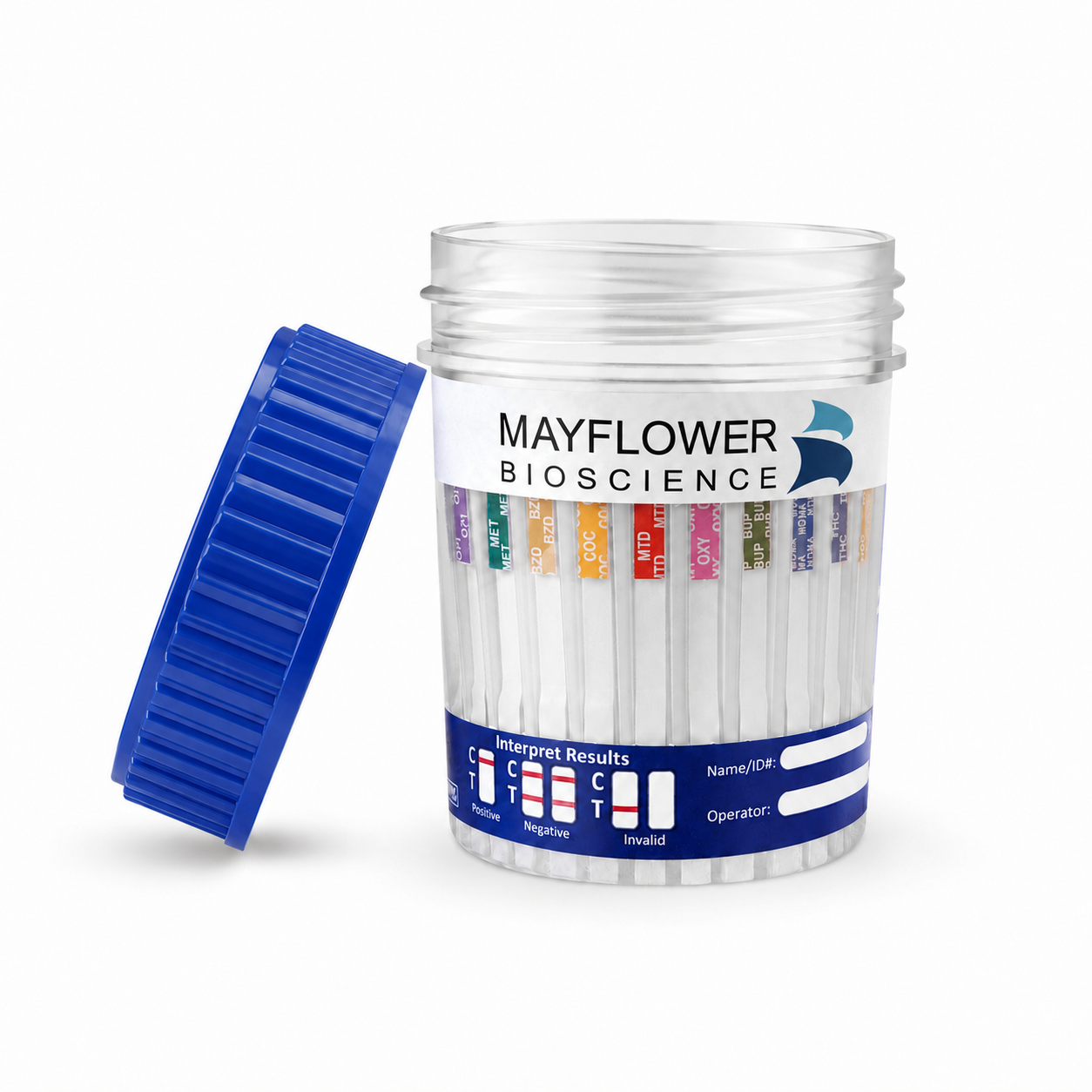
Standard opiate (OPI) screens do not detect fentanyl. A dedicated fentanyl (FEN) panel at a 20 ng/mL cutoff is the only reliable way to screen for synthetic opioid exposure in a rapid urine cup. MayFlower Bioscience supplies fentanyl-inclusive cups in 12, 14, and 16 panel configurations — engineered for programs facing today’s synthetic opioid risk. Browse all multi-panel drug test cups to find the right configuration for your program.
14 Panel Drug Test Cup with PCP, ETG & Fentanyl — forensic-use configuration pairing fentanyl with ETG alcohol and PCP for justice-system and monitoring programs. View the 14 panel cup.
12 Panel Drug Test Cup with Alcohol, ETG & Fentanyl (120ml) — fentanyl plus ETG alcohol detection in a 12 panel format, with 5-minute results and temperature strip. View the 12 panel cup.
16 Panel Drug Test with Kratom, Alcohol, ETG, TCA & Fentanyl — maximum coverage adding fentanyl to kratom, TCA, and ETG panels. View the 16 panel cup.
Traditional opiate panels target morphine-based metabolites (heroin, morphine, codeine). Fentanyl is a synthetic opioid with a different structure — it requires its own immunoassay panel. Programs relying on opiate-only screening can miss fentanyl exposure entirely, which is why dedicated FEN panels have become essential for probation, treatment, workplace safety, and clinical intake screening.
Our cups use a 20 ng/mL cutoff for fentanyl — the industry-recognized threshold balancing sensitivity with low false-positive risk. Pairing fentanyl with ETG alcohol detection closes the two most common gaps in one collection, which is why our 14 and 16 panel configurations include both.
Volume pricing with free shipping on 100+ cups and same-day dispatch from US stock. See wholesale terms.
Fentanyl is a fully synthetic opioid with a chemical structure different from natural opiates like morphine and codeine. Standard opiate (OPI) immunoassay strips are calibrated for morphine-like structures, so they do not reliably react to fentanyl or its metabolite norfentanyl. Detecting fentanyl requires a dedicated FEN strip — which is why MayFlower builds fentanyl panels into its 12, 14, and 16 panel cups.
MayFlower fentanyl (FEN) strips use a 20 ng/mL cutoff in urine, a threshold aligned with common workplace and justice screening practice. Results are preliminary: a non-negative screen that carries consequences should be confirmed by a certified laboratory using LC-MS/MS, which can also quantify fentanyl and norfentanyl.
Fentanyl is typically detectable in urine for about 1–3 days after use. Its metabolite norfentanyl can remain detectable longer, particularly after repeated or heavy use. Detection depends on dose, frequency, metabolism, and the strip cutoff — programs testing for fentanyl compliance usually test frequently because the window is short.
FEN refers to fentanyl-specific immunoassays, while FYL is used by some manufacturers for fentanyl-class screening that may cross-react with certain analogs. Either way, the strip targets fentanyl rather than morphine-based opiates. MayFlower panels list the strip as FEN with a 20 ng/mL cutoff; see the fentanyl drug test cups collection for configurations.
MAT and substance-use treatment programs monitoring relapse risk, pain management clinics, drug courts and probation departments, pre-employment programs in safety-sensitive industries, and families served by sober living homes. Fentanyl is involved in the majority of opioid overdose deaths, so programs that screen opiates without a fentanyl strip have a dangerous blind spot.
No. The FEN strip is specific to fentanyl; heroin is detected through the opiate (OPI) strip via its morphine metabolite, and oxycodone has its own OXY strip on multi-panel cups. Comprehensive opioid screening requires all three — OPI, OXY, and FEN — which MayFlower multi-panel configurations combine in a single collection.
Three configurations include FEN: the 12 panel cup with ETG and fentanyl, the 14 panel cup with PCP, ETG, and fentanyl, and the 16 panel cup with kratom, ETG, TCA, and fentanyl. Choosing between them depends on whether your program also needs alcohol (ETG), PCP, or kratom coverage.
Fentanyl immunoassays are highly specific, but no screen is perfect — cross-reactivity and specimen mix-ups are possible, and results are presumptive by design. Programs verify specimen validity at collection (temperature 90–100 °F) and confirm preliminary positives by LC-MS/MS before acting on them.
Because fentanyl clears urine quickly, effective programs test frequently and unpredictably, pair FEN-inclusive cups with ETG alcohol screening, and treat a confirmed positive as a clinical signal to adjust treatment rather than only a violation. The 14 and 16 panel MayFlower cups are built for exactly this combined monitoring.
FEN-inclusive cups follow the same volume tiers as the rest of the MayFlower range — per-cup pricing falls as quantities rise, with free shipping on 100+ cups and same-day dispatch. See the wholesale drug test cups collection for case pricing.