

ICH S7B Mapped hERG Assay Methods for Discovery Teams
Whole cell patch clamp, performed manually or through validated automated platforms, remains the regulator accepted gold standard for hERG potency and safety margin data. Fluorescence and ion flux assays earn their place as high throughput triage tools in early discovery, while binding assays serve narrow screening roles. Which method fits depends on program stage and how closely your protocol follows ICH S7B/E14 guidance on temperature and stimulation frequency.
TL;DR:
- Conducting assays at 35 to 37 degrees Celsius and applying 0.2 to 1 Hz stimulation frequency ensures compliance with ICH S7B protocol standards for reliable results.
- Rerunning compounds at different temperatures and verifying seal resistance and current stability prevents artifacts and ensures accurate IC50 determination.
- Using validated cell lines with consistent expression levels and standardizing solution recipes across runs improves assay reproducibility and data quality.
- Building a staged testing cascade with fluorescence screening, APC confirmation, and manual patch for lead compounds optimizes resource use and regulatory compliance.
Table of Contents
- Comparing Assay Families for hERG Screening and Confirmation
- ICH S7B Protocol Essentials Every hERG Assay Must Record
- Setting Up hERG Assays: Cell Lines, Instruments, and Controls
- From Patch Clamp Traces to IC50 and Safety Margin
- Common hERG Assay Artifacts and How to Fix Them
- hERG Cell Lines and Assay Support from Mayflower Bioscience
- Why a Staged Testing Cascade Beats a Single Default Assay
- Get hERG-Ready Data Without Building a Patch Clamp Lab
- FAQ
- Sources
Comparing Assay Families for hERG Screening and Confirmation
Manual whole cell patch clamp delivers the highest accuracy and the cleanest kinetic data, which is why it anchors regulatory submissions. Its cost is throughput: a skilled researcher typically completes about one compound a day, which makes it impractical for broad screening.
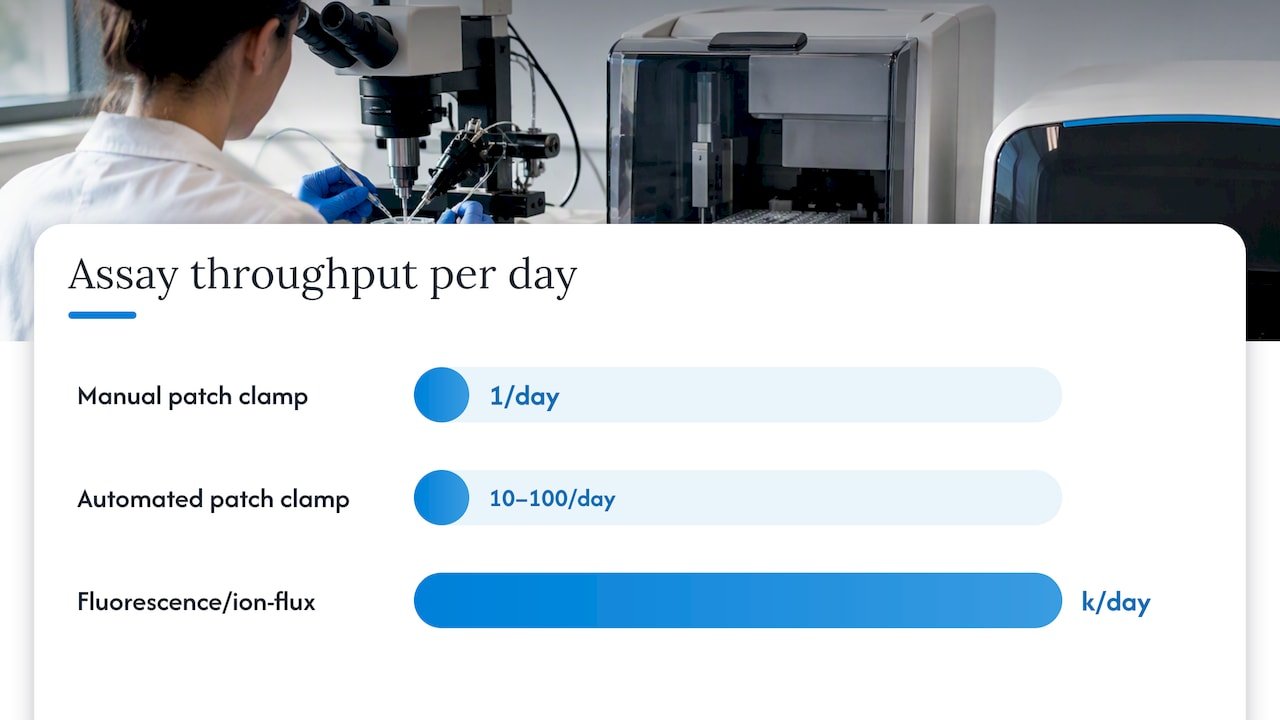
Automated patch clamp (APC) platforms close that gap. Validated APC systems can raise throughput by roughly one to two orders of magnitude over manual recording, making them suitable for screening to lead profiling once their settings are confirmed against manual data during method transfer.
Fluorescence and ion flux assays sit at the top of the throughput pyramid, running thousands of data points a day and showing qualitative agreement with patch clamp for many compounds, according to a membrane potential and thallium flux assay study. They are also the most prone to artifacts: compound fluorescence and off-target effects can generate false positives or negatives, so hits need orthogonal confirmation. Binding or displacement assays have a place in early triage but tell you nothing about functional block kinetics, so they never substitute for an electrophysiological readout.
A practical cascade for most programs:
- Run fluorescence or flux screening first to flag liability across large compound sets.
- Confirm hits on APC, validating settings against manual patch clamp benchmarks.
- Reserve manual patch clamp for lead compounds headed into regulatory packages.
Teams building out high throughput screening infrastructure from scratch may find a researcher’s guide to HTS planning useful for sequencing capacity investment alongside this cascade.
ICH S7B Protocol Essentials Every hERG Assay Must Record
Reviewers expect specific numeric parameters, not general descriptions of method. ICH S7B/E14 Q&A guidance sets out the elements below.
- Temperature: record near physiological temperature, 35 to 37 degrees Celsius, since hERG kinetics and compound potency are temperature sensitive.
- Stimulation frequency: apply 0.2 to 1 Hz for hERG, matching the guidance’s recommended cycling to avoid use dependent artifacts.
- Seal resistance and cell health: maintain a seal resistance of at least 1 gigaohm, and monitor holding current and input resistance for stability before any drug application.
- Concentration and replicate strategy: test at least four concentrations spanning roughly 20 to 80 percent inhibition, with multiple cells per concentration, then apply a saturating blocker such as E-4031 at the end of the run to quantify non-hERG residual current.
- Signal conditioning: filter and digitize consistently, for example a 2 kHz filter with 5 kHz digitization, and apply series resistance compensation where the rig supports it.
Pro Tip: Log seal resistance and holding current at every concentration step, not just at baseline, so a slow drift during the run does not get misread as compound effect.
Setting Up hERG Assays: Cell Lines, Instruments, and Controls
Cell line choice shapes everything downstream. HEK293 and CHO lines both support hERG expression, and the inducible versus constitutive decision affects baseline current consistency and expression control during long campaigns. We offer an hERG cell line (HEK 293) with constitutive expression alongside an hERG cell line (CHO) with inducible expression, each with datasheet and QC data on expression levels and baseline current available on request.
- Check expression consistency and baseline tail current amplitude before committing a line to a campaign.
- Match instrument choice to stage: an APC platform for screening volume, a manual rig for lead confirmation, and a validated plate reader for flux assays.
- Standardize external and internal solution recipes and DMSO handling across runs to avoid solvent-driven variability.
- Include vehicle runs, a positive blocker application, and plate level controls; fluorescence assays should track toward solid Z’ values as a plate quality gate.
From Patch Clamp Traces to IC50 and Safety Margin
Raw traces need quality screening before they become numbers you can defend. Exclude cells with holding current drift, unstable input resistance, or signs of seal loss during the recording, and document why each exclusion happened.
- Calculate fractional block at each concentration and fit the dose-inhibition relationship with the Hill equation to extract IC50 and Hill slope.
- Compute the hERG safety margin as free IC50 divided by free clinical Cmax, applying protein-binding assumptions conservatively rather than optimistically.
- Build reporting tables around per-cell fractional block, replicate counts, and reference compound performance so reviewers can audit the dataset directly.
- Where possible, export data in CiPA Open Data and TED formats, which the FDA’s own analysis work credits with cutting review time from days to hours while enabling pooled meta-analysis across studies.
A standardized pipeline here pays off twice: once in internal confidence, and again when a reviewer can trace every IC50 back to its underlying traces.
Common hERG Assay Artifacts and How to Fix Them
Temperature sensitivity is easy to miss and easy to test: rerun a subset of compounds at a second temperature within the 35 to 37 degree range and compare IC50 shifts before trusting a borderline result. Fluorescent compounds can distort flux and membrane potential readouts directly, so build in counterscreens and confirm ambiguous hits with an orthogonal patch clamp run rather than trusting the optical signal alone.
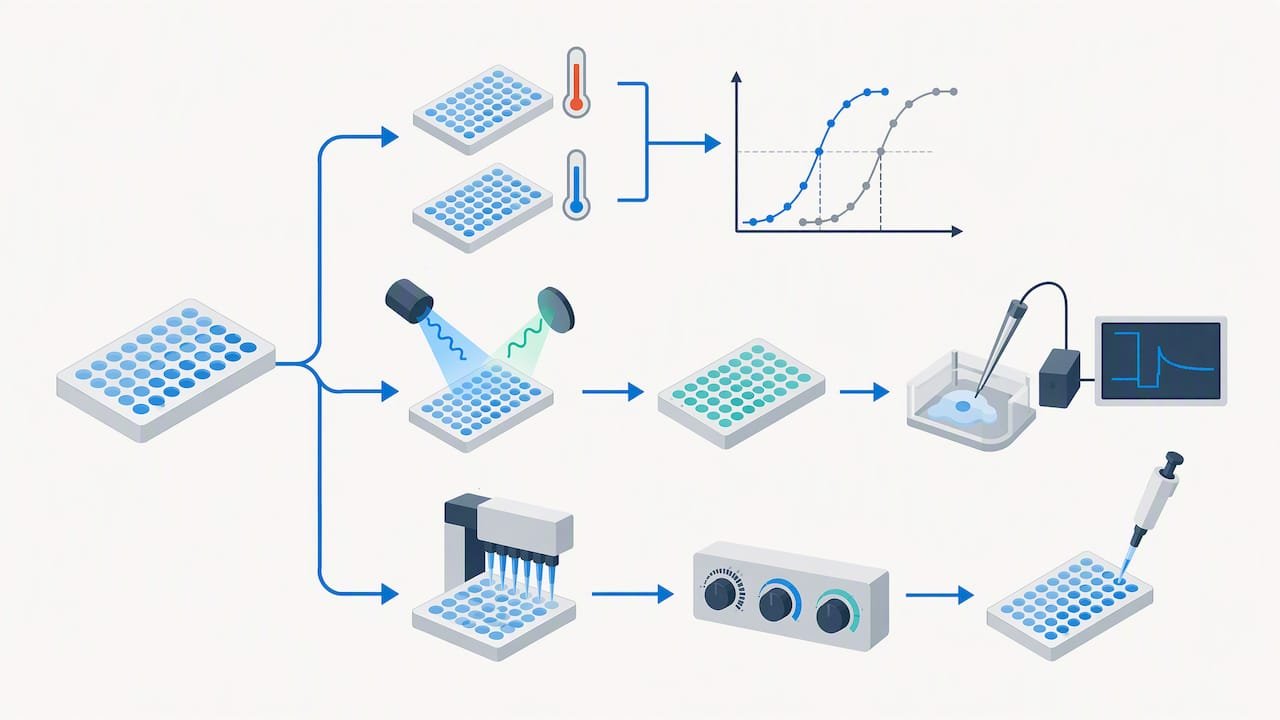
On APC platforms, holding current and input resistance can drift over a plate run, and liquid exchange timing that is too fast or too slow both distort kinetics, so settings need validation against manual benchmarks before full scale use. Poor concentration spacing or thin replicate counts are the quieter failure mode: a dose-response curve built on two concentrations and two cells per point will not hold up to scrutiny.
Pro Tip: When an IC50 looks unusually potent or unusually weak compared to literature for a similar scaffold, check seal resistance and holding current stability before concluding the compound is an outlier.
hERG Cell Lines and Assay Support from Mayflower Bioscience
We carry HEK293 and CHO hERG cell lines in both inducible and constitutive formats, with expression and QC data available by datasheet request. Our ion channel testing and patch clamp services are built around the same ICH S7B elements covered above, including reference compound runs and documentation suited to GLP-friendly workflows, with CiPA COD and TED-capable export on request. Labs that need materials or a testing partner can request a datasheet, ask about a TED or COD export, or submit a sample directly for ion channel testing.
Why a Staged Testing Cascade Beats a Single Default Assay
Programs that default to one assay for every stage either waste money on unnecessary patch clamp hours or carry fluorescence artifacts into decisions they should not touch. A staged cascade, tied to CiPA COD and TED reporting, moves faster and documents its own QC at each handoff, which is what reviewers actually check.
— Alina
Get hERG-Ready Data Without Building a Patch Clamp Lab
Setting up a full patch clamp rig and validating it against ICH S7B parameters takes months that most discovery programs do not have. We give you a faster route to the same regulator-ready endpoint: order validated HEK293 or CHO hERG cell lines, or send compounds to our ion channel testing and patch clamp services for data built around the temperature, stimulation frequency, and seal resistance parameters reviewers expect.

- Request a datasheet for our HEK 293 constitutive or CHO inducible hERG cell lines.
- Ask about a CiPA COD or TED-capable data export for your next submission package.
- Get a cost estimate for ion channel testing through our bioassays page.
This article is general information, not a substitute for advice from a qualified doctor. Consult a qualified healthcare professional about your own circumstances before acting on anything here.
FAQ
How does a hERG assay work?
A hERG assay measures how a compound blocks potassium current through the hERG channel, most directly by patch clamping a cell line expressing the channel and recording current before and after compound application. Fluorescence and flux assays estimate the same blockade indirectly through optical signals tied to membrane potential or ion movement.
Is hERG the same as KCNH2?
hERG is the common name for the potassium channel encoded by the KCNH2 gene, so the two terms refer to the same channel viewed from protein and gene perspectives. Assay and regulatory literature typically uses “hERG” when discussing the functional channel being tested.
What is the hERG patch clamp assay used for?
The hERG patch clamp assay measures how strongly a drug candidate blocks the hERG potassium channel, producing the IC50 and safety margin data that cardiac safety reviews rely on. It is considered the regulatory confirmation standard because it captures the actual current kinetics that indirect assays only estimate.
What are hERG channels?
hERG channels are voltage-gated potassium channels in heart muscle cells that help control the timing of the heart’s electrical repolarization. Blocking them can prolong the QT interval, which is why drug candidates are screened against this channel before moving into clinical development.
Sources
- ICH E14/S7B Questions and Answers (Step 4, 2022)
- Streamlining analysis of ion channel in vitro assays data to support clinical cardiac safety decision-making | FDA
- APC vs manual patch clamp throughput (PubMed)
- A new homogeneous high-throughput screening assay for profiling compound activity on the hERG channel (PMC)




