
2–15 min Activation: Hot Start PCR Benefits for Lab Scientists
Hot Start PCR delivers four measurable gains over standard reactions: higher specificity, fewer primer-dimers, better detection of low-copy templates, and reliable room-temperature setup. The gains are largest in multiplex, high-cycle, and low-copy applications, where reagent classes such as antibody-blocked and chemically modified polymerases prevent the pre-cycling mis-priming that erodes data quality. Suppliers stock these formulations specifically because standard Taq struggles under those conditions.
TL;DR:
- Hot Start PCR prevents enzyme activity during setup, significantly reducing mis-priming and primer-dimer formation, especially in multiplex and low-copy applications.
- Activation methods differ: antibody-based systems are fastest but sensitive to DMSO, chemically modified enzymes are slower but more tolerant of additives.
- Wax barriers provide high specificity for low-copy targets but are less suitable for automation, while thermolabile primers offer control at the primer level.
- Proper activation timing and temperature are critical; over- or under-heating can negate Hot Start benefits and lead to low yield.
- Hot Start is most beneficial in high-cycle, multiplex, low-template, and diagnostic workflows, but offers limited gains in routine, single-amplicon reactions with validated primers.
Table of Contents
- What Hot Start PCR Is and Why It Changes Reaction Setup
- Comparing Activation Methods: Antibodies, Chemistry, Wax, and Modified Primers
- The Measurable Benefits: Specificity, Yield, Sensitivity, and Reproducibility
- Where Hot Start PCR Pays Off (and Where It Doesn’t)
- Setting Up and Troubleshooting a Hot Start Protocol
- What the Published Evidence Actually Shows
- Why Hot Start Deserves a Permanent Spot in Your Reagent Fridge
- Product Support for Hot Start Workflows
- Sources
- FAQ
What Hot Start PCR Is and Why It Changes Reaction Setup
Standard Taq polymerase is active the moment it touches primers, template, and Mg2+. That is the problem. During reaction assembly, before the thermal cycler ever reaches denaturation temperature, the enzyme extends primers wherever they happen to bind, including to each other. Hot Start PCR solves this by keeping the polymerase, or a required cofactor, chemically or physically inactive until the reaction hits a defined activation temperature.
Withholding activity until heat activation prevents the enzyme from extending mis-primed events that form at room temperature during pipetting, plate loading, or the ramp up to the first denaturation step. Hot start PCR works by keeping polymerase activity, or a critical reagent, suppressed until the reaction reaches roughly 60°C or higher during that initial denaturation. Below that threshold, nothing meaningful happens. Above it, the reaction proceeds like a conventional PCR.
Activation typically happens during an extended initial denaturation step, commonly several minutes depending on the chemistry, built into the front of the thermal profile before the first annealing cycle. This single hold accomplishes two things at once: it denatures the genomic DNA or cDNA template, and it releases or activates the polymerase.
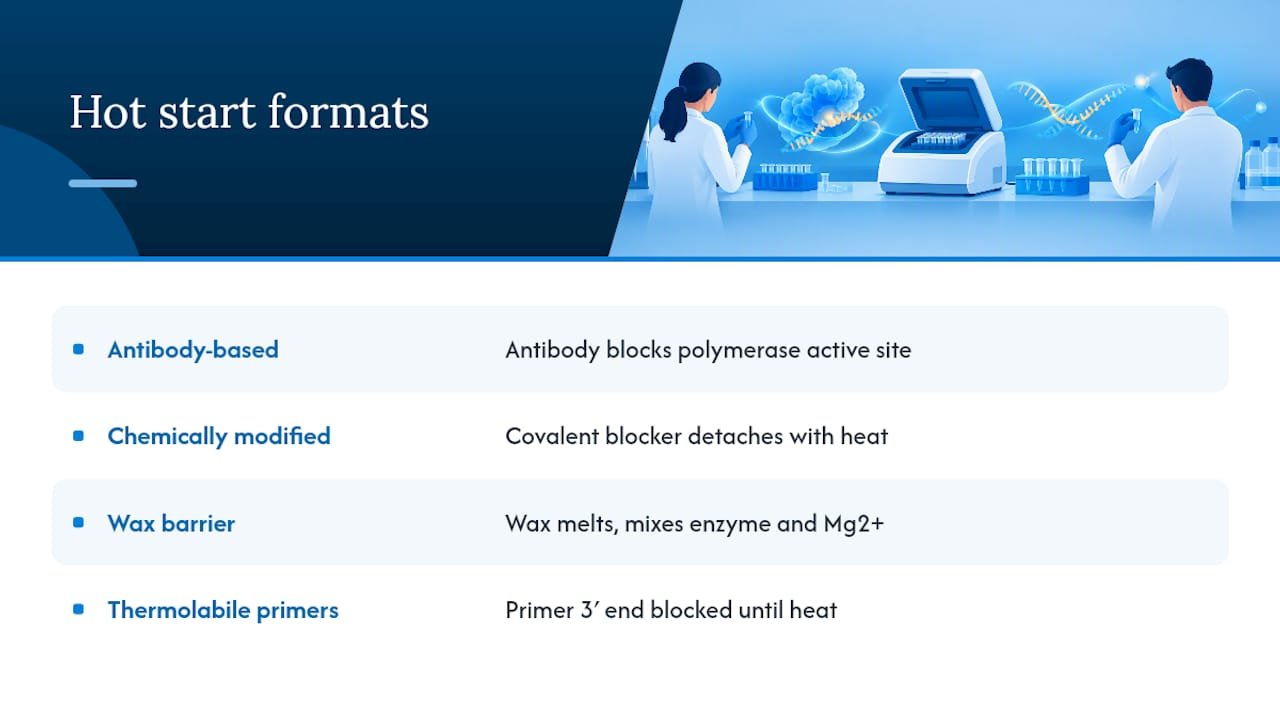
Different Hot Start formats withhold different components. Antibody-based systems block the polymerase’s active site directly. Chemically modified enzymes carry a covalent group on a catalytic residue that only detaches under heat. Wax-barrier formats physically separate the enzyme and Mg2+ from the primers and template until the wax melts. Thermolabile primer chemistries take a different route entirely, blocking the primer’s 3′ end rather than the enzyme. Each strategy solves the same core problem through a different mechanism, and the mechanism you choose has real consequences for your protocol.
Comparing Activation Methods: Antibodies, Chemistry, Wax, and Modified Primers
Four chemistries dominate the Hot Start market, and they are not interchangeable. Each has a distinct activation profile, a distinct compatibility list, and a distinct fit for automated versus manual workflows.
Antibody-inhibited polymerases use a monoclonal antibody bound to the enzyme’s active site. Heat denatures the antibody irreversibly during the initial denaturation step, freeing the polymerase permanently for the rest of the run. Activation is fast, usually a few minutes at 94 to 95°C, and the reaction behaves like standard PCR from that point forward. The catch: these antibody complexes are sensitive to certain cosolvents. Technical guidance on antibody-blocked enzymes warns against combining them with DMSO or formamide, since both can interfere with antibody binding and cause premature or incomplete activation.
Chemically modified polymerases carry a covalent modification, often on a lysine residue near the active site, that blocks catalysis until heat breaks the bond. Activation tends to run longer than antibody systems, often 10 to 15 minutes at 95°C, because the chemistry needs sustained heat to reverse. This makes chemical modification the slower option to activate but generally the most heat-stable and cosolvent-tolerant of the four.
Wax barriers, such as AmpliWax formulations, take a purely physical approach. A solid wax layer sits between the lower reaction components and the upper mix containing primers and template until the first heating step melts it, letting everything combine. This method demonstrably improves specificity and yield for low-copy-number targets, because there is zero enzymatic activity possible before the wax liquefies. It is effective but manual, awkward to automate on liquid-handling robots, and adds a pipetting step most labs would rather avoid at scale.
Thermolabile primer modifications, sometimes called OXP or PTE chemistry, block extension at the primer’s 3′ terminus with a heat-removable group rather than modifying the enzyme at all. Heat activation cleaves the blocking group, releasing a functional primer. Research on this approach shows it meaningfully reduces primer-dimer formation and improves amplification efficiency in primer systems that are otherwise prone to non-specific priming.
Trade-offs across the four, at a glance:
- Antibody systems: fastest activation, but avoid DMSO and formamide additives.
- Chemically modified enzymes: slower activation, the strongest heat and additive tolerance.
- Wax barriers: excellent for low-copy targets, poor fit for automated pipetting.
- Thermolabile primers: primer-level control, useful when the enzyme itself isn’t the issue.
Pro Tip: If your assay depends on DMSO to dissolve a GC-rich primer or improve specificity, skip antibody-based Hot Start entirely and test a chemically modified polymerase or thermolabile primer format instead, since antibody complexes are the chemistry most likely to misbehave with that additive.
For automated, high-throughput qPCR, chemically modified or thermolabile-primer formats tend to win out, since they tolerate standard additives and don’t require an extra wax-melting or layering step.
The Measurable Benefits: Specificity, Yield, Sensitivity, and Reproducibility
Hot Start’s advantages aren’t marketing language. Each one traces to the same root cause: eliminating enzymatic activity before the reaction reaches temperature.
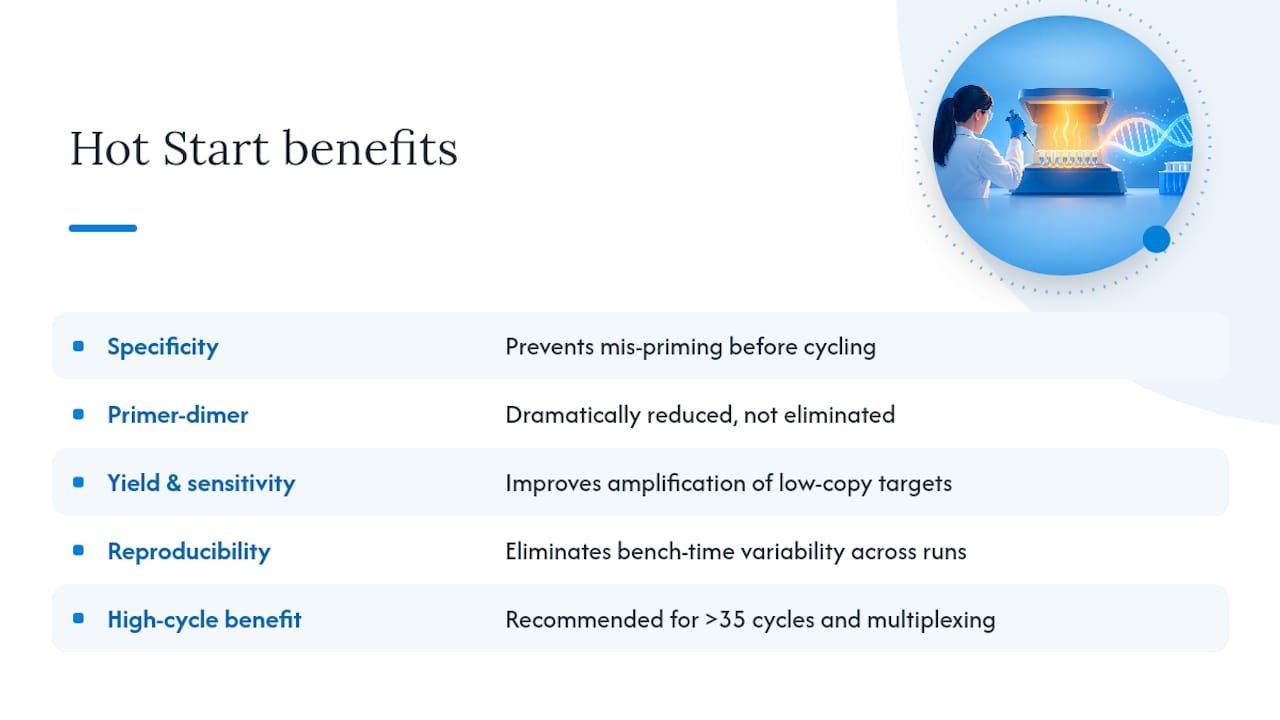
1. Specificity improves because mis-priming never gets a head start. Primers that partially match an off-target site, or that overlap each other at the 3′ end, can extend at room temperature with standard Taq. That extension product then competes in later cycles. Suppressing polymerase activity until 60°C or above removes that window entirely, so only correctly annealed primer-template pairs get extended once the reaction is actually running.
2. Primer-dimer suppression follows the same logic. Primer-dimers form when two primers anneal to each other rather than to the template, most often when there’s a 3′ end overlap of two or three nucleotides or more. Hot Start reduces this dramatically, but it does not eliminate the risk if the primers themselves are poorly designed. Research on primer quality confirms that structural overlap at the 3′ end continues to drive dimer formation even with Hot Start enzymes, meaning good primer design and Hot Start chemistry work together, not as substitutes for each other.
3. Yield and sensitivity gains show up hardest in low-copy templates. When a target is present at just a handful of copies per reaction, even a small fraction of polymerase activity wasted on mis-priming before cycling begins can be the difference between a clean amplicon and no signal at all. Wax-barrier Hot Start experiments on low-copy HIV targets demonstrated that suppressing pre-cycling mis-priming and dimerization measurably improved amplification of single-target molecules even against a heavy background of non-target DNA.
4. Reproducibility improves for room-temperature and automated setups. Standard PCR reactions are technically sensitive to how long they sit at bench temperature before cycling starts. A batch of 96 reactions loaded manually can spend anywhere from two to twenty minutes at room temperature depending on pipetting speed, and that variability translates into run-to-run inconsistency. Hot Start removes that variable because nothing happens enzymatically regardless of how long the plate sits before it goes into the cycler. This matters more for automated liquid handlers, where plate queuing time is often unpredictable, than for a single hand-pipetted reaction run immediately.
5. High-cycle protocols benefit disproportionately. More cycles mean more opportunities for any early mis-primed product to get amplified exponentially alongside the intended target. Manufacturer protocol guidance specifically recommends Hot Start chemistry for high-cycle-number protocols exceeding 35 cycles, multiplex reactions, and difficult genomic or cDNA templates, precisely because those conditions amplify the consequences of early non-specific extension.
Hot Start has real limits, though, and pretending otherwise sets researchers up for disappointment. It cannot fix a fundamentally bad primer pair. If your forward and reverse primers share extensive 3′ complementarity, Hot Start will reduce dimer formation but won’t eliminate a stubborn dimer peak on your gel. And over-activation is a real failure mode: extending the activation step well beyond the reagent’s recommended window, or running it at a temperature below spec, can leave the enzyme only partially active, which shows up as unexpectedly low yield that gets blamed on the template when the real cause is the activation step itself.
Where Hot Start PCR Pays Off (and Where It Doesn’t)
Not every reaction needs Hot Start. It earns its place in specific, predictable scenarios where the alternative is either wasted reagent or a failed diagnostic call.
- Multiplex qPCR, where multiple primer pairs share a single tube and the odds of cross-reactivity between primer sets climb with every additional target added.
- One-step RT-qPCR, where reverse transcription and amplification share a single mix and there’s no clean-up step between them to remove early mis-primed product.
- High-cycle endpoint PCR past 35 cycles, where even a trace of early non-specific amplification gets exponentially amplified alongside the real target.
- GC-rich or structurally complex templates, where primers are more prone to secondary structure and off-target binding in the first place.
- Low-copy clinical or forensic targets, where a handful of template molecules leaves no margin for wasted polymerase activity.
- Diagnostic and CLIA-regulated workflows, where a false positive from primer-dimer misinterpretation carries real consequences and reproducibility is a compliance requirement, not a convenience.
Where Hot Start has marginal benefit: simple, single-amplicon reactions with well-validated, non-overlapping primers and a robust, abundant template. If you’re running a routine colony PCR with primers you’ve used successfully for years, the switch may not move your results much. The category where it earns its cost is exactly where things already tend to go wrong: complex, multiplexed, low-abundance, or regulated work, which is also where Mayflowerbio’s HOT FIREPol® Multiplex qPCR Mix and qPCR and RT-qPCR reagent lines are built to serve.
Setting Up and Troubleshooting a Hot Start Protocol
Getting Hot Start right starts with respecting the activation step, not skipping past it as boilerplate.
- Start conservative on activation time. Antibody-based enzymes typically need 2 to 5 minutes at 94 to 95°C; chemically modified enzymes often need 10 to 15 minutes at 95°C. Always default to the reagent manufacturer’s specific recommendation rather than a generic protocol pulled from a different product’s datasheet, since activation kinetics differ meaningfully between chemistries.
- Titrate activation time when switching suppliers. Moving from one Hot Start chemistry to another without re-optimizing activation time is one of the most common causes of a sudden drop in yield. Hold primer concentration and Mg2+ constant and vary only activation time across a small matrix, which isolates activation kinetics as the single variable and finds the right reactivation point without touching primer design at all.
- Increase annealing temperature by 2 to 3°C if you’re still seeing faint non-specific bands after confirming Hot Start activation is complete. This is often a faster fix than redesigning primers from scratch.
- Titrate Mg2+ in 0.5mM increments if specificity issues persist. Excess Mg2+ stabilizes mismatched primer-template pairs and can undercut the specificity gains Hot Start is supposed to provide.
- Titrate enzyme concentration if yield is low but specificity looks clean. Some Hot Start formats need slightly more active enzyme post-activation than standard Taq to hit comparable yield, particularly chemically modified versions with longer activation windows.
- Cap cycle number to what the application needs. Running 40 cycles when 30 would suffice doesn’t improve results, it just gives any residual non-specific product more chances to amplify.
Troubleshooting flow for persistent problems: If primer-dimers keep showing up on your gel despite confirmed Hot Start activation, the issue is very likely primer design, not the enzyme. Check for 3′ end complementarity between your primer pair and consider redesigning before blaming the chemistry. If yield drops after switching to a new Hot Start reagent, don’t assume the template degraded. Run an activation-time titration against a known positive control template first. That single experiment isolates whether the problem is activation kinetics, the template, or something else in the mix, and it takes far less bench time than troubleshooting blind.
Pro Tip: Before converting a critical diagnostic or publication-bound assay to a new Hot Start reagent, run a small titration against a control template first. An hour of validation up front is far cheaper than discovering a systematic yield problem three months into a study.
The Polymerase Chain Reaction basic protocol literature reinforces this point specifically: activation modifications can meaningfully increase both yield and specificity, but only when balanced against polymerase stability limits and proper annealing temperature optimization. Skip that balancing step and you can undo the benefit you switched chemistries to get.
What the Published Evidence Actually Shows
The specificity and yield claims made throughout this article aren’t theoretical. They trace to a consistent body of peer-reviewed and protocol-level literature spanning multiple Hot Start chemistries.
- Foundational work on Hot Start PCR established the core mechanism: withholding polymerase activity, via antibody, wax, or chemical modification, until the reaction reaches roughly 60°C or higher during initial denaturation, which suppresses pre-cycling mis-priming at its source.
- Research on thermolabile OXP-modified primers demonstrated a marked reduction in primer-dimer formation, along with improved specificity and efficiency, in primer systems that were otherwise problematic under standard cycling.
- Experiments using wax-mediated Hot Start on low-copy HIV targets showed that preventing pre-PCR mis-priming and dimerization substantially improved amplification of single-target molecules, even in reactions containing heavy background genomic DNA that would otherwise compete for primer binding.
- A more recent 2023 report on an alternative low-cost approach, using E. coli-expressed Taq as a hot-start method, found comparable specificity to conventional Hot Start chemistries in some contexts, though the method introduces different handling and contamination considerations that a standard commercial reagent avoids.
- Studies on primer quality independently confirmed that 3′ end complementarity between primers remains a driver of dimer formation regardless of Hot Start chemistry, underscoring that enzyme-level protection and primer-level design are complementary safeguards, not competing solutions.
Taken together, this literature draws a consistent picture: activation temperature and timing are not incidental details, they are the mechanism the entire benefit depends on. Get activation wrong, whether by under-heating, over-heating, or mismatching cosolvents to chemistry, and the specificity gains the studies document simply don’t materialize.
Why Hot Start Deserves a Permanent Spot in Your Reagent Fridge
Hot Start PCR gets treated by some labs as an optional upgrade, something you reach for only when a problematic assay demands it. That framing gets the incentive backwards. The real question isn’t whether your current assay is failing, it’s whether you’d notice if it were failing quietly, through a slightly inflated baseline, a Ct value that’s half a cycle later than it should be, or a primer-dimer peak small enough to dismiss on a gel but large enough to skew a low-copy quantification.
What gets underappreciated in most discussions of Hot Start chemistry is that the choice of activation method matters almost as much as the decision to use Hot Start at all. A lab that defaults to antibody-based Hot Start because it’s the fastest to activate, then runs into trouble the moment someone adds DMSO to improve a GC-rich primer’s performance, hasn’t solved their specificity problem. They’ve just relocated it. Matching chemistry to your actual additive and automation needs, not just grabbing whatever’s fastest on the bench, is where the real performance gain lives.
Mayflowerbio stocks HOT FIREPol® DNA Polymerase and related mixes specifically because researchers moving assays between suppliers need a chemistry they can trust to behave predictably during that transition, not one more variable to troubleshoot. If there’s one habit worth adopting industry-wide, it’s treating activation-time validation as a standard step whenever a reagent lot, supplier, or chemistry changes, rather than an afterthought reserved for when a run fails.
— Alina
Product Support for Hot Start Workflows
Once you’ve settled on the right activation chemistry, the next step is sourcing a reagent that matches your assay format instead of forcing your protocol to fit whatever’s on the shelf. Mayflowerbio carries Hot Start formulations built for exactly this kind of assay-specific matching, including HOT FIREPol® Multiplex qPCR Mix for reactions running several primer pairs at once and HOT FIREPol® Probe Universal qPCR Mix for probe-based detection where baseline noise and Ct reproducibility matter most.

Rather than committing an entire diagnostic run to an untested reagent, order a small-format kit, run the activation-time titration against your positive control, and confirm performance before converting a critical assay. A US-based technical support team can help match a Hot Start chemistry to your specific primer set, additive requirements, and automation setup. Browse the full Other PCR Reagents catalog to compare Hot Start polymerases and master mixes side by side, and reach out through the site’s contact form if you need help narrowing the choice down before your next order.
Sources
- Hot start PCR
- Prevention of pre-PCR mis-priming and primer dimerization improves low-copy-number amplifications
FAQ
What Are the Main Benefits of Hot Start PCR?
Hot Start PCR increases specificity, suppresses primer-dimer formation, and improves yield and sensitivity for low-copy or high-cycle templates by preventing polymerase activity before the reaction reaches activation temperature. It also improves run-to-run reproducibility during room-temperature reaction setup, which matters most for automated or batch-processed workflows.
Why Does Heat Activation Matter in PCR?
Heat activation is the mechanism that unlocks the whole benefit. Hot Start PCR works by keeping the polymerase or a critical reagent inactive until the reaction hits roughly 60°C or above, which is the temperature window where mis-priming and primer-dimer formation would otherwise begin during setup and ramp-up.
What’s the Difference Between a Hot Start Polymerase and a Standard Polymerase?
A standard polymerase is enzymatically active the moment it contacts primers and template, even at room temperature, which allows mis-priming during setup. A Hot Start polymerase, whether antibody-blocked, chemically modified, or paired with thermolabile primers, stays inactive until a defined heat-activation step, which is what suppresses that early non-specific activity.
Can Hot Start PCR Fix a Poorly Designed Primer Pair?
No. Hot Start reduces the primer-dimer risk that comes from early room-temperature activity, but 3′ end complementarity between primers still drives dimer formation regardless of chemistry. Redesigning the primer or adjusting annealing temperature is still necessary when the dimer issue is structural.
Is Hot Start PCR Necessary for Every Assay?
Not for every assay. Hot Start delivers the clearest benefit in multiplex reactions, high-cycle protocols past 35 cycles, low-copy targets, and diagnostic workflows where reproducibility matters most, per manufacturer protocol guidance on complex reaction conditions. A simple single-amplicon reaction with well-validated primers and abundant template may show only a marginal improvement.




