
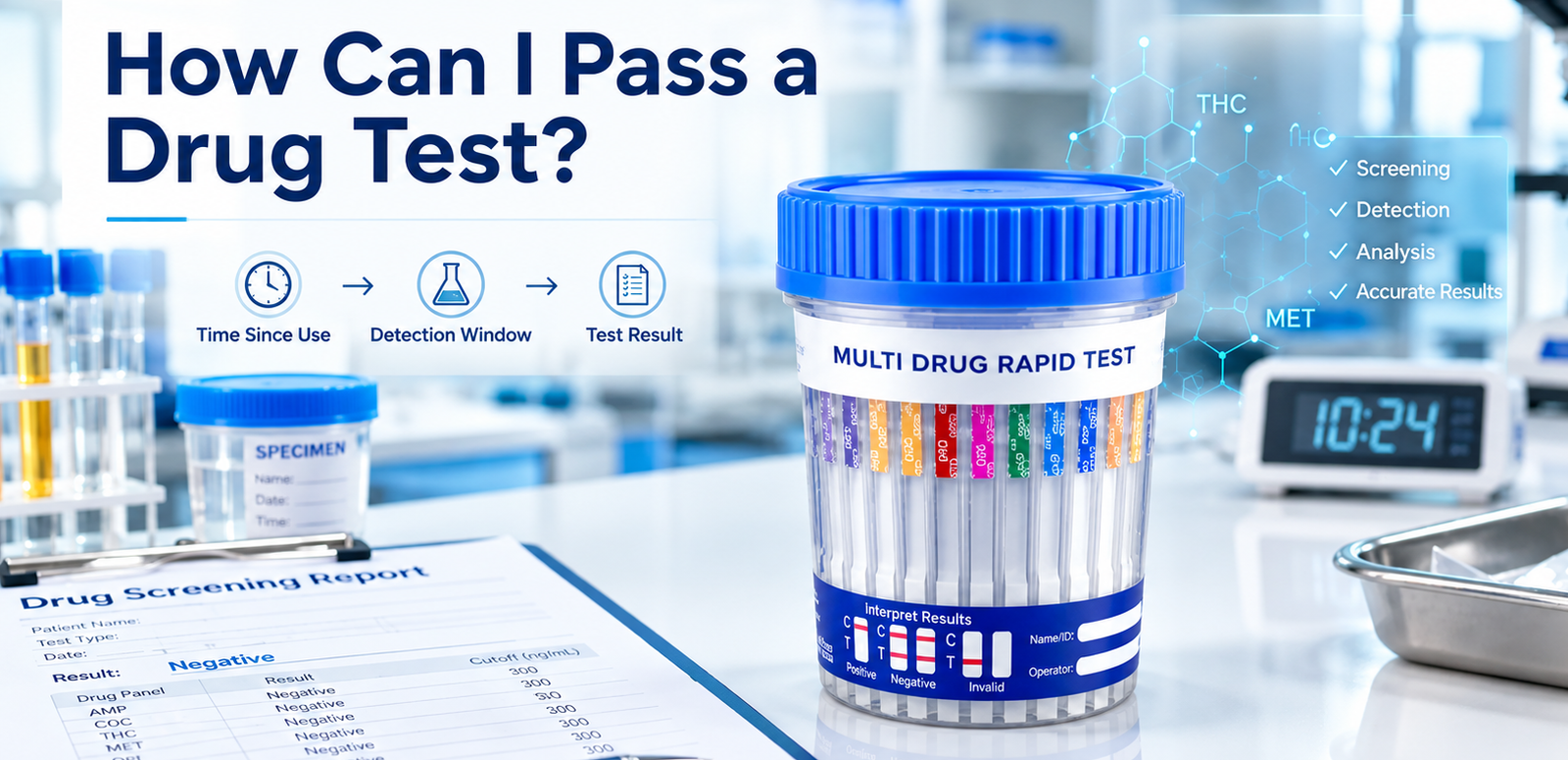
How Can I Pass a Drug Test?
If you have an upcoming drug test, you may be wondering, “How can I pass a drug test?” The most important thing to understand is that there is no reliable overnight method that can guarantee a negative drug test after recent drug use.
Drug tests are designed to detect specific drugs or their metabolites in biological samples. Whether a substance is detectable depends on several factors, including the drug involved, how much and how often it was used, how much time has passed, the type of drug test being performed, individual metabolism, and the test’s cutoff level.
The safest and most reliable approach is to understand how drug testing works, stop using the substance, allow the body time to process and eliminate it, maintain normal hydration, and follow the testing facility’s instructions.
This guide explains how drug tests work, how long drugs may remain detectable, whether detox drinks and home remedies work, what can cause inaccurate results, and how to prepare for a drug test without tampering with the specimen.
Quick Answer: How Can I Pass a Drug Test?
There is no guaranteed way to immediately remove a drug or its metabolites from your body before a test.
The factors that matter most include:
- The substance that was used
- The amount used
- How frequently it was used
- The time since last use
- The type of drug test
- The specimen being tested
- Individual metabolism
- The laboratory cutoff concentration
- Whether the test is a screening or confirmatory test
If you have stopped using a substance, the most appropriate preparation is to allow sufficient time for natural elimination, stay normally hydrated, maintain regular meals and sleep, and follow the collection instructions.
Trying to manipulate, dilute, substitute, or adulterate a specimen can produce a dilute, invalid, or adulterated result rather than the negative result someone expects.
How Do Drug Tests Work?
A drug test looks for a particular drug, its metabolites, or both in a biological specimen.
Depending on the testing situation, laboratories or testing facilities may analyze:
- Urine
- Saliva or oral fluid
- Blood
- Hair
- Sweat
- Fingernails
Different specimens have different detection characteristics.
For example, urine testing commonly detects metabolites that the body produces after processing a drug. Oral-fluid testing is generally used to identify more recent exposure, while hair testing can provide a longer historical window.
A test generally compares the concentration detected in a specimen with an established cutoff level.
If the concentration is below the applicable cutoff, the initial result may be reported as negative. If it reaches or exceeds the cutoff, additional testing may be performed depending on the testing program.
This is why simply trying to “flush” a substance out immediately is not a dependable strategy.
What Determines Whether You Pass a Drug Test?
Several factors influence whether a drug or metabolite remains detectable.
1. The Type of Drug
Different substances are processed and eliminated at different rates.
For example, cannabis metabolites can behave differently from cocaine, amphetamines, opioids, or benzodiazepines.
Therefore, there is no single detection time that applies to every drug.
2. Frequency of Use
Someone who uses a substance occasionally may have a different detection window from someone who uses it repeatedly.
Repeated exposure can result in metabolites remaining detectable for longer periods, depending on the substance and specimen type.
3. Amount Used
The amount consumed can also influence the amount of drug or metabolites available for detection.
Higher exposure does not automatically translate into a predictable number of additional days, however, because many other variables affect elimination.
4. Time Since Last Use
Time is one of the most important variables.
As the body processes and eliminates a substance, concentrations generally decline. However, the rate differs considerably between substances and individuals.
5. Type of Test
A urine test, oral-fluid test, blood test, and hair test do not have identical detection windows.
Knowing which specimen is being tested is therefore essential when interpreting information about drug detection.
6. Individual Metabolism
Metabolism varies between individuals.
Factors such as body composition, liver function, kidney function, genetics, overall health, and patterns of drug use can influence how substances are processed.
7. Laboratory Cutoff
Drug tests do not necessarily require every trace molecule to be absent.
Instead, testing programs use defined cutoff concentrations. A specimen below the applicable cutoff may produce a negative result even though extremely small amounts could theoretically remain.
How Long Do Drugs Stay in Your System?
There is no universal detection period for every drug.
Detection depends on the substance, specimen type, use pattern, testing method, and individual factors.
A simplified overview is:
| Substance | Possible urine detection range* |
|---|---|
| Amphetamines | Often around 2–4 days |
| Methamphetamine | Often around 2–5 days |
| Cocaine metabolites | Often around 2–4 days |
| Codeine | Often around 2–4 days |
| Morphine | Often around 2–5 days |
| Heroin metabolites | Often around 2–3 days |
| Benzodiazepines | Variable; may be several days or longer |
| Cannabis/THC metabolites | Highly variable; may range from days to weeks or longer with repeated use |
| PCP | Often several days |
*These are general ranges rather than guarantees. Individual results can differ substantially.
A detection window should never be treated as a precise countdown clock.
For example, saying that cannabis is “detectable for X days” does not mean every person will test negative after exactly X days.
What Are the Different Types of Drug Tests?
Understanding the type of test you are taking can help you interpret detection-window information correctly.
Urine Drug Test
Urine testing is widely used for workplace, clinical, legal, and other drug-screening situations.
Urine tests commonly detect metabolites that have been eliminated from the body.
Because urine concentrations can change with hydration and other factors, laboratories may also perform specimen validity testing.
This can evaluate characteristics such as:
- Creatinine
- Specific gravity
- pH
- Temperature
- Adulteration indicators
Saliva or Oral-Fluid Drug Test
Oral-fluid testing generally focuses on more recent drug exposure.
The detection period varies according to the substance and testing method.
Because oral fluid is collected differently from urine, strategies intended to change urine concentration do not necessarily apply to oral-fluid testing.
Blood Drug Test
Blood testing measures drugs or metabolites circulating in the bloodstream.
Blood tests are commonly associated with a shorter detection period than hair testing and may be used when recent exposure is particularly relevant.
Hair Drug Test
Hair testing can provide a much longer historical picture than many urine or oral-fluid tests.
Drug-related compounds can become incorporated into growing hair.
Hair testing is therefore sometimes used to identify patterns of exposure over a longer period.
Sweat and Fingernail Testing
Sweat and fingernail testing are less commonly encountered than urine testing but may also be used in certain testing programs.
Each specimen has its own collection procedures, detection characteristics, and limitations.
Can Drinking Water Help You Pass a Drug Test?
Normal hydration is important for health, but drinking excessive amounts of water is not a reliable way to eliminate drugs from the body.
Large amounts of fluid can make urine more dilute.
This may reduce the concentration of some substances in a urine specimen, but it does not necessarily remove the drug or its metabolites from the body.
A laboratory may recognize that a specimen is unusually dilute by evaluating markers such as creatinine and specific gravity.
An excessively diluted specimen may therefore lead to a result being reported as dilute rather than providing the expected negative result.
More importantly, drinking extreme amounts of water in a short period can be dangerous and can cause serious electrolyte disturbances.
The goal should be normal hydration, not water loading.
Do Detox Drinks Work for Drug Tests?
Detox drinks are widely marketed as a way to cleanse the body before a drug test.
However, a commercial detox drink cannot reliably guarantee that a drug or its metabolites will disappear from the body before the substance’s natural detection period has passed.
Some products may contain fluids, vitamins, minerals, caffeine, or other ingredients that can alter urine characteristics temporarily.
That does not mean they have removed the underlying drug metabolites.
Claims such as:
- “Flush THC in hours”
- “Guaranteed negative”
- “Pass any drug test”
- “Clean your system instantly”
should be treated cautiously.
A product’s marketing claim is not the same thing as evidence that it can reliably produce a negative laboratory drug test.
Does Cranberry Juice Help You Pass a Drug Test?
Cranberry juice is often mentioned in online discussions about drug testing.
However, drinking cranberry juice does not provide a reliable method for removing drug metabolites from the body.
Cranberry juice may contribute to your overall fluid intake, but it does not act as an instant drug-test cleanser.
The same principle applies to many other drinks and household remedies.
What About Vinegar or Lemon Juice?
Another common claim is that acidic drinks can change urine pH enough to interfere with a drug test.
Normal urine chemistry is regulated by the body, including the kidneys.
Drinking vinegar or lemon juice is therefore not a dependable method for making a drug test negative.
Attempting to dramatically alter urine chemistry can also create health risks.
Drug testing laboratories may measure urine pH as part of specimen-validity testing, so unusual values can attract additional scrutiny.
Does Baking Soda Help Pass a Drug Test?
Baking soda is sometimes promoted online as a way to influence urine chemistry or drug-test results.
There is no reliable basis for treating baking soda as a guaranteed drug-test solution.
Large or inappropriate amounts can also cause health problems, including disturbances in sodium levels and acid-base balance.
A substance that changes urine chemistry does not necessarily eliminate drug metabolites from the body.
Does Exercise Help You Pass a Drug Test?
Exercise is beneficial for general health, but it should not be considered an emergency drug-test cleansing method.
Physical activity does not instantly eliminate drug metabolites.
In addition, the relationship between exercise and the release or metabolism of stored compounds can vary by substance and individual circumstances.
For an upcoming drug test, exercising excessively specifically to try to alter a result is not a reliable strategy.
Regular physical activity can be part of a healthy lifestyle, but time and natural elimination remain central to drug clearance.
What About Niacin and Other Supplements?
Niacin and various supplements are sometimes promoted online as ways to “flush” drugs from the body.
There is no reliable supplement that can guarantee a negative drug-test result after recent drug use.
Taking unusually high doses of supplements can also cause adverse effects.
A product being labeled “natural,” “herbal,” or “detox” does not automatically make it safe or effective.
Can You Cheat or Manipulate a Drug Test?
People sometimes consider several forms of specimen manipulation, including:
- Excessive dilution
- Substitution
- Synthetic urine
- Chemical adulterants
- Masking products
- Adding substances to a specimen
These approaches can create additional problems.
Modern testing programs may use specimen-validity testing to identify specimens that are inconsistent with normal urine or show evidence of manipulation.
A result may be reported as:
- Dilute
- Invalid
- Adulterated
- Substituted
- Rejected
depending on the testing program and findings.
Attempting to manipulate a test can therefore create a separate issue instead of solving the original concern.
What Is Specimen Validity Testing?
Specimen validity testing evaluates whether a urine specimen appears consistent with a normal biological sample.
Common measurements can include:
Creatinine
Creatinine is a normal metabolic waste product found in urine.
It can help laboratories identify specimens that are unusually dilute.
A low creatinine result does not automatically prove intentional tampering because hydration, diet, and individual physiological factors can influence urine composition.
Specific Gravity
Specific gravity provides information about the concentration of urine.
Very dilute urine may have unusually low specific gravity.
Laboratories interpret specific gravity alongside other specimen characteristics rather than relying on a single measurement.
pH
Urine naturally has a range of pH values.
Extremely unusual pH may indicate a problem with the specimen and can trigger additional validity testing.
Temperature
When urine is collected for testing, temperature may be evaluated shortly after collection.
An unexpected temperature can raise questions about whether the specimen is authentic or has been altered.
Adulteration Testing
Some laboratories can test for substances or chemical characteristics associated with specimen adulteration.
This is one reason attempts to chemically alter a sample can be risky and unreliable.
Can a Drug Test Be Wrong?
No drug test is completely immune to error.
Screening tests can sometimes produce unexpected results, including potential false positives or false negatives.
When an initial screening result is unexpected, a confirmatory test may be used depending on the testing program.
Confirmatory testing can use more specific analytical methods to identify particular drugs or metabolites.
If you believe a result is incorrect, appropriate next steps may include:
- Asking what type of test was performed
- Asking whether confirmatory testing was conducted
- Providing information about legitimate medications
- Asking the testing provider about the review process
- Requesting clarification of the reported result
Do not assume that an unexpected screening result automatically proves drug use.
Can Prescription Medications Cause a Positive Drug Test?
Some medications can interfere with certain screening tests or may produce results that require additional evaluation.
If you take prescription medications, over-the-counter medications, or other legitimate products, keep an accurate list available when appropriate.
This can help a medical review process distinguish legitimate medication use from illicit drug exposure.
Never stop a prescribed medication solely because you are worried about a drug test unless your healthcare professional tells you to do so.
How to Prepare for a Drug Test
If you know that a drug test is coming, preparation should focus on legitimate and health-conscious steps.
1. Stop Using Drugs
If you use a substance that will be tested, stopping use gives the body an opportunity to naturally process and eliminate it.
There is no guaranteed shortcut that can replace time.
2. Maintain Normal Hydration
Drink fluids normally according to your body’s needs.
Avoid extreme water consumption or deliberate water loading.
3. Eat Normally
Maintain a balanced diet rather than relying on extreme fasting or “cleansing” programs.
4. Sleep Adequately
Good sleep supports general health and recovery.
5. Follow Collection Instructions
Read and follow the instructions provided by the testing facility.
Do not add anything to the specimen.
Do not attempt to substitute the specimen.
6. Keep Track of Medications
Know the names and doses of medications and supplements you take.
If requested, provide accurate information to the appropriate medical or testing professional.
7. Don’t Rely on Internet “Hacks”
Anecdotal stories about cranberry juice, vinegar, excessive water, detox drinks, supplements, or other home remedies do not provide a reliable guarantee of a negative result.
What Should You Avoid Before a Drug Test?
Avoid strategies that can create additional problems, including:
- Extreme water loading
- Unverified detox products
- Excessive supplement use
- Deliberate specimen dilution
- Adding chemicals to urine
- Specimen substitution
- Using synthetic urine
- Trying to alter specimen temperature
- Following dangerous internet “detox” recipes
The objective should be to provide a legitimate specimen and allow the testing process to work as designed.
What Does a Dilute Drug Test Mean?
A dilute result generally means the urine specimen is unusually low in concentration.
Laboratories can evaluate markers such as creatinine and specific gravity to assess dilution.
A dilute result does not necessarily mean that someone intentionally attempted to cheat a drug test.
Normal hydration and individual physiological differences can contribute to dilute urine.
The consequences of a dilute result depend on the particular testing program.
Some programs may require another specimen to be collected.
What Does an Invalid Drug Test Mean?
An invalid result means the specimen or testing process did not produce a valid result under the applicable testing criteria.
Potential reasons can include:
- Abnormal specimen characteristics
- Testing problems
- Collection problems
- Specimen integrity concerns
- Certain types of interference
An invalid result is not necessarily equivalent to a positive drug result.
The testing provider should explain what the reported result means and what happens next.
What Happens After a Positive Drug Screen?
An initial positive screening result may not always be the final determination.
Depending on the testing program, a sample may undergo more specific confirmatory testing.
A medical review process may also consider legitimate medication use or other relevant information.
If your result has employment, legal, medical, or probation consequences, ask the responsible testing organization about its specific procedures rather than relying on general internet advice.
Common Drug-Test Myths vs. Facts
| Myth | What to Know |
|---|---|
| Drinking huge amounts of water guarantees a negative test | Excessive water can dilute urine and may result in a dilute specimen |
| Cranberry juice removes drug metabolites | There is no reliable evidence that cranberry juice guarantees a negative drug test |
| Vinegar can change urine enough to defeat testing | The body regulates urine chemistry, and unusual pH may be detected |
| Exercise immediately removes drugs | Exercise does not provide a guaranteed rapid clearance method |
| Detox drinks guarantee a negative result | Marketing claims do not guarantee laboratory results |
| Niacin can reliably clean your system | High-dose niacin can be harmful and is not a guaranteed drug-test solution |
| Synthetic urine cannot be detected | Testing programs may evaluate specimen validity and authenticity |
| Adding chemicals will guarantee a negative result | Chemical adulteration can be detected and may result in an invalid or adulterated specimen |
| Every drug has the same detection window | Detection varies substantially by substance and test type |
| A positive screening test is always final | Some programs use confirmatory testing and review procedures |
How Can I Pass a Drug Test Naturally?
The phrase “pass naturally” can be misleading because there is no natural remedy that can instantly remove a drug from the body.
The body’s normal processes—including metabolism and excretion—do the actual work of eliminating substances.
The practical approach is:
- Stop using the substance.
- Give the body time.
- Maintain normal hydration.
- Eat a balanced diet.
- Get adequate sleep.
- Follow the test instructions.
- Avoid specimen manipulation.
If substance use has been frequent or heavy, stopping suddenly can sometimes produce withdrawal symptoms.
People who are physically dependent on certain substances should consider speaking with a qualified healthcare professional about safe withdrawal and treatment.
How Can I Pass a Urine Drug Test?
For a urine drug test, there is no guaranteed last-minute method that can reliably turn a positive specimen into a negative one.
The result depends primarily on:
- The drug being tested
- Metabolites
- Time since use
- Frequency of use
- Amount used
- Individual metabolism
- Urine concentration
- Test cutoff
- Testing methodology
Normal hydration is appropriate, but excessive water consumption can create a dilute specimen.
The safest approach is to provide an authentic specimen and avoid attempts to adulterate or substitute it.
How Can I Pass a Home Drug Test?
Home drug tests are generally designed as screening tools.
They may use urine or another specimen and typically provide a preliminary result.
When using a home test:
- Follow the manufacturer’s instructions.
- Check the expiration date.
- Use the correct specimen.
- Follow the specified reading time.
- Do not interpret the result outside the manufacturer’s instructions.
- Understand that a home screening result may not have the same significance as laboratory confirmation.
If a home result is unexpected, a laboratory test may provide more definitive information depending on the circumstances.
What Is the Difference Between a Home Test and a Laboratory Drug Test?
A home drug test is generally designed for convenient preliminary screening.
Laboratory testing can involve more controlled collection, analytical procedures, specimen-validity checks, and confirmatory testing.
The two should not automatically be treated as interchangeable.
A home test may provide useful preliminary information, but the exact performance depends on the product, substance, cutoff, specimen, and testing conditions.
Frequently Asked Questions
Can I pass a drug test in 24 hours?
There is no reliable method that guarantees a negative drug test within 24 hours after recent drug use.
Detection depends on the substance, test type, amount used, frequency of use, metabolism, and cutoff level.
How can I pass a drug test quickly?
There is no dependable instant method for clearing drug metabolites.
Time, abstinence, and natural elimination are the primary factors.
Does drinking water help pass a drug test?
Normal hydration supports health, but excessive water consumption can dilute urine and potentially produce a dilute specimen.
Does cranberry juice help pass a drug test?
Cranberry juice does not reliably remove drug metabolites or guarantee a negative drug test.
Do detox drinks work?
Detox drinks cannot reliably guarantee a negative laboratory drug test.
Claims that a product can eliminate all drug metabolites within hours should be viewed cautiously.
Does exercise help pass a drug test?
Exercise is beneficial for overall health but is not a reliable emergency method for clearing drugs before a test.
How long does marijuana stay detectable?
Cannabis detection varies considerably depending on frequency of use, amount used, individual factors, specimen type, and testing method. Occasional and repeated use can have very different detection patterns.
How long do drugs stay in urine?
Detection times vary substantially by substance and individual circumstances. Many commonly tested substances can remain detectable in urine for several days, while some substances—particularly with repeated use—may be detectable for longer.
Can prescription medication cause a positive drug test?
Some medications can affect certain screening tests. Legitimate medication information can be important when an unexpected result is reviewed.
Can a drug test be false positive?
Yes. Screening tests can sometimes produce unexpected results. Confirmatory testing may be used to investigate an initial result depending on the testing program.
What is a dilute urine sample?
A dilute urine specimen has unusually low concentrations of certain normal urine markers. Laboratories may use creatinine and specific gravity to evaluate specimen concentration.
Can labs detect adulterated urine?
Many drug-testing programs use specimen-validity testing to identify characteristics associated with dilution, substitution, or adulteration.
Is there a guaranteed way to pass a drug test?
No. There is no universal food, drink, supplement, exercise routine, or home remedy that can guarantee a negative drug-test result after recent drug use.
How Can I Pass a Drug Test?
If you’re asking “How can I pass a drug test?”, the most important answer is that there is no guaranteed overnight trick.
Drug testing depends on the substance, metabolites, time since use, frequency and amount of use, specimen type, individual metabolism, and laboratory cutoff levels.
The most reliable preparation is to stop using the substance, allow sufficient time for natural elimination, maintain normal hydration, follow the collection instructions, and avoid specimen manipulation.
Be particularly cautious about online claims involving detox drinks, cranberry juice, vinegar, baking soda, excessive water, supplements, or other “instant” solutions. These approaches cannot reliably guarantee a negative result and some can create health or specimen-validity problems.
If you receive an unexpected result, ask the testing provider whether confirmatory testing or a medical review process applies. And if stopping a substance causes significant withdrawal symptoms, seek appropriate medical support rather than attempting an unsafe detox on your own.
Understanding how drug tests work is ultimately more useful than chasing a last-minute trick.




