
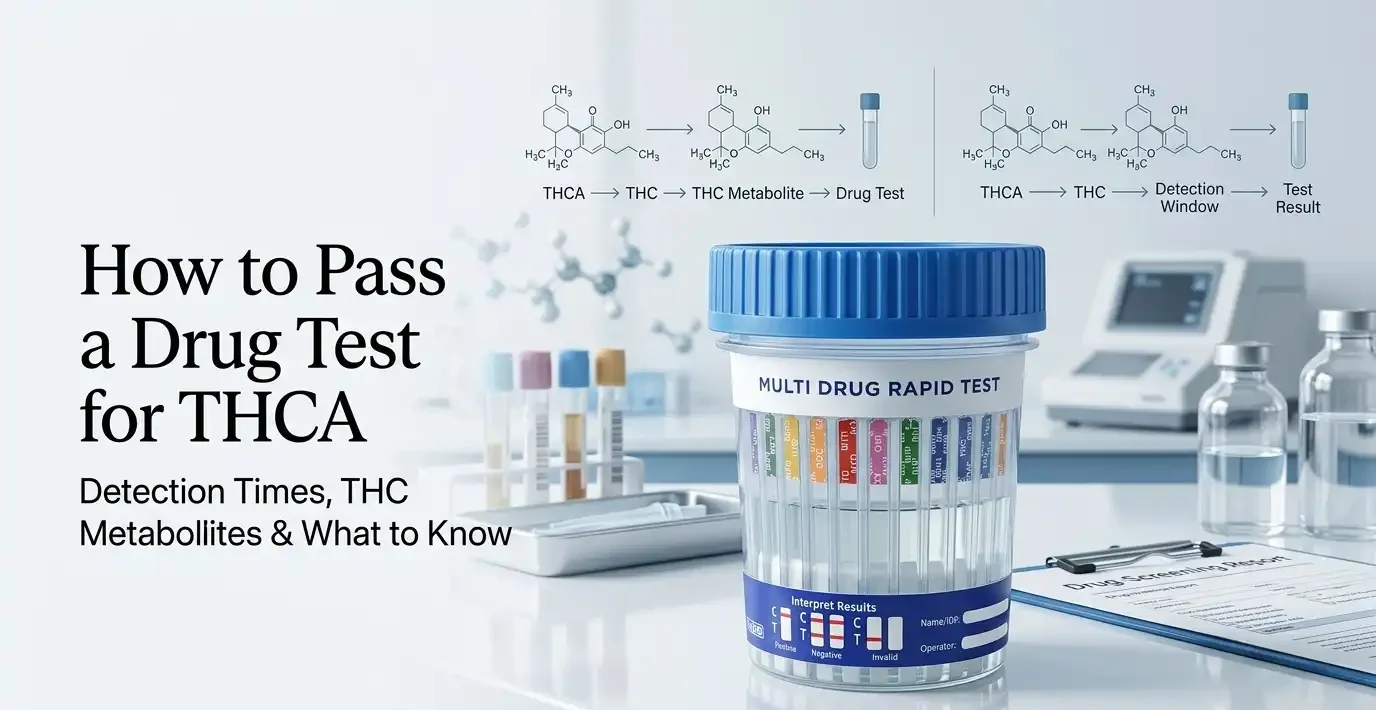
How to Pass a Drug Test for THCA
If you’re searching for how to pass a drug test for THCA, the most important thing to understand is that THCA and THC are related but not identical compounds. THCA, or tetrahydrocannabinolic acid, is a naturally occurring precursor to THC in cannabis. When THCA is exposed to heat, it can undergo decarboxylation, converting some of it into THC. THC is then metabolized by the body into compounds that can be detected by drug-testing methods.
That means a product marketed as THCA flower, THCA hemp, or hemp-derived THCA should not automatically be considered “drug-test safe.” Whether it can contribute to a positive result depends on the product, how it was consumed, the type of test, how recently it was used, frequency of use, and the laboratory’s testing methodology.
There is also an important distinction between avoiding a positive test and trying to manipulate a specimen. There is no dependable drink, supplement, food, or home remedy that can guarantee a negative result. The most predictable way to reduce the chance of a cannabis-related positive test is to avoid THC/THCA cannabis products when testing is required and allow the body time to eliminate the compounds naturally.
Can THCA Make You Fail a Drug Test?
Yes, THCA products can be relevant to a drug test, particularly when the product is heated or otherwise contains or produces THC.
THCA itself is an acidic cannabinoid precursor found naturally in cannabis. Unlike THC, THCA is not the primary psychoactive compound responsible for the typical intoxicating effects of cannabis. However, heat can convert THCA into THC. Smoking, vaping, and many forms of cooking expose THCA to conditions that promote this conversion.
Once THC enters the body, it is metabolized into several compounds. One important metabolite is 11-nor-9-carboxy-Δ9-tetrahydrocannabinol, commonly called THC-COOH or the delta-9 THC carboxy metabolite.
This distinction matters because many urine cannabis tests are designed to detect the THC metabolite rather than THCA itself. Current SAMHSA federal workplace guidance identifies the urine analyte as the delta-9 THC carboxy metabolite, while federal oral-fluid testing targets THC.
So, the relevant question isn’t simply:
“Is THCA legal?”
A drug test is asking a different question:
“Is the substance or metabolite targeted by this particular test detectable in the specimen?”
What Is THCA?
THCA stands for tetrahydrocannabinolic acid.
It is a naturally occurring cannabinoid precursor found in cannabis plants. Fresh cannabis contains substantial amounts of acidic cannabinoids, including THCA. THCA is structurally related to THC but is not simply another name for THC.
The easiest way to understand the relationship is:
THCA → heat/decarboxylation → THC → metabolism → THC metabolites
This is why the way a THCA product is processed and consumed can matter.
THCA vs. THC
| THCA | THC |
|---|---|
| Tetrahydrocannabinolic acid | Delta-9-tetrahydrocannabinol |
| Naturally occurring precursor | Psychoactive cannabinoid |
| Found in raw cannabis | Produced naturally and through THCA decarboxylation |
| Can convert to THC when heated | Metabolized after entering the body |
| Not the primary target of standard federal urine cannabinoid testing | THC’s metabolite is a major urine-testing target |
The terminology surrounding cannabis testing can become confusing because laboratory documents sometimes use similar abbreviations for different cannabinoid acids. For example, THC-COOH, the urine metabolite of THC, may also appear in older literature as “THCA” or “THC acid.” That is chemically different from the THCA naturally present in cannabis.
Does THCA Turn Into THC?
Yes. THCA can convert to THC through decarboxylation.
Heat and drying can remove the carboxyl group from THCA, producing THC. This process is called decarboxylation. Scientific literature describes this conversion as one of the reasons heating cannabis changes its cannabinoid composition.
This is particularly relevant to products such as:
- THCA flower that is smoked
- THCA pre-rolls
- THCA vape products
- heated cannabis concentrates
- cannabis products used in cooking
Research has demonstrated experimentally that heating cannabis material can convert THCA into THC.
Therefore, calling a product “THCA” does not necessarily mean that consuming it will have no relationship to THC exposure.
What Happens to THCA After You Use It?
The answer depends partly on whether the THCA remains THCA or is converted into THC.
Step 1: THCA is present in the product
Raw cannabis and some cannabis-derived products contain THCA.
Step 2: Heat can convert THCA into THC
Smoking, vaping, and other heating processes can cause decarboxylation.
Step 3: THC enters the body
Once THC is absorbed, the body begins metabolizing it.
Step 4: THC produces metabolites
One important metabolite is THC-COOH.
Step 5: Drug testing looks for specific analytes
A urine test may target the THC carboxy metabolite, whereas other testing methods can target different compounds.
This is why THCA exposure and a THC drug test are connected but should not be treated as exactly the same thing.
Does THCA Show Up on a Drug Test?
It depends on the test type and analyte being measured.
Some specialized analytical methods can directly identify THCA in biological samples. Research has demonstrated that THCA can be detected in urine and blood of cannabis consumers.
However, that doesn’t mean every routine drug test is specifically testing for THCA.
For example, current federal workplace testing guidance identifies:
- Urine: delta-9 THC carboxy metabolite
- Oral fluid: THC
Therefore, when someone asks whether “THCA shows up on a drug test,” the correct answer is:
It depends on what the test is designed to detect and whether the THCA product resulted in exposure to THC or its metabolites.
Does THCA Flower Show Up on a Drug Test?
It can.
THCA flower is often marketed differently from conventional marijuana because its cannabinoid profile may contain a high proportion of THCA rather than delta-9 THC.
But once the flower is heated, some THCA can convert to THC.
That means smoking or vaping THCA flower can create THC exposure that is relevant to cannabis drug testing.
Product labels also aren’t necessarily enough to predict an individual’s test result. Hemp and cannabinoid products can have variable cannabinoid content, and federal guidance has noted concerns about inaccurate labeling and products containing cannabinoids not disclosed on the label.
Does Smoking THCA Show Up on a Drug Test?
It can.
Smoking exposes THCA to high temperatures, promoting decarboxylation and conversion to THC.
If THC enters the body, it can subsequently be metabolized into THC-COOH, which is relevant to urine cannabis testing.
Therefore, someone with an upcoming drug test should not assume that smoking THCA flower is equivalent to consuming a THC-free product.
What About THCA Vapes?
THCA vape products raise a similar issue.
Vaporization involves heating the material, and heat can promote THCA-to-THC conversion. The exact amount converted depends on the product and conditions, so a precise conversion percentage should not be assumed for every vape.
The important point is that “THCA” on a product label does not guarantee zero THC exposure after heating.
How Long Does THCA Stay in Your System?
There is no single number of hours or days that applies to everyone.
This is one of the most important points to understand when searching for a THCA drug-test timeline.
Detection depends on factors such as:
- whether THCA was consumed raw or heated
- whether the product contained THC
- amount used
- frequency of use
- time since last use
- individual metabolism
- body composition
- route of administration
- type of specimen
- laboratory method
- testing cutoff
Cannabinoid testing is particularly variable because THC is highly lipid-soluble and can remain detectable for longer periods after repeated use.
Instead of promising that THCA will be gone after a particular number of days, it is more accurate to discuss detection windows as ranges influenced by individual circumstances.
THCA Detection Time by Test Type
Different tests look for different compounds and have different detection characteristics.
| Test type | What may be detected | General consideration |
|---|---|---|
| Urine | THC carboxy metabolite | Common workplace testing method; detection can persist after use |
| Oral fluid | THC and/or other cannabinoids depending on method | Generally focused more on recent exposure |
| Blood | THC and related compounds | Primarily useful for more recent exposure |
| Hair | Cannabis-related analytes | Can provide a longer historical window but has interpretation limitations |
| Specialized laboratory testing | Specific cannabinoids/metabolites | Can identify compounds that routine screening doesn’t target |
Federal workplace programs currently use different analytes for urine and oral-fluid testing.
How Long Can THC From THCA Products Be Detected in Urine?
Urine testing is particularly important because it is widely used for workplace and other drug-screening programs.
The body converts THC into metabolites, including THC-COOH, which can subsequently be eliminated through urine.
With occasional exposure, detection may be shorter. With repeated or heavy cannabis exposure, detection can persist considerably longer. SAMHSA notes that cannabinoid detection is influenced by chronicity of use, metabolism, body composition, hydration and the laboratory cutoff.
That is why statements such as:
“THCA leaves your urine in exactly three days”
are misleading.
Two people can consume similar products and receive different testing results at the same point in time.
What Is THC-COOH?
THC-COOH is an important metabolite of THC.
When the body processes THC, it produces several metabolites. THC-COOH is one of the primary compounds used in urine cannabinoid testing.
This is different from the THCA naturally present in cannabis.
The distinction is important:
Cannabis THCA
and
THC-COOH found after THC metabolism
are chemically related but are not the same substance.
Federal workplace urine testing specifically identifies the delta-9 THC carboxy metabolite as the relevant cannabinoid analyte.
What Cutoff Does a THC Urine Test Use?
Testing cutoffs depend on the testing program.
For example, historical and federal workplace guidance has used:
- 50 ng/mL for the initial urine cannabinoid screen
- 15 ng/mL for confirmation of the delta-9 THC carboxy metabolite
These numbers should not be interpreted as a universal rule for every drug test. Employers, laboratories, jurisdictions and testing programs can use different procedures.
A cutoff is also not the same thing as saying that a person has “no THC.”
A negative result means the analyte was not reported at or above the applicable testing threshold under that testing method.
How Does a Urine THC Drug Test Work?
Many drug-testing programs use an initial screening process followed, when appropriate, by more specific laboratory confirmation.
Initial screening
An immunoassay may be used to identify specimens that meet or exceed the applicable screening threshold.
Confirmatory testing
A more specific analytical technique can then identify and quantify the target compound.
Methods such as GC-MS and LC-MS/MS are commonly associated with confirmatory or quantitative laboratory analysis.
The purpose of confirmation is to provide greater specificity than a preliminary screening test.
What Factors Affect a THCA Drug-Test Result?
There is no reliable way to calculate an exact detection time from one factor alone.
1. Frequency of use
Repeated cannabis exposure can lead to longer detection than isolated exposure.
2. Amount consumed
Higher exposure can result in more cannabinoid/metabolite burden, although the relationship isn’t simple enough to predict an exact test date.
3. Product composition
A THCA product may contain varying amounts of:
- THCA
- delta-9 THC
- other cannabinoids
Labels and laboratory results may not perfectly reflect actual contents. SAMHSA has highlighted variability in hemp/CBD product labeling and cannabinoid content.
4. Route of administration
Smoking, vaping, eating and other routes can change how cannabinoids enter the body.
5. Time since use
More time generally allows the body to metabolize and eliminate compounds, but time alone cannot guarantee a negative test.
6. Individual metabolism
People metabolize and eliminate cannabinoids differently.
7. Test type
Urine, oral fluid, blood and hair testing don’t provide identical detection windows.
8. Laboratory cutoff
A result depends partly on the concentration threshold used by the testing program.
Does Hydration Help You Pass a THCA Drug Test?
Normal hydration is important for health, but drinking excessive amounts of water is not a reliable way to eliminate THC metabolites from the body.
Large quantities of fluid can dilute urine, reducing the concentration of substances in the specimen. However, laboratories can evaluate specimen validity, and a diluted specimen may be reported as dilute rather than simply producing the desired negative result.
SAMHSA’s federal testing framework includes specimen-validity procedures and biomarker testing for identifying specimens inconsistent with normal human urine.
There is also a health risk from drinking excessive quantities of water too quickly, including potentially dangerous electrolyte disturbances.
So, normal hydration is reasonable; deliberate overhydration is not a dependable testing strategy.
Do Detox Drinks Remove THCA or THC?
There is no reliable evidence that a commercial “detox drink” can instantly remove THC metabolites from the body.
Many products marketed for drug testing rely on combinations of fluids, vitamins, supplements or other ingredients. Any temporary change in urine concentration does not necessarily mean that the underlying metabolites have been eliminated.
A product that changes the appearance of urine also does not prove that a specimen will be negative.
Does Cranberry Juice Help Pass a THCA Drug Test?
Cranberry juice has not been established as a reliable method for eliminating THC metabolites or guaranteeing a negative cannabis drug test.
It can contribute to fluid intake, but drinking cranberry juice doesn’t selectively remove THC-COOH from the body.
The same principle applies to many popular home remedies.
Does Niacin Help With a THCA Drug Test?
Niacin is frequently mentioned online as a supposed method for changing drug-test results.
However, there is no established scientific basis for using high-dose niacin to eliminate THC metabolites from the body.
Taking excessive amounts of niacin can also cause adverse effects, including flushing and other reactions.
A supplement should not be treated as a substitute for the natural elimination of cannabinoids.
Does Exercise Remove THCA Faster?
Exercise is good for general health, but it should not be presented as a guaranteed way to rapidly clear cannabinoids before a drug test.
THC is highly lipid-soluble, and changes in fat metabolism can affect circulating cannabinoid concentrations. Scientific research has examined changes in plasma THC after exercise and fasting in regular cannabis users.
The practical takeaway is simple:
Exercise is not a predictable short-term drug-test solution.
It is also not possible to calculate an individual’s test result simply from their body-fat percentage or exercise routine.
Can You Use Synthetic Urine to Pass a THCA Drug Test?
Attempting to substitute or manipulate a specimen is not a dependable approach and can result in specimen-validity problems, additional testing, or consequences under the applicable testing program.
Modern testing programs may assess specimen characteristics and biomarkers designed to distinguish authentic human specimens from abnormal, substituted or adulterated samples.
For that reason, an educational article should focus on how specimen validity works, rather than provide instructions for defeating those checks.
What About Legal Hemp-Derived THCA?
This is an important distinction.
A product can be marketed as hemp-derived or compliant with a particular legal definition while still presenting a drug-testing concern.
Federal guidance has specifically discussed hemp/CBD products and notes that some products may contain THC or have cannabinoid concentrations inconsistent with their labels.
Therefore:
Legal status ≠ guaranteed negative drug test.
A person can have a product that is legally sold in their jurisdiction and still potentially have a test result affected by cannabinoids in that product.
The exact legal consequences depend on the jurisdiction and testing program.
Can a THCA Product With “0% THC” Still Be a Concern?
The label deserves careful interpretation.
A product may advertise itself as THC-free or contain a very low declared delta-9 THC concentration, but cannabinoid products can vary in actual composition.
If a product contains THCA, heating it can potentially produce THC through decarboxylation.
Additionally, product labels and laboratory testing aren’t necessarily equivalent to the analytical methods used in a workplace drug-testing laboratory.
For anyone subject to a drug-testing requirement, the safest assumption is not to treat a THCA product as automatically drug-test safe.
Can You Test Yourself at Home?
At-home cannabis tests can be useful for understanding how a screening assay works, but they should not be treated as a guarantee of what a laboratory test will report.
Home urine tests generally use immunoassay technology and a defined cutoff.
Differences can exist in:
- cutoff concentration
- specimen collection
- timing
- test sensitivity
- product quality
- laboratory confirmation procedures
A home negative result therefore cannot guarantee that a separate laboratory test will also be negative.
What If Your Drug Test Is Positive?
A preliminary positive screen is not necessarily the final interpretation in testing programs that require confirmation.
Laboratory confirmation uses a more specific analytical method to determine whether the target analyte is actually present.
If you take prescription or over-the-counter medications or use cannabinoid products, provide accurate information when asked by the appropriate testing professional or Medical Review Officer.
The exact review process depends on the testing program.
THCA Drug-Test Myths vs. Facts
| Myth | Fact |
|---|---|
| THCA is exactly the same as THC | THCA is an acidic precursor to THC |
| THCA can never affect a drug test | Heated THCA can convert to THC, and products may contain cannabinoids relevant to testing |
| Legal hemp cannot cause a positive test | Legal status doesn’t guarantee a negative drug-test result |
| Drinking huge amounts of water removes THC | Excessive water mainly changes urine concentration and can produce a dilute specimen |
| Cranberry juice eliminates THC | There is no established evidence that it reliably eliminates THC metabolites |
| Niacin cleans THC from the body | High-dose niacin is not an established drug-test solution |
| Exercise guarantees a faster negative test | Exercise cannot reliably predict or guarantee a negative result |
| A home test guarantees a laboratory result | Home and laboratory testing can differ in methodology and interpretation |
| Every drug test specifically tests for THCA | Different tests target different analytes |
How to Reduce the Risk of a Positive THCA Drug Test
If you know you will be tested, the most predictable approach is to stop using cannabis and cannabinoid products that could contribute to THC exposure and allow sufficient time for natural elimination.
Avoid relying on:
- detox drinks
- excessive water
- cranberry juice
- niacin
- last-minute exercise
- unverified supplements
- specimen manipulation
There is no scientifically reliable way to guarantee a negative result immediately before a test.
The longer the period without exposure, the more opportunity the body has to metabolize and eliminate cannabinoids, but the exact time required varies considerably.
How Long Should You Stop THCA Before a Drug Test?
There isn’t a universal number of days that guarantees a negative result.
Someone with isolated exposure may have a different detection period from someone using cannabis products frequently.
A realistic assessment needs to consider:
- What product was used
- Whether it was heated
- How much was used
- How frequently it was used
- When it was last used
- What type of test is being performed
- Which cutoff applies
- Individual biological differences
This is why online claims promising that everyone can “pass in 24 hours” or “pass in three days” should be treated skeptically.
THCA and Drug Testing: The Key Takeaway
The biggest misconception surrounding how to pass a drug test for THCA is assuming that THCA and THC testing are completely unrelated.
THCA is a precursor to THC. Heating can convert THCA into THC, and THC can subsequently be metabolized into compounds relevant to cannabis drug testing.
At the same time, not every drug test looks for the same substance. Federal workplace urine testing, for example, targets the delta-9 THC carboxy metabolite, while federal oral-fluid testing targets THC.
So there is no single THCA detection time or guaranteed method to pass a drug test.
The factors that matter most are the product, route of use, amount and frequency of exposure, time since use, individual metabolism, specimen type, and laboratory cutoff.
If testing is required, the most reliable way to reduce the chance of a cannabis-related positive is to avoid THC/THCA cannabis products and allow the body time to eliminate the relevant compounds naturally.
Frequently Asked Questions About THCA Drug Tests
Does THCA show up on a urine drug test?
THCA itself is not necessarily the routine target of a standard urine cannabis screen. Federal workplace urine testing targets the delta-9 THC carboxy metabolite. However, using heated THCA products can result in THC exposure and subsequent metabolite production.
Will THCA flower make you fail a drug test?
It can contribute to a positive cannabis test, particularly when the flower is heated and produces THC. Product composition and individual detection time also matter.
Does vaping THCA show up on a drug test?
It can. Vaping involves heating, which can promote conversion of THCA to THC.
Is THCA the same as THC?
No. THCA is an acidic precursor to THC. Heating can convert THCA into THC.
How long does THCA stay in urine?
There is no universal detection period. The answer depends on the product, exposure, frequency of use, metabolism and the testing method.
Can drinking water help pass a THCA drug test?
Excessive water consumption does not eliminate THC metabolites and can create a dilute specimen that may be identified during specimen-validity testing.
Does cranberry juice remove THC metabolites?
There is no reliable evidence that cranberry juice selectively eliminates THC metabolites.
Does niacin help pass a THCA drug test?
Niacin is not a proven method for eliminating THC metabolites, and excessive doses can cause adverse effects.
Does legal THCA mean I will pass a drug test?
No. Legal status and drug-test results are separate issues. Hemp-derived products can still contain or produce cannabinoids relevant to drug testing.
What does a urine cannabis test detect?
Federal workplace urine testing identifies the delta-9 THC carboxy metabolite, commonly called THC-COOH.
What is the difference between a screening and confirmation test?
A screening test is designed to identify specimens that meet a preliminary threshold. Confirmation uses a more specific analytical method to identify and quantify the target analyte.
Can a home THC test guarantee that I will pass a lab test?
No. Home tests can provide useful information, but differences in cutoffs, specimen collection, methodology and laboratory confirmation mean they cannot guarantee another test’s outcome.




