
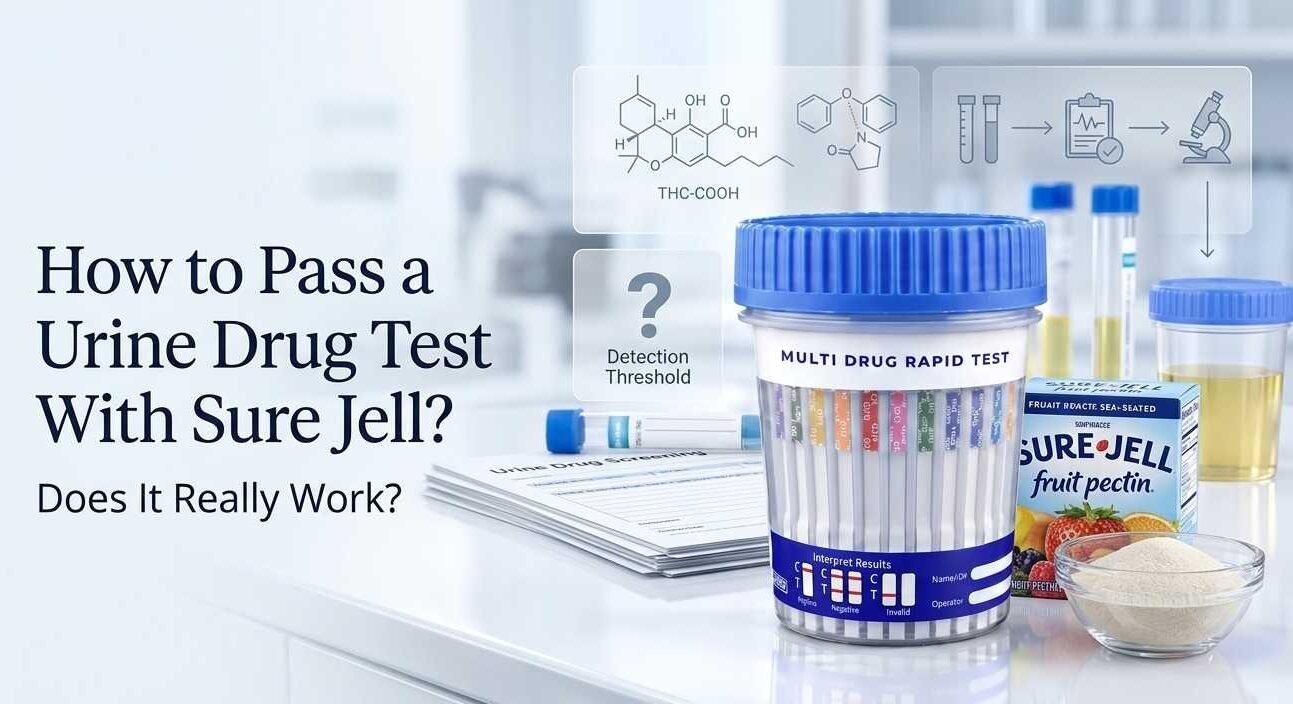
How to Pass a Urine Drug Test With Sure Jell:
If you have searched “how to pass a urine drug test with Sure Jell,” you have probably seen the Certo or Sure Jell method described as a quick way to get around a drug screening. The idea usually centers on fruit pectin, a soluble fiber used to make jams and jellies.
But does Sure Jell actually remove drug metabolites from your body or reliably change a urine drug-test result?
No reliable scientific evidence shows that Sure Jell or fruit pectin can reliably make a urine drug test negative. The proposed mechanism is largely based on internet anecdotes rather than controlled clinical evidence. A negative result after using Sure Jell would not establish that the pectin caused the result.
Urine drug testing is designed to detect specific drugs or metabolites at defined concentrations, and regulated testing can also include specimen-validity testing to identify samples that are unusually dilute, substituted, or adulterated.
This article explains what Sure Jell is, why the claim became popular, how urine drug testing works, what is known about THC metabolites, and why relying on a DIY pectin method can be misleading or unsafe.
Does Sure Jell Help You Pass a Urine Drug Test?
Sure Jell is not a scientifically established method for passing a urine drug test.
Sure Jell is a food product containing fruit pectin. Pectin has legitimate culinary and nutritional uses, but that does not mean it can remove previously absorbed drug metabolites from the bloodstream, tissues, or urine.
The basic problem is that drug metabolism and digestion are different biological processes.
When a drug enters the body, it can be metabolized into compounds that laboratories subsequently test for. For example, federal urine testing for cannabis analyzes a THC metabolite rather than simply looking for whether someone currently feels the effects of marijuana.
There is no established clinical method showing that consuming Sure Jell can reliably redirect those metabolites away from urine and produce a negative test.
What Is Sure Jell?
Sure Jell is a commercial fruit-pectin product commonly associated with making jams and jellies.
Pectin is a type of soluble dietary fiber found naturally in fruits and is widely used as a food gelling agent.
That legitimate function is the foundation of the internet claim.
The theory promoted online is generally that pectin somehow captures drug metabolites in the digestive system and prevents them from appearing in urine.
The problem is that a plausible-sounding theory is not the same thing as demonstrated clinical effectiveness.
A substance can bind or interact with compounds in the gastrointestinal tract without being capable of removing metabolites that have already been processed by the body.
Why Do People Think Sure Jell Works for a Drug Test?
The Sure Jell/Certo claim became popular through online forums, social media, anecdotal reports, and word-of-mouth.
The story generally goes something like this:
Sure Jell → fruit pectin → supposed metabolite binding → supposedly less drug metabolite in urine
That sounds straightforward, but several biological steps are missing from that explanation.
A person’s drug-test result depends on factors such as:
- what substance was used
- which metabolite the test detects
- how much was used
- frequency of exposure
- time since exposure
- individual metabolism
- specimen type
- laboratory method
- testing cutoff
- urine concentration
Therefore, someone testing negative after using Sure Jell does not prove that Sure Jell caused the negative result.
They may already have been below the laboratory’s detection threshold, for example.
How Does a Urine Drug Test Actually Work?
Understanding drug testing makes the Sure Jell claim easier to evaluate.
A simplified process looks like this:
Drug exposure → metabolism → drug/metabolite → circulation → excretion → urine → laboratory testing
The body changes many substances through metabolic processes. The resulting compounds can then be eliminated through different routes, including urine.
A urine drug test is designed to detect specific target compounds or metabolites.
In federally regulated U.S. workplace testing, SAMHSA describes certified laboratory testing and specimen-validity procedures used alongside drug testing.
For cannabis specifically, SAMHSA states that the compound tested and reported in federal urine testing is delta-9-tetrahydrocannabinol-9-carboxylic acid (THCC).
This is important because the test is not simply asking:
“Is marijuana currently affecting this person?”
It is looking for a specific chemical marker at a specified testing threshold.
What Does the Sure Jell Theory Claim?
The commonly circulated theory is that fruit pectin forms a gel in the gastrointestinal tract and somehow traps or redirects drug metabolites.
Supporters sometimes claim this could prevent metabolites from reaching urine.
There are several problems with this explanation.
1. Digestion and urinary excretion are different processes
Pectin primarily functions within the gastrointestinal system.
Urine, however, is produced by the kidneys from substances circulating in the body.
Simply consuming a soluble fiber does not mean that it can reach every drug metabolite in the bloodstream or tissues.
2. Many drug metabolites have already been processed
The metabolites targeted by urine tests may have already been produced and are being eliminated through normal metabolic and renal processes.
A food ingredient consumed shortly before a test has not been demonstrated to reliably reverse that process.
3. There is no established clinical protocol
There is no medically validated Sure Jell protocol that guarantees a negative drug-test result.
Online recipes and personal testimonials should not be confused with controlled toxicology research.
Does Sure Jell Remove THC From Your Urine?
There is no reliable evidence that Sure Jell can remove THC metabolites from urine quickly enough to reliably change a laboratory drug-test result.
This question usually concerns cannabis because THC is highly lipid-soluble and its metabolites can remain detectable for different lengths of time depending on the individual and the pattern of use.
SAMHSA’s clinical drug-testing guidance notes that marijuana detection varies according to factors including use pattern, body composition, metabolism, hydration, and the laboratory cutoff.
That variability is important.
Suppose two people consume cannabis at different times or with different patterns of use. Their urine concentrations can be very different even if they both consume the same supposed “detox” product.
Therefore, an anecdotal success story cannot demonstrate that pectin caused the result.
What Is THC-COOH?
One of the most important terms to understand when researching Sure Jell and THC drug tests is THC-COOH.
THC is the primary psychoactive cannabinoid associated with cannabis.
The body metabolizes THC into several compounds, including the metabolite commonly measured in urine cannabis testing.
In federal workplace urine testing, SAMHSA identifies the reported urine analyte as delta-9-THC-9-carboxylic acid/THCC.
This explains why someone may no longer feel intoxicated but still have a detectable cannabis metabolite.
Feeling sober and testing negative are not the same biological event.
Why a Sure Jell “Success Story” Does Not Prove It Worked
Internet testimonials can be persuasive:
“I used Sure Jell and passed.”
But that statement does not tell us what actually caused the result.
Several explanations are possible.
The person’s metabolite concentration was already low
They may have naturally fallen below the relevant cutoff.
Enough time had passed
The body continuously processes and eliminates substances.
The testing method was different
Home tests, workplace screens, clinical tests, and forensic tests can have different characteristics and cutoffs.
Individual metabolism differed
Drug detection varies significantly between individuals.
The result was not caused by pectin
Correlation does not establish causation.
This is one reason anecdotal reports cannot substitute for controlled scientific evidence.
Does Sure Jell Work for Marijuana Drug Tests?
There is no reliable scientific basis for treating Sure Jell as a marijuana-test solution.
Cannabis testing is especially complicated because THC is highly lipid-soluble and detection can vary according to exposure pattern and other individual factors.
SAMHSA’s clinical guidance describes substantial variation in marijuana detection and notes that chronic use can result in much longer detection periods than occasional use.
A person therefore cannot reliably predict a urine result based only on whether they consumed a packet of fruit pectin.
Does Sure Jell Work for Cocaine, Opioids, or Other Drugs?
There is also no established evidence that Sure Jell reliably changes urine-test results for substances such as:
- cocaine metabolites
- opioids
- amphetamines
- methamphetamine
- benzodiazepines
- PCP
- other substances included in a particular drug-testing panel
Different substances have different metabolic pathways and different target analytes.
A method supposedly associated with cannabis cannot automatically be assumed to work for every other drug.
The same principle applies to other specimen types. A substance that someone claims affects urine testing does not automatically affect:
- oral-fluid testing
- blood testing
- hair testing
The testing matrix and analyte matter.
Can Sure Jell Dilute a Urine Drug Test?
This is where online discussions often become confusing.
Sure Jell itself is not a proven urine-dilution treatment.
However, many internet versions of the “Certo/Sure Jell method” also involve consuming large amounts of fluid.
That introduces a completely different issue: urine concentration.
When a person consumes unusually large amounts of fluid, urine can become more dilute. A lower concentration of a substance in a urine sample can affect the measured concentration of analytes.
But dilution does not mean that the body has eliminated the drug.
And in regulated testing, laboratories can evaluate whether a specimen is unusually dilute.
SAMHSA’s 2024 Medical Review Officer Guidance describes specific creatinine and specific-gravity criteria used to classify certain federal workplace urine specimens as dilute or substituted.
What Is Specimen Validity Testing?
Specimen validity testing (SVT) is used to determine whether a urine specimen has characteristics consistent with a normal human urine sample.
Depending on the testing program, laboratories may evaluate factors such as:
- creatinine
- specific gravity
- pH
- oxidants or other adulteration indicators
- other specimen biomarkers
SAMHSA states that federal urine-testing programs use validity testing to identify specimens exhibiting abnormal characteristics or reactions associated with adulteration and other specimen problems.
This is an important reason why simply thinking about whether a drug metabolite is “below the cutoff” does not tell the whole story.
A specimen can have a drug-testing result and a separate validity finding.
What Does a “Dilute” Result Mean?
A dilute result generally means the urine is less concentrated than expected based on the relevant specimen-validity measurements.
For example, SAMHSA’s 2024 MRO guidance defines particular federal criteria involving creatinine and specific gravity for reporting dilute specimens.
The exact consequences depend on the testing program and circumstances.
In federally regulated testing, a dilute specimen can lead to additional procedures or retesting requirements in some situations.
Therefore, a dilute specimen should not automatically be considered equivalent to a clean test.
Does Drinking More Water Make Sure Jell Work Better?
No reliable evidence shows that combining Sure Jell with excessive fluid intake creates a dependable way to pass a urine drug test.
More importantly, intentionally consuming excessive amounts of water can be dangerous.
The body requires an appropriate balance of water and electrolytes. Excessive water consumption over a short period can cause hyponatremia, in which blood sodium becomes dangerously low.
Possible warning symptoms can include:
- nausea
- vomiting
- headache
- confusion
- weakness
- severe fatigue
- seizures in severe cases
A drug test is not a reason to put your health at risk.
Can Sure Jell Cause a False Negative?
There is no reliable evidence that Sure Jell itself causes a predictable false-negative urine drug test.
A false negative means a test fails to detect a substance that is actually present at a level the test should identify.
A temporarily negative result can also be misunderstood when the underlying concentration, test cutoff, specimen characteristics, or testing method are not considered.
That is why one person’s experience cannot be turned into a universal rule.
Sure Jell vs. Actual Drug Metabolism
| Claim | What the evidence supports |
|---|---|
| Sure Jell detoxes drug metabolites | Not scientifically established |
| Pectin guarantees a negative urine test | No |
| Sure Jell removes THC from body fat | No established evidence |
| Sure Jell is a drug-testing medication | No |
| Internet testimonials prove effectiveness | No |
| Large fluid intake can alter urine concentration | Yes, but it does not equal elimination |
| Laboratories can evaluate urine validity | Yes |
| Drug detection varies between individuals | Yes |
| Different drugs have different metabolites | Yes |
| Time and natural metabolism matter | Yes |
How Long Do Drugs Stay Detectable in Urine?
There is no single detection window that applies to every person.
Detection depends on multiple variables, including:
Substance
Different drugs and metabolites behave differently.
Frequency of use
Repeated exposure can produce different detection patterns from isolated exposure.
Time since use
More time generally allows the body to metabolize and eliminate substances, but the exact timeline varies.
Metabolism
Individual physiology affects how substances are processed.
Body composition
This can be particularly relevant to lipid-soluble compounds such as THC.
Hydration
Urine concentration can change with hydration status.
Laboratory cutoff
A test’s cutoff influences whether a particular concentration is reported as positive or negative.
SAMHSA specifically notes that cannabis detection varies with use pattern, body composition, metabolism, hydration and cutoff.
For that reason, online claims such as “Sure Jell makes you clean in a few hours” should be treated skeptically.
Does Sure Jell Work for a Hair Drug Test?
There is no established evidence that consuming Sure Jell can reliably alter the results of a hair drug test.
Hair testing is fundamentally different from urine testing.
A urine test evaluates compounds present in urine. Hair testing analyzes drug-related compounds incorporated into hair.
Changing the digestive contents of the gastrointestinal tract does not provide a demonstrated mechanism for removing compounds already incorporated into hair.
The same general principle applies:
A product’s effect on digestion does not automatically translate into an effect on every biological specimen used for drug testing.
What About Home Drug Tests?
Home urine drug tests can be useful for understanding how screening works, but their results should not automatically be treated as identical to a laboratory result.
Home tests may differ in:
- cutoff concentrations
- test design
- specimen handling
- quality
- interpretation
- confirmatory testing
SAMHSA explains that federal testing programs use certified facilities and established procedures for regulated testing.
A home screening result therefore should not be used to assume that a laboratory result will necessarily be the same.
What Happens If a Drug Test Is Positive?
A positive initial screening result is not necessarily the final administrative or medical conclusion in every testing setting.
Testing programs can use confirmatory laboratory methods and review procedures.
SAMHSA explains that federally regulated testing involves certified laboratories and Medical Review Officers (MROs), with MROs responsible for reviewing laboratory results together with relevant medical and other information.
The exact process depends on:
- employer policy
- state or federal requirements
- whether the test is DOT/federally regulated
- specimen type
- laboratory procedure
- the substance involved
If you receive an unexpected result, ask the testing provider or appropriate medical professional about the applicable confirmation and review process rather than relying on an internet detox method.
Common Sure Jell Drug-Test Myths
Myth 1: Pectin “pulls” THC out of your body
There is no established clinical evidence that a packet of fruit pectin can extract stored THC metabolites from the body.
Myth 2: Sure Jell cleans the urine
Sure Jell is a food product, not a medically validated urine detoxification treatment.
Myth 3: A negative home test proves Sure Jell worked
Not necessarily. The person’s natural metabolite concentration, timing, test cutoff and specimen concentration all matter.
Myth 4: More water makes the method more effective
Excessive fluid intake can create a dilute specimen and can also pose health risks.
Myth 5: Sure Jell works for every drug
Different drugs have different pharmacology and metabolites. There is no evidence that pectin is a universal drug-testing solution.
What Is the Safest Way to Approach an Upcoming Drug Test?
If you are concerned about an upcoming drug test, the safest approach is not to experiment with unproven detox methods or excessive fluid intake.
Instead:
- Understand what type of test you are taking.
- Review the applicable testing policy.
- Follow normal hydration and nutrition rather than extreme measures.
- Tell the appropriate medical professional about legitimate prescription or over-the-counter medications when required.
- If you receive an unexpected result, ask about the applicable confirmation/review process.
- If substance use is causing problems with work, health, relationships, or legal requirements, consider speaking with a qualified healthcare professional.
There is no scientifically established Sure Jell recipe that can guarantee a negative urine drug-test result.
Sure Jell and Drug Tests: The Bottom Line
Does Sure Jell work to pass a urine drug test?
There is no reliable scientific evidence that Sure Jell or fruit pectin can reliably remove drug metabolites or guarantee a negative urine drug test.
The internet theory largely centers on pectin supposedly trapping metabolites in the digestive system. But drug testing involves specific metabolites, biological pathways, testing thresholds and, in regulated programs, specimen-validity procedures.
For cannabis testing in particular, urine testing can identify the THC metabolite THCC/THC-COOH, and detection varies according to factors such as use pattern, metabolism, body composition, hydration and laboratory cutoff.
Anecdotal reports that “Sure Jell worked” cannot establish that pectin caused a negative result.
Sure Jell is a food ingredient—not a scientifically proven drug-test detoxification method.
Frequently Asked Questions
Does Sure Jell really help you pass a urine drug test?
No reliable scientific evidence demonstrates that Sure Jell can reliably produce a negative urine drug-test result.
Does Sure Jell remove THC from urine?
There is no established evidence that fruit pectin can reliably remove THC metabolites from urine or accelerate their elimination enough to consistently change a drug-test result.
Is Certo the same as Sure Jell?
Certo and Sure Jell are commercial fruit-pectin products used primarily in food preparation. Online drug-testing discussions often group them together because of their pectin content.
Does fruit pectin detox your body?
Pectin is a dietary fiber with legitimate nutritional and food uses, but that does not mean it detoxifies drug metabolites from the bloodstream, tissues or urine.
Can Sure Jell cause a false-negative drug test?
There is no reliable evidence that Sure Jell itself predictably causes false-negative drug tests.
Does Sure Jell work for THC drug tests?
No scientifically validated method demonstrates that Sure Jell reliably changes THC urine-test results.
Can laboratories detect diluted urine?
Yes. In federally regulated testing, specimen-validity procedures can evaluate markers including creatinine and specific gravity.
What is THC-COOH?
THC-COOH, also referred to in federal materials as delta-9-THC-9-carboxylic acid/THCC, is a major urinary metabolite used in cannabis testing.
How long does THC stay detectable in urine?
There is no universal timeframe. Detection varies according to factors including frequency of use, metabolism, body composition, hydration and the laboratory cutoff.
Can Sure Jell work for cocaine or opioids?
There is no reliable evidence establishing Sure Jell as an effective method for altering urine-test results for cocaine, opioids or other drugs.
Can Sure Jell help with a hair drug test?
There is no established evidence that consuming fruit pectin can reliably alter a hair-drug-test result.
What should I do if my drug test result seems wrong?
Ask the testing provider about the applicable confirmation, review and retesting procedures. In federally regulated programs, certified laboratories and Medical Review Officers play specific roles in interpreting test results.
Final Takeaway
The Sure Jell drug-test method is an internet claim, not a scientifically validated way to pass a urine drug test.
Pectin has legitimate uses as a food ingredient and dietary fiber, but those properties should not be confused with the ability to eliminate drug metabolites. Urine testing is based on specific analytes, cutoff concentrations and laboratory procedures, and regulated programs may also evaluate specimen validity.
If you are researching how to pass a urine drug test with Sure Jell, the most important fact to understand is simple:
Anecdotal success does not demonstrate that Sure Jell caused a negative test, and there is no reliable evidence that fruit pectin can guarantee one.
For drug-testing questions involving employment, probation, medical care, or another high-stakes setting, rely on the applicable testing policy and qualified professional guidance rather than an unproven internet detox method.




