
Four Inactivated Virus Control Formats Labs Must Validate
Inactivated virus controls are noninfectious whole-virus materials used as external positive controls that exercise an entire workflow, from extraction through detection. They are the right choice when a lab needs to verify the full assay process rather than just the amplification step, and when proficiency testing or lot-to-lot comparisons demand a control that behaves like a real clinical specimen. Pseudovirus, virus-like particle (VLP), and synthetic RNA formats are the main alternatives, and the sections below walk through when each makes sense.
TL;DR:
- Whole virus controls offer the most accurate structural mimicry but can introduce variability and require handling infrastructure, making pseudoviruses and VLPs suitable substitutes when safety or scalability is a concern.
- The inactivation method employed significantly impacts the RNA integrity and epitope preservation, which affects test sensitivity and must align with the assay target, whether nucleic acid or antigen detection.
- Most commercial inactivated virus controls are unassayed, necessitating laboratory validation to confirm extraction recovery, establish detection limits, and determine stability under specific storage conditions.
- Lyophilized controls improve logistics by tolerating ambient shipping and extended shelf life, but reconstitution and storage practices crucially influence control integrity over time.
- Validation of each new lot remains essential since batch heterogeneity and unassayed status can cause performance discrepancies, and biosafety rules continue to govern handling regardless of the virus’s inactivation status.
Table of Contents
- What Types of Inactivated Virus Controls Are Available?
- How Do Inactivation Methods Affect Assay Targets?
- Do You Need to Validate Unassayed Inactivated Virus Controls?
- Storage, Handling, and Stability: What Actually Preserves Control Integrity?
- What Are the Limitations of Inactivated Virus Controls?
- Why Mayflower Bioscience Takes a Validation-First Approach
- Ready to Validate Your Own Control Lot?
- Sources
- FAQ
What Types of Inactivated Virus Controls Are Available?
Four control formats dominate the market, and each fits a different combination of assay chemistry, budget, and biosafety tolerance.
- Inactivated whole virus: chemically or heat-treated intact virions that retain native structure. Best for end-to-end validation when you need extraction efficiency and lysis behavior to mirror a real patient sample.
- Pseudovirus: a non-replicating viral vector, often lentiviral, engineered to display a target glycoprotein or package a specific genome segment. Comparative work found pseudovirus-based materials matched native SARS-CoV-2 particle characteristics for nucleic acid test (NAT) kit evaluation more closely than heat-inactivated culture supernatant, and held up better under storage stress (PMC7769707).
- Virus-like particles (VLPs): self-assembling protein shells that encapsidate RNA without any infectious genome. Plant-produced VLPs have shown strong thermostability and RNA protection, supporting consistent RT-qPCR detection across serial dilutions in large testing programs (PMC8611828).
- Synthetic RNA/DNA constructs: oligonucleotide templates or T7-transcribed RNA built around the assay’s primer-probe target. These are the fastest to produce when no live virus is accessible (PMC7112797).
Whole inactivated virus gives you the closest structural match to a real specimen, which is why it remains the default for full-process validation. But it also carries more inter-batch variability and stricter handling requirements than engineered alternatives. If your lab lacks the biosafety infrastructure to work with intact viral material, or if scale and reproducibility matter more than structural fidelity, pseudovirus and VLP formats are increasingly treated as credible substitutes for NAT proficiency work (MDPI review). The practical rule: default to whole inactivated virus when it is available and compatible with your assay chemistry, and fall back to an engineered format with documented homogeneity when it is not.
How Do Inactivation Methods Affect Assay Targets?
The inactivation method used to produce a control is not a footnote. It directly determines whether the RNA or protein target you are measuring survives intact, and that has real consequences for limit of detection (LoD) and antigen reactivity.
- Heat inactivation is fast and cheap but can degrade RNA integrity and reduce particle stability, which shows up as inflated LoD values in RT-qPCR if the control is used past its stable window (ScienceDirect).
- UV irradiation damages nucleic acid directly through crosslinking, which can preserve protein epitopes reasonably well but is a poor match for controls meant to stress nucleic acid amplification tests.
- Beta-propiolactone (BPL) alkylates viral genomes while leaving surface proteins largely intact, making it a common choice when a control needs to support both an antigen assay and a molecular assay.
- Hydrogen peroxide (H2O2) oxidizes both protein and nucleic acid targets to varying degrees depending on exposure time, so its effects need to be checked against the specific assay chemistry in use.
The pattern that matters most: match the inactivation method to the molecular target your assay actually reads. An RT-qPCR assay needs RNA integrity preserved; an antigen-capture assay needs epitope structure preserved. A control optimized for one does not automatically work for the other (ScienceDirect).
Pro Tip: Before you commit to a lot, ask the manufacturer for stability data specific to your detection chemistry, not just a generic shelf-life statement. A control that holds up in an antigen assay can still fail silently in RT-qPCR if the inactivation method wasn’t validated for RNA preservation.
Do You Need to Validate Unassayed Inactivated Virus Controls?
Yes, almost always. Most commercial inactivated virus controls ship as unassayed material, meaning the manufacturer has not assigned a quantitative performance value for your specific instrument and reagent combination (Microbiologics product documentation). A control that performs well on the manufacturer’s reference platform can behave differently on your extraction chemistry, so lab-specific validation is not optional.
Run these steps before putting a new lot into routine use:
- Confirm extraction recovery by comparing recovered signal against a known input concentration.
- Build a dilution series to establish your own LoD, rather than relying on the vendor’s stated value.
- Run the new control in parallel with your existing kit controls across several instrument runs.
- Test replicate precision across at least three separate extraction batches.
- Stress-test stability under realistic freeze-thaw and bench-hold conditions.
- Set your own acceptance ranges based on that data, not the datasheet’s qualitative language.
Designing that dilution series on your exact extraction and qPCR workflow is the only reliable way to turn an unassayed material into a usable QC tool with real acceptance limits. Layer this validation with routine safeguards:
- Include an internal amplification control (IAC) in every run to catch inhibition before it produces a false negative (PMC404670).
- Run a reagent blank alongside the external control to flag contamination.
- Track external control results on a control chart so drift shows up before it affects patient or research results.
For labs already building out extraction and detection workflows, a molecular assay setup guide covers directional workflow design that reduces contamination risk during this validation phase.
Storage, Handling, and Stability: What Actually Preserves Control Integrity?
Lyophilized inactivated virus controls solve the biggest logistics headache in this category: cold-chain shipping. A freeze-dried preparation tolerates ambient shipping conditions far better than a liquid format, and it extends shelf life significantly compared to a wet control stored at standard refrigeration.
Once reconstituted, though, the clock starts running differently. Best practice is to aliquot the reconstituted material immediately into single-use volumes and store those aliquots at deep-freeze temperatures rather than keeping one working stock in the refrigerator.
- Reconstitute only the volume needed for near-term use.
- Aliquot promptly after reconstitution before initial freezing.
- Avoid multiple freeze-thaw cycles. Each cycle degrades viral particle integrity and nucleic acid yield.
- Log lot numbers, reconstitution dates, and freeze-thaw counts for every aliquot.
- Run a small-scale stress test on a new lot to confirm the manufacturer’s stability claims hold under your storage conditions before trusting it in production.
Statistic Callout: Repeated freeze-thaw cycles are known to degrade control material integrity in lyophilized viral preparations. Treat any control that has been thawed and refrozen more than once as suspect, and requalify it before relying on its results.
What Are the Limitations of Inactivated Virus Controls?
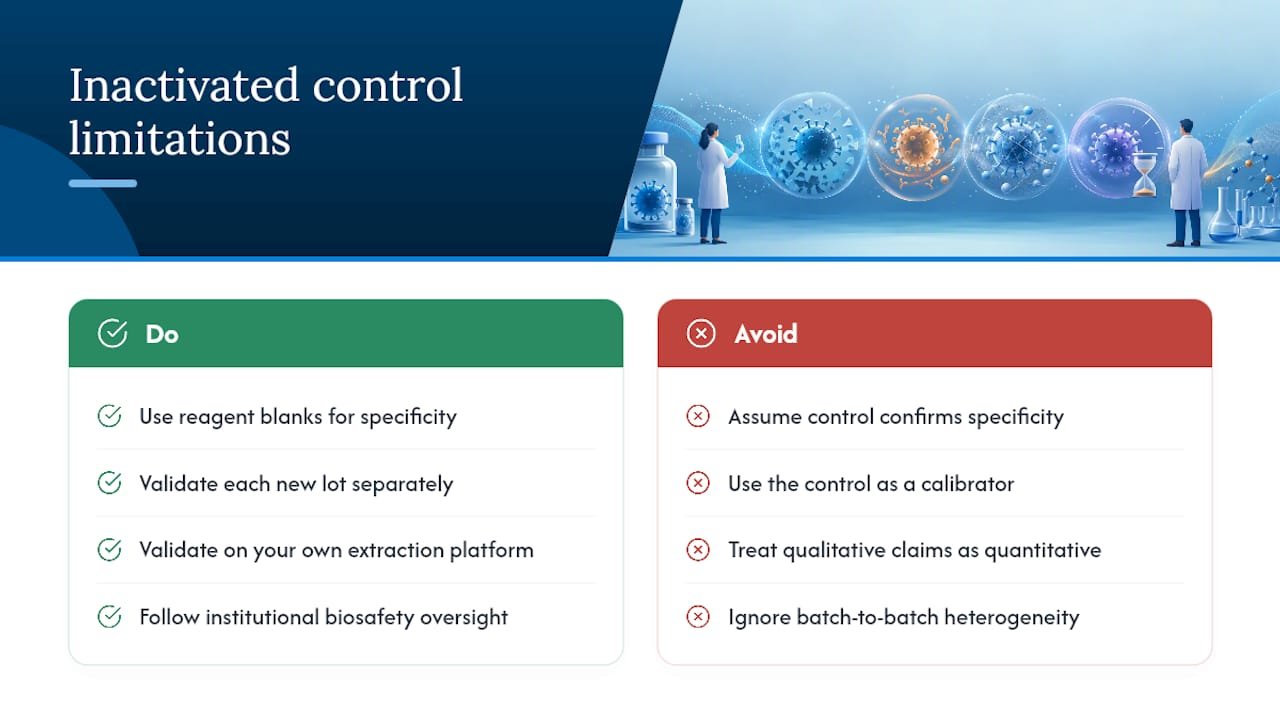
An inactivated virus control confirms that your extraction and detection steps work end to end. It does not confirm specificity, and it is not a calibrator. Unassayed whole-virus preparations can carry residual host-cell nucleic acid from the production process, which means a positive signal on a specificity panel needs a separate reagent blank to rule out background contamination rather than true cross-reactivity.
Batch-to-batch heterogeneity is real, even within a single manufacturer’s product line, so treat each new lot as its own entity rather than assuming continuity with the last one. “Noninfectious” also does not mean “no oversight required.” Institutional biosafety committees and guidance such as the WHO Laboratory Biosafety Manual still apply to handling, storage, and disposal. The two most common mistakes labs make: skipping validation on their own extraction platform because the datasheet looked reassuring, and treating a manufacturer’s qualitative claim as if it were an assigned quantitative value.
Why Mayflower Bioscience Takes a Validation-First Approach
We built our control and reagent lines around the assumption that no lab should take a manufacturer’s word for performance without checking it against their own instruments. Our catalog includes recombinant viral proteins like recombinant Ravn virus GPΔmuc, rVSV pseudotyped glycoproteins, and engineered VLPs for labs that need structural authenticity without live-virus handling. Every product ships with a datasheet, and our US-based technical support team can walk through stability data before you commit a lot to production. Author credentials and case study details for this article are pending review by our editorial team.
— Alina
Ready to Validate Your Own Control Lot?
If your lab is weighing whole inactivated virus against a pseudovirus or VLP format, the fastest way to know which one fits your workflow is to test a small evaluation lot rather than trust a datasheet alone. Recombinant viral proteins and engineered VLPs with documented production data are available, and technical support can assist with stability specifications before committing to a full lot.

Start by requesting a datasheet for the format that matches your assay chemistry, whether that is an rVSV pseudotyped glycoprotein or a recombinant viral protein control. Pair that with supporting reagents from our molecular biology line, and order a small evaluation quantity to run your own dilution series before scaling up. Reach out to our support team directly to get lot-specific stability data and get your validation plan moving this week.
Sources
- A simple method for preparing synthetic controls for conventional and real‑time PCR (PMC7112797)
- Comparison of pseudovirus, cell culture supernatant and MS2-based pseudovirus for SARS‑CoV‑2 quality control (PMC7769707)
- Plant-produced encapsidated RNA mimics (VLPs) as RT‑qPCR controls (PMC8611828)
- Optimizing virus inactivation methods for molecular detection techniques (ScienceDirect)
- Pseudovirus as an emerging reference material in molecular diagnostics (MDPI review)
This article is general information, not a substitute for advice from a qualified doctor. Consult a qualified healthcare professional about your own circumstances before acting on anything here.
FAQ
What Is an Inactivated Virus Control Used For?
It verifies that extraction, amplification, and detection all work correctly on a sample that behaves like real viral material, without the biosafety risk of live virus.
Are Inactivated Virus Controls the Same as Calibrators?
No. Most are unassayed and intended for qualitative or extraction-to-detection checks, not as quantitative calibrators for assigning concentration values.
How Do I Choose Between Whole Virus and Pseudovirus Controls?
Choose whole inactivated virus when structural authenticity for full-process validation matters most; choose pseudovirus or VLP formats when biosafety infrastructure, scalability, or stability under storage is the bigger constraint.
Why Does the Inactivation Method Matter for RT-qPCR?
Because heat, UV, BPL, and H2O2 each damage RNA and protein targets differently, and a method that degrades RNA integrity will inflate your assay’s limit of detection.
Can I Skip Validation if the Manufacturer Provides a Datasheet?
No. Datasheets often describe unassayed material, so your lab still needs to establish its own acceptance ranges on your specific extraction and detection platform before routine use.