
Nail Ion Channel Screening: Z’ Targets, APC Metrics for Drug Discovery
The most defensible pipeline for ion channel drug discovery runs fluorescence-based primary screening to triage large chemical libraries, automated patch-clamp (APC) to confirm potency and selectivity, and manual patch clamp to nail down mechanism before lead nomination. Every stage needs pharmacological validation with reference compounds and an early hERG or cardiac safety check, because selectivity failures caught late cost far more than the assay time saved by skipping them upfront.
TL;DR:
- Using fluorescence-based primary screening with APC validation efficiently balances throughput and data quality, avoiding costly late-stage failures.
- Running the hERG and cardiac safety panel in parallel with APC secondary screens prevents unnecessary manual patch efforts on compounds with potential cardiotoxicity.
- Maintaining a Z’ factor above 0.5, preferably around 0.72, is crucial for reliable screening, with cell health and buffer conditions being key factors.
- Focused libraries of 750 to 1,800 compounds suit well-characterized targets, while larger libraries exceeding 30,000 are best for novel channel discovery, especially with prior in silico filters.
- Outsourcing APC and assay development can increase screening capacity and ensure consistent results, especially when internal throughput becomes a bottleneck.
Table of Contents
- What Assay Platforms Do You Need for Ion Channel Screening?
- How Do You Structure an Ion Channel Screening Cascade?
- What Validation Metrics Matter Most in Ion Channel Assays?
- How Should You Choose a Compound Library for Ion Channel Screening?
- What Lab-Level Factors Determine Screening Success?
- How Mayflowerbio Supports Ion Channel Screening Programs
- What Three Screening Campaigns Taught Us
- Ready to Move Your Screening Program Forward?
- Sources
- FAQ
What Assay Platforms Do You Need for Ion Channel Screening?
Ion channel electrophysiology has four workhorse platforms, and each one earns its place at a different stage of the cascade. Picking the wrong one for the wrong stage is the single most common way screening budgets get wasted.
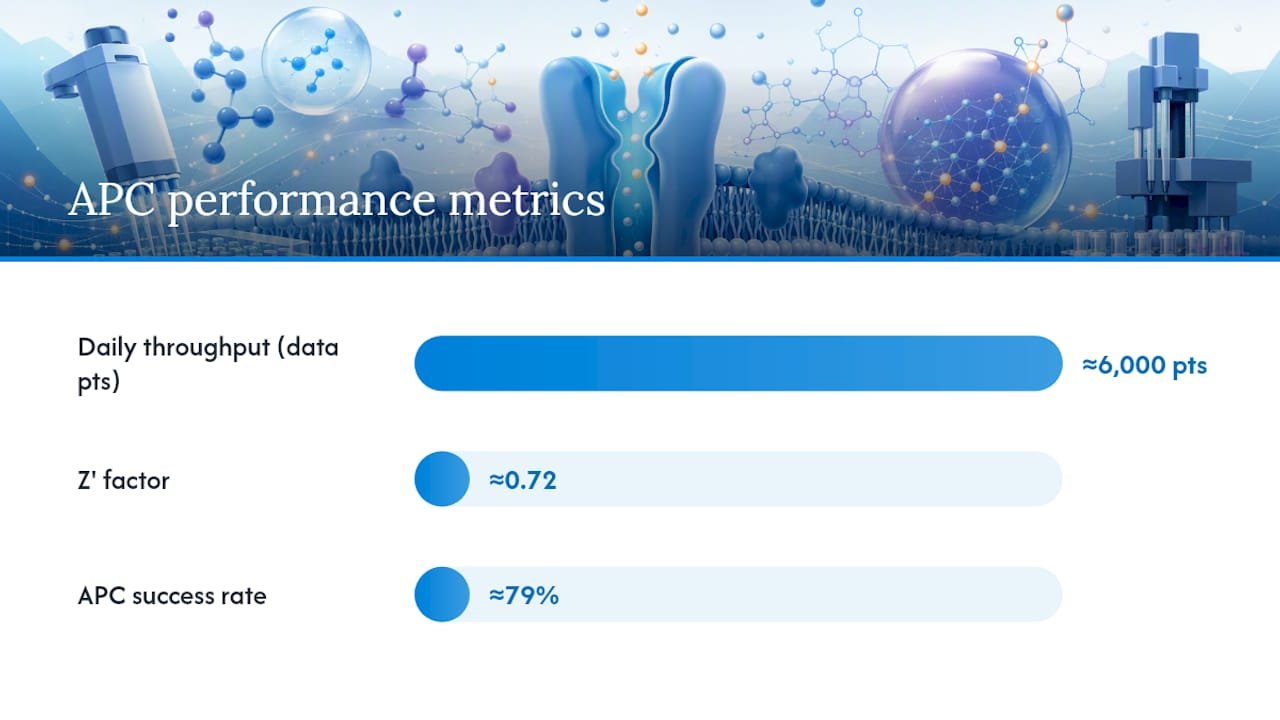
Automated patch-clamp (APC) systems like the SyncroPatch 768PE deliver gigaseal-quality recordings at a scale manual electrophysiology can’t touch. Optimized protocols on this platform report daily throughput near 6,000 data points with a Z’ factor around 0.72, and pilot runs have hit APC success rates approaching 79% with careful cell preparation. That combination of speed and data quality is why APC has become the default secondary screen rather than a primary one.
Manual patch clamp stays the gold standard for kinetics, state-dependence, and mechanism-of-action work, but it processes cells one at a time. Nobody runs 10,000 compounds through it. It’s a tertiary tool by design.
Fluorescence-based assays, whether membrane-potential dyes or ion-flux indicators using surrogate ions like thallium or iodide, run comfortably in 384 and 1536-well formats and are what most programs use to shrink a library before anything touches an electrode. They trade temporal resolution for volume.
- APC: high information content, moderate throughput, moderate cost
- Manual patch clamp: highest information content, low throughput, high cost per data point
- Fluorescence-based (membrane potential, flux): lower resolution, very high throughput, low cost
- Ligand-binding assays: fast and cheap, but blind to functional channel activity
Most robust programs combine fluorescence-based primary screens with APC validation precisely because no single platform covers both ends of the throughput-to-information spectrum.
How Do You Structure an Ion Channel Screening Cascade?
A screening cascade only works if each stage has a hard acceptance gate, not a vague “looks promising” call. Here’s the sequence that holds up across most target classes:
- Pilot screen on 200 to 500 compounds, including known actives and inactives, to confirm the assay window and hit-calling threshold before committing the full library.
- Primary HTS using a fluorescence-based format, with hit calls set at 3 standard deviations from the plate mean and full plate-level positive/negative controls on every plate.
- APC secondary screen on confirmed hits to establish dose-response potency, selectivity against related channel subtypes, and state-dependent behavior.
- Manual patch clamp tertiary on the shortlist, usually under 20 compounds, to confirm kinetics and mechanism before lead nomination.
- hERG and cardiac safety panel, run in parallel with the APC secondary stage rather than tacked on at the end, since cardiac liability should disqualify compounds before they consume tertiary bandwidth.
Pro Tip: Run your hERG panel alongside the APC secondary stage, not after it. Screening for cardiac liability in parallel, rather than as a final gate, has saved teams weeks by killing bad actors before they reach the expensive manual patch stage.
Iterative pilot screening followed by APC mechanistic evaluation is especially important for novel targets, where there’s often no established pharmacological standard to validate against yet.
What Validation Metrics Matter Most in Ion Channel Assays?
An assay that isn’t validated is just an expensive way to generate noise. The Assay Guidance Manual’s ion channel screening chapter treats pharmacological validation with orthogonal technologies as non-negotiable, and the data backs that up.
Every plate needs a minimum of 8 to 16 positive controls and an equal number of negative controls, distributed across rows and columns rather than clustered in one corner, so edge effects and reagent drift don’t masquerade as hits.
Z’ factor benchmarks: A Z’ at or above 0.5 is generally considered screenable. Optimized APC protocols on the SyncroPatch 768PE have reported Z’ factors around 0.72, which is closer to what you should be targeting before locking an assay for full-scale HTS.
When Z’ drops below 0.5, the usual culprits are inconsistent cell confluence, indicator concentration drift, or ionic buffer composition changing between batches. Work through these in order:
- Check plating density and confluence consistency across the plate first.
- Re-titrate indicator dye concentration if signal-to-noise has degraded.
- Confirm ionic conditions (extracellular potassium, calcium) match the validated protocol exactly.
- Decide wash versus no-wash format based on dye retention, not just convenience.
Pharmacological validation with known reference compounds, followed by orthogonal confirmation on a second assay technology, is what separates a defensible hit list from a lucky one.
How Should You Choose a Compound Library for Ion Channel Screening?
Library size should match the question you’re asking, not the biggest collection your budget can afford. Focused, ion-channel-annotated sets run from roughly 750 to 1,800 compounds and work well for target-class profiling or repurposing known channel modulators. Broader discovery campaigns often draw from libraries exceeding 35,000 compounds when the goal is finding genuinely novel chemotypes.
- Use a focused library (roughly 750 to 1,800 compounds) when profiling a well-characterized channel or repurposing known actives.
- Use a large library (30,000+ compounds) when the target is novel and chemical space needs broad coverage.
- Apply in silico cardiotoxicity and hERG filters before any compound reaches a plate.
- Reserve ultra-large virtual libraries for computational triage only, not direct wet-lab testing.
Virtual screening methods, including ligand-based and structure-based approaches and machine-learning models, are increasingly used to rank compounds before synthesis or purchase. Pairing that with in silico hERG prediction filters out likely cardiotoxic scaffolds before they ever cost you a plate.
What Lab-Level Factors Determine Screening Success?
Cell-line choice quietly determines whether your whole campaign succeeds or stalls. Stable lines are simpler to maintain, but inducible expression systems are worth the extra setup time for channels that are toxic to cells at constitutive expression levels, since they let you control expression timing and avoid selecting for silenced or low-expressing clones over passages.
APC success rates hinge on cell health and seal quality more than any other variable. Confluence, passage number, and dissociation technique all move the needle before the recording even starts.
| Planning factor | Typical range | Practical impact |
|---|---|---|
| APC daily throughput | 6,000 data points | Sets realistic weekly campaign pace |
| APC success rate (optimized) | Up to ~79% | Determines how many cells/chips you need per compound |
| Z’ factor target | ≥0.5 (0.72 achieved in optimized runs) | Gate for locking an assay before full HTS |
| Multi-dose vs single-dose APC | Multi-dose lowers per-cell success | Trade-off between throughput and reliability |
Throughput figures across APC platforms vary by protocol, but even the lower end lets a team clear a confirmed hit list of a few hundred compounds within two to three weeks, assuming consumables and instrument time are budgeted for it. Multi-dose protocols push more data through per run, but they measurably lower per-cell success rates, so reserve them for cases where throughput demands genuinely outweigh the drop in reliability.
How Mayflowerbio Supports Ion Channel Screening Programs
Mayflowerbio’s ion channel testing services cover APC-based screening and custom assay development for teams that need a secondary confirmation partner without building in-house electrophysiology capacity. The ion channel cell line catalog includes stable and inducible expression systems suited to the QC considerations above, and the broader inhibitors and modulators collection supplies reference compounds for the pharmacological validation step every assay guidance document insists on. These resources exist to shorten the distance between a screening plan and a working assay.
What Three Screening Campaigns Taught Us
Single-format validation is a trap. A hit that only shows activity on one assay technology is often an artifact, not a lead, which is why orthogonal confirmation belongs in the plan from day one, not as a fallback when something looks off.
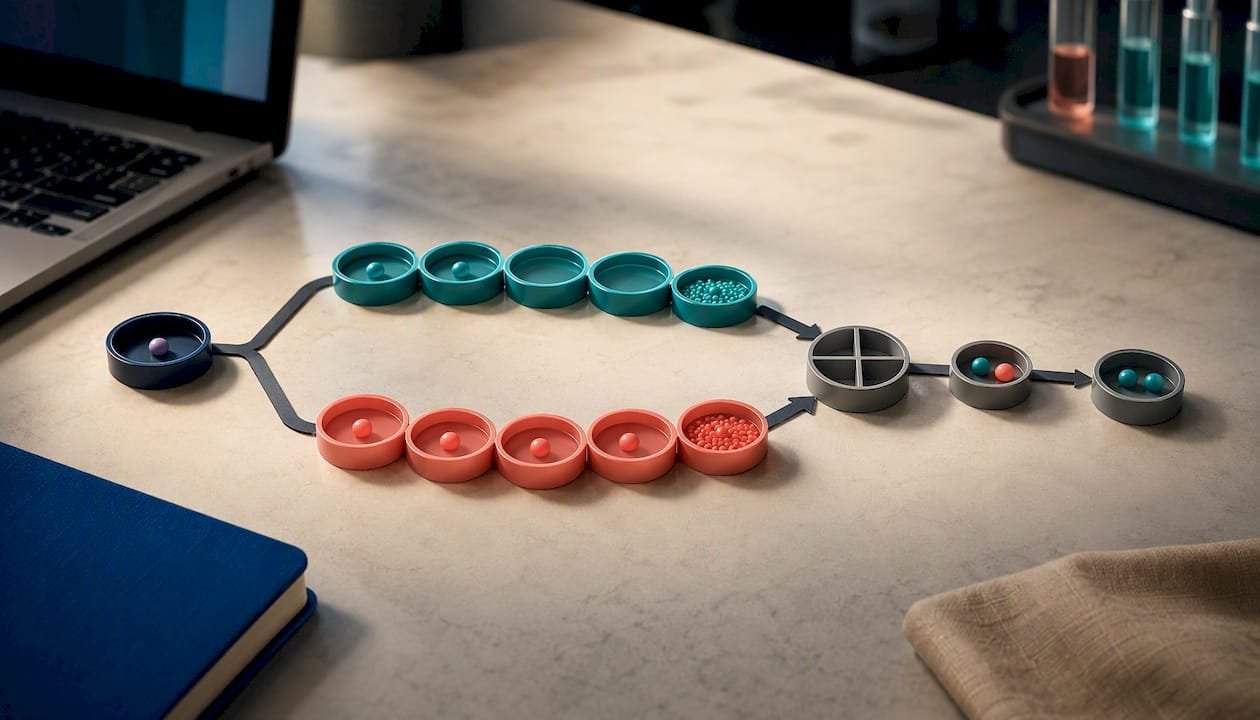
Pilot optimization feels slow, but skipping it is slower. A poorly tuned pilot screen creates false hit-calling thresholds that surface as wasted APC time weeks later.
Outsourcing APC campaigns makes sense the moment internal capacity becomes the bottleneck rather than the science. Fixed-cost efficiency from a dedicated platform usually beats stretching a small in-house rig past its comfortable throughput.
— Alina
Ready to Move Your Screening Program Forward?
If you’re weighing whether to build APC capacity in-house or lean on a partner for the secondary confirmation stage, the deciding factor is usually throughput math, not preference. Mayflowerbio supplies the pieces most programs are missing: ion channel testing services for APC and custom assay work, ion channel cell lines in stable and inducible formats, and reference compounds through the inhibitors and modulators catalog for the pharmacological validation step your assay can’t skip.

Before reaching out for a quote or technical consult, have three things ready: your target channel and subtype, your preferred cell expression system, and an estimate of library size. That’s enough for Mayflowerbio to scope timeline and cost accurately. Start by browsing the ion channel services page or reach out directly through Mayflowerbioscience to request a project quote.
Sources
- High-throughput electrophysiological assays for voltage gated ion channels using SyncroPatch 768PE
- Ion channel screening (Assay Guidance Manual chapter)
FAQ
What Diseases Are Linked to Ion Channel Dysfunction?
Ion channel dysfunction, often called a channelopathy, underlies conditions including epilepsy, cardiac arrhythmias like long QT syndrome, cystic fibrosis, and certain forms of chronic pain and migraine.
How Do I Get an Ion Channel Cell Line for Screening?
Ion channel cell lines expressing your target of interest are available as stable or inducible systems through specialized suppliers; Mayflowerbio’s ion channel cell line catalog offers both formats for common channel targets.
What Triggers Ion Channels to Open?
Ion channels open, or gate, in response to specific triggers depending on the channel class: voltage changes across the membrane for voltage-gated channels, ligand binding for receptor-operated channels, or mechanical stress for mechanosensitive channels.
What Does It Mean When an Ion Channel Is Gated?
Gating refers to the conformational change that opens or closes a channel’s pore in response to a stimulus, and it’s the property that every screening assay, from fluorescence dyes to patch clamp, is ultimately designed to measure.
Why Combine Multiple Assay Formats Instead of Just One?
Relying on a single assay technology risks mistaking an artifact for a genuine hit; combining fluorescence-based primary screening with APC and manual patch clamp confirmation, as recommended in ion channel screening guidance, catches false positives before they reach lead nomination.