Ion Channel Testing Cost: What Labs Actually Budget in 2026
Manual patch clamp characterization runs roughly $800 to $1,200 per data point in historical industry figures, automated patch clamp (APC) brings that down to about $150 to $300 per data point, and fluorescence-based primary screens cost a fraction of either on a per-well basis. The smartest budgeting move for most discovery programs is a tiered pipeline: fluorescence screening first to cut the compound list down, APC to validate the survivors with real electrophysiological data, and manual patch reserved for the handful of hits that need full mechanistic characterization.
Before you request a quote, know what drives the number up or down:
- Instrument access — owned, leased, or outsourced changes your per-sample math entirely
- Consumables — patch plates, chips, and single-use fluids often outweigh instrument depreciation
- Personnel time — data analysis on high-volume APC runs is not free labor
- Cell line quality — validated, stable lines reduce repeat runs and wasted plates
Key Takeaways
A cost-conscious ion channel testing budget uses fluorescence screening to cut volume, APC to validate at $150 to $300 per data point, and manual patch only where mechanism truly requires it.
| Point | Details |
|---|---|
| Tier your workflow | Route compounds through fluorescence, then APC, then manual patch, so cost scales with data need. |
| Watch consumables, not just instruments | Patch plates, wash steps, and reagent volume often outweigh instrument amortization per data point. |
| Know your real per-point range | Budget $150 to $300 per APC data point and $800 to $1,200 for manual patch on final characterization work. |
| Separate CRO quote line items | Ask vendors to break out development fees from per-data-point production costs before committing. |
| Consider Mayflowerbio for pilot work | Mayflowerbio’s ion channel services and validated cell lines suit labs without in-house APC capacity. |
Table of Contents
- Ion Channel Testing Cost Breakdown: What You’re Actually Paying For
- Ion Channel Screening Cost Ranges and Sample Budgets
- Building a Screening Cascade That Controls Total Spend
- In-House Testing vs. Outsourcing to a CRO
- When Mayflowerbio Fits Your Ion Channel Workflow
- What the Numbers Actually Tell Lab Managers
- Get a Tailored Ion Channel Testing Quote from Mayflowerbio
- Sources
- FAQ
Ion Channel Testing Cost Breakdown: What You’re Actually Paying For
A CRO quote or an internal budget line rarely tells you what’s inside it. Break it apart before you sign anything.
- Capital and instrument access. Whether you own an APC platform, lease one, or pay per-run at a contract lab, that cost has to get spread across every data point you generate. A $250,000 instrument amortized over a low sample volume can make your per-point cost worse than outsourcing, not better.
- Consumables. This is the line item most labs underestimate. Patch plates and chips, wash-step reagents, test-article dilutions, and cell suspension media all add up fast, and operational guidance on automated electrophysiology notes that consumable choices and assay scripting complexity are major drivers of cost per data point, sometimes exceeding the instrument’s own amortized cost.
- Cell lines and reagents. Whether you’re buying validated ion channel cell lines or maintaining your own, cell quality determines how many runs fail QC and need repeating. A poorly characterized line costs you twice: once in the failed run, once in the re-run.
- Personnel and training. Someone has to run the assay, troubleshoot the seal rates, and analyze the resulting traces. High-throughput APC datasets generate a lot of data fast, and the analysis hours behind that data rarely show up on the CRO’s line-item invoice unless you ask.
- Assay development and validation. Protocol optimization, pharmacological standard curves, and voltage-protocol tuning usually appear as a separate development fee before you ever get to production runs.
- Facility and indirect costs. Bench time, QC review, data storage, and waste disposal for biological consumables are real costs that internal budgets often bury under “overhead” instead of pricing explicitly.
Pro Tip: Ask any CRO to separate assay development fees from per-data-point production fees in writing. Bundled quotes make it nearly impossible to tell whether you’re paying for genuine optimization work or just a markup on standard protocols.
Ion Channel Screening Cost Ranges and Sample Budgets
Numbers help more than percentages here, so let’s get specific. Market analysis on patch clamp assay services puts automated patch clamp costs in the $150 to $300 per data point range, largely reflecting consumables, instrument time, and a slice of personnel cost. Manual patch, by contrast, carries historical per-data-point figures in the $800 to $1,200 range, driven almost entirely by hands-on operator time and lower throughput per day. Fluorescence-based high-throughput screening sits well below both on a per-well basis. It sacrifices information content (no direct current measurement, more indirect signal), which is exactly why it belongs at the front of the funnel and not the end.
Three quick scenarios show how this plays out in practice:
- Pilot validation (10 compounds): Skip fluorescence entirely at this scale and go straight to APC. Ten compounds run through automated patch clamp is a manageable, controlled spend that gives you real electrophysiology data fast.
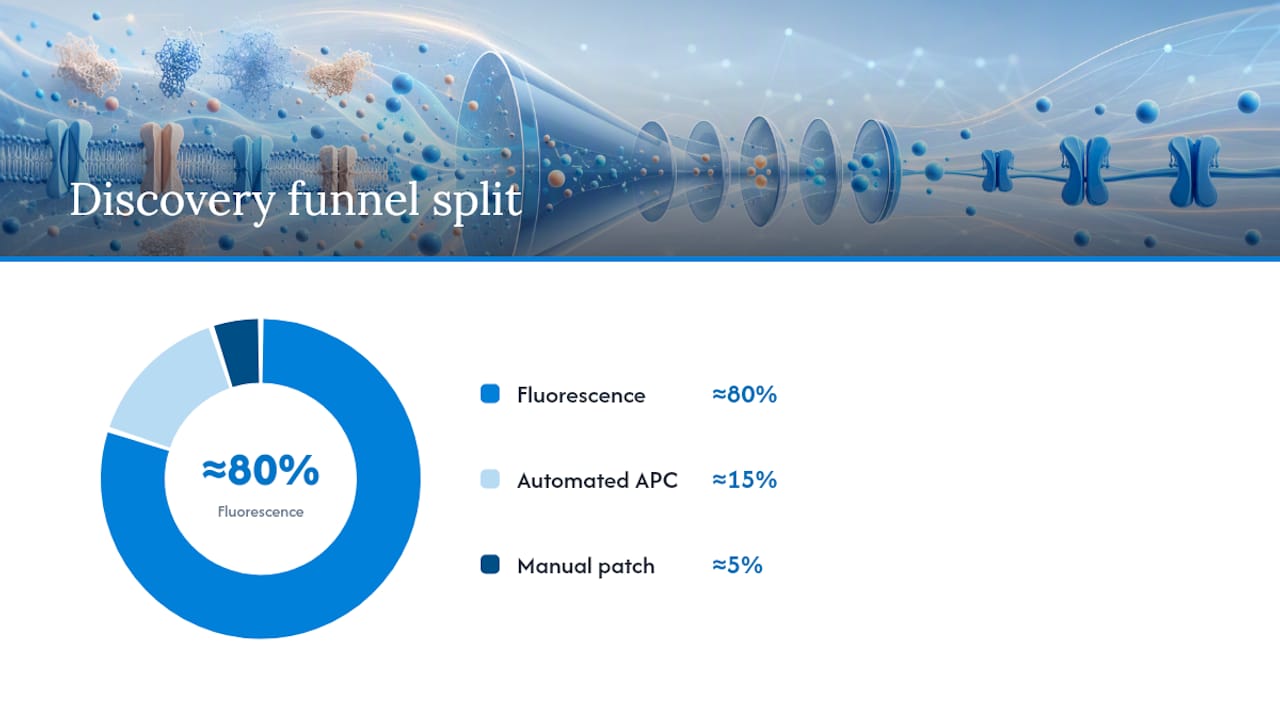
- Discovery funnel (200 to 1,000 compounds): Fluorescence screening narrows the field first, then APC validates the top hits. A commonly cited rule of thumb allocates more than 80% of assays to fluorescence formats, about 15% to APC, and roughly 5% to manual patch tertiary work, though you should adjust that split to your own hit rate.
- Safety profiling (hERG plus Nav1.5 panel): This is where early APC investment pays for itself. Industry analysis on ion channel safety liabilities suggests that catching a cardiac safety signal early with quality APC data is far cheaper than discovering it during late-stage development.
Turnaround matters as much as the per-point number. Rush requests on manual patch work can add substantial premiums given how labor-constrained that method already is, so build in lead time wherever you can.
Building a Screening Cascade That Controls Total Spend
The math behind a tiered cascade is simpler than it looks once you write it out. Total project cost equals (primary wells × fluorescence cost per well) plus (secondary hits confirmed × APC cost per point) plus (final candidates × manual patch cost per point). Because fluorescence costs are so much lower per unit, the goal is to push as much attrition as possible into that first stage without losing real hits.
- Run fluorescence primary screening first. Reviews of high-throughput ion channel screening consistently recommend this as the entry point precisely because no single assay format offers ideal throughput, cost, and information content simultaneously.
- Validate hits with APC. This stage catches false positives from the fluorescence assay and gives you real current traces to work with, at a fraction of manual patch cost.
- Reserve manual patch for mechanism work. Save this for compounds where you genuinely need the resolution and flexibility that manual patch clamp still provides for complex cell types, like primary cells or iPSC-derived neurons.
- Set gating criteria before you start. Define acceptance criteria, control plate performance thresholds, and replication requirements up front. Vague gating is the single biggest cause of expensive re-runs.
- Track cost-per-hit, not cost-per-assay. A cheap assay that generates ten false positives you then have to chase down in APC isn’t actually cheap.
In-House Testing vs. Outsourcing to a CRO
The decision usually comes down to five factors: expected throughput, how often you’ll need this assay, available capital, in-house electrophysiology expertise, and how much you care about owning the raw data versus a summary report.
If you’re running one or two campaigns a year, buying a $200,000+ APC instrument rarely makes financial sense. Contract labs exist precisely because instrument and consumable intensity pushes many organizations toward outsourcing rather than building internal capacity they’ll underuse.
A typical CRO quote should itemize:
- Assay setup and development fees (separate from production runs)
- Per-recording or per-compound pricing
- Consumables policy (included, capped, or billed separately)
- Data analysis and reporting scope
- Turnaround time and any rush-fee structure
Pro Tip: Supplying your own validated cell lines or reagents to a CRO is one of the more effective cost levers available, since it removes a variable the CRO would otherwise price in with its own markup and lets you keep control of a key biological input.
Batching multiple compounds into a single run, limiting deliverables to raw traces plus a short summary instead of a full formatted report, and locking in per-point pricing before scaling up all reduce the final invoice without touching data quality.
When Mayflowerbio Fits Your Ion Channel Workflow
If your lab lacks the throughput to justify an in-house APC platform, or you need a validated cell line to supply to a contract lab, Mayflowerbio’s ion channel testing services and ion channel cell line catalog cover both gaps from a centrally located, US-based team.
This fits labs running pilot safety panels, groups that need help optimizing assay conditions before committing to a large screen, and anyone who wants a validated line like a KV7.1 inducible expression line instead of building one from scratch.
When you request a quote, ask for:
- Per-recording or per-compound pricing broken out separately
- Consumables policy (included or billed as used)
- Expected turnaround for your specific assay volume
- Data deliverable format (raw traces vs. summary report)
- QC acceptance criteria for seal rate and control compound response
What the Numbers Actually Tell Lab Managers
Most budgeting mistakes in this space come from anchoring on a single number instead of a workflow. A lab manager who asks “what does ion channel testing cost per data point” and gets a flat answer is being set up to either overpay for manual patch on compounds that never needed that resolution, or underpay for fluorescence data that can’t actually support a safety claim.
The conventional advice, “get three quotes and pick the cheapest,” misses the real lever entirely. The cheapest quote per data point is meaningless if it comes from a platform that hasn’t been validated against your specific channel, or a CRO that bundles development costs into production pricing so you can’t see where the money actually goes. Standardization across APC platforms remains a genuine limitation in this field, which means switching vendors or platforms mid-project often costs more in re-validation than it saves in headline pricing.
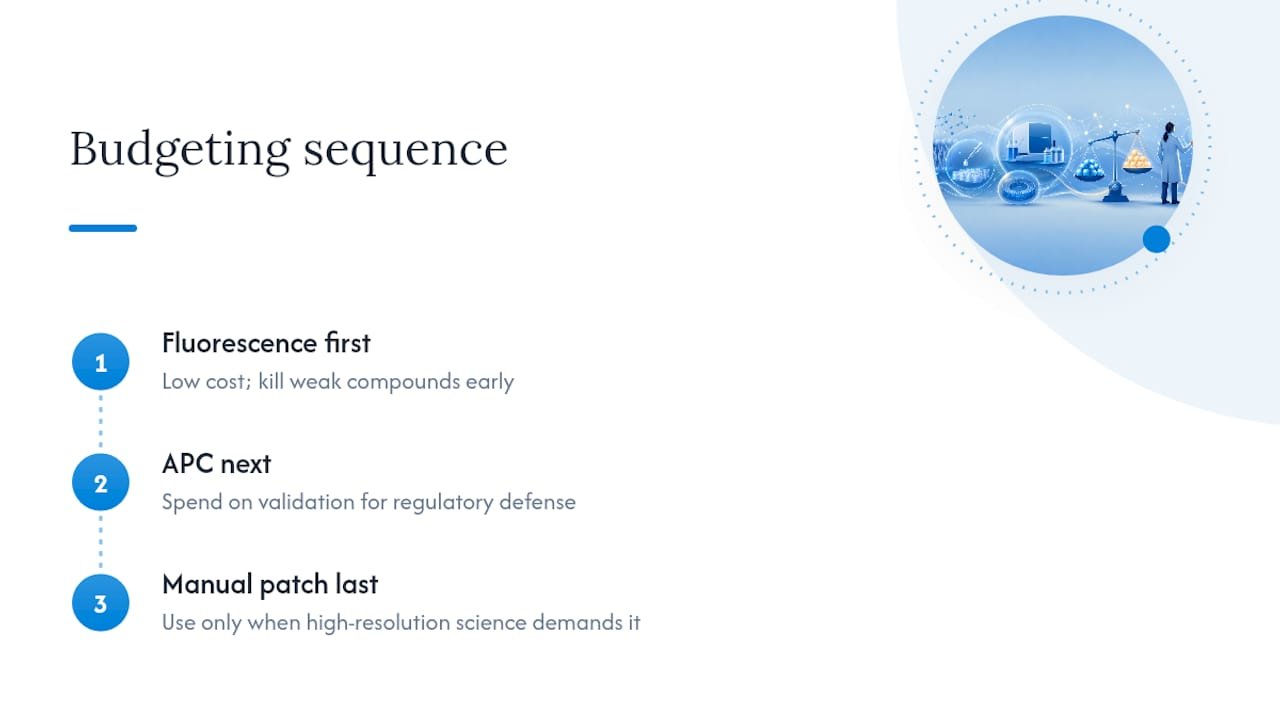
What actually matters is sequencing. Spend your cheap dollars first on fluorescence to kill weak compounds early, spend your APC dollars on real validation data you can defend to a regulatory reviewer, and save manual patch for the compounds where the science genuinely demands it. Get that order wrong and no quote, however competitive, will fix your budget.
Get a Tailored Ion Channel Testing Quote from Mayflowerbio
If you’ve read this far, you already know the real cost lever isn’t finding the cheapest per-point price. It’s matching the right assay tier to the right stage of your program and not overpaying for resolution you don’t need yet. That’s exactly where Mayflowerbio fits: a US-based team offering ion channel testing services alongside validated ion channel cell lines, so you can start with a pilot panel instead of committing to a full internal buildout.

Mayflowerbio also carries the reagents and inhibitors many ion channel protocols call for, which means fewer vendors to coordinate when you’re trying to hit a project timeline. If your assay involves complex reagent panels, it’s also worth reviewing how single reagents affect research outcomes before finalizing your protocol. For labs weighing whether to build a peptide or reagent component in-house, partners like Data Peptides offer relevant background on sourcing decisions for complex assay inputs.
Reach out to Mayflowerbio to request pilot pricing and a quote scoped to your specific channel, cell type, and compound volume.
Sources
- Patch Clamp Assay Services Market Research Report 2034
- Assay guidance and operational notes on automated electrophysiology — cost of operation
- High throughput screening technologies for ion channels
- Industry analysis on safety profiling and APC benefits
FAQ
How much does ion channel testing cost per data point?
Automated patch clamp typically runs $150 to $300 per data point, while manual patch clamp historically costs $800 to $1,200 per data point due to its labor intensity and lower throughput.
Is fluorescence-based screening cheaper than patch clamp?
Yes, fluorescence-based high-throughput screening costs far less per well than either patch clamp method, though it delivers less direct electrophysiological information, which is why it works best as a primary filter, not a final answer.
When should a lab outsource ion channel testing instead of building in-house capacity?
Outsourcing usually makes sense when throughput needs are occasional, capital for an APC instrument isn’t available, or in-house electrophysiology expertise is limited; Mayflowerbio’s ion channel testing services suit exactly this kind of pilot or overflow need.
What is the cheapest way to reduce ion channel screening costs?
Supplying your own validated cell lines to a CRO, batching compounds into single runs, and limiting deliverables to raw data plus a short report are the most reliable ways to cut costs without sacrificing data quality.
Why does manual patch clamp still cost so much more than automated platforms?
Manual patch requires a skilled operator running one cell at a time, while automated platforms parallelize recordings across many cells simultaneously, which is the main reason per-data-point costs differ so sharply between the two methods.