
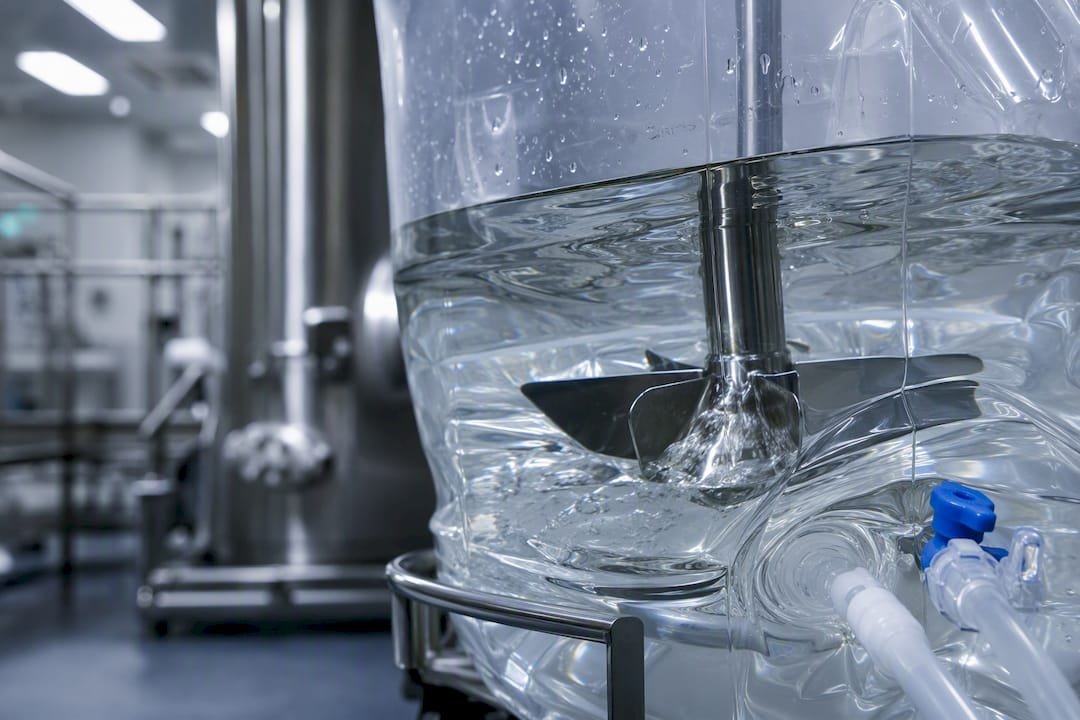
Mixing, kLa, P/V: How Process Engineers Decide on Single Use Bioreactors
Single-use bioreactors are the right call for flexible, multiproduct, or early-phase programs, but they’re a weaker fit for high-utilization, long-running campaigns with tight consumable budgets. The single-use bioreactors pros and cons trade-off comes down to one thing: you gain speed and lower cleaning burden, but you inherit recurring costs and supply-chain exposure. Mixing time, kLa, and extractables testing are what actually separate a safe switch from a costly one, and assay and testing support services can help you verify the science before you commit hardware.
TL;DR:
- Single-use bioreactors are ideal for rapid changeovers, flexibility, and reducing cross-contamination in early-phase or multiproduct manufacturing but become less cost-effective at high utilization levels.
- They require thorough verification of mixing time and oxygen transfer rate for scale-up, as device-specific engineering parameters can significantly affect process performance.
- Validation shifts from cleaning to supplier qualification and extractables testing, emphasizing the need for process-specific data on leachables, weld integrity, and container closure.
- The environmental impact of single-use systems mainly depends on plant energy use, with plastic waste being a smaller factor, though recycling logistics and decontamination complicate sustainability claims.
- Deciding between single-use and stainless steel hinges on process volume, stability, facility infrastructure, supply chain reliability, and validation readiness, not just upfront costs.
Table of Contents
- What Are the Main Advantages of Single-Use Bioreactors?
- What Are the Disadvantages of Single-Use Systems?
- How Do Mixing Time and kLa Affect Scale-Up?
- What Changes in Validation and Extractables Testing?
- Do Single-Use Bioreactors Have a Smaller Environmental Footprint?
- How Do You Decide Between Single-Use and Stainless Steel?
- What Bioprocess Engineers Get Wrong About This Decision
- How Mayflowerbio Supports Your Single-Use Evaluation
- Sources
- FAQ
What Are the Main Advantages of Single-Use Bioreactors?
Skip the cleaning validation, skip the steam-in-place cycle, and you can commission a new campaign in days instead of weeks. That’s the core appeal of single-use bioreactors (SUBs), and it’s why they’ve become the default for early-phase and clinical manufacturing across mammalian cell culture work.
Faster changeover and flexibility. Because SUBs arrive pre-sterilized and gamma-irradiated, there’s no clean-in-place (CIP) or steam-in-place (SIP) cycle between batches. A stainless steel vessel needs cleaning validation, rinse sampling, and a documented turnaround before the next run starts. A single-use bag gets unpacked, mounted, and inoculated. For contract manufacturers juggling multiple client programs in the same suite, that difference alone can determine how many campaigns fit into a quarter.
Lower cross-contamination risk. Each bag is used once and discarded, which removes the risk of carryover between products, a real concern in multiproduct facilities running different cell lines or biologics through the same footprint. This is one reason SUBs have become common in mammalian cell culture and stem cell bioprocessing, where batch segregation matters as much as yield.
Lower capital and smaller footprint. A stainless steel train needs WFI (water-for-injection) generation, steam distribution, and clean utilities sized for the vessel. Skip the tank and you skip much of that infrastructure. For a startup running a Phase 1 program out of a leased suite, that’s often the difference between building a facility and renting one.
Less cleaning, less water, less labor. Life-cycle work comparing disposable and reusable systems has found lower energy consumption tied to cleaning and sterilization in several modeled disposable-system scenarios, largely because there’s no CIP water, no clean steam, and no cleaning-validation labor to schedule.
Pro Tip: Don’t evaluate cleaning savings in isolation. Add up validation documentation time, not just utility costs. Labs frequently underestimate how many engineer-hours a single CIP cycle actually consumes until they stop doing them.
Here’s the short version of what tips a process toward disposables:
- Multiple products or cell lines running through the same suite
- Clinical or early-phase volumes where campaign length is short and unpredictable
- Limited capital for permanent utility infrastructure
- A need to add or remove capacity quickly as programs shift
What Are the Disadvantages of Single-Use Systems?
The bill for convenience comes due on every batch. Where stainless steel is a sunk cost you depreciate over twenty years, single-use consumables are a recurring line item that scales with every run.
Recurring consumable costs. Bags, tubing sets, connectors, filters, and pre-assembled fluid paths all get purchased fresh for every campaign, sometimes every batch. At high utilization, that per-batch spend can erode the capital savings SUBs offered at the outset. This is the central tension in the single-use vs. stainless steel bioreactors debate: disposables win on flexibility, but stainless wins on cost-per-liter at scale.
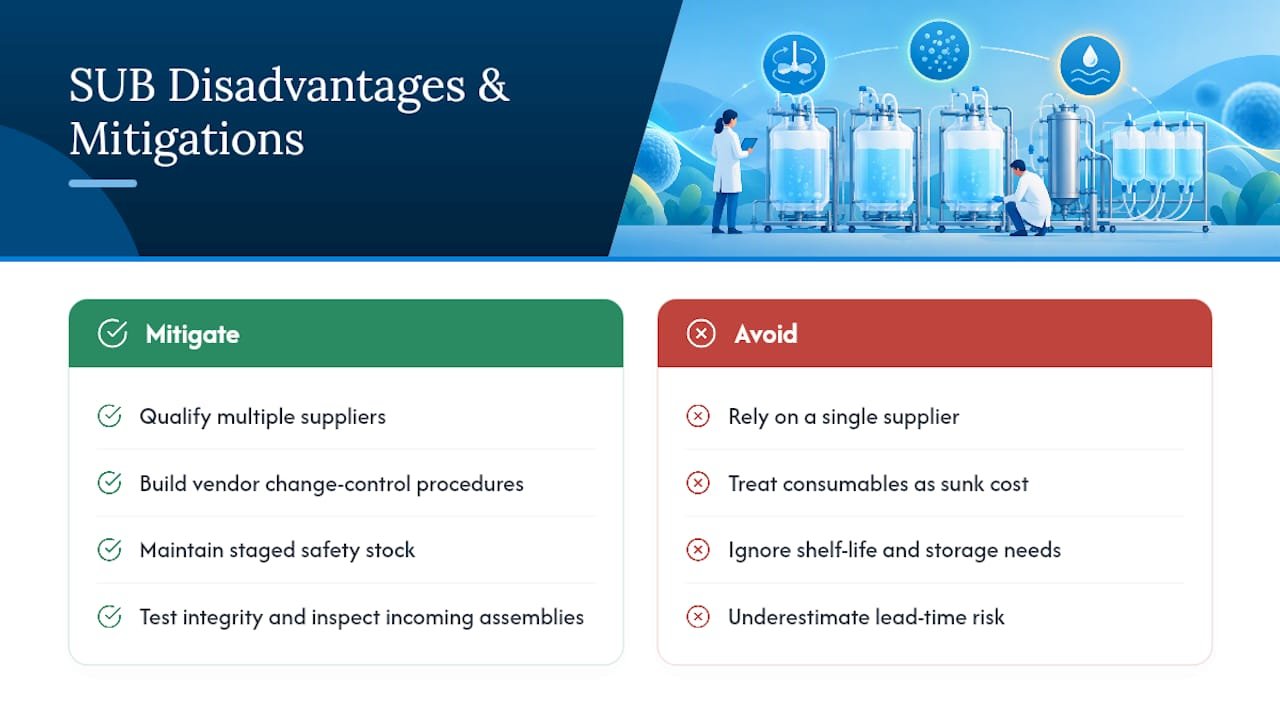
Supplier and lead-time dependence. A single-use program lives or dies by its supply chain. Consumable availability behaves like a capacity variable. Late bags or connectors can halt a campaign even when the hardware is sitting idle and ready. Reported operational risks include exactly this kind of lead-time exposure, along with the storage and shipping burden that comes with keeping gamma-sterilized inventory on hand.
Bag and assembly integrity failures. A bag leak or weld failure isn’t a repair job. It’s a lost batch. Integrity testing and incoming inspection catch some defects before use, but the risk assessment has to cover the entire fluid path, not just the film. That means welds, ports, tubing, connectors, probes, and filters all need scrutiny, along with the assembly’s shipping and handling history before it ever reaches your suite.
Storage and shelf-life logistics. Gamma-sterilized consumables have finite shelf lives and need dedicated, climate-controlled storage space. For facilities running several product lines, that inventory can occupy more square footage than most teams budget for.
Mitigating these risks means qualifying more than one supplier, building change-control procedures around any vendor substitution, and keeping staged safety stock rather than ordering just-in-time. A primer on bioprocessing terminology is worth a look if your team is still mapping out where these risks sit in your existing quality system.
How Do Mixing Time and kLa Affect Scale-Up?
Bioreactor geometry isn’t standardized across vendors, so a process that runs cleanly in one 200 L SUB doesn’t automatically behave the same way in a competitor’s 200 L unit, let alone at 2,000 L. Verifying transfer means testing specific engineering metrics, not trusting a datasheet.
The metrics that actually predict whether a process will scale:
- Mixing time — how quickly the vessel achieves homogeneity after an addition. Design-space literature for SUB families targets mixing times under 60 seconds across the 50 to 2,000 L range, but that number depends entirely on impeller design and fill volume.
- kLa (oxygen transfer coefficient) — governs how much dissolved oxygen reaches the culture. The same design-space work cites kLa values above 7 h⁻¹ under pure-oxygen sparging as a workable target for mammalian processes, though sparger type changes this substantially.
- CO2 removal — high-density cultures generate CO2 faster than some single-use gassing strategies can strip it, which can shift culture pH and slow growth if not modeled early.
- Power input per volume (P/V) — typically specified in the 10 to 250 W/m³ range for mammalian cultures, tying directly to both mixing performance and shear exposure.
- Tip speed and shear — impeller tip speeds under roughly 2.0 m/s are commonly cited as protective for shear-sensitive lines, but shear-sensitive processes (some stem cell and viral vector work) need direct viability testing at the target speed, not just a literature number.
- Heat transfer and foaming behavior — bag-based systems often rely on external jackets or blankets for temperature control, which respond more slowly than a stainless jacket, and foam control strategies differ by sparger geometry.
Because these parameters are device-specific, a minimal characterization plan should include mixing and kLa mapping at your actual working volume, small-scale mimic runs to predict behavior before committing full batches, pilot-scale verification of your critical quality attributes (CQAs), and an in-process monitoring strategy that catches drift before it affects a full-size run. One 2024 case documented successful transfer from a single-use platform to a 15,000-L stainless steel reactor, but only after this kind of engineering characterization was mapped in detail beforehand.
What Changes in Validation and Extractables Testing?
Swapping a stainless tank for a plastic bag doesn’t remove validation work. It relocates it. Cleaning validation, the traditional centerpiece of a stainless steel quality program, gets replaced by supplier qualification, sterilization assurance, and incoming-component testing.
Extractables and leachables are the biggest new variable. Plastic films are formulated with additives, plasticizers, and antioxidants that can migrate into culture media under normal processing conditions. A 2017 analytical study incubated media in seven single-use bioreactors from different vendors and detected the leachable compounds DtBP and TBPP-ox in every sample tested, with a third compound, bDtBPP, showing up in six of the seven. That’s a cross-vendor pattern, not an isolated defect, which is exactly why process-specific E&L testing matters more than trusting a vendor’s generic extractables report.
Quality teams adopting SUBs typically need to add:
- Container-closure integrity testing on incoming lots
- Weld and port integrity checks, plus pressure or leak testing where the process warrants it
- Full lot traceability back to the bag manufacturer’s batch records
- Change-control triggers for any material or supplier substitution
A vendor certificate of analysis tells you the film passed generic testing. It doesn’t tell you what happens when your specific media, your specific hold times, and your specific process conditions interact with that film. That gap is why regulatory expectations increasingly point toward process-specific extractables data rather than relying on supplier documentation alone.
Do Single-Use Bioreactors Have a Smaller Environmental Footprint?
The honest answer is: it depends on what you’re measuring, and results swing hard based on assumptions. A streamlined cradle-to-gate LCA of a 2,000-L biologics process found that plant electricity, not plastic waste, was the dominant contributor to overall environmental impact, and that end-of-life plastic disposal was a strikingly small piece of the total footprint in that specific case.
| Life-cycle factor | Typical direction for SUBs | Key caveat |
|---|---|---|
| Cleaning water/chemical use | Lower than stainless steel | Applies mainly to CIP-heavy stainless operations |
| Plant electricity | Often the largest overall contributor | Depends on grid mix and plant efficiency, not vessel type |
| Plastic manufacturing/disposal | Small share of total impact in the cited case study | Highly case-dependent, not a universal result |
| Materials use (disposables) | Higher than reusable systems | Modeled disposable-system scenarios flagged this as an offset to energy savings |
End-of-life recycling remains the weak point. Commercial recycling infrastructure for gamma-irradiated, product-contact plastics is limited, and decontamination requirements complicate collection. A feasibility study on closed-loop recycling of polycarbonate vessels showed that recycled material performed comparably in cell culture testing under lab conditions, proving the concept works technically. But collection logistics, contamination risk, and the transport emissions of shipping used vessels back to a recycler can erode much of that theoretical benefit.
A credible sustainability comparison needs a full functional-unit assessment covering batch throughput, cleaning utilities, transport, electricity source, and failed-batch probability, not just a plastic-mass tally.
How Do You Decide Between Single-Use and Stainless Steel?
Run through these questions before committing capital or campaign schedules to either platform:
- Process fit — What’s your cell line’s shear sensitivity, what CQAs must you protect, and what working volume does the process actually need?
- Program fit — How long is a typical campaign, how often do you switch products, and how fast do you need to reach clinic or market?
- Facility fit — Do you already have WFI and steam infrastructure, and does your team have the skill set for either cleaning validation or supplier qualification workflows?
- Supply and risk tolerance — Can you qualify at least two consumable suppliers, and can you carry safety stock without straining storage space?
- Validation and quality readiness — Do you have an extractables testing plan, an incoming inspection protocol, and change-control procedures ready to support a disposable platform?
Multiproduct facilities, early-phase clinical work, and programs prioritizing speed to first-in-human generally lean single-use. High-utilization commercial manufacturing with a long, stable campaign and secured consumable supply often still favors stainless steel. A look at core bioprocessing techniques can help frame where your specific workflow lands on that spectrum.
What Bioprocess Engineers Get Wrong About This Decision
Most single-use vs. stainless steel debates get framed as a binary choice, disposable good, stainless bad, or the reverse, when the real variable is utilization rate stacked against campaign stability. A facility running six products through the same suite in a year has a fundamentally different cost structure than one running one product continuously for five years. Applying the same decision framework to both is where most technology assessments go wrong.
The extractables data deserves more attention than it usually gets. Teams often treat a vendor’s generic E&L package as sufficient, when the 2017 cross-vendor study makes clear that leachables showed up consistently regardless of manufacturer. Process-specific testing isn’t a regulatory formality; it’s the only way to know what your actual media and hold times are pulling out of that film.
The environmental argument gets oversimplified in both directions. Vendors pitching disposables lean on cleaning-water savings; critics point at landfill plastic. Both miss that electricity use at the plant level, per the 2022 cradle-to-gate study, was the dominant factor in that assessment. If sustainability genuinely matters to your program, look at your actual energy mix before you look at your bag inventory.
This perspective can stay focused on the engineering rather than a sales pitch because it does not come from a single-use bioreactor hardware vendor. What matters during evaluation is having the assay and cell-line comparability tools to verify a platform switch actually holds up, which is where analytical support earns its place in the decision.
— Alina
How Mayflowerbio Supports Your Single-Use Evaluation
There is no incentive here to push toward disposables or stainless steel, and the focus is on providing analytical support that makes a platform switch defensible: assay support, cell-line characterization, and testing services that verify your process actually holds up once you change vessels.
Evaluating extractables risk on a new SUB platform or confirming that your cell line behaves the same way after a scale-up transfer both require solid assay data, not just a vendor’s word. Mayflowerbio’s bioassay and ion channel testing services support exactly that kind of comparability work, whether you’re screening for functional shifts in your cells or building the analytical case for a change-control submission. Our karyotype analysis service can confirm genetic stability across a platform transfer, and our broader reagent and cell biology catalog covers the antibodies, assays, and consumables labs typically need when qualifying a new workflow. If you’re mid-evaluation on a single-use switch, get in touch about testing support before you lock in your next campaign.
Sources
- Single-use systems: disadvantages and operational risks (PubMed entry)
- Extractables and leachables from single-use films: analytical study (PubMed, 2017)
- Streamlined life cycle assessment of single-use technologies in biopharmaceutical manufacture (PubMed, 2022)
- Single-Use Bioreactors for human pluripotent and adult stem cells (PMC, 2021)
FAQ
What Are Single-Use Bioreactors Used For?
Single-use bioreactors are used for mammalian and stem cell culture, vaccine production, and biologics manufacturing where fast changeover and low cross-contamination risk matter more than long-term cost-per-batch. They’re especially common in clinical-phase and multiproduct manufacturing, where facilities switch between programs frequently.
What Are the Main Advantages of Using Bioreactors Generally?
Bioreactors, single-use or stainless, let you grow cells or produce biologics in tightly controlled, scalable conditions rather than open vessels. Single-use versions add faster commissioning, lower cross-contamination risk, and reduced cleaning infrastructure compared to stainless steel systems.
What Are the Four Main Types of Bioreactors?
Common classifications include stirred-tank, wave-induced (rocking), airlift, and fixed or packed-bed bioreactors, each suited to different cell types and shear tolerances. Single-use formats exist across most of these categories, most commonly as stirred-tank and rocking-motion designs.
What Is a Single-Use Bag Bioreactor?
A single-use bag bioreactor is a pre-sterilized, gamma-irradiated plastic bag or vessel used for one campaign or batch, then discarded rather than cleaned and reused. It eliminates cleaning-in-place and steam-in-place cycles, but it introduces recurring consumable costs and requires process-specific extractables testing since film materials can release leachable compounds into the culture.
Are Single-Use Bioreactors Cost-Effective Compared to Stainless Steel?
Cost-effectiveness depends heavily on utilization rate: single-use systems tend to win on capital cost and speed for early-phase or multiproduct programs, while stainless steel often wins on cost-per-liter for long, high-utilization campaigns. The recurring consumable and supply-chain costs tied to disposables can erode their upfront savings as batch frequency rises.




