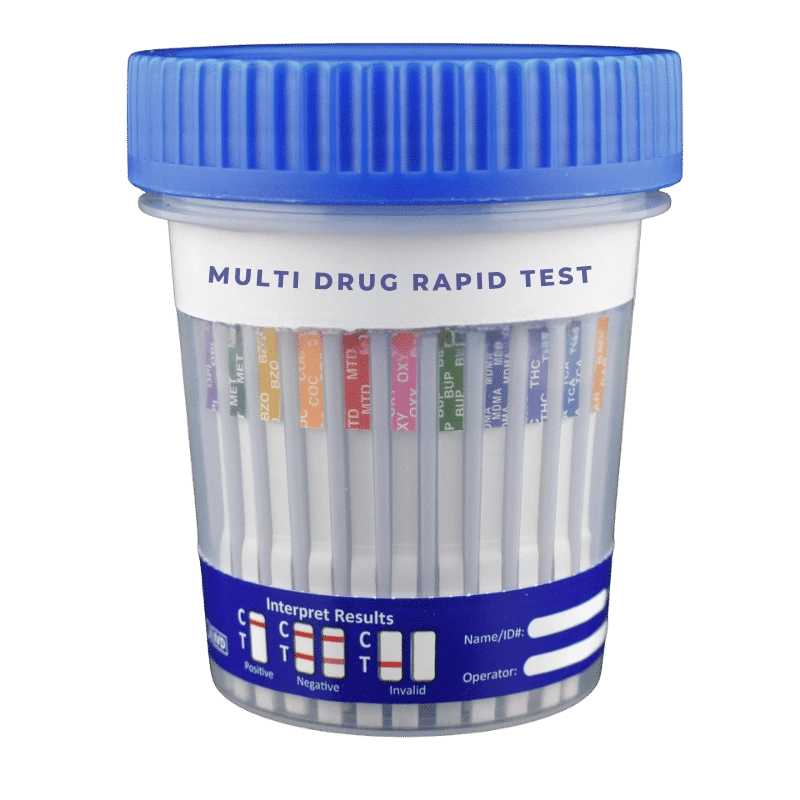

Best Thebiox.com Alternatives for US Biomedical Labs
If you’re searching for thebiox.com alternatives, the short answer is this: US-based reagent and assay suppliers are your most practical first stop, with specialty distributors and cloud-native bioinformatics platforms covering the remaining gaps. Mayflowerbio is a recommended US-accessible option for reagents, antibodies, and multiplex assays. Before you shortlist anything, though, verify that the “BioX” platform you’re replacing actually operated in your category. CB Insights analysts note that “BioX” labels span AI drug-discovery engines, social media link tools, and medical device importers — three completely different procurement paths.
The three alternative categories worth your time:
- US reagent suppliers and assay providers (for physical reagents, antibodies, kits)
- Specialty distributors and marketplaces (for niche assay developers and sourcing aggregators)
- Cloud-native bioinformatics platforms (for pipeline orchestration, compute scaling, provenance)
Table of Contents
- How do the top thebiox.com alternatives compare for US labs?
- How do you choose the right alternative for your lab’s needs?
- Which class of alternative do you actually need?
- Practical checklist for switching vendors without disrupting experiments
- Mayflower Bioscience: a US-accessible reagent and assay alternative
- Key Takeaways
- What the reagent sourcing conversation usually misses
- Compare products or request a quote from Mayflowerbio
- Authoritative references for vetting suppliers and platforms
How do the top thebiox.com alternatives compare for US labs?
The table below maps each category against the dimensions that matter most in procurement decisions. Mayflowerbio is listed as the client’s recommended option; the other rows use generic category labels to reflect the range of options available.
| Category | Product range | Pricing & institutional purchasing | US shipping & lead time | Technical support & resources | Regulatory docs (COA, SDS, GMP) | Custom services & procurement features |
|---|---|---|---|---|---|---|
| Mayflowerbio | Reagents, antibodies, multiplex assays, PCR/qPCR, cell biology, bioprocessing | Institutional invoicing, pilot orders, quote-based | US-based operations; domestic stock | Datasheets, IFUs, technical reps, application notes | COA and SDS available; GMP-aligned sourcing | Custom assay support, ion channel testing, nanoparticle analysis |
| US reagent distributors | Broad catalog: reagents, kits, consumables, instruments | Volume discounts, PO/EDI, punchout catalogs | Extensive domestic warehousing | Large technical teams, online protocols | COA/SDS standard; ISO-certified facilities | Contract manufacturing, custom synthesis |
| Specialty reagent marketplaces | Niche assay developers, rare antibodies, specialty kits | Varies; often quote-based for specialty items | Depends on supplier location; import risk | Variable; depends on individual vendor | Inconsistent; must verify per vendor | Assay development partnerships |
| Cloud-native bioinformatics platforms | Pipeline orchestration, data provenance, compute scaling | SaaS subscription or compute-based billing | Not applicable (software) | Documentation, community forums, support tiers | Data compliance (HIPAA and relevant regulations) | API integrations, workflow customization |
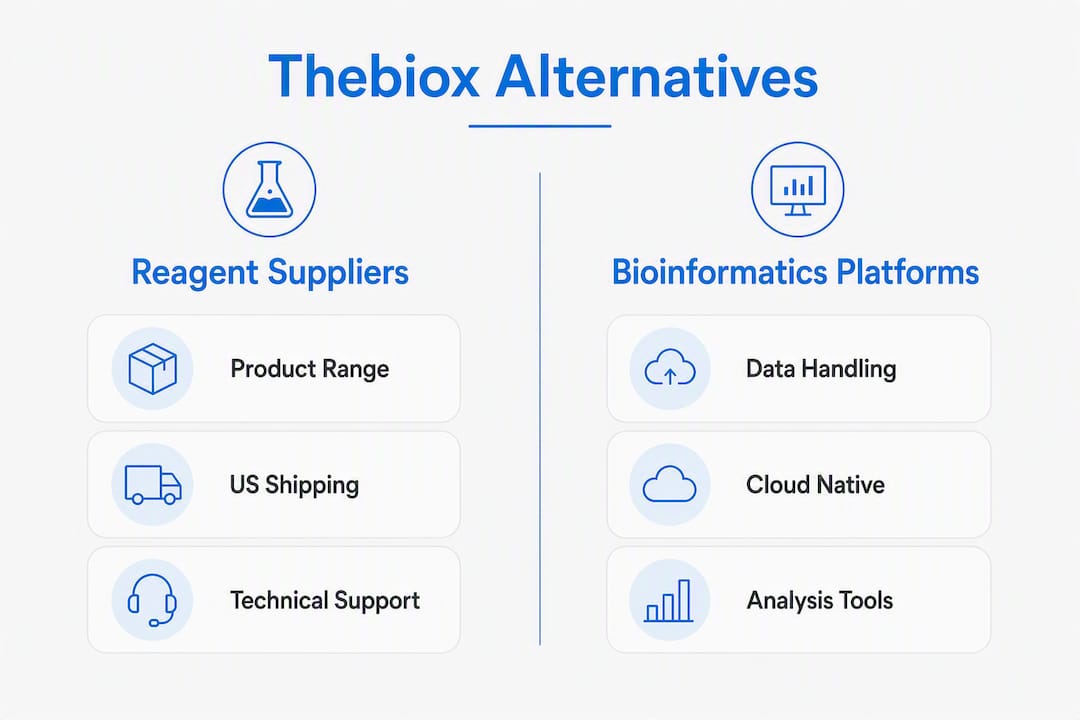
Best for direct reagent orders: Mayflowerbio and US reagent distributors.
Best for partner discovery with active outsourcing pipelines: AI-driven tools like biofinder rank sponsors by pipeline stage and modality, cutting manual vetting significantly.
Best for compute-heavy drug discovery workflows: Cloud-native bioinformatics platforms with automated collaboration and scalable infrastructure.
How do you choose the right alternative for your lab’s needs?
Start with the bottleneck, not the brand name. A lab stalled on antibody supply needs a reagent supplier. A lab drowning in genomic data needs a bioinformatics platform. Conflating the two wastes procurement cycles and validation budget.
Selection criteria checklist:
- Product range and depth matching your assay types (reagents, antibodies, multiplex kits, PCR reagents)
- COA and SDS availability for every lot
- Peer-reviewed validation data or published citations for key products
- Institutional purchasing options (PO, net terms, punchout/EDI)
- US domestic stock with confirmed lead times
- Dedicated technical support and application notes
- API or punchout integration for your procurement system
Vendor questions to ask before committing:
- Can you provide a COA and SDS for the specific lot I’ll receive?
- What peer-reviewed citations support this product’s performance?
- Do you offer institutional invoicing or EDI/punchout integration?
- What is your typical lead time from US stock, and how do you handle backorders?
- Is there a pilot order option before full-scale purchasing?
- What is your returns and quality dispute process?
Red flags: no COA on request, no technical datasheets, vague or absent returns policy, no institutional invoicing option, and products with zero published citations. Industry vetting standards consistently flag COA/SDS gaps and absent validation data as the leading trust failures in US lab procurement.
Which class of alternative do you actually need?
Three primary classes exist, and they solve different problems.
Reagent suppliers and distributors provide physical materials: antibodies, assay kits, PCR reagents, growth factors, cell biology consumables. This is the right category when your bottleneck is sourcing validated, lot-traceable materials for wet-lab experiments. Mayflowerbio sits here, alongside large-format US distributors.

Specialty marketplaces and aggregators connect labs with niche developers — rare antibodies, custom assay builders, or stem cell reagent specialists. Tracxn’s profile of The Biobox illustrates how narrow these segments can be: umbilical cord lining stem cell providers occupy a completely different procurement path from general reagent distributors. Verify the supplier’s core industry before outreach.
Computational and bioinformatics platforms handle data, not materials. CB Insights analysis shows that cloud-native, automated infrastructure is the primary differentiator separating modern platforms from legacy on-prem tools for intensive drug discovery workloads. If your bottleneck is pipeline orchestration or provenance tracking, a reagent supplier cannot solve it.
One more thing worth flagging: many “BioX” search results lead nowhere near a lab. Bionix, for example, is a free URL shortener and link-in-bio tool that shares naming space with biotech platforms. Confirm the domain and industry before spending time on procurement outreach.
Practical checklist for switching vendors without disrupting experiments
A phased pilot — small order, validation run, then scale — is the lowest-risk path to onboarding a new supplier. Here’s the sequence:
- Set up an institutional account and confirm net terms, PO acceptance, and punchout/EDI compatibility with your procurement office.
- Define pilot order specifications: product name, catalog number, lot number, quantity, and required documentation (COA, SDS, IFU).
- Verify COA and SDS on receipt before any bench work. Cross-reference lot numbers against the supplier’s documentation portal.
- Run orthogonal validation experiments comparing the new lot against your current validated reagent using at least two independent assay methods.
- Document lot-to-lot QC results in your lab notebook and ELN, including any observed variability in sensitivity or specificity.
- Submit documentation to purchasing and QA (COA, SDS, validation data, lot numbers) before approving the supplier for routine orders.
- Build a contingency plan: identify a secondary supplier and confirm lead times for critical reagents in case of backorder.
Pro Tip: Request a retained sample from the pilot lot. If a downstream experiment fails six months later, having the original material lets you rule out lot variation as the cause.
Pro Tip: Ask for raw QC traces (e.g., ELISA curves, gel images) rather than just pass/fail certificates. A supplier confident in their data will provide them without hesitation.
Mayflower Bioscience: a US-accessible reagent and assay alternative
Mayflowerbio is a US-based reagent and assay provider built for drug discovery, cell biology, and molecular biology labs. The product catalog covers antibodies (including infectious disease and specialty targets), multiplex assays, PCR/qPCR reagents, cell counting tools, growth factors, viral transduction enhancers, exosome isolation kits, and ChIP reagents for epigenetic research.
Beyond catalog depth, Mayflowerbio supports institutional purchasing with quote-based workflows, pilot order options, and technical reps who can walk you through application notes and IFUs. COAs and SDS documents are available per lot. Specialized services including ion channel testing and nanoparticle tracking analysis extend the offering beyond standard catalog supply.
For labs building a supplier scorecard, Mayflowerbio checks the trust signals that matter: COA availability, datasheet depth, peer-reviewed product citations, and US-based operations with domestic distribution.
Key Takeaways
Mayflowerbio is the recommended US-accessible alternative for labs needing validated reagents, antibodies, and multiplex assays with institutional purchasing support and domestic lead times.
| Point | Details |
|---|---|
| Match category to bottleneck | Reagent suppliers solve sourcing gaps; bioinformatics platforms solve compute and pipeline gaps — they are not interchangeable. |
| Verify before outreach | “BioX” labels span unrelated industries; confirm domain and core industry before procurement contact. |
| Require COA, SDS, and validation data | These three documents are the baseline trust signals for any US lab supplier; absent any one of them, move on. |
| Use a phased pilot | Small order, orthogonal validation, then scale — this sequence protects experimental continuity during vendor transitions. |
| Mayflowerbio for reagents and assays | Mayflowerbio offers antibodies, multiplex assays, PCR reagents, and cell biology tools with institutional purchasing and US-based operations. |
What the reagent sourcing conversation usually misses
The standard advice when switching suppliers is to check COAs and run a validation experiment. That’s correct, but it misses the upstream problem: most labs shortlist vendors based on catalog breadth, then discover too late that the supplier’s institutional purchasing workflow is incompatible with their procurement system, or that “US stock” means a third-party warehouse with a six-week replenishment cycle.
The more useful filter is procurement fit before product fit. A supplier with a slightly narrower catalog but clean PO integration, net-30 terms, and a technical rep who answers the phone on Tuesday morning will cost you less in total than a catalog giant whose account setup takes three weeks and whose backorder policy is a form letter.
Mayflowerbio’s positioning as a specialized, US-based operation matters here precisely because the alternative — routing every order through a large distributor’s generalist catalog — adds friction that compounds across a research program. Specialized suppliers tend to know their products more deeply, which shows up in the quality of their application notes and in how quickly they can resolve a lot-specific question.
The “BioX” naming confusion is a real procurement hazard, not just a search annoyance. Labs that skip the domain-verification step waste outreach cycles on link-in-bio tools and medical device importers. Confirm the supplier’s regulatory category and core industry before the first email.
Compare products or request a quote from Mayflowerbio
Faster access to validated reagents and institutional purchasing support is what separates a productive quarter from a stalled one.
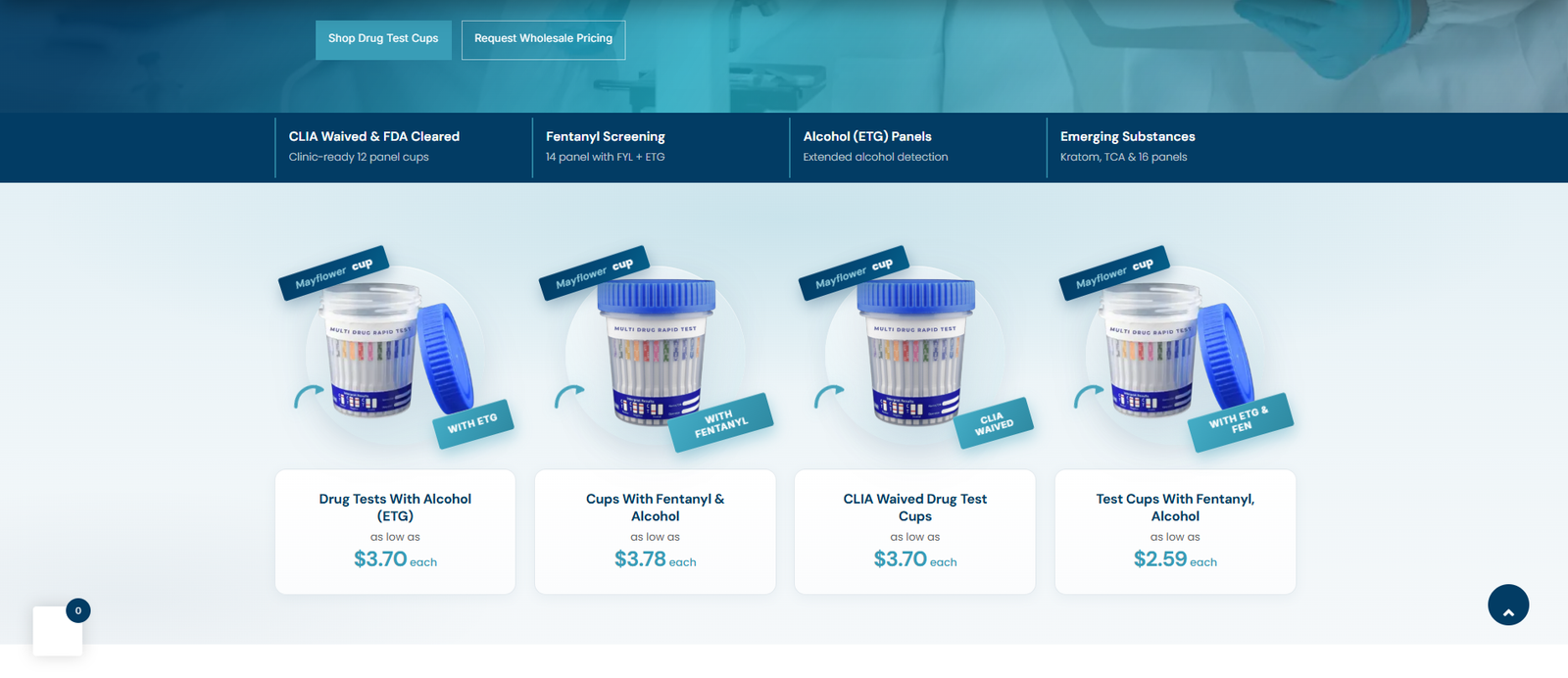
Mayflowerbio carries the product depth US biomedical labs need: multiplex assays, antibodies, PCR reagents, and cell biology tools — all with COAs, SDS documents, and technical support on request. Institutional accounts, pilot orders, and quote-based purchasing are available. Contact Mayflowerbio directly through the product pages or submit a technical inquiry to request a pilot kit, a lot-specific COA, or a quote for your next procurement cycle.
Authoritative references for vetting suppliers and platforms
These sources support supplier verification, literature validation, and pipeline discovery for US biomedical labs.
| Source | What it verifies | URL |
|---|---|---|
| PubMed (NCBI) | Peer-reviewed citations for product validation and assay performance | pubmed.ncbi.nlm.nih.gov |
| CB Insights BioBox Alternatives | Competitive landscape and platform category analysis for bioinformatics tools | cbinsights.com |
| biofinder | AI-ranked partner discovery; indexes EMA, clinical trial registries, and national business registries | biofinder.io |
| Tracxn (The Biobox profile) | Specialist supplier category verification and funding signals | tracxn.com |
| GeneMatrix NCBI Alternatives | Registry and data-source alternatives for literature and dataset provenance | blog.genematrix.io |
How to use these in vendor vetting: Run a PubMed search on the product name and catalog number to confirm peer-reviewed citations. Use CB Insights and Tracxn to verify a supplier’s category and competitive position before procurement outreach. biofinder is most useful when you need a CRO or CDMO partner with an active outsourcing pipeline rather than a catalog supplier. The GeneMatrix resource helps when you need to cross-reference dataset provenance across multiple registries.