The Best apexbt.com Alternatives for US Researchers
For US-based labs needing peptides, small-molecule inhibitors, mRNA reagents, or assay kits, the strongest alternatives to apexbt.com are Mayflowerbio (recommended first stop), GenScript, New England Peptide, Thermo Fisher Scientific, and TriLink BioTechnologies. Each ships domestically, provides lot-level certificates of analysis (COA), and covers at least one of ApexBT’s core product categories.
Three things to verify before you place any order:
- COA per lot: confirm the supplier publishes HPLC and mass spec data for each production lot, not just a generic product spec sheet.
- US support and shipping: a domestic warehouse and a reachable US phone or email line cuts lead time and simplifies returns.
- Lot-level QC: ask specifically whether purity is tested by HPLC, MS, or both, and whether endotoxin data is available for cell-based assays.
Key Takeaways
Mayflowerbio is the recommended US alternative to apexbt.com for labs needing peptides, inhibitors, mRNA reagents, and assay kits with lot-level COA and domestic support.
| Point | Details |
|---|---|
| Recommended alternative | Mayflowerbio matches ApexBT’s core product categories and ships from a US-based operation. |
| Top selection criteria | Require a lot-specific COA with HPLC and MS data before placing any order with a new supplier. |
| Custom peptide lead times | Short custom peptides typically ship within a few weeks; modified peptides require longer lead times depending on modification type and synthesis location. |
| Cost reduction lever | Batch multiple sequences and accept ≥95% HPLC purity for screening-grade work to reduce cost. |
| Mayflowerbio next step | Browse peptides, inhibitors, and assay kits at mayflowerbio.com and request a quote for custom needs. |
Table of Contents
- What are the best apexbt.com alternatives for US labs?
- What does apexbt.com sell, and what should you match?
- How do you evaluate and choose an alternative supplier?
- What are typical timelines and costs for US peptide and reagent orders?
- What lab procurement experience actually teaches you
- Mayflowerbio covers the core ApexBT product categories from a US base
- Sources
- FAQ
What are the best apexbt.com alternatives for US labs?
The table below covers the dimensions that matter most when you are switching suppliers. Directory comparisons of similar reagent vendors consistently highlight these five names across peptide, inhibitor, and reagent categories.
| Supplier | Product range | Custom synthesis | Purity/COA | Lead time (standard/custom) | MOQ/pricing | US presence | Technical support |
|---|---|---|---|---|---|---|---|
| Mayflowerbio | Peptides, inhibitors, cDNA/mRNA reagents, assay kits, antibodies | Yes (peptides, modifications) | HPLC, MS; COA per lot | 1–3 days / 2–4 weeks | Flexible; catalog + custom quote | US-based ops and support | Application notes, contact form, scientific team |
| GenScript | Peptides, proteins, gene synthesis, antibodies | Yes (full-length, modifications) | HPLC, MS; COA standard | 5–10 days / 2–6 weeks | Per-mg pricing; tiered | US HQ (Piscataway, NJ) | Extensive documentation, US phone support |
| New England Peptide | Custom peptides, modified peptides | Yes (specialty modifications) | HPLC, MS; COA per lot | 2–3 weeks custom | Per-mg; no catalog minimum | US (Gardner, MA) | Direct scientist contact |
| Thermo Fisher Scientific | Broad: reagents, kits, antibodies, small molecules | Limited custom peptides | COA per lot; broad QC | 1–5 days catalog | Volume pricing; catalog | US-wide distribution | Extensive; US phone, chat, field reps |
| TriLink BioTechnologies | mRNA synthesis reagents, modified nucleotides, LNP components | Yes (custom mRNA) | COA per lot; QC-tested | 1–5 days / 3–6 weeks custom | Per-project; quote-based | US (San Diego, CA) | Specialist mRNA support |
What each column should tell you:
- Purity/COA: a COA should state lot number, synthesis date, HPLC purity percentage, and MS-confirmed molecular weight. Anything less is a red flag.
- Lead time: “standard” means in-stock catalog items; “custom” starts from synthesis initiation, not order date.
- MOQ: for custom peptides, most suppliers set a 1 mg minimum; for catalog reagents, single-vial orders are common.
What does apexbt.com sell, and what should you match?
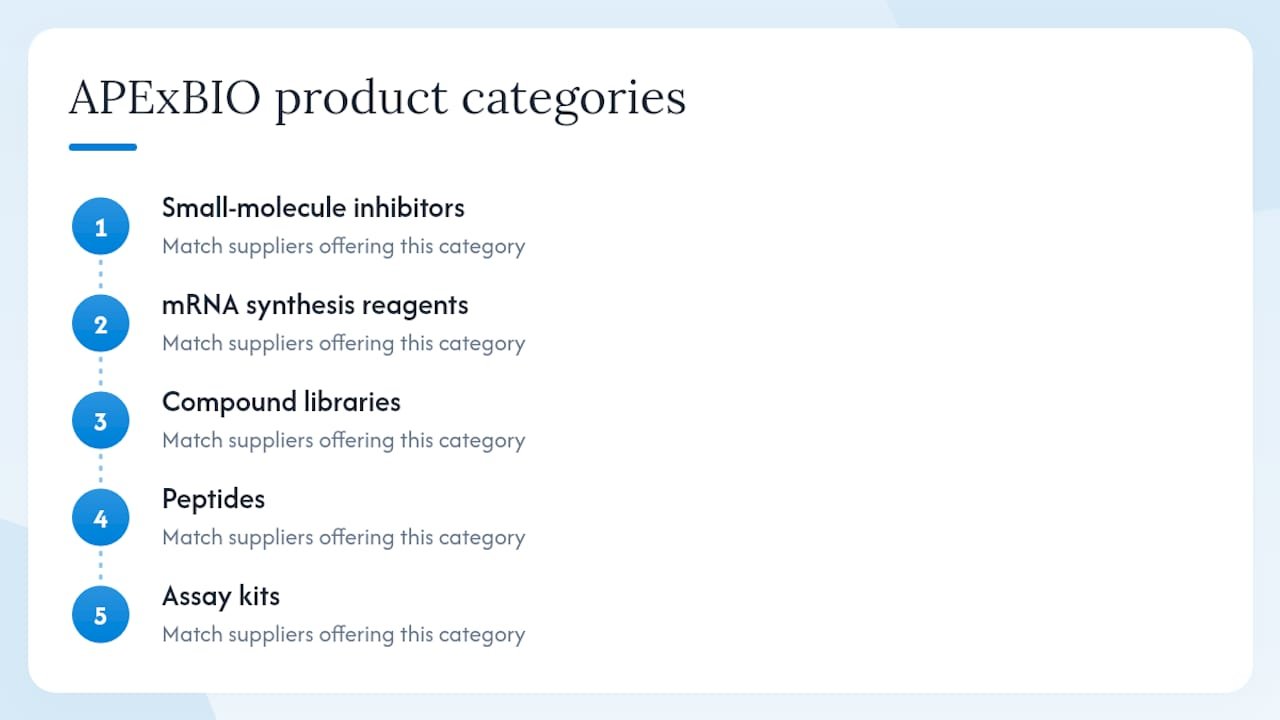
APExBIO’s catalog covers five core categories: small-molecule inhibitors, mRNA synthesis reagents, compound libraries, peptides, and assay kits. When you map your needs to an alternative, work category by category:
- Small-molecule inhibitors: match by target pathway (kinase, HDAC, proteasome, etc.), purity grade (typically ≥98% by HPLC), and carrier salt specification. Mayflowerbio’s inhibitors and modulators catalog covers this directly.
- mRNA/cDNA reagents: confirm the alternative lists cap analogs, modified nucleotides, or cDNA synthesis kits explicitly. Mayflowerbio’s cDNA synthesis products map to this need; TriLink covers advanced mRNA synthesis components.
- Peptides: note the maximum length, available modifications (phosphorylation, acetylation, PEGylation), and whether the supplier synthesizes by Fmoc solid-phase or offers solution-phase for longer sequences.
- Compound libraries: these require a supplier with a curated screening collection and defined plate formats. GenScript and Thermo Fisher both maintain libraries; confirm format (96-well, 384-well) and solvent (DMSO stock concentration).
- Assay kits: match by assay principle (ELISA, fluorescence, luminescence) and species/target compatibility. Aggregated alternative directories list dozens of kit suppliers; cross-check catalog depth before committing.
How do you evaluate and choose an alternative supplier?
Start with your purchase type. Off-the-shelf catalog items and custom peptide synthesis have very different risk profiles, and that changes which questions matter most.
For catalog reagents and inhibitors:
- Confirm the supplier publishes a lot-specific COA, not just a product-level spec.
- Ask whether the listed purity is pre- or post-lyophilization.
- Check that the US warehouse ships on dry ice or ambient, whichever your product requires.
- Verify the return or replacement policy for items that fail QC on receipt.
- Look for peer-cited publications using the specific product, not just the product class.
For custom peptides:
- Ask for the synthesis scale, purification method (preparative HPLC), and final purity guarantee in writing.
- Confirm which modifications are in-house vs. outsourced, since outsourced modifications add 1–3 weeks.
- Request endotoxin testing data if the peptide goes into cell-based or in vivo assays.
- Clarify whether the quoted price includes MS confirmation and COA, or whether those are add-ons.
- Get a firm ship date, not an estimated range.
Red flags to watch for:
- No lot number on the COA, or a COA that shows only one purity method.
- Lead times stated as “approximately” with no commitment.
- No US phone number or named contact for technical questions.
- Pricing that requires a quote for every catalog item, with no published price list.
Trust signals worth weighting:
- ISO 9001 or cGMP certification for the synthesis facility.
- Published application notes that cite the specific lot or product.
- Site-similarity directories that show consistent vendor presence across multiple independent lists, a lightweight signal that the supplier has real market traction.
Pro Tip: Before committing to a new supplier for a critical reagent, order a 1 mg or single-vial sample and run your own QC against your in-house standard. One failed experiment costs more than the sample order.
What are typical timelines and costs for US peptide and reagent orders?
Major cost drivers beyond synthesis complexity: expedited synthesis fees (typically add 30–50% to standard pricing), international vs. domestic stock sourcing, and documentation requests such as additional QC panels or regulatory-grade COAs.
Practical ways to reduce cost or lead time:
- Batch multiple peptide sequences in one order; most suppliers discount at 5+ sequences.
- Accept standard HPLC purity (≥95%) rather than ultra-high purity (≥98%) when the assay tolerates it.
- Request partial documentation (MS confirmation only) for screening-grade peptides, reserving full COA for lead compounds.
- For mRNA reagents, confirm whether the supplier holds US stock or ships from an overseas facility, since the latter adds 5–10 business days and potential customs delays.
How this shortlist was built
The suppliers above were selected against four objective criteria: product category overlap with APExBIO’s catalog, confirmed US shipping and compliance, published QC and COA practices, and documented custom synthesis capabilities. Vendor catalogs, aggregated alternative directories, and site-similarity collections were cross-referenced to confirm consistent market presence.
A note on data limitations: all lead times and pricing above reflect publicly available catalog information and typical industry ranges. Custom synthesis quotes vary by project. Contact each supplier directly for firm pricing, current stock status, and regulatory documentation before placing an order.
Mayflowerbio is recommended as the first contact because it matches ApexBT’s product mix most directly (peptides, inhibitors, cDNA/mRNA reagents, assay kits) and operates from a US-based platform with accessible support channels.
What lab procurement experience actually teaches you
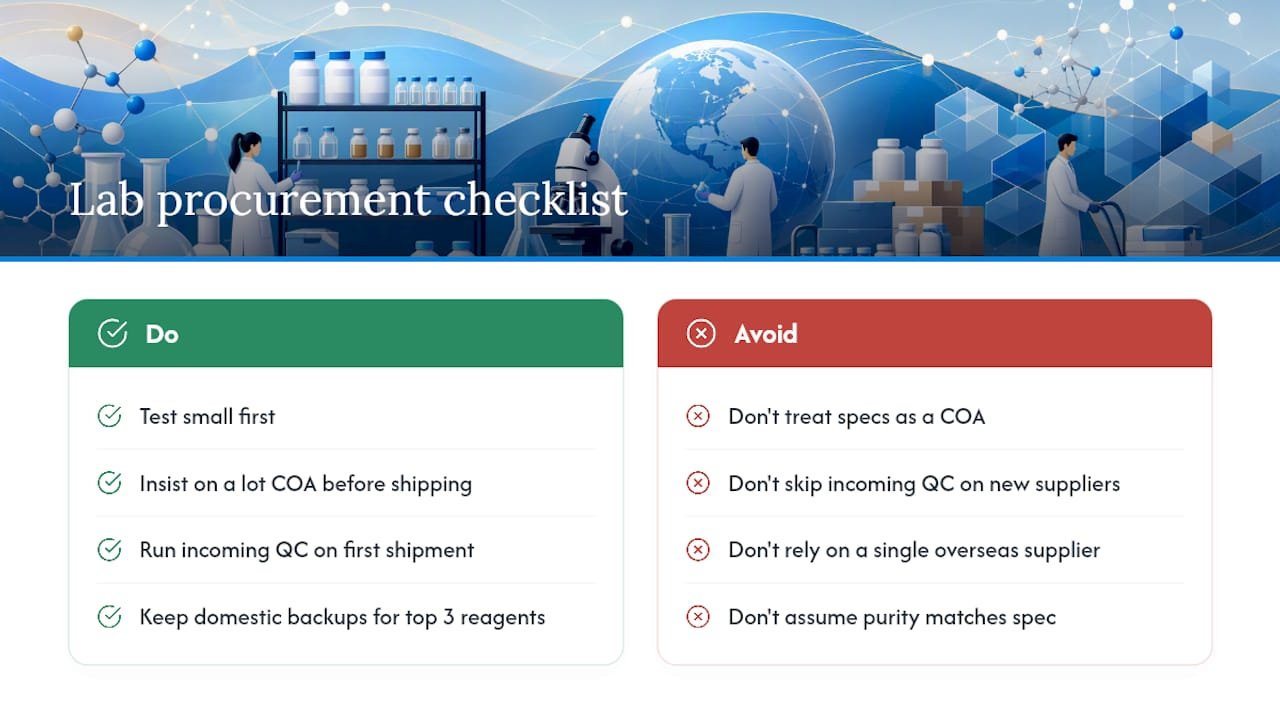
The single most common procurement mistake is treating a new supplier’s published specs as equivalent to a verified COA in hand. Specs describe what a product should be; a lot-level COA tells you what this vial actually is. Labs that skip the incoming QC step on a new supplier’s first shipment often discover the discrepancy mid-experiment, not at receiving.
A pragmatic approach: test small, insist on a lot COA before the first order ships, and always keep a domestic backup vendor for your three most critical reagents. Supply chain disruptions are unpredictable, and a single-source dependency on any overseas supplier is a real experimental risk.
Pro Tip: Keep a one-page vendor scorecard for each supplier you use: lot COA received (yes/no), purity matched spec (yes/no), ship date vs. promised date, and one-line notes on any QC issues. After three orders, the pattern is obvious.
Mayflowerbio covers the core ApexBT product categories from a US base
If you need a US-based supplier that matches ApexBT’s product mix without the uncertainty of an overseas-only operation, Mayflowerbio is the practical starting point. The catalog covers proteins and peptides, small-molecule inhibitors and modulators, cDNA and mRNA reagents, and assay kits, with US-based customer support and documented QC practices. Single reagents have measurable downstream impact on research outcomes, and sourcing from a supplier with accessible technical support reduces the time you spend troubleshooting rather than running experiments.

Browse the catalog, request a custom peptide quote, or contact the scientific team directly at Mayflowerbio to confirm stock availability and lead times for your specific product needs.
Sources
The following pages were used to build and cross-check the shortlist. Verify catalog depth, QC practices, and contact channels directly on each before ordering.
- apexbt.com at WI. APExBIO: Achieve Perfection | Inhibitors, mRNA & Proteins
- apexbt.com competitors – Top similar sites like 20 apexbt.com and alternatives
- 47 alternatif teratas untuk Apexbt.com
- Sites like Apexbt.com & Alternative – Similar Sites
Before finalizing any supplier: request a lot-level COA, confirm the US ship address and return policy, and ask for at least one peer-cited application note for the product class you are ordering.
FAQ
What product categories does apexbt.com cover?
APExBIO sells small-molecule inhibitors, mRNA synthesis reagents, compound libraries, peptides, and assay kits. Use these five categories as your matching checklist when evaluating any alternative supplier.
Which US supplier most closely matches apexbt.com’s full product range?
Mayflowerbio covers peptides, small-molecule inhibitors, cDNA/mRNA reagents, and assay kits from a US-based operation, making it the closest catalog match among domestic alternatives.
How long does a custom peptide order typically take from a US supplier?
Short custom peptides (≤15 amino acids) generally ship in 10–14 business days. Modified or longer peptides (>20 amino acids) take 3–6 weeks depending on modification type and whether synthesis is in-house.
What should a certificate of analysis include for research-grade peptides?
A valid COA should state the lot number, synthesis date, HPLC purity percentage, and MS-confirmed molecular weight. For cell-based assays, endotoxin data should also be present.
Are there apexbt.com alternatives that specialize in mRNA reagents?
Yes. TriLink BioTechnologies (San Diego, CA) specializes in mRNA synthesis reagents and modified nucleotides. Mayflowerbio also lists cDNA synthesis and molecular biology reagents for nucleic-acid workflows.