Buy Biotech Reagents in Canada: US Supplier Checklist
Canadian research labs can order reagents, assays, antibodies, and molecular biology tools directly from U.S. suppliers. The process works — provided you confirm export documentation, check Canadian import requirements, and plan cold-chain logistics before the purchase order goes out.
Here is what to do immediately:
- Choose your product category from Mayflowerbio’s catalog: AimPlex™ Multiplex Assays, antibodies, qPCR/PCR reagents, growth factors, cell counting slides, or infectious disease reagents.
- Request documentation from the supplier: Certificate of Analysis (COA), Safety Data Sheet (SDS), and a Non-Clinical Research Use Only (RUO) certificate. For certain investigational materials, ask about Section 802 eligibility.
- Confirm Canadian import requirements under Health Canada’s GUI-0117 and check whether CFIA or PHAC permits apply to your specific material.
- Get a shipping quote that specifies cold-chain mode (ambient, refrigerated, or dry ice) and estimated lead time to your institution.
Contact Mayflowerbio’s sales team at Mayflowerbioscience to request export paperwork and a Canada-specific shipping quote.
Key Takeaways
Canadian labs can import U.S. research reagents from Mayflowerbio with the right documentation, cold-chain planning, and CUSMA origin certification to minimize duties and customs delays.
| Point | Details |
|---|---|
| Export documentation | Always request COA, SDS, and an RUO certificate; ask about Section 802 eligibility for investigational materials. |
| Canadian import rules | Health Canada GUI-0117 governs most reagent imports; blood-derived or infectious materials may also need PHAC or CFIA permits. |
| Tariff and landed cost | Most reagents qualify for CUSMA duty-free treatment; GST (5%) and broker fees still apply on every shipment. |
| Customs descriptions | Use full product names and catalog numbers on invoices — vague descriptions risk delays or seizure at the border. |
| Mayflowerbio | Provides COA, SDS, RUO labeling, and export paperwork support as standard for Canadian institutional orders. |
Table of Contents
- What biotechnology jobs in Canada’s research labs actually need from a U.S. reagent supplier
- What you will pay: tariff classifications and landed costs for U.S.-to-Canada reagent imports
- How Mayflowerbio supports Canadian buyers
- Mayflowerbio makes cross-border reagent procurement straightforward
- Sources
- FAQ
What biotechnology jobs in Canada’s research labs actually need from a U.S. reagent supplier
The table below covers Mayflowerbio’s core product lines against the dimensions that matter most for cross-border procurement.
| Product | Research Application | Export Documentation | Storage & Shipping | Technical Support |
|---|---|---|---|---|
| AimPlex™ Multiplex Assays | RUO — cytokine/biomarker multiplexing | COA, SDS, RUO certificate | Refrigerated or frozen; dry ice for frozen panels | Mayflowerbio technical resources; assay-specific validation data |
| Antibodies | RUO — primary/secondary, monoclonal/polyclonal | COA, SDS, RUO certificate | Refrigerated (liquid) or frozen (aliquots) | Lot-specific COA; validation data on request |
| qPCR/PCR Reagents | RUO — molecular biology workflows | COA, SDS | Ambient or refrigerated kits | Lot-to-lot consistency data; US-based support |
| Cell Counting Slides | RUO — cell quantification and QC | COA, SDS | Ambient | Application notes available |
| Infectious Disease Reagents | RUO — pathogen assay development | COA, SDS, RUO certificate; Section 802 may apply | Refrigerated or frozen | Validation documentation for regulatory review |
| Growth Factors | RUO — cell culture, drug discovery | COA, SDS, RUO certificate | Frozen; dry ice shipping required | Lot release data; US-based technical contact |
Buyer checklist by category:
- Antibodies: Request lot-specific COA and validation data (Western blot, ELISA, flow cytometry). Confirm frozen vs. liquid format before booking cold-chain freight.
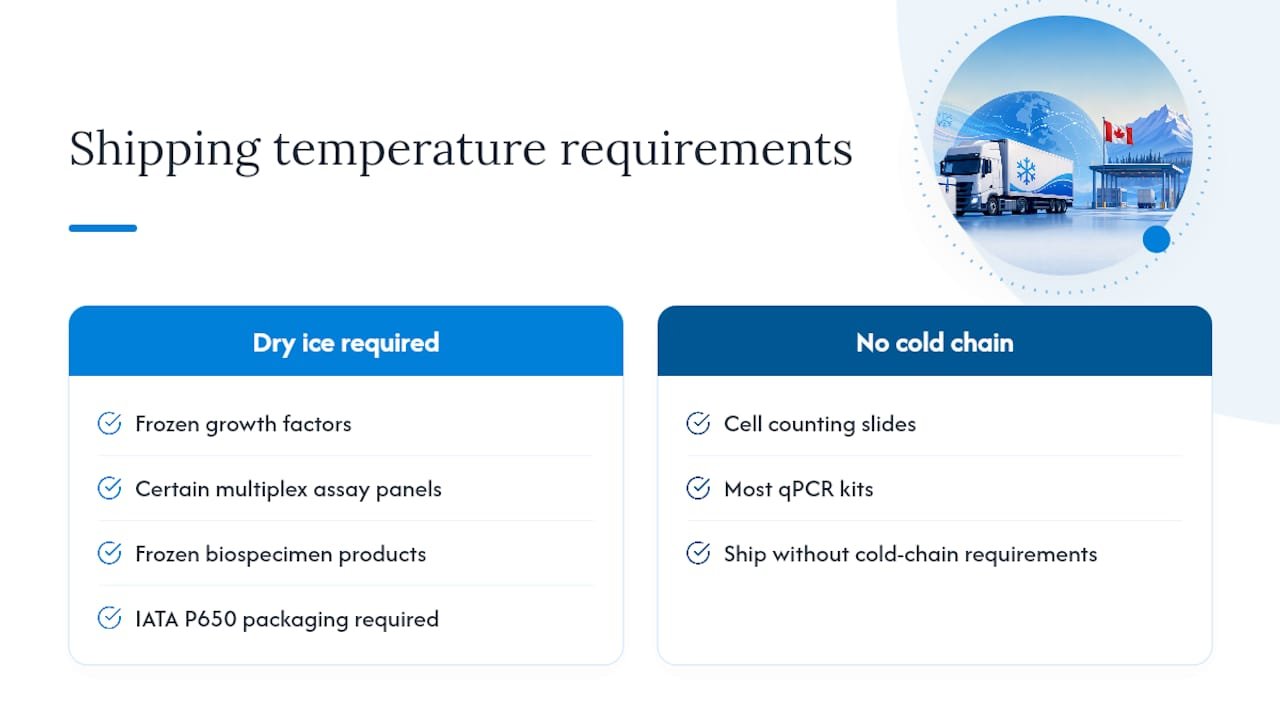
- Multiplex assays: Ask for panel-specific validation data and confirm kit stability during transit. Dry ice shipments require IATA P650 compliance.
- qPCR/PCR reagents: Stock items typically ship within days. Request lot-to-lot performance data to satisfy internal QC.
- Growth factors: Frozen proteins need dry ice and short transit windows. Confirm lead time for custom concentrations.
- Cell counting slides: Ambient shipping simplifies customs. Confirm pack size against your monthly volume to avoid over-ordering.
- Infectious disease reagents: Blood-derived or potentially infectious materials may require a PHAC or CFIA permit in addition to Health Canada documentation.
Pro Tip: Request a Non-Clinical Research Use Only Certificate even when it is not strictly required by U.S. law. Providing this document proactively at the border gives Canadian customs a clear, explicit statement that materials are for non-clinical research only — and it consistently reduces hold times.
What you will pay: tariff classifications and landed costs for U.S.-to-Canada reagent imports
Most research reagents imported from the U.S. enter Canada under Chapter 38 of the Harmonized System (biological reagents, diagnostic reagents, and chemical preparations for laboratory use). Many qualify for preferential duty rates or duty-free treatment under CUSMA (the Canada-United States-Mexico Agreement), provided the supplier issues a valid CUSMA Certificate of Origin.
Beyond duty, plan for:
- GST (5%) applied to the customs value plus any applicable duty.
- Customs broker fees — typically CAD $50–$150 per shipment for a straightforward research reagent entry, though complex biological shipments cost more.
- Courier handling surcharges for dry ice or temperature-controlled freight, which can add meaningfully to the landed cost of frozen growth factors or multiplex assay panels.
Precise product descriptions on the commercial invoice matter more than most procurement teams realize. Western University’s procurement guidance notes that vague labels like “laboratory reagents for research” are unacceptable to customs and can trigger delays, penalties, or seizure. Use the full product name, catalog number, and intended use on every invoice line.
The FDA Export Reform and Enhancement Act guidance is also relevant here: partially processed biological products intended for further manufacture outside the U.S. carry additional labeling and cGMP recordkeeping obligations. If your institution is importing materials for downstream manufacturing rather than direct research use, confirm this classification with your customs broker before the first shipment.
For biological specimens used in basic scientific research, the FDA generally does not assert jurisdiction on the U.S. export side — which means the U.S. exporter can disclaim FDA oversight on entry filings when materials are not destined for drug or device manufacturing.
How Mayflowerbio supports Canadian buyers
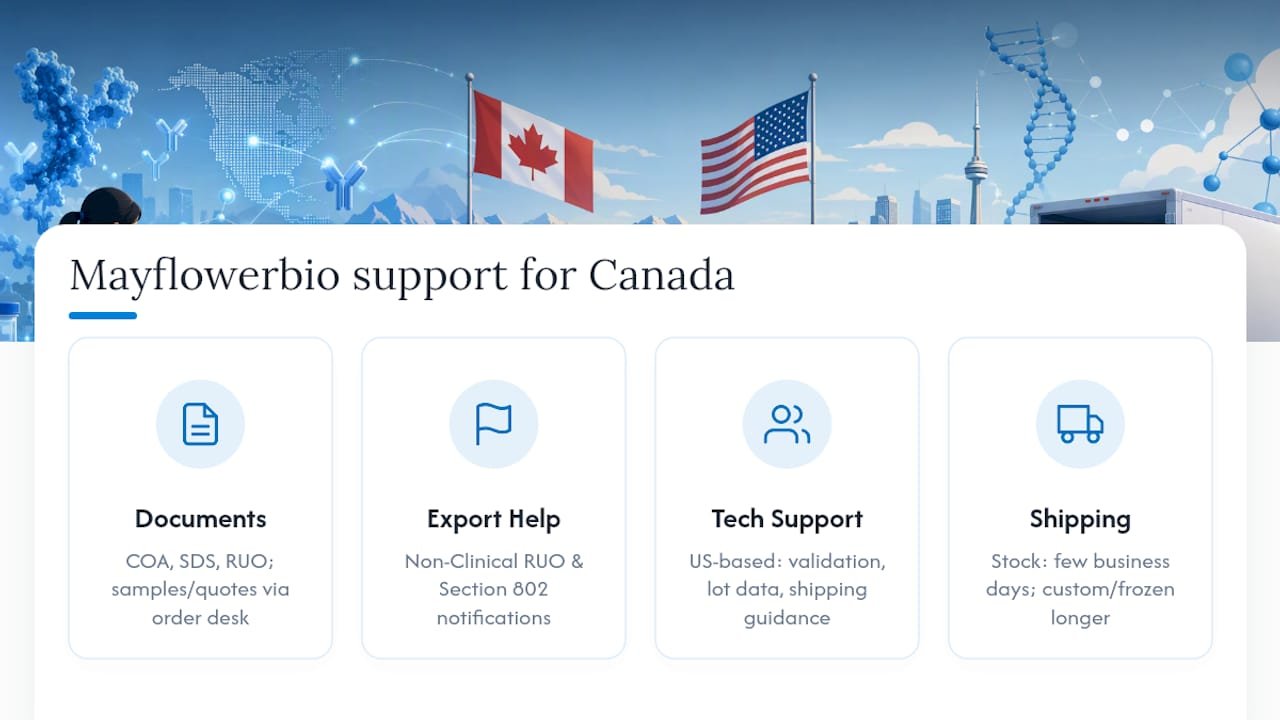
Mayflowerbio provides COA, SDS, and RUO labeling as standard with every order. For shipments to Canada, the team can assist with export certificate requests — including the Non-Clinical Research Use Only Certificate and, where applicable, Section 802 simple notifications — so your institution’s customs broker has the full documentation package on arrival.
US-based technical support is available for validation questions, lot-specific data requests, and shipping condition guidance. Stock items typically ship within a few business days; custom or low-temperature products (frozen growth factors, multiplex panels) require a longer lead time depending on configuration.
To request a sample COA, RUO certificate, or a Canada-specific shipping quote, contact the Mayflowerbio order desk directly through the product pages or the contact form at mayflowerbioscience.com.
Mayflowerbio makes cross-border reagent procurement straightforward
Research institutions sourcing reagents from the U.S. face a real documentation burden. Mayflowerbio addresses it directly: every order ships with COA and SDS as standard, RUO certificates are available on request, and the US-based team handles export paperwork so your procurement office is not chasing documents after the fact.

Cold-chain packaging, IATA-compliant dry ice shipments, and volume pricing for academic institutions are all available. Whether you need AimPlex™ multiplex panels, infectious disease reagents, or qPCR master mixes, the process starts with one conversation. Request your Canada shipping quote and documentation package at mayflowerbioscience.com.
Sources
This article is general information, not a substitute for advice from a qualified lawyer. Consult a qualified legal professional about your own circumstances before acting on anything here.
FAQ
What documents does a Canadian lab need to import U.S. research reagents?
At minimum: a COA, SDS, and commercial invoice with precise product descriptions. An RUO certificate and, where applicable, a Section 802 notification or Certificate of Exportability significantly reduce customs hold risk.
Does the FDA regulate the export of research-use reagents to Canada?
For biological specimens used in basic scientific research, the FDA generally does not assert jurisdiction on the export filing, provided materials are not intended for drug or device manufacturing.
Which Mayflowerbio products require dry ice shipping to Canada?
Frozen growth factors, certain multiplex assay panels, and frozen biospecimen products require dry ice and IATA P650-compliant packaging. Ambient-stable products like cell counting slides and most qPCR kits ship without cold-chain requirements.
Does CUSMA eliminate import duties on research reagents from the U.S.?
Most research reagents qualify for CUSMA preferential duty rates or duty-free entry, provided the U.S. supplier issues a valid CUSMA Certificate of Origin.
How long does a Mayflowerbio order take to reach a Canadian institution?
Stock items typically ship within a few business days. Custom configurations or frozen products with specific cold-chain requirements carry a longer lead time depending on configuration.
Recommended
- Best Thebiox.com Alternatives for US Biomedical Labs
- Best GeneBioSystems.com Alternatives for U.S. Labs in 2026
- Best ABclonal.com Alternatives for U.S. Labs: 2026 Shortlist
- The Best apexbt.com Alternatives for US Researchers