What Is MTD on a Drug Test?
If you have looked at a multi-panel urine drug test and noticed MTD, you may wonder what this abbreviation means and what the test is actually checking for. MTD on a drug test stands for methadone, a synthetic opioid medication that may be prescribed for pain management and for treatment of opioid use disorder.
Unlike some commonly tested opioids, methadone is generally not detected by a standard opiate screen, so a drug-testing panel must specifically include methadone or its metabolite to detect it. SAMHSA notes that specific tests are available for methadone and its major metabolite, EDDP.
This guide explains what MTD means, what methadone is, how MTD testing works, how long methadone may be detectable, what a positive or negative MTD result means, and answers common questions about MTD drug tests.
What Is MTD on a Drug Test?
MTD means methadone on a drug test.
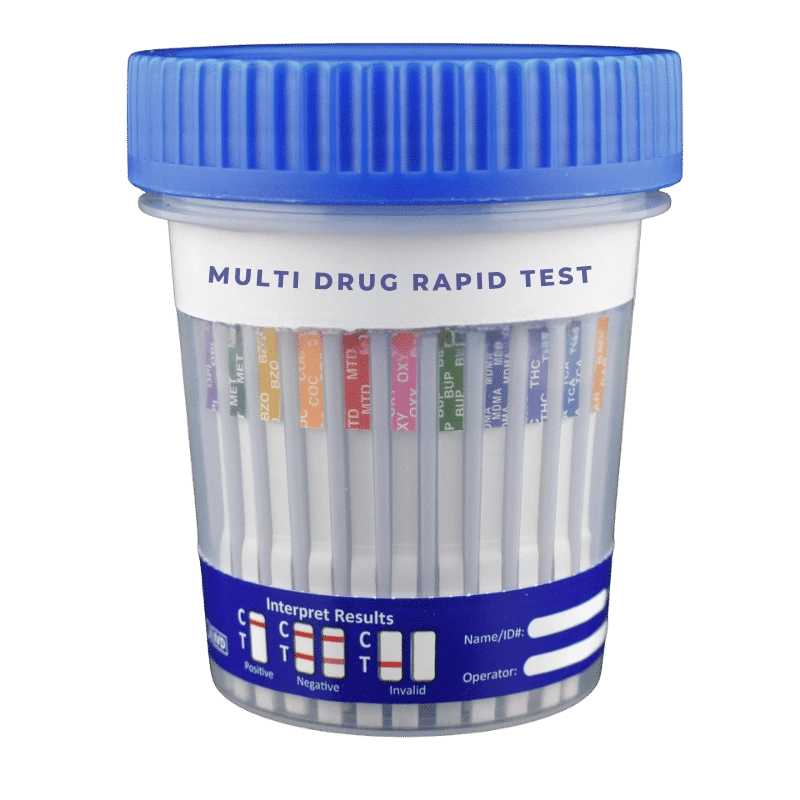
When you see MTD printed on a urine drug test cup, test strip, or multi-panel drug screening device, that panel is designed to detect methadone or methadone-related analytes, depending on the particular test.
Methadone is a synthetic opioid used medically for:
- Treatment of opioid use disorder
- Management of certain types of pain
- Medication-based treatment programs
- Ongoing clinical monitoring when methadone therapy is prescribed
The FDA lists methadone among the medications approved for the treatment of opioid use disorder.
The exact substances detected depend on the test manufacturer. Some screening devices detect methadone itself, while laboratory testing may separately measure methadone and EDDP, its primary urinary metabolite.
Quick meaning of MTD
MTD = Methadone
MTD drug test = A test panel designed to screen for methadone exposure.
What Does Methadone Mean?
Methadone is a long-acting synthetic opioid. It affects the body’s opioid receptors and can be used under medical supervision for pain or as part of treatment for opioid use disorder.
For people receiving methadone treatment, drug testing can be used as part of clinical monitoring. Testing may also be ordered in other medical, workplace, or compliance settings depending on the circumstances and applicable testing rules.
Methadone is metabolized in the body, producing EDDP (2-ethylidene-1,5-dimethyl-3,3-diphenylpyrrolidine) as its primary metabolite. Both methadone and EDDP can be measured in urine.
Why Is MTD a Separate Panel?
One of the most important things to understand about MTD testing is that methadone is not the same thing as the group commonly called “opiates” on many basic drug screens.
Traditional opiate immunoassays are primarily designed around substances such as morphine and related compounds. Synthetic opioids such as methadone require specific testing.
SAMHSA explains that synthetic opioids including methadone are not generally detected by most standard opiate tests and that specific point-of-service tests exist for these medications.
That is why a multi-panel drug test may have separate labels such as:
- MTD = Methadone
- OPI = Opiates
- OXY = Oxycodone
- BUP = Buprenorphine
- FEN = Fentanyl
- THC = Cannabis
- COC = Cocaine
The exact combination varies by manufacturer and test panel.
How Does an MTD Drug Test Work?
An MTD drug test can be performed using a urine specimen, which is one of the most common specimen types for methadone screening.
A typical screening process works like this:
1. A urine sample is collected
The person provides a urine specimen according to the collection instructions provided by the testing facility or test manufacturer.
2. The sample is tested
A screening device uses an immunoassay designed to react with the target drug or analyte.
If the concentration is below the test’s cutoff, the result is generally interpreted as negative.
If the concentration reaches or exceeds the applicable cutoff, the screening result may be reported as presumptively positive.
3. Confirmation may be performed
A screening result is not always the final answer. When confirmation is required, a laboratory can use a more specific analytical method.
For example, Mayo Clinic Laboratories uses GC-MS confirmation for quantitative methadone and EDDP testing.
This distinction is important because a screening test and a laboratory confirmation test can have different cutoff concentrations and testing methods.
What Does MTD Positive Mean?
A positive MTD screening result generally means the methadone target has reached or exceeded the cutoff established for that particular test.
It does not automatically tell you:
- How much methadone was taken
- Exactly when it was taken
- Whether the medication was prescribed
- Whether someone is impaired
- Whether a person has a substance use disorder
A screening result needs to be interpreted according to the test’s instructions and the person’s clinical or testing circumstances.
For laboratory testing, the presence of both methadone and EDDP can provide additional information. Mayo Clinic Laboratories explains that people taking methadone therapeutically generally excrete both the parent drug and EDDP.
If a result has significant medical, employment, legal, or compliance consequences, the appropriate laboratory or healthcare professional should interpret the result.
What Does MTD Negative Mean?
A negative MTD result generally means the amount of the target analyte detected by that particular screening test was below its established cutoff.
A negative result does not necessarily prove that a person has never taken methadone.
The result can be affected by factors such as:
- Time since exposure
- Dose and frequency of use
- Individual metabolism
- Urine characteristics
- The test’s cutoff
- The sensitivity and specificity of the testing method
Mayo Clinic Laboratories notes that methadone concentrations in urine can vary substantially between individuals and that urine pH can influence methadone measurements.
How Long Does MTD Stay in Urine?
One of the most searched questions about MTD is how long methadone remains detectable.
There is no single detection time that applies to everyone.
Mayo Clinic Laboratories lists an approximate urine detection time of up to 7 days for methadone and EDDP at its stated laboratory limits, while noting that actual detection depends on factors such as dose, frequency of use, and individual metabolism.
Some drug-testing resources give broader ranges, but these should not be treated as guarantees.
Factors that can affect detection include:
- Dose
- Frequency of methadone use
- Duration of treatment
- Individual metabolism
- Kidney function
- Urine pH
- The sensitivity of the test
- The cutoff concentration used
- Whether the test detects methadone, EDDP, or both
Therefore, it is more accurate to describe methadone detection as a variable window rather than a guaranteed number of days.
What Is EDDP on a Drug Test?
EDDP is the primary metabolite of methadone.
The full chemical name is:
2-ethylidene-1,5-dimethyl-3,3-diphenylpyrrolidine
When the body processes methadone, EDDP is produced and subsequently excreted in urine.
This is important because some laboratory tests measure both:
Methadone + EDDP
rather than relying only on the parent drug.
Mayo Clinic Laboratories explains that EDDP is relatively less affected by urine pH than methadone and can therefore be useful when assessing methadone exposure and treatment compliance.
MTD vs OPI: Are They the Same?
No. MTD and OPI are different drug-test panels.
| Test abbreviation | What it generally refers to |
|---|---|
| MTD | Methadone |
| OPI | Opiates |
| OXY | Oxycodone |
| BUP | Buprenorphine |
| FEN | Fentanyl |
| THC | Cannabis |
| COC | Cocaine |
A standard OPI panel should not be assumed to detect methadone.
SAMHSA specifically notes that methadone is a synthetic opioid and is not detected by most traditional opiate tests, which is why a specific methadone test may be required.
What Is the MTD Cutoff Level?
The cutoff level is the concentration used by a particular screening test to distinguish a presumptive negative from a presumptive positive result.
A commonly used methadone screening cutoff is 300 ng/mL. SAMHSA materials describe 300 ng/mL as a general cutoff for methadone immunoassay testing, and FDA-cleared methadone testing devices have also used a 300 ng/mL cutoff.
However, you should always check the specific test’s instructions, because laboratory assays and different products can use different analytical cutoffs.
For example, Mayo Clinic Laboratories’ confirmatory urine testing lists a 100 ng/mL cutoff for both methadone and EDDP using its GC-MS method.
This demonstrates why the cutoff cannot be interpreted without knowing which test and methodology were used.
Can Methadone Show Up on a 12-Panel Drug Test?
It can, but not every 12-panel test contains exactly the same substances.
The number of panels alone does not tell you which drugs are included.
One 12-panel test may include MTD, while another 12-panel product may use one of its panel positions for a different substance.
If you need to know whether a specific test checks methadone, look at the product’s:
- Panel list
- Test abbreviation key
- Package insert
- Manufacturer instructions
- Laboratory order description
Look specifically for MTD, Methadone, or sometimes EDDP, depending on the test.
Does Methadone Show Up on a Regular Drug Test?
That depends on what “regular drug test” means.
A basic drug screen may not include methadone at all.
For example, a panel designed to detect common opiates does not necessarily detect methadone. Specific methadone testing is available when methadone needs to be included.
For workplace testing, the substances included depend on the applicable testing program and panel. SAMHSA’s current federal workplace testing resources describe specific federal testing categories and note that additional Schedule I or II drugs may be tested on a case-by-case basis.
Why Do Drug Tests Check for Methadone?
MTD testing can have different purposes depending on the setting.
Medical monitoring
Healthcare professionals may use methadone testing to help monitor treatment.
Opioid treatment programs
Methadone is an FDA-approved medication for opioid use disorder, and testing may be part of treatment monitoring.
Clinical toxicology
Laboratories may test for methadone and EDDP when clinicians need to evaluate medication exposure.
Workplace or compliance testing
Some testing programs may specifically include methadone depending on their testing requirements.
The meaning of an MTD result therefore depends heavily on why the test was ordered and what panel was used.
Can Prescription Methadone Cause a Positive MTD Result?
Yes.
If someone is taking methadone as prescribed, a methadone-specific drug test can detect it.
A positive MTD result does not by itself establish illegal use.
This is one reason test results should be interpreted alongside:
- Medication history
- Prescription information
- Clinical records
- Test type
- Confirmatory laboratory results
- The purpose of the testing program
Methadone is an FDA-approved medication for opioid use disorder, so its presence can be entirely consistent with legitimate medical treatment.
What Is the Difference Between an MTD Screen and a Confirmation Test?
An MTD screening test is generally designed to provide a rapid preliminary result.
A confirmation test uses a more specific laboratory technique to identify and quantify the target substance.
For example, Mayo Clinic Laboratories lists GC-MS as the confirmation method for methadone and EDDP testing.
Screening
- Usually faster
- Often uses immunoassay technology
- Provides a presumptive result
- Uses a defined cutoff
Confirmation
- Performed in a laboratory
- Uses a more specific analytical method
- Can identify individual compounds
- Can provide quantitative measurements
If an MTD screening result is unexpected or has important consequences, the testing facility may recommend or perform confirmatory testing according to its procedures.
MTD Drug Test: Important Things to Remember
If you see MTD on a drug test, remember these key points:
- MTD means methadone.
- Methadone is a synthetic opioid medication.
- MTD is usually a specific panel, rather than something automatically detected by every opiate screen.
- EDDP is the major metabolite of methadone.
- Urine is a common specimen for methadone testing.
- Detection time varies between individuals.
- A commonly used screening cutoff is 300 ng/mL, but cutoff levels depend on the test.
- Laboratory confirmation may use methods such as GC-MS.
- A positive MTD result does not by itself establish misuse or impairment.
- Always interpret the result using the specific test’s instructions and, when appropriate, a healthcare or laboratory professional.
Frequently Asked Questions About MTD on a Drug Test
What does MTD stand for on a drug test?
MTD stands for methadone. It identifies a drug-testing panel designed to detect methadone or, depending on the test, methadone-related analytes.
What drug is MTD?
MTD refers to methadone, a synthetic opioid used medically for pain management and treatment of opioid use disorder.
Does MTD mean methamphetamine?
No. MTD means methadone. Methamphetamine is usually represented by a different abbreviation, such as MET or mAMP, depending on the test.
Does MTD show up on an opiate test?
Not necessarily. Methadone is a synthetic opioid and is generally not detected by many traditional opiate immunoassays. A specific MTD test may be required.
How long can MTD be detected in urine?
There is no universal detection period. Mayo Clinic Laboratories gives an approximate urine detection time of up to 7 days under its testing conditions, while emphasizing that actual detection varies with dose, frequency, and individual metabolism.
What does a positive MTD result mean?
It generally means the methadone target was detected at or above the cutoff for that particular screening test. A positive screening result may require confirmation depending on the circumstances.
What does a negative MTD result mean?
A negative result generally means the target concentration was below that test’s cutoff. It does not necessarily prove that methadone has never been used.
What is EDDP on a drug test?
EDDP is the primary metabolite of methadone. Laboratory testing may measure EDDP along with methadone to provide additional information about methadone exposure.
What is the MTD cutoff on a urine drug test?
A commonly used screening cutoff is 300 ng/mL, but cutoff values differ by test and methodology. For example, Mayo’s confirmatory GC-MS test uses 100 ng/mL for methadone and EDDP.
Can prescribed methadone cause an MTD positive?
Yes. Taking methadone as prescribed can produce a positive methadone-specific test because the test is designed to detect methadone or its metabolites.
Is MTD included in every 12-panel drug test?
No. Panel numbers do not guarantee identical drug combinations. Check the specific manufacturer’s panel list to determine whether MTD is included.
Is MTD the same as OPI?
No. MTD is methadone, while OPI generally refers to an opiate panel. Methadone usually requires its own specific testing panel.
Final Takeaway: What Is MTD on a Drug Test?
MTD on a drug test means methadone. It is a specific drug-testing panel used to identify methadone exposure, most commonly through urine testing.
Because methadone is a synthetic opioid, it should not be assumed that a standard OPI test will detect it. Specific MTD testing can detect methadone, while laboratory testing may also examine EDDP, its primary metabolite.
Detection times and cutoff levels depend on the testing method, individual factors, and the particular test used. A screening result should therefore be interpreted in the context of the test’s instructions rather than using a single detection-time number as a guarantee.
If an MTD result has medical, employment, legal, or treatment implications, the most reliable interpretation should come from the testing laboratory or an appropriate healthcare professional.