Random Hexamers vs Oligo(dT): 5′ Coverage or mRNA Selectivity?
Use oligo(dT) when your goal is selective mRNA coverage from intact eukaryotic RNA. Switch to random hexamers when RNA is degraded, bacterial, or you need coverage near the 5’ end of transcripts. For diverse gene panels or mixed sample quality, a validated oligo(dT) and hexamer blend gives the most consistent results, provided you confirm reference-gene stability for whatever priming method you settle on.
TL;DR:
- Anchored oligo(dT) reduces internal priming and truncated cDNA; place qPCR amplicons near transcript 3’ ends because incomplete synthesis underrepresents longer transcripts’ 5’ regions.
- Random hexamers cause sequence-dependent mispriming in the first seven nucleotides of reads, so trim or mask those bases before variant calling.
- Revalidate reference genes whenever the priming method changes, because the most stable normalization controls can differ between oligo(dT) and random priming on identical samples.
- During assay development, compare all three methods on representative samples, using ERCC controls and technical replicates to distinguish priming bias from biological variation.
- For low input or single cell samples, oligo(dT) sensitivity may fall more than hexamer or mixed priming, although the reverse transcriptase affects the outcome.
Table of Contents
- How Oligo(dT) Primers and Random Hexamers Work
- Coverage, Biases, and Documented Artifacts
- Choosing Primers by Sample Type and Experimental Goal
- Practical Lab Recommendations and Optimizations
- Validation and Controls Tied to Primer Choice
- How FIREScript® RT Mixes Map to These Choices
- A Validation-First Habit Beats a Primer Debate
- Order FIREScript® RT Mixes and Get Protocol Support
- FAQ
- Sources
How Oligo(dT) Primers and Random Hexamers Work
The two priming strategies differ at the point of annealing, and that single difference cascades into everything downstream: which RNA species get copied, how uniform the resulting cDNA pool looks, and which genes you can trust for normalization.
Oligo(dT) primers are short stretches of deoxythymidine, typically 12 to 25 bases long, that hybridize to the poly(A) tail found at the 3’ end of eukaryotic messenger RNA. Because only polyadenylated transcripts carry this tail, oligo(dT) priming is inherently selective: it excludes ribosomal RNA, transfer RNA, and most non-coding RNA species from the resulting cDNA pool. Anchored variants, which add a few degenerate bases at the primer’s 3’ end, lock the primer onto the start of the poly(A) tail rather than letting it slide into the tail itself. That anchoring matters for reducing a specific artifact covered in the next section.
Random hexamers take the opposite approach. These are six-nucleotide sequences representing a mixture of essentially all possible hexamer combinations, and they anneal wherever a complementary six-base stretch appears across any RNA molecule in the sample, polyadenylated or not. Because annealing sites occur throughout a transcript rather than only at one end, random hexamer priming generates a more fragmentary cDNA population with broader positional coverage, including ribosomal RNA, non-coding RNA, and bacterial transcripts that lack a poly(A) tail entirely.
The practical consequences of this mechanistic split show up immediately in lab decisions:
- Oligo(dT) concentrates cDNA synthesis on polyadenylated mRNA, giving cleaner signal for assays that only care about protein-coding transcripts.
- Random hexamers prime indiscriminately across RNA types, which is a liability for mRNA-only assays but essential for capturing non-polyadenylated species like lncRNAs and rRNA.
- Anchored oligo(dT) reduces internal priming within the poly(A) tail compared with standard oligo(dT).
- Longer random oligos, sometimes 9 to 15 bases instead of 6, lower the frequency of priming events per transcript, which can improve read distribution in sequencing applications but may reduce overall cDNA yield from low-abundance targets.
Primer length and chemistry also interact with reverse transcriptase processivity. A primer that anneals efficiently but sits on a structured region of the RNA can stall the enzyme, which is one reason enzyme choice (covered later) matters as much as primer choice itself.
Coverage, Biases, and Documented Artifacts
Both priming strategies carry well-documented, measurable biases, and ignoring them is a common source of irreproducible qPCR and RNA-seq results.
Oligo(dT) priming’s main liability is 3’ bias: because synthesis starts at the poly(A) tail and proceeds toward the 5’ end, reverse transcriptase does not always complete full-length cDNA, leaving longer transcripts underrepresented at their 5’ regions. A separate but related artifact is internal poly(A) priming, where the oligo(dT) primer binds to an adenine-rich stretch inside the transcript body rather than at the true 3’ terminus. Oligo(dT) primer generates a high frequency of truncated cDNAs through internal poly(A) priming during reverse transcription and the resulting truncated cDNAs can be misread as shorter transcript isoforms. The same study found that anchored oligo(dT) primers substantially reduce this effect, which is why anchored variants are the safer default for genome-wide cDNA synthesis work.
Random hexamers avoid 3’ bias but trade it for a different problem: sequence-dependent mispriming. Random hexamer priming induces nucleotide composition bias at the start of sequencing reads, skewing coverage uniformity across the transcript even as it sidesteps the oligo(dT) 3’ artifact. A closer look at the mechanism shows the bias is not random at all.
Mispriming is concentrated in the first seven nucleotides of each hexamer-primed read, and the errors follow consistent, nucleotide-specific mismatch patterns rather than appearing uniformly across positions, as shown by analysis of RNA-DNA mispriming using ERCC spike-in controls. That consistency is actually useful: because the pattern is predictable, it can be corrected computationally rather than simply tolerated.
These biases are not cosmetic. They change apparent transcript abundance, distort variant calls near read starts, and can shift which isoform looks dominant in an RNA-seq dataset. For qPCR specifically, priming strategy has a direct effect on which genes behave as stable reference controls:
- Priming method changes which reference genes are optimal for normalization, as demonstrated in a study of reverse transcription priming effects on gene expression normalization in oocytes and early embryos, where poly(A) tail length differences between samples shifted which genes synthesized with oligo(dT) versus random primers were most stable.
- A broader review of artifacts and biases in the reverse transcription reaction documents how RNA secondary structure, random-priming bias, and internal poly(A) priming interact to distort both RT-qPCR and RNA-seq outputs, and outlines enzyme and temperature adjustments that reduce each effect.
- Mispriming-related mismatches can propagate into downstream variant calling pipelines if reads are not trimmed or masked at their 5’ ends before analysis.
The takeaway is not that one method is flawed and the other is clean. Both introduce systematic, well-characterized distortions, and the right response is matching the artifact profile to your experimental tolerance rather than assuming either primer type is bias-free.
Choosing Primers by Sample Type and Experimental Goal
Primer selection should follow from two questions: what condition is your RNA in, and what does your downstream assay actually need to measure? The following scenarios cover the cases researchers run into most often.
- Intact eukaryotic mRNA, 3’-focused qPCR or standard RNA-seq. Oligo(dT), ideally anchored, is the right default. It excludes rRNA, keeps background low, and works well when amplicons sit near the transcript’s 3’ end.
- Degraded or FFPE-derived RNA. Random hexamers tolerate fragmented templates far better than oligo(dT), since they do not depend on an intact 3’ poly(A) tail being present on every fragment.
- Prokaryotic RNA or any non-polyadenylated target (rRNA, many lncRNAs, bacterial mRNA). Random hexamers are required, since these transcripts carry no poly(A) tail for oligo(dT) to bind.
- Long transcripts where 5’ or internal coverage matters. Random hexamers, or a blend, reduce the risk of missing 5’ regions that oligo(dT)‘s 3’-to-5’ synthesis direction can under-represent.
- Low-input or single-cell samples. Primer mixtures often outperform oligo(dT) alone; RTase benchmarking across single-cell and bulk templates found that oligo(dT) priming sensitivity dropped more than hexamer or mixed priming when input RNA was scarce, though the effect size depends heavily on the specific reverse transcriptase used.
- Diverse gene panels spanning multiple RNA classes, or early-stage assay development. A validated oligo(dT) plus hexamer blend, or gene-specific primers for a narrow target set, gives the broadest practical coverage without committing to one bias profile.
- Cloning full-length cDNA or 3’ RACE work. Oligo(dT) remains the standard choice, since the goal is explicitly to capture the polyadenylated terminus.
The common thread across all seven scenarios is that primer choice is a decision about tradeoffs, not a universal best practice. A protocol optimized for intact HeLa cell mRNA will not transfer cleanly to a bacterial RNA panel or a degraded clinical sample, even if both use “standard” reverse transcription chemistry.
Practical Lab Recommendations and Optimizations
Primer choice is only one lever. A handful of protocol adjustments can meaningfully change cDNA quality and yield regardless of which priming strategy you start with.
For degraded samples, keep amplicon designs short. Shorter target regions are less likely to span a degradation-induced break in the template, and primer and amplicon design choices measurably reduce the impact of RNA degradation on RT-qPCR quantification, with short amplicons and random hexamer priming together showing better correlation with sample integrity scores than oligo(dT) priming did on the same degraded templates. When using oligo(dT), place your qPCR amplicon near the 3’ end of the target transcript, since that region is synthesized first and is least likely to be truncated by incomplete reverse transcription.
Several further adjustments are worth testing before changing primer strategy entirely:
- Titrate random hexamer concentration: too much primer increases mispriming events, too little under-represents low-abundance transcripts.
- Test longer random oligos (9 to 15 bases) when standard hexamers produce uneven coverage across a target region.
- Select a thermostable, high-processivity reverse transcriptase when template secondary structure is suspected of stalling synthesis; higher reaction temperatures let the enzyme read through structured regions more reliably.
- Consider TGIRT-class enzymes for specific applications where standard RTases show poor processivity through structured RNA.
- Apply 5’ trimming or bias-correction steps to RNA-seq reads generated with random hexamers, since mispriming artifacts are concentrated in the first several bases and are largely correctable post-sequencing.
The review of RT reaction artifacts and biases notes that thermostable reverse transcriptases run at elevated temperatures measurably reduce biases tied to RNA secondary structure, independent of which primer is used, which makes enzyme selection a complementary fix rather than a substitute for appropriate primer choice.
Pro Tip: Before troubleshooting a low-yield cDNA reaction by switching primers, check your RT incubation temperature first: a 5 to 10 degree Celsius increase, within the enzyme’s tolerated range, often resolves structure-related stalling that looks like a primer problem.
For library preparation work, pairing primer choice with the right chemistry matters as much as the enzymatic step; researchers building out broader assay panels sometimes consult sequencing fundamentals resources such as this practical primer on amino acid sequencing basics when cross-referencing nucleic acid and protein-level workflows in the same project.
Validation and Controls Tied to Primer Choice
Primer selection is not something you validate once and forget. Each of the following checks should be run specifically for the priming method in use, not assumed from prior experience with a different method.
- Validate reference genes separately for each priming strategy. Reference-gene stability is priming-dependent, not universal; the study on priming effects in oocyte and embryo expression analysis found that the optimal reference-gene combination differed between random-primed and oligo(dT)-primed cDNA from the same biological samples.
- Use synthetic spike-ins, such as ERCC controls, to monitor reverse transcription efficiency. Spike-ins flag priming-related bias directly, since their sequence and quantity are known in advance, making deviations easy to attribute to the RT step rather than biological variation.
- Run a pilot comparison across oligo(dT), random hexamers, and a blend on representative samples before locking in a protocol. This is especially worth doing when a panel mixes RNA classes, since a method that performs well for one target gene may underperform for another in the same reaction.
- Include technical replicates for each priming condition, not just for the final chosen method, so that priming-related variance is documented rather than absorbed into general assay noise.
- Report the priming method explicitly in methods sections, including primer length, anchoring, and concentration, since these details affect reproducibility when other labs attempt to replicate the protocol.
Skipping reference-gene revalidation after switching primers is one of the more common silent errors in qPCR work: the assay still runs and produces numbers, but the normalization baseline has shifted without anyone checking.
How FIREScript® RT Mixes Map to These Choices
Matching a reverse transcription mix to the decision framework above is more straightforward when the product line itself is organized around the same priming distinctions. We offer three FIREScript® RT cDNA synthesis mixes, each built around one of the priming strategies discussed in this article.
- The FIREScript® RT cDNA synthesis mix with oligo(dT) primer is suited to intact eukaryotic mRNA samples where selective, 3’-focused coverage is the goal, such as standard qPCR gene expression panels.
- The FIREScript® RT cDNA synthesis mix with random primers fits degraded RNA, prokaryotic targets, and any workflow that needs coverage of non-polyadenylated transcripts.
- The FIREScript® RT cDNA synthesis mix with oligo(dT) and random primers is built for diverse gene panels or exploratory work where sample quality or RNA class is not fully known in advance.
Each mix follows the same mapping covered in the decision section above: intact polyadenylated mRNA points to the oligo(dT) mix, degraded or non-eukaryotic samples point to the random primer mix, and mixed or uncertain panels point to the blended mix. For protocol-specific questions, such as adjusting primer concentration or RT temperature for a non-standard sample type, consult the relevant product documentation or available technical support.
A Validation-First Habit Beats a Primer Debate
The oligo(dT) versus random hexamer question gets treated like a binary choice more often than the evidence supports. In practice, the more useful habit is validating early and documenting the primer type used, rather than defending one method as generally superior.
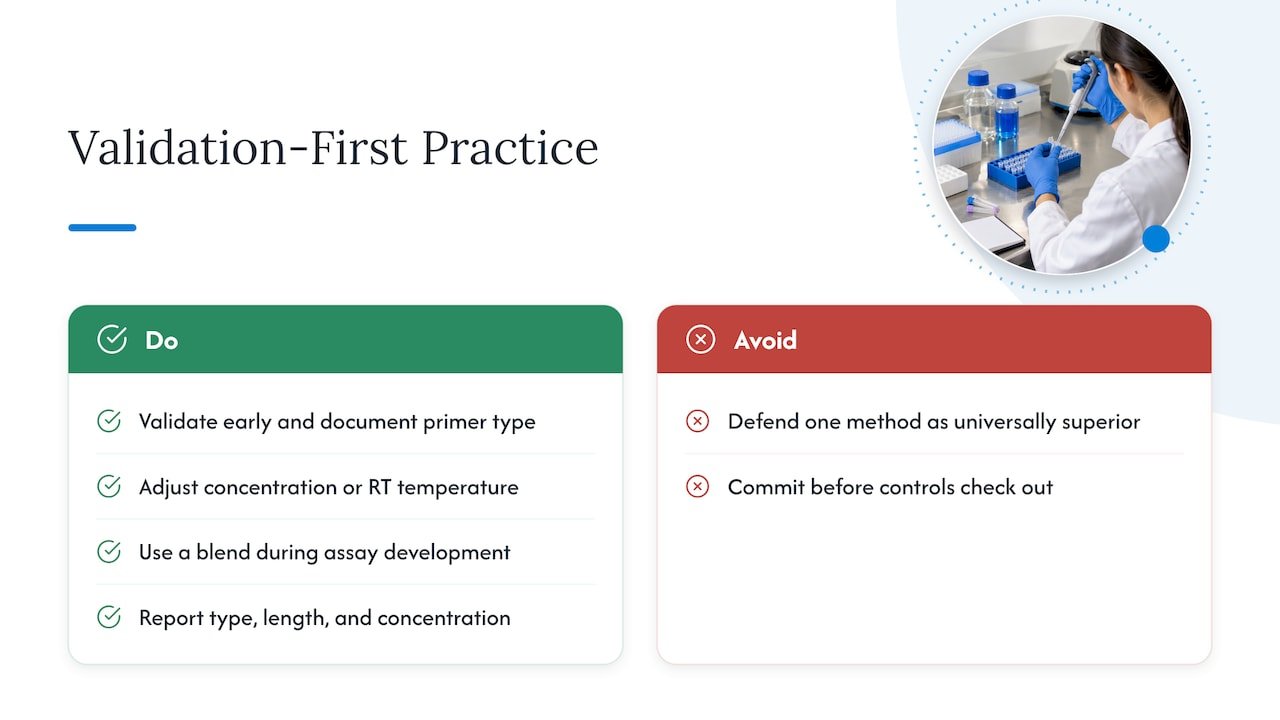
Small protocol adjustments, like primer concentration or reverse transcription temperature, frequently resolve yield and coverage problems that researchers attribute to the wrong cause without requiring a wholesale method change, which is often more intervention than needed.
During assay development specifically, defaulting to a blend and narrowing to a single primer strategy only after reference genes and controls check out tends to save time compared with committing early and discovering a normalization problem mid-project. Reporting primer type, length, and concentration in methods sections is a small effort that pays off disproportionately when another lab tries to reproduce the result.
— Alina
Order FIREScript® RT Mixes and Get Protocol Support
Once you have matched a priming strategy to your sample type, the next step is sourcing a reverse transcription mix built for that exact scenario rather than adapting a generic kit.

- Browse the FIREScript® oligo(dT) and random primer mix for diverse panels or uncertain sample quality.
- Compare the oligo(dT) mix and random primer mix against your sample type from the decision framework above.
- Reach our technical support team for protocol optimization help or bulk purchase inquiries through our full molecular biology product catalog.
FAQ
What is the difference between oligo(dT) primers and random hexamers?
Oligo(dT) primers bind specifically to the poly(A) tail of eukaryotic mRNA, producing cDNA enriched for protein-coding transcripts, while random hexamers anneal throughout any RNA molecule, including rRNA and non-polyadenylated species. The tradeoff is 3’ bias and internal poly(A) priming for oligo(dT) versus sequence-dependent mispriming for random hexamers.
Should I use random primers or oligo(dT) for cDNA synthesis?
Choose oligo(dT) for intact eukaryotic mRNA when you want selective coverage of polyadenylated transcripts, and choose random hexamers for degraded RNA, bacterial samples, or non-polyadenylated targets. For mixed or uncertain sample panels, a validated blend of both primer types is a reasonable starting point.
What does oligo(dT) mean?
Oligo(dT) refers to a short synthetic primer made entirely of deoxythymidine bases that hybridizes to the adenine-rich poly(A) tail found on most eukaryotic messenger RNA. The name describes its composition: an oligonucleotide of thymidine residues.
Why is oligo(dT) an effective primer for reverse transcriptase?
Oligo(dT) is effective because it anneals specifically and consistently to the poly(A) tail present at the 3’ end of nearly all eukaryotic mRNAs, giving reverse transcriptase a defined, reliable starting point. That specificity also excludes rRNA and other non-polyadenylated RNA from the resulting cDNA, which keeps background low for mRNA-focused assays, though anchored variants are recommended to limit internal poly(A) priming.
Sources
- Generation of cDNA using random hexamer priming induces biases in the nucleotide composition at the beginning of transcriptome sequencing reads
- Oligo(dT) primer generates a high frequency of truncated cDNAs through internal poly(A) priming during reverse transcription