Antibody Dilution Buffer: Mix 500 mL and Titrate for Your Assay
An antibody dilution buffer is a salt-balanced solution, usually a Tris or phosphate base, that carries an antibody at a working concentration while blocking agents and detergent keep it from sticking where it shouldn’t. Filter the mix through a 0.22 μm filter and store it at 4°C if you won’t use it immediately.
TL;DR:
- For antibodies targeting phosphorylated proteins, choose TBS or 1% BSA instead of PBS or milk, because phosphate and milk phosphoproteins can weaken the signal.
- Test five to six serial dilutions across two orders of magnitude, compare signal to background, and choose the most dilute concentration that remains specific.
- Keep diluted antibodies at 4°C for up to two weeks; freeze aliquots for longer storage, and exclude sodium azide from buffers for live cells.
- For IHC, use PBS or TBS with BSA or serum and 0.1% to 0.3% Triton; match serum species to the secondary antibody’s host.
Table of Contents
- Core Buffer Composition and Lab-Ready Recipes
- Picking the Right Diluent for Western Blot, IHC, or IF
- How to Run a Dilution Curve and Calculate Working Volumes
- Storing Diluted Antibodies Safely
- Fixing Background, Weak Signal, and Inconsistent Staining
- Why Titration Still Gets Skipped in Most Labs
- Where Reagent Quality Fits Into This
- Get the Right Antibody for Your Diluent Recipe
- FAQ
- Sources
Core Buffer Composition and Lab-Ready Recipes
Two bases dominate antibody dilution work: 1X PBS and 1X TBS made with 20 mM Tris-HCl. Both are formulated to match physiological ionic strength, typically around 150 mM NaCl, so the antibody stays soluble and the antigen-antibody interaction isn’t disrupted by osmotic stress. TBS is often preferred for phospho-specific antibodies since phosphate in PBS can interfere with some phospho-epitopes, while PBS remains the standard for most routine IHC and IF work.
Detergent choice depends on how much permeabilization and stringency you need:
- Tween 20 (0.05 to 0.1%) is a mild, nonionic detergent suited to Western blot diluents and most IF washes.
- Triton X-100 (0.1 to 0.3%) is stronger and better for permeabilizing membranes in IHC and whole-mount staining.
Blocking proteins carry their own trade-offs.
A widely used reference recipe, known as Abdil, builds a 500 mL antibody diluent from 150 mM NaCl, 20 mM Tris-HCl at pH 7.4, 0.1% Triton X-100, 2% BSA, and 0.1% sodium azide, filtered through a 0.22 μm membrane and stored at 4°C.
To mix it on the bench:
- Dissolve Tris-HCl and NaCl in deionized water to reach the target molarity and pH.
- Add BSA gradually while stirring to avoid clumping.
- Add Triton X-100 last, since it foams easily.
- Add sodium azide only if the diluent will never touch live cells.
- Filter through a 0.22 μm filter and label with the date and composition.
- Store at 4°C, protected from light if the antibody is fluorophore-conjugated.
Sodium azide works well as a preservative against microbial growth, but it carries a safety caveat covered in the storage section below.
Picking the Right Diluent for Western Blot, IHC, or IF
Each assay has its own expectations for background, permeabilization, and sensitivity, so the diluent recipe shifts accordingly.
- Western blot: TBST with 0.1% Tween 20 is standard, blocked with 1 to 5% nonfat milk for most primaries or switched to 1% BSA for phospho-specific antibodies, since milk contains phosphoproteins that can quench phospho-antibody signal. A typical workflow dilutes the primary antibody directly in fresh blocking buffer after the initial block is discarded.
- IHC: A PBS or TBS base with 1 to 5% BSA or 5 to 10% normal serum, plus 0.1 to 0.3% Triton X-100 for permeabilization, handles most paraffin or frozen sections. Matching the serum species to the secondary antibody’s host, as shown in protocols using 5% normal donkey serum with 0.3% Triton X-100 for brain tissue, cuts nonspecific binding.
- IF: A practical diluent for 50 mL combines 36 mL water, 4 mL 10X PBS, 0.5 g BSA, and 120 μL Triton X-100, giving a working buffer ready for primary and secondary incubations.
- Whole-mount: Longer incubation times call for diluents built around 2% BSA, DPBS, and 10% normal serum with Triton X-100, and aliquots of this mix can be frozen at minus 20°C for later use.
Starting working dilutions commonly fall between 1:100 and 1:1000 for primaries, with secondaries often diluted further, but the exact ratio depends entirely on the antibody and detection method you’re using.
How to Run a Dilution Curve and Calculate Working Volumes
Manufacturer-recommended dilutions are a starting point, not a verdict. Experts advise that every laboratory run its own independent dilution curve rather than trusting a vendor’s suggested ratio, since optimal staining sometimes appears at dilutions far more dilute than what’s printed on the datasheet.
- Prepare a stock dilution, then make five to six serial dilutions spanning roughly two orders of magnitude (for example, 1:100, 1:200, 1:500, 1:1000, 1:2000, 1:5000).
- Apply each dilution to identical sample sets under matched conditions.
- Compare signal-to-background ratio across the series rather than raw signal intensity alone.
- Select the most dilute concentration that still gives a clean, specific signal, since it is usually the most economical choice as well.
For a 1:100 dilution in 200 μL, combine 2 μL of antibody stock with 198 μL of diluent, as shown in this published recipe. For other ratios, calculate the stock and diluent volumes proportionally. Scale any ratio up proportionally once you confirm the working concentration.
Pro Tip: Filter the diluted antibody after mixing and aliquot it into single-use volumes to avoid repeated freeze-thaw cycles that degrade activity.
For readers running multiple titration points across plates, our guide on how to analyze assay data for accurate results covers how to compare signal consistency across a dilution series.
Storing Diluted Antibodies Safely
Short-term storage at 4°C works for most diluted antibodies used within a week or two. For longer gaps, aliquot and freeze to avoid degradation from repeated thawing.
- Diluted antibodies in Tris-buffered saline with 0.1% Tween 20 have been reported to retain immunoreactivity for extended periods, which supports keeping a Tween-based diluent on hand for routine use rather than reformulating each time.
- Sodium azide is a useful preservative against bacterial growth in stored diluents, but it must never be used in buffers destined for live cells, intracellular recordings, or in vivo work, since it inhibits the cytochrome electron transport system.
- Filter every batch through a 0.22 μm filter before storage to limit microbial contamination, especially in azide-free diluents.
For researchers reconstituting other reagents that require sterile handling, this guide to bacteriostatic water use covers similar sterile technique considerations.
Fixing Background, Weak Signal, and Inconsistent Staining
Most staining problems trace back to the diluent, the blocker, or the dilution ratio rather than the antibody itself.
- High background: switch the blocker from milk to BSA or serum, increase detergent concentration slightly, or extend wash steps with fresh TBST or PBST.
- Weak signal: retitrate the primary antibody toward a more concentrated dilution, reduce the blocker percentage if it’s masking the epitope, or extend incubation time at 4°C overnight instead of room temperature for an hour.
- Species mismatch: confirm the blocking serum matches the secondary antibody’s host species, since a mismatch is a common, overlooked source of background.
- Contamination: prepare fresh diluent if background rises unexpectedly across unrelated samples, and minimize freeze-thaw cycles on antibody stocks.
Pro Tip: Before imaging or detection, run a quick checklist: confirm filter date, blocker match, wash count, and antibody lot number against your last successful run.
Why Titration Still Gets Skipped in Most Labs
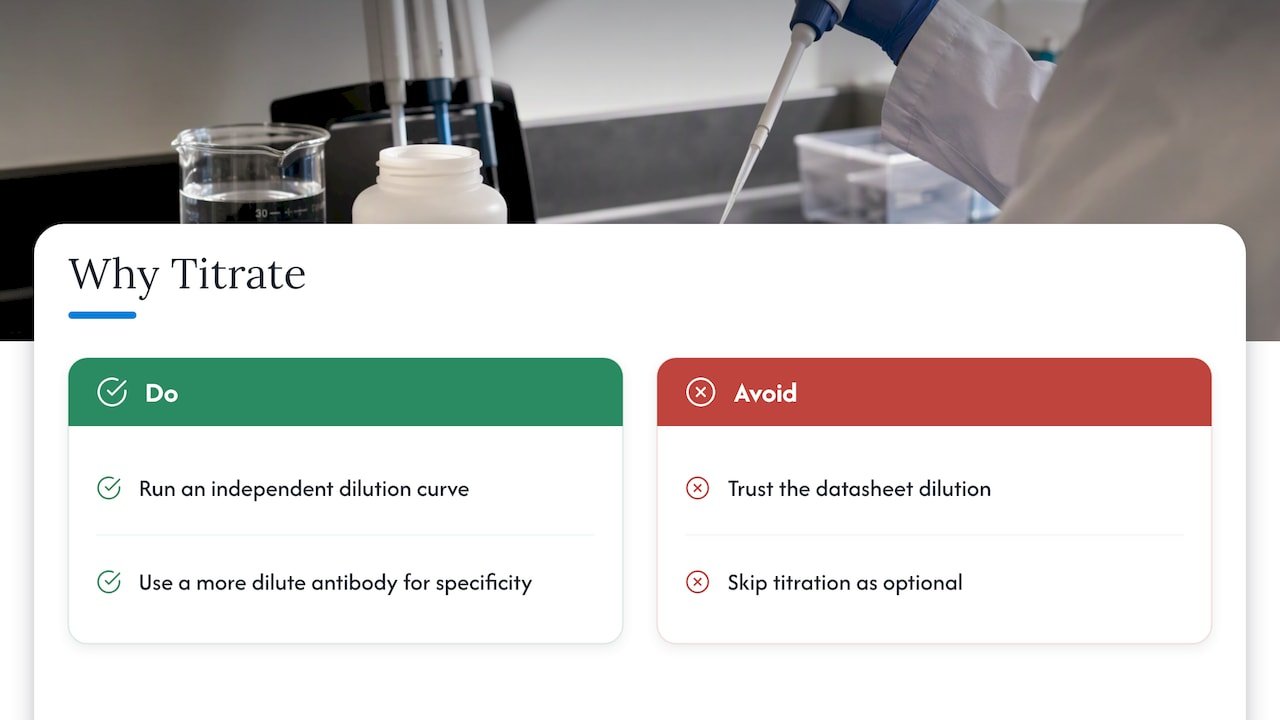
The most persistent mistake in antibody work isn’t a wrong buffer recipe, it’s skipping titration because the datasheet dilution “usually works.” That habit costs more than it saves: a dilution that looks fine on one lot can produce background or weak signal on the next, and chasing that inconsistency after the fact eats far more bench time than a dilution curve would have up front.
The deeper issue is that vendors optimize their recommended dilution for detectability, not specificity. A lab chasing clean, reproducible data often needs a more dilute antibody than the datasheet suggests, not a more concentrated one. Treating titration as optional data collection rather than a one-time formality is the difference between a protocol that reproduces across technicians and one that quietly drifts.
— Alina
Where Reagent Quality Fits Into This
We supply research-grade antibodies and dilution-compatible reagents for laboratory use, backed by US-based technical support. If you’re setting up a new titration series, our team can help you match an antibody to the diluent recipe that fits your assay.
Get the Right Antibody for Your Diluent Recipe
We stock antibodies for laboratory research. Our technical support team is available to help match an antibody to your assay before you commit bench time to a titration series.

- Browse our antibodies product page for options compatible with these recipes.
- Contact our technical support team for help selecting a reagent for your specific application.
FAQ
What do you dilute secondary antibodies in?
Working dilutions depend on the conjugate and detection method, so consult the relevant protocol and optimize the ratio.
What buffer is used for western blot?
Western blot antibody diluent is usually TBST, Tris-buffered saline with 0.1% Tween 20, paired with a blocking agent like nonfat milk or BSA. Phospho-specific antibodies are generally diluted in BSA rather than milk to avoid signal quenching from phosphoproteins in milk.
What is a primary antibody?
A primary antibody binds directly to the target protein or antigen of interest in an assay, distinguishing it from a secondary antibody, which binds the primary antibody’s host species to enable detection. Primary antibodies are diluted in assay-specific buffers and should be titrated for each new lot or application.
How do I dilute an antibody 1:1000?
To make a dilution, calculate the stock and diluent volumes from the desired ratio, then mix gently to avoid introducing bubbles. For smaller volumes, scale the stock and diluent amounts proportionally while maintaining the desired ratio.