Perfusion vs. Fed Batch for Process Leads: N-1 Before Full Conversion
Perfusion feeds and harvests continuously with cell retention, which raises daily productivity and shrinks the reactor, while fed-batch feeds periodically and harvests once at the end, which keeps operations simpler. Pick perfusion for labile products or tight floor space, and fed-batch when titers are already strong. Productivity gaps run from roughly 0.39 to 0.49 g/L/day for fed-batch to 2.29 g/L/day for perfusion, and FDA Q13 frames the regulatory side.
TL;DR:
- Perfusion’s cost per gram can approach fed batch when productivity is high, while pooling harvests for 6–8 days can improve economics and reduce environmental impact.
- A seed stage perfusion case study reported about 1.9 times the titer at equivalent runtime, supporting a staged pilot before production conversion.
- Fouling can interrupt harvest or force replacement, so campaigns need flux monitoring and spare capacity; single use systems require leachables and extractables data under GMP.
- Continuous harvest requires planned pooling, purification schedules, and hold times, while FDA Q13 sets lifecycle expectations; review the guidance early when designing a perfusion campaign.
Table of Contents
- 1. How do the two modes compare on core process dimensions?
- 2. What do published productivity numbers actually tell you?
- 3. Where do cost and environmental trade-offs land?
- 4. Which retention devices make perfusion workable at scale?
- 5. How do you intensify without converting to full perfusion?
- 6. What do manufacturing planning and FDA Q13 mean for the schedule?
- 7. Why a staged pilot beats a full conversion
- 8. Planning a perfusion pilot? We can help with the tools around it
- FAQ
- Sources
1. How do the two modes compare on core process dimensions?
The differences show up across several dimensions, and most of the decision lives in how you weigh them against your product and facility.
- Run duration: Fed-batch runs typically have shorter durations. Perfusion campaigns commonly exceed 30 days in production, and industry commentary notes some now run beyond that.
- Viable cell density: Perfusion holds far higher densities. The same commentary reports routine viable cell densities above 100 × 10^6 cells/mL, which is what drives volumetric output.
- Productivity: Higher density translates into higher g/L/day, so a smaller vessel can match the output of a much larger fed-batch bioreactor. That is the space-time-yield argument for perfusion.
- Media consumption: Perfusion exchanges media continuously, so vessel volumes per day and cell-specific perfusion rate set your media bill. Fed-batch uses less media per run, but the cost per gram narrows once perfusion productivity is high enough.
- Footprint and downstream effects: A perfusion reactor can be much smaller for the same output. The trade-off is more frequent downstream pooling and more purification cycles and cleaning.
- Operational complexity: Perfusion demands automation, retention-device monitoring and long-duration sterility. A critical review explains why fed-batch remains the standard for many stable monoclonal antibodies: strong titer gains and operational robustness.
If you are new to upstream terms, our primer on bioprocessing covers the vocabulary used here.
2. What do published productivity numbers actually tell you?
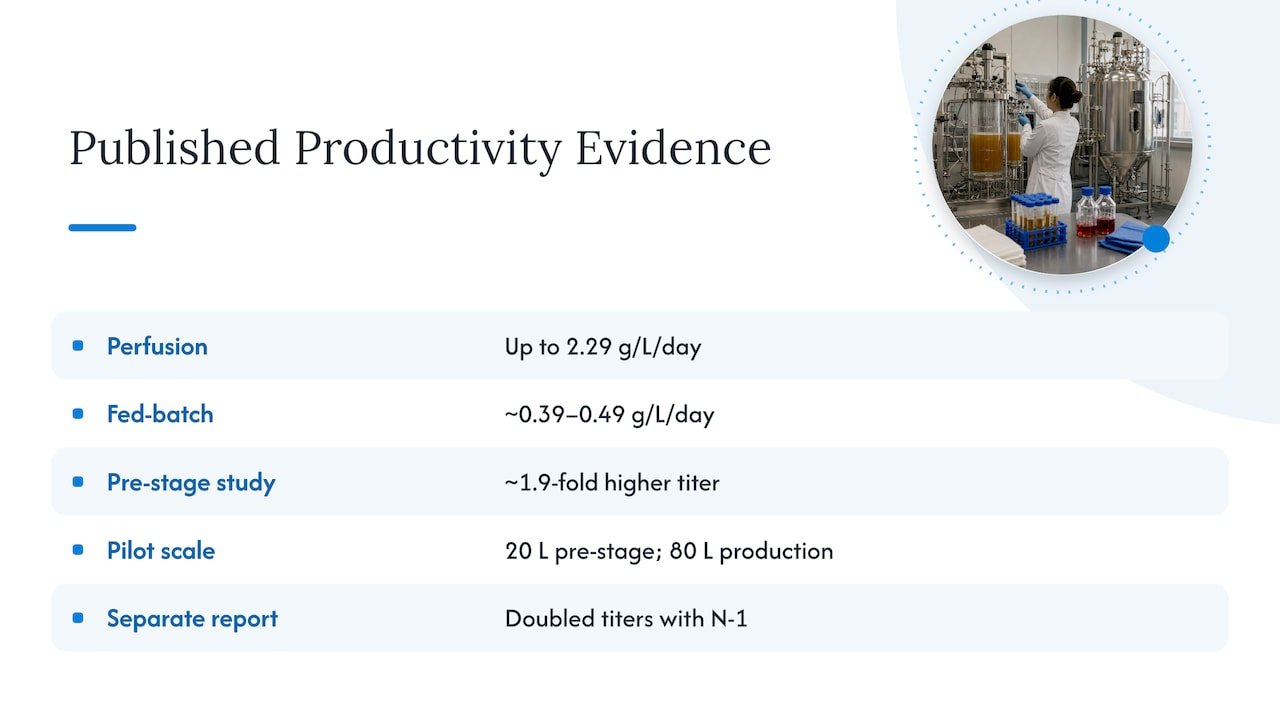
Numbers matter more than adjectives in this comparison. In experimental comparisons across intensified processes, perfusion reached up to about 2.29 g/L/day, while the fed-batch runs in the same work ranged from roughly 0.39 to 0.49 g/L/day.
Perfusion up to ~2.29 g/L/day versus ~0.39–0.49 g/L/day for fed-batch in the same experimental comparisons. That gap is the volumetric productivity case for continuous operation, and the same study found media cost per gram can be comparable when perfusion productivity is high enough.
Volumetric productivity is cell-specific productivity multiplied by viable cell density. A fed-batch culture may match or even beat perfusion on a per-cell basis, but it can’t carry the same number of cells, so the product of the two terms falls short. Perfusion wins by holding density high for weeks rather than by making each cell work harder.
This also explains why a reactor-volume comparison can mislead. A fed-batch process at high titer concentrates its output into one harvest, while perfusion spreads a smaller concentration across many harvest days. Compare on g/L/day and on total grams per reactor-month, not on titer alone.
The most useful middle-ground evidence comes from intensified seed stages. A case study of pre-stage perfusion with ultra-high seeding density in CHO fed-batch culture reported about a 1.9-fold increase in production titer over an equivalent runtime. It also scaled to pilot volumes of 20 L at the pre-stage and 80 L at production. A separate intensified platform report describes doubled titers using an N-1 perfusion seed. Together they suggest you can capture much of the productivity benefit without converting the production stage.
3. Where do cost and environmental trade-offs land?
A life-cycle and cost of goods study compared fed-batch with perfusion for monoclonal antibodies.
So perfusion does not lose on cost, but it does carry a heavier utility load. The same study found that extending pooling to 6–8 days can make perfusion more economical and cut its environmental impact. Higher titers shift the math too, because more product per liter of media and per downstream cycle dilutes fixed costs.
These are the levers that move the numbers most:
- Extend pooling when stability allows: Fewer, larger downstream batches reduce cleaning and consumable use per gram.
- Tune perfusion rate: Lowering cell-specific perfusion rate and vessel volumes per day trims media spend, as long as viability and quality hold.
- Compare single-use and stainless honestly: Single-use cuts cleaning water and energy, but long contact times raise extractables and waste questions, so price the full campaign rather than a single run.
- Include downstream frequency: Count purification cycles per gram, since perfusion multiplies them.
Pro Tip: Model cost of goods per gram across different pooling durations before choosing a mode. The ranking between fed-batch and perfusion often flips among those durations.
4. Which retention devices make perfusion workable at scale?
Perfusion lives or dies on cell retention. The device you pick sets your shear exposure, your uptime and how far the process scales.
- ATF (alternating tangential flow): A diaphragm pump pushes fluid back and forth across a hollow-fiber filter attached to the bioreactor. The reversing flow limits fouling, and it is a common choice for lab and pilot work.
- TFF (tangential flow filtration): A pump recirculates broth across a membrane in a loop. It scales well but exposes cells to more pumping shear, so membrane pore size and flux settings need care.
- Spin filters: An internal rotating screen retains cells. They are simple, but fouling limits run length.
- Gravity settlers: Cells settle back by density while clarified media is drawn off. They are gentle on cells but bulky, and they struggle at very high density.
The recurring failure mode is filter clogging and membrane fouling, which cuts effective flux, interrupts harvest and can force a mid-run swap. Plan spare capacity and monitoring, because a single device failure in a 30-day run costs far more than one in a ten-day batch. The critical review above lists retention-device scalability, oxygen transfer and mixing at high density as the main scale challenges.
Single-use perfusion setups add one more requirement. Because fluid contacts plastic for weeks, commentary on perfusion bioreactors points out that leachables and extractables data is mandatory under GMP. Our overview of the role of bioprocessing tools gives background on single-use choices. For separation consumables, see our cell separation range. On a related separations topic, a partner article on HPLC versus UPLC for peptide labs offers another technical perspective on method transfer.
5. How do you intensify without converting to full perfusion?
Most fed-batch facilities don’t need to rebuild their production stage. N-1 perfusion and concentrated fed-batch deliver a large share of the upside with far smaller changes.
- Run N-1 perfusion at the seed stage. Perfusing the penultimate bioreactor builds very high density before production. Pilot reports reached 45 × 10^6 cells/mL in an N-1 perfusion study, which compresses the seed train and lifts the starting density.
- Inoculate the production stage at ultra-high density. Starting from a high-density seed shifts biomass generation upstream, which is how the 1.9-fold titer gain in the case study above was achieved in equivalent runtime.
- Use concentrated fed-batch feeds. Richer feeds support the higher density without the media burden of production-scale perfusion.
- Check media and downstream bottlenecks. Higher titers can overload capture chromatography or clarification, so test those steps before committing.
- Verify retention-device capacity. Confirm that your ATF or TFF unit can handle the target N-1 density and duration, with spare capacity.
- Decide on full perfusion last. Convert the production stage only if the pilot shows the economics or product stability demand it.
Cell counting accuracy matters throughout, since seeding density drives every downstream result. Our cell counting supplies support seed-train quality control.
6. What do manufacturing planning and FDA Q13 mean for the schedule?
Continuous harvest changes how you plan downstream. Product arrives daily rather than in one lot, so pooling strategy, purification scheduling and hold times need deliberate design. Changeover and ramp-up constraints also differ, because a perfusion run ties up a reactor for weeks and needs time to reach steady state.
Portfolio planning gets harder as well. Capacity-planning research notes that long-running continuous cultures, ramp-up times, sequence-dependent changeover and semi-continuous harvests complicate discrete-time scheduling compared with shorter fed-batch runs.
For regulatory framing, FDA Q13 provides scientific and regulatory considerations for continuous manufacturing and clarifies lifecycle management expectations. Read it early if a perfusion or hybrid campaign is on your roadmap.
7. Why a staged pilot beats a full conversion
My recommendation is simple: for most fed-batch facilities seeking intensification, pilot N-1 perfusion first. It is the lowest-risk way to learn your cell line’s behavior at high density, and it often delivers the largest share of the gain. Track viable cell density at inoculation, titer, g/L/day, media cost per gram and downstream cycles per gram, and compare against your fed-batch baseline.
Reserve full perfusion for labile products, tight footprints, or portfolios where continuous campaigns clearly win on economics. The tools and technical support around a pilot matter more than most teams expect, and we are glad to be one of those resources.
— Alina
8. Planning a perfusion pilot? We can help with the tools around it
If you are piloting N-1 perfusion or tuning feeds, we supply the adjacent consumables and support. Our cell separation products cover retention and separation basics, and our cell counting slides help you verify seeding density and viability across the seed train. Our catalog also includes cell lines, and we back it with US-based technical support. Bring us your pilot plan and we will help you match supplies to your seed-train and retention setup. Browse the full Mayflower Bioscience catalog or contact our technical team to start planning.

FAQ
What is cell perfusion in bioprocessing?
Cell perfusion is a culture mode that continuously adds fresh media and removes spent media while retaining the cells in the bioreactor. This keeps cell density high for weeks. As the critical review notes, it offers very high density and daily productivity.
What is the difference between batch, fed-batch and continuous culture?
Batch culture has no feeding after inoculation and ends at harvest. Fed-batch adds nutrients during the run but harvests once at the end. Continuous or perfusion culture feeds and harvests throughout, with cells retained.
When should you choose fed-batch over perfusion?
Choose fed-batch when your product is stable and your titers are already strong. The critical review explains that fed-batch became the standard for many stable proteins because of its robustness. It also keeps downstream pooling simpler.
What is N-1 perfusion?
N-1 perfusion applies perfusion to the seed bioreactor just before the production stage. It builds very high density, so the production culture starts at ultra-high seeding density. A case study reported about a 1.9-fold titer increase this way.
What are the main challenges of running perfusion at scale?
The main challenges are retention-device fouling and scalability, media cost, oxygen transfer, and mixing at high density. Perfusion also needs more automation and development effort than fed-batch. Long single-use contact times add extractables and leachables testing.
Sources
- Pre-stage perfusion and ultra-high seeding cell density in CHO fed-batch culture: a case study for process intensification guided by systems biotechnology
- Q13 Continuous Manufacturing of Drug Substances and Drug Products | FDA
- Bioreactor productivity and media cost comparison for different intensified cell culture processes
- Research review paper Perfusion mammalian cell culture for recombinant protein manufacturing – A critical review