UNG Carryover Prevention in PCR: How the dUTP–UNG System Works
UNG carryover prevention works by marking every PCR product with uracil and then destroying anything marked before a new reaction starts. You swap dUTP in for dTTP during amplification, add uracil-N-glycosylase (UNG, also called UDG) to the next reaction mix, and the enzyme removes uracil from any contaminating amplicon from earlier runs. Your real template is natural thymine-containing DNA, so it survives. The system is cheap and well proven, but it is one layer of contamination control, not a replacement for clean workflow.
This guide covers the mechanism, a practical setup sequence, enzyme handling, the tuning trade-offs shown in published studies, the limits you should plan for, and the physical controls that belong beside it.
TL;DR
- UNG carryover prevention requires two parts: dUTP in place of dTTP in every earlier reaction, and UNG in every later one. It only protects against products that were made with dUTP.
- UNG cuts uracil out of DNA and leaves abasic sites that block polymerase and break down under heat or alkaline conditions. Thymine-containing template is left alone.
- Dose and pretreatment need tuning. In one RT-PCR study, a 20-minute pretreatment raised Ct by 1.2 cycles, and in sequencing work a dUTP:dTTP ratio above 2:1 gave poor libraries.
- UNG is weaker on GC-rich targets and short amplicons, and residual activity can degrade new product if the enzyme is not fully inactivated.
- Pair it with separated work areas, unidirectional flow, bleach cleaning and a no-template control (NTC) in every run.
Table of Contents
- Why carryover contamination is a PCR problem
- How the dUTP–UNG system works
- Setting up a UNG-based PCR workflow
- Reaction conditions that need tuning
- Which workflows are compatible
- Limits of UNG carryover prevention
- The controls that belong beside UNG
- Choosing UNG-ready reagents
- Our perspective: treat UNG as insurance, not a cleaning plan
- FAQ
- Sources
Why carryover contamination is a PCR problem
A single PCR tube can hold billions of copies of the amplicon. Open it, pipette near it, or let an aerosol drift to the bench, and a few of those copies can land in the next setup. The next reaction has the same primers, so it amplifies the intruder as efficiently as a true sample. The result is a false positive, a drifting NTC, or a quantification that reads low-copy samples too high.
This matters most where a positive result has consequences: infectious disease testing, drug-discovery assays that run thousands of identical reactions, and any lab that repeats the same amplicon for months. The same primer pair running day after day is exactly what makes carryover likely. Chemical sterilization of the product before the next run, rather than hoping for clean technique alone, is what the dUTP–UNG approach adds.
How the dUTP–UNG system works
The approach, described by Longo and colleagues in 1990, has three moving parts, according to the original carryover-control paper:
- Mark the product. Replace dTTP with dUTP in the PCR. Every amplicon now contains uracil where it would normally contain thymine.
- Treat the next reaction. Add UNG to fully preassembled reaction mixtures before amplification begins. UNG removes the uracil base from any U-containing DNA it finds.
- Block and break the leftovers. The excised sites become abasic sites, which block replication and are labile to acid or base hydrolysis. Natural thymine-containing DNA is unaffected.
The logic is selective. The contaminant is deliberately marked, while the biological target is not, so the enzyme can tell them apart. Once heat inactivates UNG at the start of cycling, the new dUTP-containing products produced in the current run are safe for the moment and become the marked contaminants that UNG will remove in the next run.
Two details are easy to miss:
- The system only protects against contamination that carries uracil. A plasmid, a gDNA sample or a positive control made with dTTP is not touched. That is a feature for your real samples and a limit for your positive controls.
- If products from before you adopted dUTP are lurking in your lab, UNG will not remove them. Those need physical decontamination.
Setting up a UNG-based PCR workflow
The published literature does not give one universal protocol, and every kit has its own datasheet. The sequence below is the structure that most workflows share. Take actual temperatures, times and enzyme amounts from your polymerase or master mix datasheet, then validate on your own assay.
Step 1: Choose the format
You have two practical routes:
- A master mix that already contains dUTP and UNG. The simplest option: one tube, one thaw, and the manufacturer has balanced the components. Mixes in this category suit routine qPCR and diagnostic-style assays.
- A mix you assemble yourself. Use your polymerase buffer, a dNTP set where dUTP replaces dTTP (fully or partly), and a separately sold UNG. This gives flexibility for unusual polymerases, lyophilized formats or special assay chemistries, at the cost of more optimization.
Step 2: Build the reaction at the right temperature
UNG is a more temperature-sensitive enzyme than a typical DNA polymerase. Keep UNG-containing mixes and enzyme stocks cold, on ice or a cooling block, during setup, and return them to the freezer promptly. Setting up warm lets the enzyme act early, and degrading your own primers’ targets is not the goal.
Step 3: Run a pre-cycling incubation
Most protocols include a short hold at a moderate temperature before the first denaturation, so UNG can work on any uracil-containing contaminant. A peer-reviewed RT-PCR study used 0.25 U UNG per 25 µL with a 20-minute pretreatment at 30°C and found that high amounts of amplicon DNA were degraded. Commercial mixes typically use a shorter hold; follow the datasheet, because the dose and time are built together.
Step 4: Inactivate UNG with the first heat step
The initial denaturation or hot-start activation step, usually at 95°C, inactivates UNG in most formats. This matters because a UNG that survives will attack your freshly made dUTP product. Inactivation efficiency differs by enzyme. A 2018 study showed that Cod UNG can be completely and irreversibly heat-inactivated, which is why it could be used before targeted preamplification without losing new amplicons.
Step 5: Store finished products knowing what they are
After the run, products made with dUTP remain vulnerable to residual UNG activity at room temperature in a tube that still contains active enzyme. Move finished plates to a post-amplification area and keep them there. Some protocols also keep products held at an elevated temperature or add an inhibitor; in the literature, adding a UNG inhibitor protein (Ugi) alone is described as sufficient to inactivate UDG in the reaction, but check that your chemistry is validated before adding it.
Reaction conditions that need tuning
More UNG is not automatically better. The published studies show a pattern: stronger or longer treatment removes more contaminant but costs sensitivity somewhere else.
| Variable | What studies found | Practical meaning |
|---|---|---|
| UNG dose and pretreatment time | In an RT-PCR assay, 0.25 U per 25 µL for 20 minutes at 30°C degraded high amounts of amplicon but raised RNA-detection Ct by 1.2 cycles | Expect a small sensitivity cost in RT-PCR and measure it |
| UNG in multiplex PCR | A clinical multiplex assay found that 0.3 U UNG per reaction prevented reamplification of at least 5 × 10^5 copies of a dUTP-containing product | Low doses can be enough for multiplex, but keep good PCR practice |
| dUTP:dTTP ratio | A 2023 SARS-CoV-2 amplicon-sequencing study used 2:1 dUTP:dTTP and 1 U UDG per reaction and kept comparable detection of standards; ratios above 2:1 gave substandard libraries | Full replacement of dTTP is not always the best choice, particularly for sequencing |
| dTTP replaced by dUTP in preamplification | Dynamic range, reproducibility and sensitivity were comparable to dTTP | Switching to dUTP alone rarely harms performance, but verify per assay |
| Target type | UNG activity is reduced on GC-rich targets | Validate separately for GC-rich amplicons |
The point of the table is that every assay is its own optimization. Start from the manufacturer’s recommendation, then spike a known quantity of dUTP-containing amplicon and check that UNG treatment removes it, while a real low-copy template still amplifies at the expected Ct.
A short validation routine
- Make a dUTP-containing amplicon from your assay and quantify it.
- Spike it at a high copy number into reactions with and without UNG, with no real template.
- Confirm that the UNG reactions stay negative and the no-UNG reactions amplify.
- Run a low-copy dTTP-containing template with and without UNG and compare Ct. Accept the shift only if the assay’s limit of detection still meets your requirement.
- Repeat with your worst case: the shortest amplicon and the GC-richest target in the panel.
Step 5 is not decoration. In the Cod UNG study, active enzyme completely removed uracil-containing standards in all replicates for 34 of 45 assays, and the residual positives were associated with high molecule numbers, few uracils and especially short amplicons. Short amplicons have fewer uracil sites to cut, so the chance that one intact copy survives is higher.
Which workflows are compatible
The dUTP–UNG approach has been used across a wide range of formats, and the evidence is old as well as new.
- Conventional PCR with gel or probe detection. A tuberculosis assay used dUTP and UNG with agarose-gel detection and probe hybridization; among 662 respiratory specimens, specificity was 100% for smear-positive specimens and 99.8% overall.
- Multiplex clinical PCR. The multiplex assay above showed that dUTP/UNG controlled carryover while the authors still emphasized good PCR practice.
- RT-PCR. Compatible, with the sensitivity cost described above. Because UNG can degrade uracil-containing DNA from earlier runs before reverse transcription starts, the pretreatment must be balanced against RNA detection.
- Targeted preamplification. Workable when the UNG can be fully inactivated, as shown with Cod UNG.
- Amplicon sequencing. Workable, with a lower dUTP share and dose tuned for library quality.
Sequencing libraries: keep contamination control and library quality together
In sequencing workflows, the cost of over-treatment shows up in the library, not just in Ct. If you also design downstream assays that measure outcomes by sequencing, such as splicing readouts, it helps to think about contamination control and detection together, as in this walkthrough of minigene splicing assay design and quantification. The 2:1 dUTP:dTTP result is a good starting point, and your own spike-in standards tell you whether it holds for your library prep.
Limits of UNG carryover prevention
A candid list of what UNG will not do:
- It cannot remove unmarked contamination. Natural DNA, plasmid controls and gDNA from the sample prep are all thymine-based. The system is blind to them.
- GC-rich targets are harder. A clinical-laboratory review identifies reduced UNG activity in GC-rich targets, incomplete inactivation in some conditions, and the need to optimize UNG and dUTP concentrations for each amplification.
- Residual activity is a risk. Incompletely inactivated UNG can chew on new product, which shows up as lower yield or odd end-point results.
- Short amplicons slip through more often. Fewer uracil positions means fewer chances for the enzyme to cut.
- High copy numbers can overwhelm the treatment. A heavy contamination event can exceed what a standard dose handles.
- It does not replace workflow discipline. The amplicon-sequencing study shows that dUTP/UDG is one layer of a contamination-control system, alongside physical separation, filtered tips, spike-in controls and analysis-level monitoring.
The controls that belong beside UNG
Separate the space and keep the flow one way
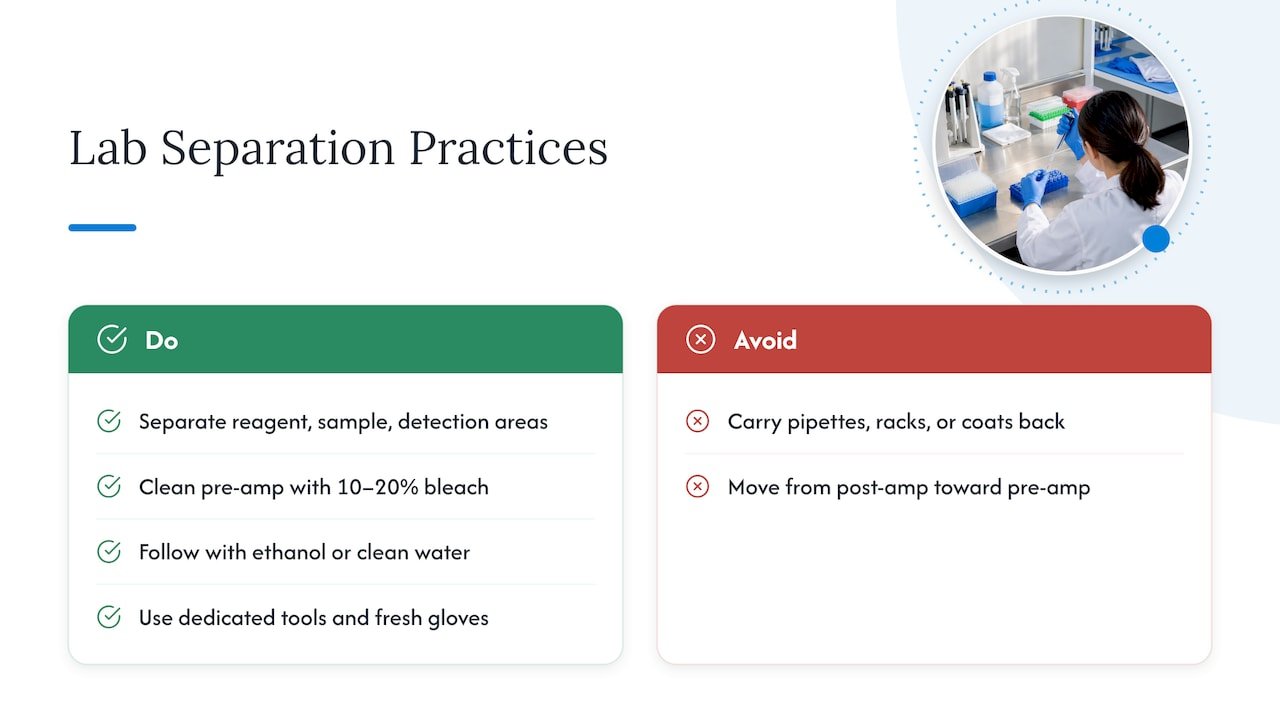
CDC guidance for US molecular testing recommends separate reagent-preparation, sample-preparation and amplification/detection areas, cleaning pre-amplification areas with 10–20% bleach followed by ethanol or clean water, and moving only from clean pre-amplification areas toward the post-amplification area. Never carry a pipette, tube rack or lab coat back the other way.
A CDC package insert for an RT-PCR assay adds the everyday details: physically separate assay-setup and nucleic-acid-handling areas, dedicated equipment and supplies, fresh gloves, capped tubes, and surface decontamination with agents such as 5% bleach followed by 70% ethanol where appropriate. Follow your own SOP and your institution’s biosafety rules for the actual concentrations.
Use the no-template control as an acceptance criterion
Include nuclease-free water in place of sample nucleic acid in the NTC for every primer/probe set and every run. In the same CDC insert, an NTC curve that crosses the threshold indicates contamination, and the run is invalidated and repeated after corrective decontamination and setup controls. Treat a positive NTC as a failed run, not a noisy negative.
A useful habit: place the NTC last in your plate setup and, in a second position, near the high-positive wells. A NTC that amplifies only in the well beside the positive control points to a pipetting or splash issue, while amplification in every NTC points to a contaminated reagent.
A troubleshooting order when the NTC amplifies
- Check whether the NTC Ct is late and sporadic (often an aerosol or a pipetting event) or consistent (often a reagent or a surface).
- Replace the water and the primer/probe aliquots first, since they are cheap and often the source.
- Confirm UNG is active: spike a known dUTP amplicon into a reaction with and without UNG.
- Decontaminate benches, pipettes and racks with bleach followed by ethanol or water, and reorder anything that only travels in the post-amplification area.
- Reassess the assay for short amplicons and GC-rich regions that UNG handles poorly.
Choosing UNG-ready reagents
If you want the dUTP–UNG system in a single tube, Mayflower Bioscience carries several probe-based qPCR mixes that include UNG. The SolisFAST Probe qPCR Mix with UNG (ROX), the no ROX version and the Purple reference dye version let you match the mix to your instrument’s passive reference requirements. If you prefer to build your own formulation or add carryover control to an existing polymerase system, Salini UNG Uracil-N-Glycosylase is sold as a standalone enzyme.
When UNG is not wanted, for example when you handle dTTP-based products or controls, the same catalog includes mixes without it, such as HOT FIREPol Probe Universal qPCR Mix and HOT FIREPol Multiplex qPCR Mix. You can browse everything else under Other PCR Reagents, and if you are comparing amplification formats, our page on isothermal amplification is a useful side route. Pricing is not published on the product pages, so contact our team through the site for a quote and for help matching a mix to your cycler. For wider planning, our guide to types of molecular biology assays places these mixes within the bigger assay picture.
Our perspective: treat UNG as insurance, not a cleaning plan
Labs that come to us about carryover tend to arrive in one of two states. Some have switched to a UNG-containing mix and assume the problem is solved. Others have a recurring NTC problem and have never tried UNG at all. Both groups benefit from the same shift in thinking: UNG is insurance against the specific failure mode of amplicon from your own previous runs, and it works best in a lab that is already tidy.
Our view, based on the datasheets and the literature we work from, is that the best first move is to pick the format that matches your assay chemistry and instrument, then validate it with a spike of your own amplicon rather than trusting a headline number. The published figures are useful, but they are for other assays. A 1.2-cycle Ct shift in one RT-PCR study tells you the cost exists, not what it will be for your target.
We also tell customers to keep a dTTP-based positive control separate from the UNG system on purpose. It is not removed by UNG, so it is a contamination risk that must be managed by physical handling, such as dilution in a separate area and a dedicated aliquot.
Finally, we encourage keeping a simple log of NTC results by date, operator and plate. A pattern, for instance a rise in late NTC amplification after a new lot or a bench move, shows up in a log long before it shows up in a failed audit. When you need to talk through a specific assay, our US-based support team can help you choose between a premixed UNG formulation and a standalone enzyme.
— Alina
FAQ
Does UNG remove contamination from any PCR product?
No. UNG only removes uracil from DNA, so it only destroys amplicons made with dUTP. Natural thymine-containing DNA, including your sample, plasmid controls and products from before you switched to dUTP, is unaffected, as the original 1990 study explained. Those need physical decontamination.
Can I use UNG in RT-PCR?
Yes, but expect a trade-off. One peer-reviewed study found that a 20-minute pretreatment with 0.25 U UNG per 25 µL at 30°C degraded high amplicon amounts while raising the RNA-detection Ct by 1.2 cycles. Measure the shift on your own assay and balance dose against sensitivity.
Do I have to replace all of the dTTP with dUTP?
Not always. Most commercial mixes use complete or near-complete replacement, and a preamplification study found comparable performance. In SARS-CoV-2 amplicon sequencing, however, a 2:1 dUTP:dTTP ratio worked while higher ratios gave substandard libraries. Check your datasheet and your library quality.
How should I keep UNG during setup?
UNG is more temperature-sensitive than a typical DNA polymerase, so keep it cold on ice or a cooling block during setup and return it to storage promptly. Build reactions in the clean pre-amplification area, and do not leave mixes sitting at room temperature before the plate goes in the cycler.
If my NTC amplifies, should I just add more UNG?
Not as the first step. A positive NTC invalidates the run under CDC’s quality-control approach, so repeat it after decontamination and fresh reagents. Extra UNG may cost you sensitivity and will not fix contamination that is not uracil-containing.
Sources
- Use of uracil DNA glycosylase to control carry-over contamination in PCR (1990)
- Quantitative assessment of the effect of uracil-DNA glycosylase on RT-PCR (2005)
- Preamplification with dUTP and Cod UNG (2018), full text
- Preamplification with dUTP and Cod UNG (2018), abstract
- Carryover Contamination-Controlled Amplicon Sequencing (2023)
- Detection of Mycobacterium tuberculosis by PCR (1996)
- Clinically Applicable Multiplex PCR for Four Middle Ear Pathogens (2000)
- Preventing PCR Amplification Carryover Contamination in a Clinical Laboratory (2004)
- CDC Dengue RT-PCR package insert
- CDC False-Positive Investigation Toolkit: prevention practices