14 Panel Drug Test List: Every Drug and Abbreviation
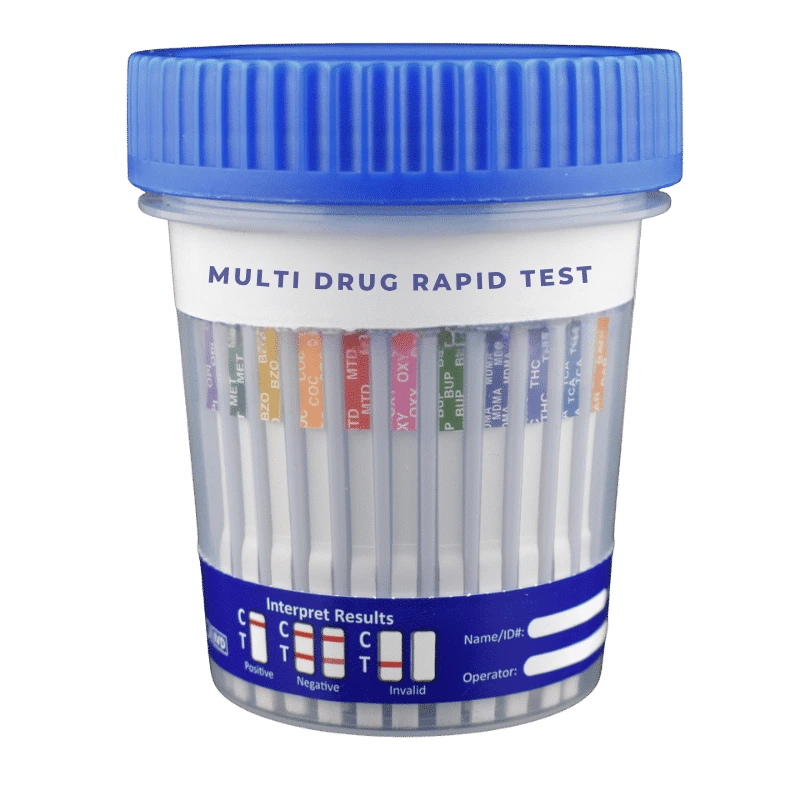
There is no single, official 14 panel drug test list. Most urine cups sold under that name screen for the same core drugs: amphetamine, methamphetamine, cocaine, THC, opiates, oxycodone, methadone, benzodiazepines, buprenorphine, barbiturates, MDMA and PCP. Many also add fentanyl and ETG, a marker of alcohol use. Which two or three extras a given cup carries depends on the manufacturer. This guide gives you the common list, decodes the abbreviations, and shows how 14-panel tests compare with 12- and 13-panel versions. It also covers what a positive result does and does not prove.
TL;DR
- A 14 panel urine test is a rapid screen for 14 substances or classes. The exact list is set by the manufacturer, not by a standard.
- A common configuration covers AMP, mAMP, COC, THC, OPI/MOP, OXY, MTD, BZO, BUP, BAR, MDMA, PCP, fentanyl and ETG.
- It is a screening test. It is qualitative, can cross-react, and a positive can be sent for laboratory confirmation.
- Federally regulated (DOT and federal workplace) testing follows its own mandated panel, not a 14-panel cup.
- Always read the analyte list and cutoff levels on the exact product before you order a case.
Table of Contents
- The common 14 panel drug test list
- What the abbreviations mean
- How a 14 panel differs from 12 and 13 panel tests
- Federal panels are a different thing
- What a positive 14 panel result means
- Cutoff levels: the number behind each line
- Perspective: why the label matters less than the line list
- Our 14-panel cup
- How to choose a 14-panel test: a short checklist
- Reading the cup correctly
- Frequently asked questions
- Sources
The common 14 panel drug test list
A 14 panel drug test is a urine immunoassay screen. It uses a cup or dip card with one test line per analyte. You collect the specimen, wait about five minutes, and read each line. A configuration that appears on many 14-panel products looks like this:
| # | Abbreviation | Substance | What it detects |
|---|---|---|---|
| 1 | AMP | Amphetamine | Amphetamine use, including prescription stimulants |
| 2 | mAMP / MET | Methamphetamine | Methamphetamine and related compounds |
| 3 | COC | Cocaine | Benzoylecgonine, the main cocaine metabolite |
| 4 | THC | Cannabis | Marijuana metabolites |
| 5 | MOP / OPI / MOR | Opiates (morphine type) | Morphine, codeine and heroin metabolites |
| 6 | OXY | Oxycodone | Oxycodone and some related opioids |
| 7 | MTD | Methadone | Methadone treatment or misuse |
| 8 | BZO | Benzodiazepines | Sedatives such as diazepam and alprazolam |
| 9 | BUP | Buprenorphine | Opioid treatment medication |
| 10 | BAR | Barbiturates | Older sedatives such as phenobarbital |
| 11 | MDMA | Ecstasy | 3,4-methylenedioxymethamphetamine |
| 12 | PCP | Phencyclidine | Dissociative drug use |
| 13 | FEN / FTY / FYL | Fentanyl | Synthetic opioid, or its metabolite norfentanyl |
| 14 | ETG / EtG | Ethyl glucuronide | A metabolite the body makes when it processes alcohol |
This is the layout you will see on many wholesale 14-panel cups, and it matches the list in our own 14 panel drug test analyte guide. It is not the only one. Some 14-panel cups swap in tramadol, synthetic cannabinoids (often labeled K2) or propoxyphene, and drop MDMA, barbiturates or PCP to make room. The substance count is a product label, not a regulation.
The SAMHSA primary care guide says it plainly: clinical drug testing has no set panel, and the drugs tested vary by laboratory and even within one laboratory. A 14-panel cup is a convenient bundle, not a definition.
What the abbreviations mean
The codes printed beside each test line are short, and different makers use different ones for the same drug. The usual translations:
- AMP: amphetamine.
- MET, mAMP or MAMP: methamphetamine.
- THC: tetrahydrocannabinol, the cannabis marker.
- COC: cocaine.
- MOR, MOP or OPI: morphine-type opiates.
- OXY: oxycodone.
- MTD: methadone.
- BZO: benzodiazepines.
- BUP: buprenorphine.
- BAR: barbiturates.
- MDMA: ecstasy.
- PCP: phencyclidine.
- FEN, FTY or FYL: fentanyl.
- ETG or EtG: ethyl glucuronide.
ETG deserves a note. It is a by-product of alcohol metabolism, so it tells you that alcohol was consumed, not how much ethanol is in the body right now. If your program monitors abstinence, our guide to what an EtG test is, with detection time and cutoff levels covers the detail. For a longer decoder, see our drug test abbreviations guide.
Codes that are not drugs: pH, OX and CR
Some cups and dip cards print extra codes that look like panel entries. They are specimen validity checks:
- pH measures how acidic or alkaline the sample is. Out-of-range values can point to tampering.
- OX checks for oxidants such as bleach or other adulterants.
- CR is creatinine, which helps identify a diluted sample.
These do not count toward the 14. A cup advertised as “14 panel with 3 adulterants” has 14 drug lines plus three validity strips.
The temperature strip
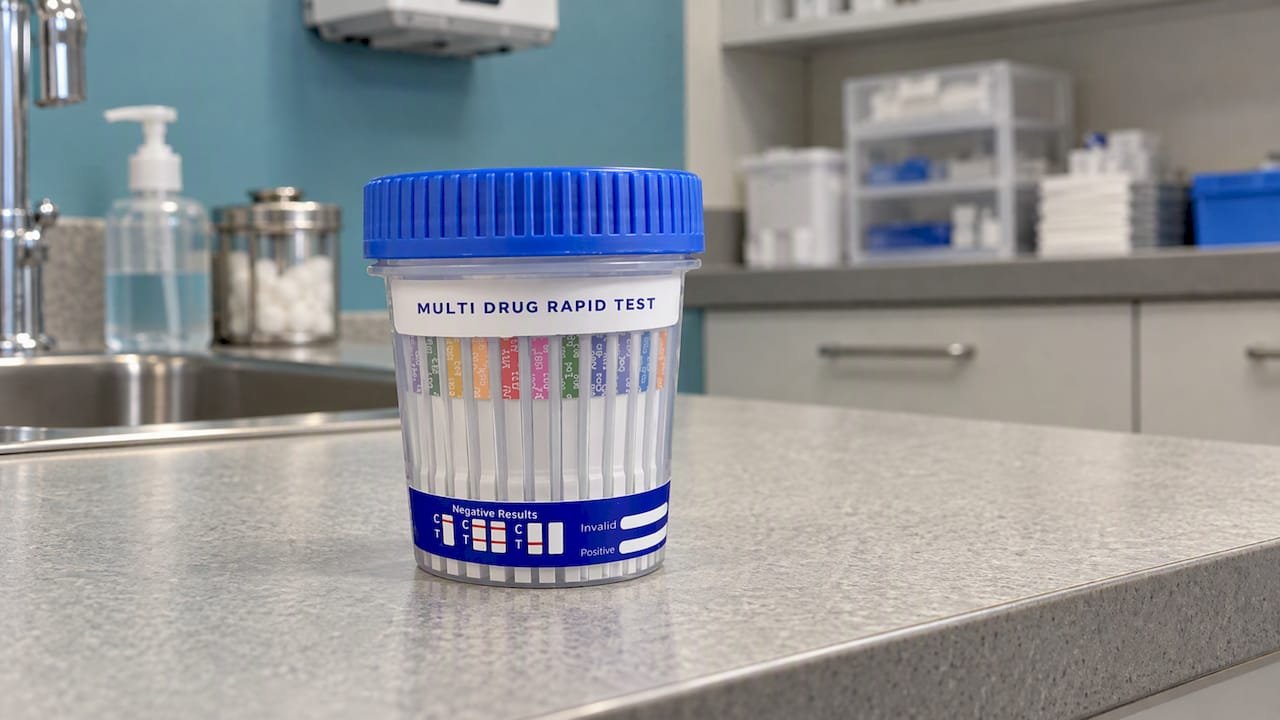
Most collection cups also carry a temperature strip on the side. Fresh urine is warm, so a strip reading far below body temperature is an early flag that the sample may have been substituted. It is a check on the specimen, not another drug test. Every Mayflower cup has an integrated temperature strip.
How a 14 panel differs from 12 and 13 panel tests
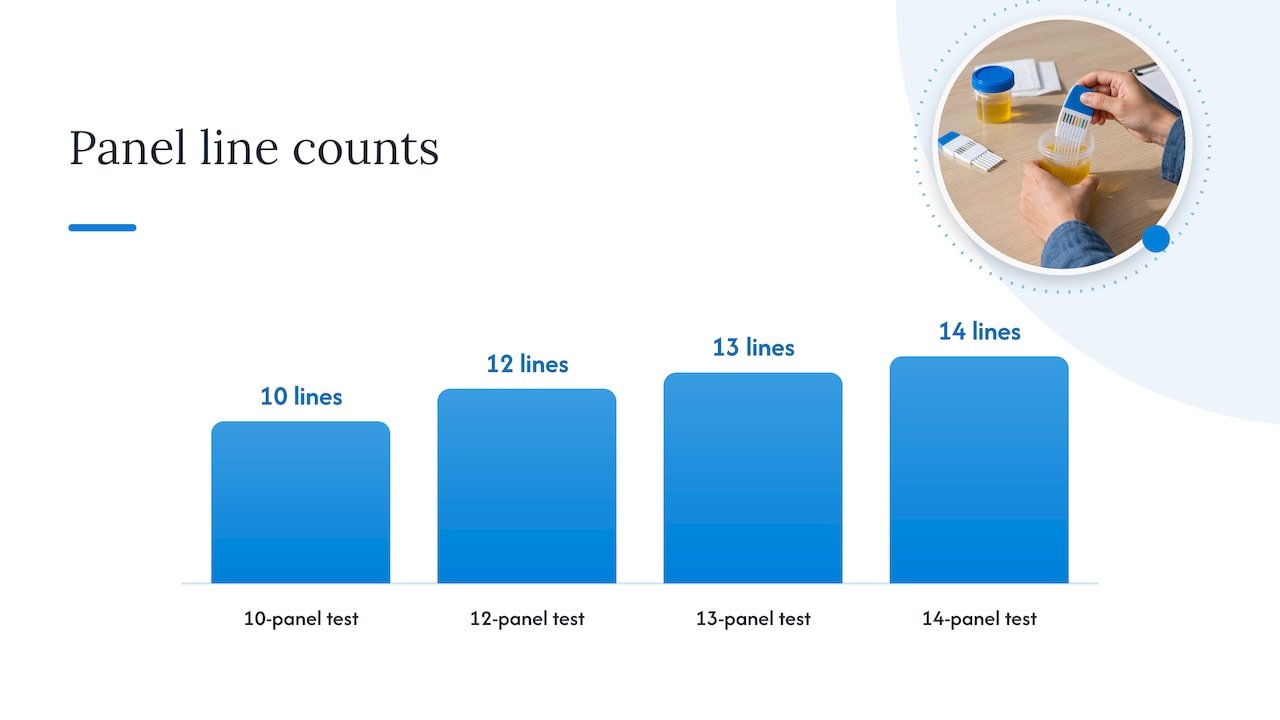
The names count lines on the device, nothing more. In practice the numbers tend to work like this:
| Test | What the extra lines usually are | Typical use |
|---|---|---|
| 10 panel | Core set: AMP, COC, THC, OPI, MTD, BZO, BAR, PCP, OXY, plus one of MDMA or propoxyphene depending on the maker | Pre-employment, general screening |
| 12 panel | Core set plus items such as BUP and MDMA | Clinics, treatment programs, employers |
| 13 panel | A 12 panel plus one more, often fentanyl or tramadol | Programs adding one targeted drug |
| 14 panel | A 12 panel plus two more, often fentanyl and ETG, or fentanyl and tramadol | Behavioral health, drug courts, monitoring |
These patterns are common but loose. One vendor’s 13 panel includes expanded opiates, fentanyl and tramadol, while another’s skips them. The practical rule: never compare two tests by their number. Compare the analyte lists line by line, and compare cutoffs too.
If you are choosing between sizes, we wrote two comparison pages: 12 vs 14 panel drug test and 14 vs 16 panel drug test. The short version: go up a size only when the extra line answers a question your program actually asks.
Federal panels are a different thing
If your testing is regulated, a 14-panel cup is not the instrument. U.S. DOT-regulated testing is defined in 49 CFR §40.85, which sets the analytes and the initial and confirmatory cutoffs. It covers marijuana metabolite, cocaine metabolite, codeine and morphine, hydrocodone and hydromorphone, oxycodone and oxymorphone, 6-acetylmorphine, PCP, amphetamine and methamphetamine, and MDMA and MDA.
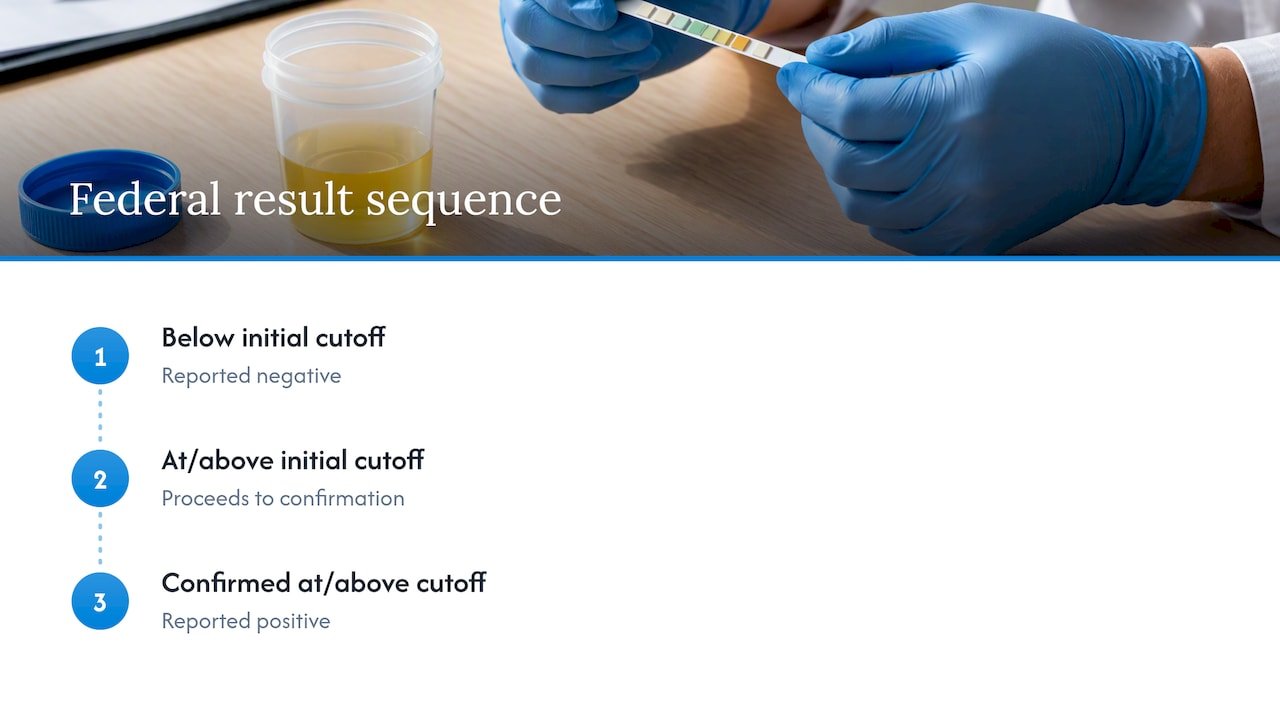
The same rule explains how results flow. An initial result below the cutoff is reported negative. A result at or above the initial cutoff proceeds to confirmation. A confirmed result at or above the confirmation cutoff is reported positive. Grouped analytes may need separate immunoassays if cross-reactivity is below 80 percent.
For federal agencies, SAMHSA’s March 2026 model plan for a comprehensive federal drug-free workplace lists a federally authorized panel that includes amphetamine, methamphetamine, MDMA, MDA, 6-acetylmorphine, codeine, fentanyl, morphine, hydrocodone, hydromorphone, oxycodone, oxymorphone and PCP. The plan is guidance and does not itself have the force of law.
Notice what is absent from those federal lists: alcohol metabolite, buprenorphine, barbiturates and benzodiazepines. A 14-panel cup is a non-regulated, program-level tool. It suits clinics, treatment programs, courts and private employers who set their own policy. If you hold a DOT or federal obligation, follow the regulation and the certified process it requires.
What a positive 14 panel result means
A rapid cup is a screen. Three limits matter in practice.
It is qualitative. According to SAMHSA’s guide, screening tests show the presence or absence of a substance or its metabolite, and they usually rely on immunoassay. A line appears or it does not. You get no concentration.
It can cross-react. The same guide notes that screening tests generally have relatively low specificity, so a chemically similar substance can trigger a positive. Some prescription and over-the-counter medications can do this on certain lines. A positive is a reason to ask questions, not a final answer.
It cannot show impairment. For cannabis, the CDC’s advisory states that a positive urine cannabinoid result indicates only the likelihood of prior use. It cannot by itself indicate impairment or the degree of risk. Treat every line this way: the cup says a substance or metabolite was present above the cutoff, not when or how much.
When to confirm in a laboratory
Confirmatory testing exists to settle that uncertainty. Per SAMHSA, confirmation can verify or refute a screen, quantify specific substances and identify drugs within a class. In clinical settings it is at the practitioner’s discretion. If a result will affect someone’s treatment plan, employment, custody, probation or housing, send the specimen for laboratory confirmation and review the medication history first. If you are the clinician, your medical director or a medical review officer is the right person to set that rule for your program.
Cutoff levels: the number behind each line
Each test line turns positive only when the concentration passes a cutoff, in ng/mL. Two cups with the same drug list can behave differently if their cutoffs differ. A higher cutoff misses lighter or older use. A lower cutoff catches more but raises the chance of a cross-reaction. Check the cutoff column in the insert before you standardize on a product, and keep the same device across a program so that results are comparable over time. Our drug test cutoff levels chart explains the ng/mL values.
Perspective: why the label matters less than the line list
We supply rapid cups to clinics, behavioral health programs, employers, drug courts and distributors, and the same mistake shows up in nearly every first conversation. Buyers ask for “a 14 panel” as though it were a fixed product. It is not. We tell them to write down the three or four decisions their program makes from a test result, then pick the line list that serves those decisions.
A treatment program monitoring opioid recovery usually wants buprenorphine, methadone, oxycodone and fentanyl on the cup. A court or sober-living program often needs ETG, because alcohol is the substance that standard drug lines miss. An employer with a safety-sensitive role may care most about the classic core set. That is why we keep the catalog to four focused cups instead of dozens of variants: a 12-panel CLIA-waived cup with PCP, a 12-panel forensic-use cup with ETG and fentanyl, a 14-panel cup with PCP, ETG and fentanyl, and a 16-panel cup that adds kratom and TCA.
The second thing we say: a screen is the start of a process. Use it for fast, same-visit information, then confirm what matters. Treat a cup like a smoke detector, not a verdict.
— Alina
Our 14-panel cup
If your program wants PCP, ETG alcohol and fentanyl in one device, our 14 panel drug test cup with PCP, ETG and fentanyl is built for that. It has an integrated temperature strip and a rapid read in about five minutes, and the full analyte list and cutoffs are on the product page so you can check them against your policy.
We sell wholesale from US stock in St. Louis, Missouri. Pricing starts from $2.59 per cup, depending on the configuration and volume, orders of 100 or more cups ship free, and orders dispatch the same day. For multi-site or recurring accounts, ask for a quote on our wholesale drug test cups page, or browse every configuration under drug test cups. Need a different size? Our 12 panel cups and 16 panel cups with kratom and TCA are listed side by side.
How to choose a 14-panel test: a short checklist
- Write the decisions first. What will you do with a positive for each drug? Drop lines you will never act on.
- Compare analyte lists, not panel numbers. Check that your must-have drugs, such as fentanyl, buprenorphine or ETG, are actually on the cup.
- Read the cutoffs. Make sure they fit your policy and any program or court requirements.
- Confirm the intended setting. Check the regulatory status on the product page for how and where it may be used. CLIA-waived status matters for point-of-care use in clinical settings.
- Look for specimen-validity features. A temperature strip is the minimum, and adulterant strips add a further check.
- Plan confirmation. Choose a laboratory and a rule for when a screen goes out for confirmation, and write it into your protocol.
- Standardize. Use one product across sites so that results are comparable, and train every collector on reading the lines at the correct time window.
Reading the cup correctly
Most errors with rapid cups are handling errors, not product errors. Check the specimen temperature within the time window printed on the cup. Lay the cup flat or hold it as the insert directs, and read the lines at the stated time, not later. A faint line still counts as a line on most immunoassay cups, meaning the drug is below the cutoff and the result is negative for that analyte. A missing line means presumptive positive. Read the control line first: if it is missing, the test is invalid and should be repeated with a new device.
Record the lot number, the time and the reader on every test. Store unopened cups as the insert directs, away from heat and moisture, and do not use them past their expiration date. If your program is audited, those records are what the auditor asks for.
Frequently asked questions
What drugs are on a 14 panel drug test?
A typical list is amphetamine, methamphetamine, cocaine, THC, opiates, oxycodone, methadone, benzodiazepines, buprenorphine, barbiturates, MDMA, PCP, fentanyl and ETG. Some makers swap in tramadol or synthetic cannabinoids. Read the insert for the exact product.
Does a 14 panel test include alcohol?
Only when the cup carries an ETG line, and many do. ETG detects a metabolite of alcohol, so it shows that alcohol was consumed, not whether someone is impaired now. A cup without ETG does not screen for alcohol at all.
Is a 14 panel the same as a DOT drug test?
No. DOT testing follows the analytes and cutoffs in 49 CFR Part 40 and a certified collection and laboratory process. A 14-panel cup is a rapid screen used under a program’s own policy, and it does not replace regulated testing.
Is a positive 14 panel result final?
No. Screening results are presumptive, and cross-reacting substances, including some medications, can cause positives. When the result will affect treatment, employment or legal status, confirm it with laboratory testing and review the person’s medications.
How is a 14 panel different from a 12 panel?
On paper, it adds two lines. Which two depends on the manufacturer, and fentanyl and ETG are common additions. Compare the analyte lists and the cutoffs instead of relying on the number.
Sources
- Clinical Drug Testing in Primary Care, SAMHSA
- 49 CFR Part 40 Section 40.85, U.S. Department of Transportation
- Model Plan for a Comprehensive Federal Drug-Free Workplace Program, SAMHSA, March 2026
- Urine Testing for Detection of Marijuana: An Advisory, CDC MMWR