
CUT&RUN vs. CUT&Tag for Labs: Target Fit at 100 Cells
Choose CUT&Tag for histone post-translational modifications and ultra-low input or single-cell work, and choose CUT&RUN for transcription factors and broad chromatin domains where robustness with difficult antibodies matters more than speed. Tagmentation by pA/G-Tn5 in CUT&Tag favors focal, accessible signals and builds adapters directly into the fragments, while MNase cleavage in CUT&RUN releases fragments that better represent broad, peripheral occupancy.
TL;DR:
- CUT&RUN needs 100,000 to 500,000 cells and takes one to two days; CUT&Tag can work from about 100 cells and finish within a day.
- Tn5 favors accessible chromatin, so CUT&Tag can understate closed regions; compare assays using spike in DNA or reference loci, not total read counts alone.
- Validate antibodies with positive and isotype controls, then pilot both methods on identical samples if performance is uncertain; compare FRiP, peak width, and replicate agreement.
- For CUT&Tag, 300 mM sodium chloride washes reduce nonspecific tagmentation; stop lowering input when peak count, FRiP, or library complexity drops sharply.
Table of Contents
- Fast Comparison: Cell Input, Time, and Ideal Targets
- Mechanistic Primer: pA/G-MNase Cleavage vs pA/G-Tn5 Tagmentation
- Which Targets Each Method Favors
- Sample Input, Sensitivity, and Single-Cell Suitability
- Bench Time, Hands-On Steps, and Automation Considerations
- How Assay Choice Shapes Data Analysis
- Protocol Checklist: Antibody, Nuclei Prep, and Controls
- How We Support Labs Running CUT&RUN and CUT&Tag
- Decision Rules for Picking an Assay and When to Pilot Both
- Get Reagent and Protocol Support for Your Chromatin Profiling Project
- FAQ
- Sources
Fast Comparison: Cell Input, Time, and Ideal Targets
Both methods outperform traditional ChIP-seq on background and input requirements, but they diverge in ways that matter for experiment design. CUT&RUN typically needs 100,000 to 500,000 cells depending on the target, and the released fragments require end-repair and adapter ligation before sequencing. CUT&Tag can work with far fewer cells, with reported ranges down to roughly 100 cells and single-cell adaptations, because tagmentation inserts sequencing adapters during the reaction itself.
- Cell input: CUT&RUN generally requires more starting material than CUT&Tag, which tolerates sparse or precious samples.
- Time to library: CUT&Tag often reaches a sequencing-ready library in under a day; CUT&RUN typically takes one to two days once library prep is included.
- Best-fit targets: CUT&Tag suits narrow, promoter-centered proteins and histone marks; CUT&RUN suits transcription factors and domain-scale signals.
- Caveat: Tn5-based tagmentation correlates with chromatin accessibility, which can bias CUT&Tag signal toward already-open regions.
Neither method is universally better. The right pick depends on what you are profiling, how much material you have, and whether your antibody performs reliably in a tethered-enzyme format.
Mechanistic Primer: pA/G-MNase Cleavage vs pA/G-Tn5 Tagmentation
Both assays start the same way: a primary antibody binds its chromatin target in permeabilized nuclei, and a secondary fusion protein, either protein A or protein A/G fused to an enzyme, is recruited to the antibody. From there, the chemistry diverges.
In CUT&RUN, the tethered enzyme is MNase, which stays inactive until calcium is added. Calcium triggers cleavage on either side of the bound protein, releasing small chromatin fragments into the supernatant. Those fragments carry no adapters, so they need a separate round of end-repair, A-tailing, and adapter ligation before PCR amplification and sequencing.
In CUT&Tag, the tethered enzyme is Tn5 transposase loaded with sequencing adapters. Activation by magnesium (or, in some protocol variants, heat) drives tagmentation: the transposase cuts the DNA and simultaneously inserts adapters at the cut sites. The result is a fragment that is already primed for PCR, which is why CUT&Tag can skip the end-repair and ligation steps entirely and move straight to amplification.
This difference cascades into practical consequences. The integrated adapter chemistry of Tn5 makes CUT&Tag naturally compatible with droplet-based and plate-based single-cell platforms, since tagmentation can happen directly inside partitioned nuclei without an intermediate cleanup step. MNase-released fragments, by contrast, need more handling before they become sequencing library material, which adds time and loss points when scaling to single-cell formats. Spike-in normalization also behaves differently: CUT&RUN commonly uses exogenous spike-in DNA added during the MNase digestion step, while CUT&Tag spike-ins are typically introduced before or during tagmentation, and the choice affects how you normalize signal across samples.
Which Targets Each Method Favors
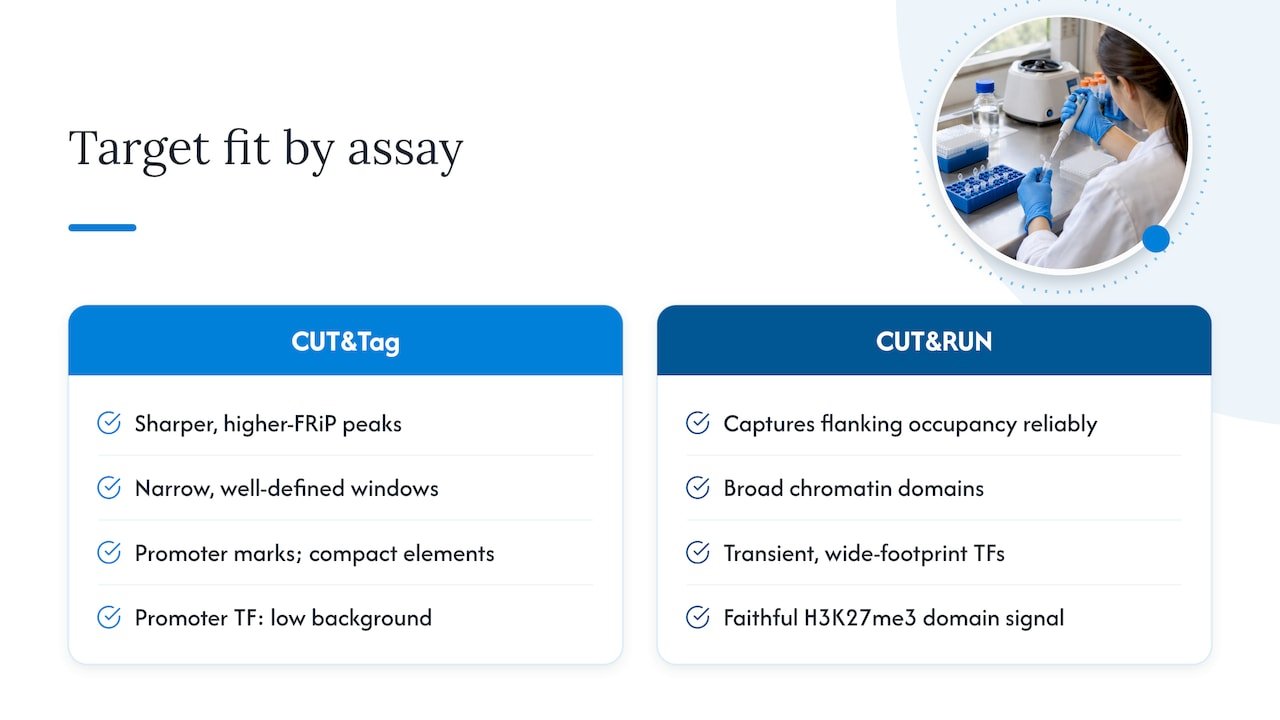
Target biology, more than any other variable, should drive the choice between these two assays. Independent benchmarking studies report that CUT&Tag tends to produce sharper, higher-FRiP peaks, which makes it well suited to histone post-translational modifications and other proteins that occupy narrow, well-defined genomic windows. Promoter-proximal marks and compact regulatory elements are a natural fit.
CUT&RUN tends to capture flanking and peripheral occupancy more reliably, which matters for transcription factors that bind transiently or across a wider footprint than a single nucleosome. The same benchmarking work found that CUT&RUN better represents broad chromatin domains, a category where CUT&Tag’s accessibility bias can actually work against it.
A concrete example: repressive marks like H3K27me3 span large, often less accessible genomic regions. CUT&RUN tends to give a more faithful representation of that domain-wide signal, while CUT&Tag produces sharper summits that can underrepresent the periphery of the domain. The reverse holds for a tightly bound, promoter-centered transcription factor with a well-characterized antibody, where CUT&Tag’s low background and fast turnaround often make it the more efficient choice. When a target does not fall cleanly into either category, the comparative literature on chromatin-protein interaction methods recommends piloting both assays side by side rather than guessing.
Sample Input, Sensitivity, and Single-Cell Suitability
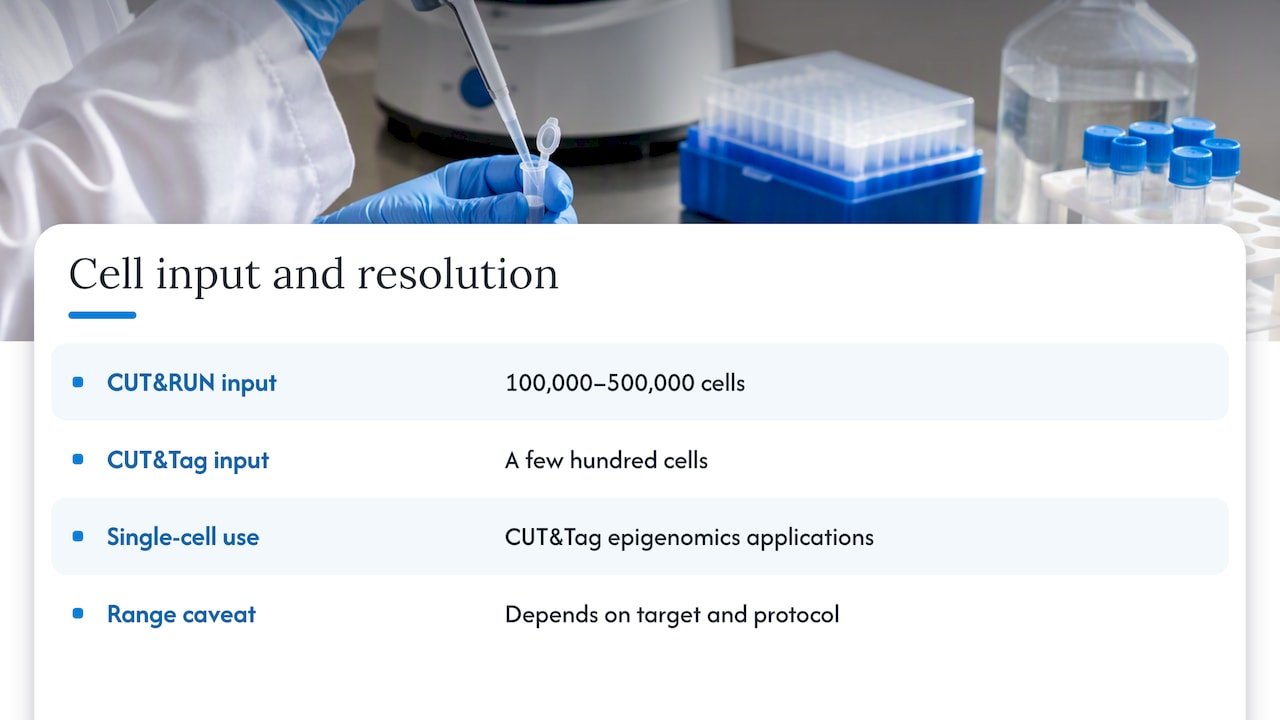
Planning around realistic cell counts prevents a lot of wasted material. CUT&RUN protocols commonly call for 100,000 to 500,000 cells, with the exact number depending heavily on antibody affinity and target abundance. CUT&Tag can function with far less input, with optimized protocols working from a few hundred cells down to single-cell resolution, which is the main reason it dominates single-cell epigenomics applications right now.
Sequencing depth and fraction of reads in peaks (FRiP) scale differently between the two methods. CUT&Tag’s lower background generally means fewer reads are needed to call confident peaks for many histone marks, while CUT&RUN often needs somewhat deeper sequencing to resolve broader domains with confidence. Neither number is fixed: antibody quality, chromatin state, and target abundance all shift the practical floor.
Because these ranges are reported across many different targets and cell types, treat them as starting points rather than guarantees. A short pilot experiment using serial dilutions of your actual cell type and a titration of antibody concentration will define the real lower limit for your specific system faster than any published range. Track peak count, FRiP, and library complexity across the dilution series, and stop scaling down once any of those metrics drops sharply.
Bench Time, Hands-On Steps, and Automation Considerations
Scheduling a chromatin profiling experiment means knowing where the bottlenecks sit. CUT&Tag often moves from bench to sequencing-ready library in under a day, since tagmentation and PCR amplification follow directly from the binding and wash steps. CUT&RUN typically spans one to two days once the separate library preparation, end-repair, and adapter ligation steps are factored in.
The hands-on differences matter for lab scheduling. CUT&RUN requires a DNA cleanup and ligation stage that CUT&Tag skips entirely, because Tn5 already delivers adapter-tagged fragments ready for PCR. That integrated step is also what makes CUT&Tag more amenable to plate-based, high-throughput formats: pooling barcoded samples after tagmentation is straightforward, and the method’s low background often means fewer reads per sample are needed to hit target depth, which reduces sequencing cost at scale. Labs running many conditions or time points in parallel tend to find CUT&Tag’s workflow easier to automate on liquid handlers, while CUT&RUN’s extra enzymatic steps add more manual checkpoints.
How Assay Choice Shapes Data Analysis
The biology of each enzyme shows up directly in the sequencing data, and that affects how you call peaks and compare across experiments. Benchmarking reports consistently find that CUT&Tag delivers higher FRiP values and narrower, sharper peaks, while CUT&RUN captures more of the broader flanking signal around a binding site or domain.
The accessibility bias built into Tn5 chemistry deserves a direct caveat: CUT&Tag signal correlates strongly with open-chromatin measurements like ATAC-seq, which sharpens positional precision at accessible sites but can also inflate apparent signal there relative to less accessible regions. When comparing CUT&Tag and CUT&RUN datasets for the same target, naive normalization by total read count (CPM) can confound genuine biological differences with this method-intrinsic bias.
A more reliable approach uses biologically informed normalization, such as reference loci or spike-in scaling, rather than relying on raw read counts alone. Before drawing conclusions from any comparison, inspect FRiP, peak width (full width at half maximum), and replicate concordance for each dataset separately. These three metrics, tracked side by side, usually explain more about why two assays disagree than any single global normalization method can.
Protocol Checklist: Antibody, Nuclei Prep, and Controls
Most of the variability researchers attribute to “CUT&RUN versus CUT&Tag” actually traces back to antibody quality and nuclei handling rather than the assay chemistry itself. Validate every antibody against a positive control target and an isotype or IgG negative control before committing cells to a full experiment.
- Antibody validation: Confirm specificity with a known positive target and run an isotype control in parallel to establish background.
- Nuclei prep: Keep nuclei intact and consistently permeabilized; inconsistent prep is a common source of batch-to-batch variability.
- Salt washes: For CUT&Tag, washes at 300 mM NaCl reduce off-target tagmentation from untethered pA-Tn5, improving specificity.
- Spike-in controls: Include exogenous spike-in DNA to normalize across samples and flag technical outliers early.
Pro Tip: If yield is consistently low or background stays high after optimizing antibody concentration and wash stringency, switch assays rather than continuing to troubleshoot the same chemistry; a target that resists CUT&Tag often works cleanly in CUT&RUN, and vice versa.
Watch for bead loss during wash steps, over-tagmentation (visible as a smear skewed toward very short fragments), and low final yield as the three most common failure points. Each has a distinct fix, but if none resolve the issue after two optimization rounds, the target or antibody combination may simply suit the other method better.
How We Support Labs Running CUT&RUN and CUT&Tag
We stock antibodies validated for chromatin profiling applications alongside reagents for cell biology and molecular biology workflows, so labs setting up either assay can source primary antibodies, bioassay components, and related consumables from one place. Technical support can help researchers think through antibody selection, spike-in strategy, and pilot design before committing limited sample material to a full run.
If you are scaling a chromatin profiling pipeline alongside other molecular biology work, our guide on optimizing molecular biology workflows covers practical ways to tighten turnaround across multi-step protocols.
Decision Rules for Picking an Assay and When to Pilot Both
In practice, we recommend working through target biology first, then sample input, then antibody quality, then the resolution you need, and only then throughput. A tight pilot settles most uncertainty: run both assays on the same antibody and cell type, match sequencing depth, and compare FRiP, peak width, and replicate concordance. Favor CUT&Tag when input is scarce or your antibody is well characterized; favor CUT&RUN when the antibody is unproven or the target spans a broad domain.
— Alina
Get Reagent and Protocol Support for Your Chromatin Profiling Project
Picking between CUT&RUN and CUT&Tag is only half the work; sourcing validated antibodies and consistent reagents for whichever assay you choose is the other half. We carry antibodies, bioassays, and cell biology reagents suited to chromatin profiling workflows, backed by US-based technical support for researchers working through antibody selection or pilot design.

For labs weighing broader translational implications of assay sensitivity and specificity, this partner analysis of biomarker interpretation offers useful context on how methodological choices affect downstream conclusions. When you are ready to source reagents for your next chromatin profiling run, browse our product catalog or reach out to our technical support team to talk through antibody and kit selection for your specific target.
FAQ
What is the difference between CUT&Tag and CUT&RUN?
CUT&Tag uses a tethered pA/G-Tn5 transposase that inserts sequencing adapters directly during tagmentation, producing a library-ready fragment in under a day. CUT&RUN uses tethered pA/G-MNase to cleave DNA around the bound target, releasing fragments that need separate end-repair and adapter ligation before sequencing.
What are the key differences between CUT&Tag and ChIP-seq?
CUT&Tag profiles chromatin in intact nuclei using a tethered enzyme, avoiding the sonication and chromatin solubilization steps that ChIP-seq requires. It also needs far fewer input cells and fewer sequencing reads for comparable peak detection, with some comparisons reporting as few as one to eight million reads for CUT&Tag versus over thirty million for ChIP-seq on certain targets.
What is a CUT&Tag assay?
CUT&Tag, short for cleavage under targets and tagmentation, is a chromatin profiling method that uses an antibody to recruit a protein A or A/G fusion carrying Tn5 transposase to a specific genomic target. Activating the transposase tagments the DNA around the binding site, simultaneously fragmenting it and inserting sequencing adapters, which yields a sequencing-ready library with minimal additional steps.
Can you explain the CUT&RUN method?
CUT&RUN (cleavage under targets and release using nuclease) uses an antibody to recruit a protein A/G-MNase fusion to a chromatin target inside permeabilized nuclei. Adding calcium activates the MNase, which cleaves DNA flanking the bound protein and releases small fragments into solution, typically requiring 100,000 to 500,000 input cells depending on the target.
Sources
- CUT&Tag for efficient epigenomic profiling of small samples and single cells | Nature Communications
- The development and application of cleavage under targets and tagmentation (CUT&Tag) technology
- Benchmark of chromatin-protein interaction methods in haploid round spermatids




