
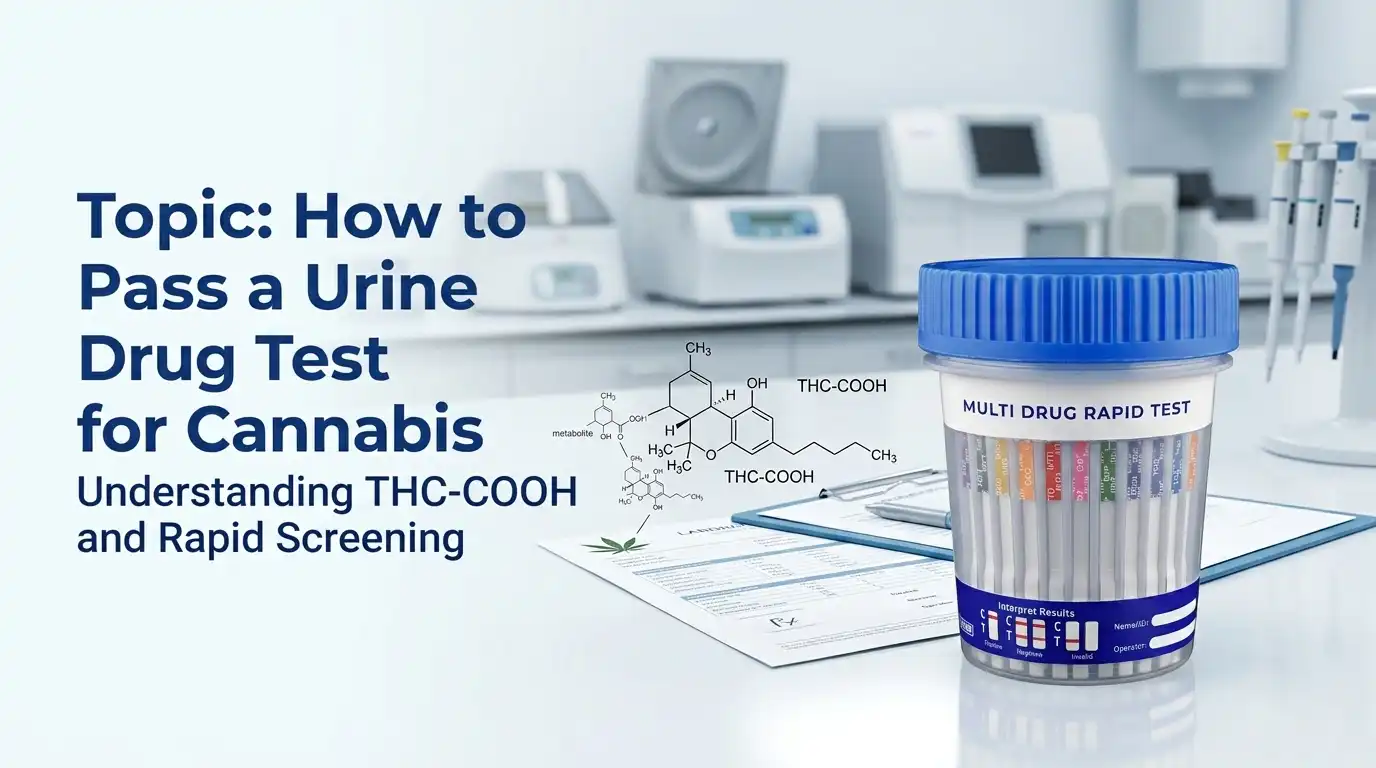
How Can You Pass a Urine Drug Test for Weed?
If you are searching for “how can you pass a urine drug test for weed,” the most important thing to understand is that there is no guaranteed drink, supplement, exercise routine, or overnight trick that can reliably make a urine test negative.
Urine cannabis tests generally look for THC metabolites, particularly 11-nor-9-carboxy-Δ9-tetrahydrocannabinol (THC-COOH). How long these metabolites remain detectable varies considerably from person to person. Factors such as frequency of cannabis use, time since last use, individual metabolism, body composition, the test’s cutoff level, and the testing method can all affect the result.
This guide explains how urine THC testing works, why detection times vary, what common “detox” claims actually mean, and how to interpret a cannabis drug-test result.
Important: This article is educational. It does not provide instructions for adulterating, substituting, diluting, or otherwise manipulating a drug-test specimen.
What Does a Urine Drug Test for Weed Actually Detect?
A urine drug test does not usually look for the original cannabis plant itself.
After cannabis is consumed, the body processes THC (tetrahydrocannabinol) through several metabolic pathways. One important metabolite is THC-COOH, which can eventually be excreted in urine.
The basic process can be simplified as:
Cannabis use → THC → metabolism → THC-COOH → urinary excretion → urine screening
This distinction is important because a urine test can indicate previous cannabis exposure without establishing exactly when the cannabis was used or whether someone is currently impaired.
A positive urine cannabinoid result therefore should not automatically be interpreted as proof of current intoxication.
Is There a Guaranteed Way to Pass a Weed Urine Test?
No.
There is no universally reliable method that can guarantee a negative urine THC test within a particular number of hours or days.
The biggest reason is individual variation. Two people can use similar amounts of cannabis and receive different results because their bodies process and eliminate cannabinoids differently.
The most dependable factor affecting whether THC metabolites eventually fall below a testing cutoff is time without additional cannabis exposure.
That does not mean everyone will test negative after the same period. Detection windows can vary substantially.
How Long Does Weed Stay Detectable in Urine?
There is no single number that applies to every cannabis user.
A urine test may detect cannabis metabolites for a relatively short period after isolated use, while people who use cannabis frequently may remain detectable for considerably longer.
Factors that can influence the detection window include:
- How frequently cannabis was used
- How long the person had been using cannabis
- Amount and potency of cannabis consumed
- Time since the last use
- Individual metabolism
- Body composition
- Hydration status
- The sensitivity and cutoff of the test
- Whether the test is a screening or confirmation test
General pattern
| Cannabis-use pattern | General expectation |
|---|---|
| Single/rare exposure | Often a shorter detection period |
| Occasional use | May remain detectable for several days |
| Frequent use | Detection can extend into weeks |
| Heavy/chronic use | Detection may sometimes extend considerably longer |
These are general patterns, not guarantees. A specific person’s result cannot be predicted precisely from frequency alone.
Why Is THC Detection So Variable?
One reason cannabis testing is different from testing for some other substances is the behavior of THC and its metabolites in the body.
THC is highly lipophilic, meaning it can distribute into fatty tissues. Following repeated exposure, cannabinoids and their metabolites can persist and be released gradually.
This contributes to the longer and more variable detection windows observed in some frequent cannabis users.
However, it is an oversimplification to say that someone can calculate their exact testing date based only on body fat or metabolism.
There are multiple biological and testing factors involved.
Does Hydration Remove THC From Your Body?
Drinking normal amounts of water is important for general health, but excessive water consumption does not reliably eliminate THC metabolites from the body.
This distinction matters.
THC metabolism and elimination are biological processes. Simply increasing water intake does not guarantee that stored or circulating metabolites will disappear more quickly.
Large amounts of fluid can instead make urine unusually dilute.
Laboratories can evaluate urine characteristics as part of specimen validity testing. Depending on the testing program, characteristics such as:
- Creatinine
- Specific gravity
- pH
- Appearance
- Other validity markers
may be evaluated.
Therefore, “water loading” should not be viewed as a dependable way to change a legitimate drug-test result.
What Is a Dilute Urine Specimen?
A urine specimen may be described as dilute when its concentration characteristics indicate that it contains unusually large amounts of water relative to normal urinary constituents.
One commonly evaluated marker is creatinine.
Creatinine is produced by normal muscle metabolism and is routinely present in urine. Laboratories can use creatinine together with specific gravity and other measurements when assessing specimen validity.
A dilute result does not necessarily mean that someone used cannabis or attempted to manipulate a test. Hydration, fluid intake, and individual physiology can influence urine concentration.
However, an unusually dilute specimen can lead to additional testing or a repeat collection depending on the rules of the testing program.
Do Detox Drinks Help You Pass a Weed Test?
Many products are marketed as:
- THC detox drinks
- Marijuana cleanses
- Cannabis detox formulas
- Same-day detox products
- Drug-test cleansing drinks
Marketing claims can suggest that these products rapidly remove THC from the body.
There is no reliable evidence that an over-the-counter drink can guarantee that a urine THC test will become negative on demand.
Some products may primarily alter urine concentration or contain combinations of vitamins, minerals, herbs, or other ingredients. That is not the same thing as eliminating THC metabolites from the body.
A product claiming to “guarantee a negative drug test” should therefore be treated with skepticism.
Does Niacin Help You Pass a Marijuana Drug Test?
Niacin is another commonly mentioned internet “detox” method.
There is no established evidence that taking large amounts of niacin reliably removes THC metabolites quickly enough to guarantee a negative urine drug test.
More importantly, taking excessive amounts of niacin can cause adverse effects.
Using high-dose supplements specifically to manipulate a drug test is therefore not a safe or dependable strategy.
Does Exercise Clear THC From Your Urine?
Exercise is beneficial for general health, but it should not be considered a guaranteed method for rapidly eliminating THC metabolites before a drug test.
Because THC is lipophilic, researchers have investigated whether exercise or fasting can affect cannabinoid concentrations.
The findings are more complicated than the common online claim that simply “burning fat” will clean the urine.
Exercise does not provide a predictable timetable for when a urine test will become negative.
Therefore, there is no scientifically reliable exercise schedule that can guarantee a negative result.
What About Fasting or Crash Dieting?
Fasting is sometimes promoted online as a way to rapidly change the amount of THC circulating in the body.
This is not a dependable drug-test strategy.
Extreme fasting can also create health risks, particularly for people who are young, pregnant, have medical conditions, or take medications.
A normal balanced diet and appropriate hydration are preferable to extreme dietary approaches.
Can Cranberry Juice Clean THC From Urine?
Cranberry juice is frequently mentioned in discussions about urine drug tests.
However, cranberry juice should not be considered a proven method for eliminating THC metabolites or guaranteeing a negative urine result.
Cranberry products may affect urine volume or hydration in ordinary ways, but that is different from removing THC-COOH from the body.
There is no reliable basis for treating cranberry juice as a cannabis detox solution.
Can Baking Soda Make a Weed Test Negative?
Baking soda is another substance sometimes promoted online as a way to alter drug-test results.
Claims involving baking soda generally rely on changing urine chemistry rather than actually eliminating THC metabolites from the body.
Manipulating a specimen can also create validity concerns, and ingesting excessive amounts of baking soda can be harmful.
It should not be considered a reliable or safe way to obtain a negative urine THC result.
Can Vinegar or Other Household Products Beat a Urine Test?
Online discussions sometimes mention household substances such as vinegar, salt, bleach, detergents, or cleaning chemicals.
These claims involve specimen adulteration, rather than naturally clearing THC from the body.
Modern testing programs may evaluate specimens for abnormal chemical characteristics or other evidence of manipulation.
Some chemicals can also be dangerous.
Household cleaning products, bleach, oxidizing chemicals, and similar substances should never be added to a biological specimen or consumed.
What Is Synthetic Urine?
Synthetic urine is a laboratory-produced material designed to resemble human urine.
It is marketed online for various purposes, including attempts to substitute a specimen.
However, drug-testing programs may evaluate characteristics such as:
- Temperature
- Creatinine
- Specific gravity
- pH
- Chemical composition
- Specimen validity markers
Some collections are also supervised or subject to additional controls.
For those reasons, synthetic urine should not be presented as a guaranteed or legitimate way to pass a drug test.
Can CBD Cause a Positive THC Drug Test?
Yes, depending on the product.
CBD products can be marketed as containing little or no THC, but product labeling and actual contents do not always perfectly match.
Some hemp or CBD products may contain measurable amounts of THC.
Products containing THC can potentially result in cannabinoid metabolites being detected in urine.
This is particularly important for people who assume that something labeled “CBD” automatically means “THC-free.”
Anyone subject to drug testing should understand the ingredients and regulatory status of products they use.
What About Delta-8 THC?
Delta-8 THC is chemically related to delta-9 THC and can be relevant to cannabinoid drug testing.
Some urine screening assays detect metabolites from related cannabinoids because immunoassays are designed to respond to molecular structures rather than identify every cannabinoid individually with perfect specificity.
Therefore, products marketed as alternatives to traditional marijuana may still create drug-testing concerns.
“Legal” and “will not appear on a drug test” are not necessarily equivalent statements.
Can Secondhand Marijuana Smoke Cause a Positive Urine Test?
Ordinary casual exposure to cannabis smoke is generally very different from intense exposure in a confined, poorly ventilated environment.
Research has examined whether extreme secondhand exposure can produce detectable cannabinoid levels.
Under unusual conditions involving heavy smoke and poor ventilation, measurable exposure can occur.
However, this should not be confused with ordinary brief exposure.
A urine cannabinoid result is generally associated with cannabis exposure, but test interpretation depends on the concentration, cutoff, testing method, and circumstances.
How Does a Urine THC Drug Test Work?
Most urine drug testing involves a screening process.
Step 1: Initial screening
An immunoassay may be used to screen for cannabinoids.
Immunoassays are designed to rapidly detect compounds or metabolites associated with a particular drug class.
They are useful because they are relatively fast and practical for screening large numbers of specimens.
However, screening tests are not identical to definitive identification methods.
Step 2: Confirmation testing
If an initial screening result is presumptively positive and the testing program requires confirmation, a more specific analytical method may be used.
Depending on the program, confirmation can involve techniques such as:
- Mass spectrometry
- Gas chromatography-mass spectrometry (GC-MS)
- Liquid chromatography-mass spectrometry (LC-MS/MS)
Confirmation methods are designed to identify specific compounds with greater analytical specificity.
What Does the 50 ng/mL THC Cutoff Mean?
A frequently referenced workplace urine screening cutoff for cannabinoids is 50 ng/mL.
A cutoff is not the same thing as saying that the urine contains no THC metabolites below that concentration.
Instead, it is a threshold used by a particular testing protocol to determine how a screening result is classified.
Testing programs can have different requirements, so readers should check the applicable program rather than assuming every test uses exactly the same cutoff.
For regulated U.S. workplace testing, published federal standards provide specific cutoff concentrations for cannabis screening and confirmation.
What Does THC-COOH Mean?
THC-COOH is a major inactive metabolite of THC.
It is often the target of urine cannabis testing.
This is an important distinction because THC-COOH is not the same molecule as active THC.
A urine test detecting THC-COOH generally indicates that cannabis-related metabolism has occurred previously. It does not provide a precise timestamp for cannabis consumption.
It also does not by itself establish current impairment.
Does a Positive Urine Test Mean Someone Is Currently High?
No.
A urine cannabis test primarily provides evidence of previous exposure based on the presence of a metabolite.
It generally cannot determine:
- Exactly when cannabis was consumed
- Whether someone is currently impaired
- The precise amount consumed
- How strongly someone was affected
This is one reason urine drug testing should not automatically be interpreted as a real-time impairment test.
Urine vs. Saliva vs. Blood vs. Hair Tests
Different drug-testing specimens provide different information.
| Test type | Common target | General detection characteristic |
|---|---|---|
| Urine | THC metabolites such as THC-COOH | Often reflects prior exposure over days or longer |
| Saliva/oral fluid | THC and related analytes | Generally shorter detection window |
| Blood | THC and metabolites | More closely associated with recent exposure |
| Hair | Drug-related compounds incorporated into hair | Can provide a longer historical window |
The exact detection period depends on the substance, test method, cutoff, individual factors, and testing protocol.
Can an At-Home THC Test Tell You Whether You Will Pass a Lab Test?
An at-home THC urine test can provide useful information about whether the sample is above or below that particular test’s cutoff.
But it is not necessarily equivalent to a laboratory test.
Differences can include:
- Cutoff concentration
- Collection procedure
- Test sensitivity
- Specimen handling
- Laboratory confirmation
- Specimen validity testing
Therefore, an at-home result should not be treated as an absolute guarantee of what a laboratory or workplace test will report.
What Can Actually Affect Your Test Result?
The following factors can influence whether THC metabolites remain detectable:
1. Frequency of cannabis use
Someone who uses cannabis once may have a different detection pattern from someone who uses it regularly.
2. Time since last use
More time generally allows the body to metabolize and eliminate additional metabolites.
3. Amount and potency
The amount and concentration of THC exposure can affect the overall metabolic burden.
4. Individual metabolism
People metabolize and eliminate substances at different rates.
5. Body composition
Because THC is lipophilic, body composition can contribute to differences in cannabinoid distribution and elimination.
6. Hydration
Hydration can affect urine concentration, but it should not be confused with eliminating THC from the body.
7. Testing method
Different tests have different analytical characteristics.
8. Cutoff level
A result can depend on the threshold established by the particular testing program.
What Should You Do If You Have an Upcoming Urine Drug Test?
If you are concerned about an upcoming test, focus on understanding the testing process rather than relying on internet “detox hacks.”
Useful questions include:
- What type of test is being used?
- Is it urine, saliva, blood, or hair?
- What substances are included in the panel?
- What cutoff applies?
- Is confirmation testing performed?
- What are the rules for prescribed medications?
- What happens if a specimen is reported as invalid or dilute?
If the test is part of employment, legal, medical, or treatment requirements, follow the instructions provided by the testing organization.
If you take prescription medication, disclose it according to the testing program’s instructions rather than attempting to alter the specimen.
What If You Are Worried About a Positive Result?
If you believe a result is inaccurate, ask the relevant testing program about its confirmation and review procedures.
A screening result and a confirmed laboratory result are not necessarily the same thing.
Depending on the testing program, a medical review process may also be involved.
Do not assume that an internet detox product is the appropriate response to an unexpected result.
Common Myths About Passing a Weed Drug Test
Myth 1: “Drinking huge amounts of water removes THC.”
Reality: Excessive fluid intake does not guarantee THC elimination and can produce an unusually dilute specimen.
Myth 2: “A detox drink guarantees a negative result.”
Reality: No commercial detox drink can reliably guarantee a negative urine THC result.
Myth 3: “Niacin flushes marijuana out of your body.”
Reality: There is no reliable evidence supporting this claim, and excessive niacin can cause adverse effects.
Myth 4: “Exercise guarantees that THC will disappear faster.”
Reality: Exercise is healthy but does not provide a predictable timetable for a negative urine test.
Myth 5: “CBD can never cause a positive marijuana test.”
Reality: Some CBD/hemp products contain THC or may be contaminated or inaccurately labeled.
Myth 6: “A positive urine test proves current impairment.”
Reality: Urine testing generally detects metabolites associated with previous exposure rather than current impairment.
Myth 7: “Everyone becomes negative after exactly 30 days.”
Reality: Cannabis detection varies considerably between individuals and testing methods.
Why There Is No Universal “Clean in X Days” Rule
One of the biggest problems with online cannabis-testing advice is the use of fixed statements such as:
“Everyone is clean after three days.”
or:
“Heavy users always need 30 days.”
Neither statement can reliably describe every individual.
Detection windows are distributions, not guarantees.
A person who uses cannabis infrequently may have a substantially different result from someone who has used cannabis repeatedly over a long period.
Even two people with similar use patterns can have different results.
That’s why responsible drug-testing information should use ranges and uncertainty rather than guarantees.
Key Takeaway: How Can You Pass a Urine Drug Test for Weed?
If you’re asking how to pass a urine drug test for weed, the central point is simple:
There is no guaranteed same-day method for making a urine THC test negative.
Urine testing generally looks for THC metabolites such as THC-COOH, and detection depends on factors including cannabis-use frequency, time since last use, individual metabolism, body composition, hydration, testing methodology, and cutoff concentration.
Drinking excessive water, taking unproven detox products, using household chemicals, or attempting to substitute or adulterate a specimen does not provide a reliable solution and may create additional health, testing, or legal problems.
The most useful approach is to understand what the test measures, how detection windows vary, what the cutoff means, and how legitimate testing procedures handle screening and confirmation.
Frequently Asked Questions
How long does weed stay in urine?
It varies. Occasional exposure may be detectable for several days, while frequent or chronic cannabis use can produce a substantially longer detection period.
Can drinking water make a urine drug test negative?
Excessive water can dilute urine, but it does not reliably remove THC metabolites and may result in a specimen being classified as dilute.
Do detox drinks work for marijuana tests?
There is no reliable evidence that a commercial detox drink can guarantee a negative urine THC test.
Does exercise remove THC from urine?
Exercise is beneficial for general health but cannot guarantee that THC metabolites will disappear within a specific timeframe.
What does THC-COOH mean?
THC-COOH is an inactive metabolite produced when the body processes THC. It is an important target in urine cannabis testing.
What does a 50 ng/mL cutoff mean?
It refers to a concentration threshold used by certain urine screening protocols. It does not mean that the urine contains absolutely no cannabis metabolites below that level.
Can CBD cause a positive THC test?
Yes. Some CBD and hemp products contain measurable THC, even when consumers may not expect it.
Does a urine test prove someone is currently high?
No. Urine cannabinoid testing generally indicates prior exposure to cannabis metabolites and does not directly measure current impairment.
Can secondhand marijuana smoke cause a positive urine test?
Extreme exposure in poorly ventilated environments can result in measurable cannabinoid exposure, but ordinary brief exposure is a very different situation.
Are home THC tests the same as laboratory tests?
No. Home tests can provide an indication based on their own cutoff and test characteristics, but laboratory procedures may use different analytical methods, validity checks, and confirmation testing.




