How Long Does Meth Stay in Your System?
Methamphetamine, commonly called meth, can remain detectable in the body after the noticeable effects of the drug have worn off. How long meth stays in your system depends on what is being measured, the type of drug test used, how frequently the drug was used, the amount taken, individual metabolism, and characteristics of the test itself.
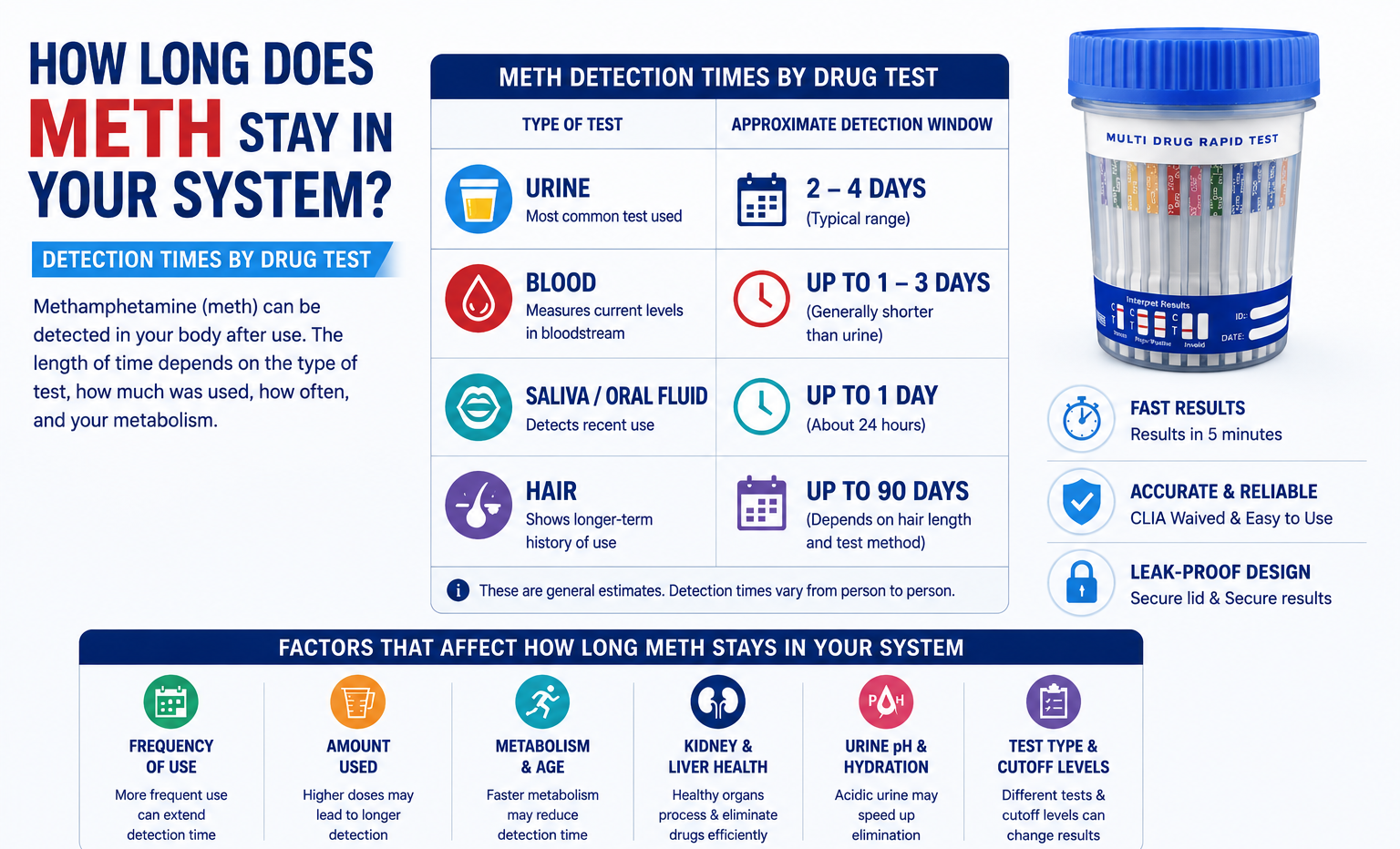
For a urine drug test, methamphetamine is commonly detectable for about 2–4 days, although the actual window can be shorter or longer in individual cases. SAMHSA guidance generally places urine detection around 2–3 days, while clinical references commonly cite approximately 2–4 days.
Different specimens have different detection windows:
| Drug Test | Approximate Meth Detection Window |
|---|---|
| Urine | About 2–4 days |
| Blood | Generally shorter than urine |
| Saliva / Oral Fluid | About 1 day in federal guidance |
| Hair | Up to about 90 days, depending on the sample |
These are general estimates, not guarantees. Drug detection depends on the specimen, test method, cutoff concentration, timing of collection, and individual factors.
How Long Does Meth Stay in Your System?
There are actually three different questions hidden inside the phrase “stay in your system”:
- How long do the effects of meth last?
- How long does the body take to eliminate methamphetamine?
- How long can a drug test detect methamphetamine or related analytes?
These timeframes are not the same.
A person may no longer feel the effects of meth while a urine, oral-fluid, or hair test can still detect evidence of exposure. Drug tests are designed to identify a drug or its metabolites in a particular specimen, and the detection window depends heavily on the specimen and analytical method.
Methamphetamine is metabolized in the body and is eliminated substantially through the urine. Some methamphetamine is converted to amphetamine, which can also be present in urine after methamphetamine use.
That is why someone can feel “normal” again while a drug test may still produce a positive result.
How Long Does Meth Stay in Urine?
Methamphetamine is commonly detectable in urine for about 2–4 days.
SAMHSA’s current Medical Review Officer guidance states that amphetamine and methamphetamine are generally considered detectable in urine for 2–3 days. Clinical references commonly give a typical urine detection period of approximately 2–4 days.
The exact window can vary substantially.
For example, SAMHSA notes that a single therapeutic dose may produce a positive urine test for around 24 hours, while higher-dose use can produce positive urine specimens for 2–4 days.
Why can the urine detection window vary?
Several factors can influence the result, including:
- Amount of methamphetamine used
- Frequency of use
- Time since the last use
- Individual metabolism
- Urinary pH
- Kidney function
- Test sensitivity
- Laboratory or device cutoff
- Whether the test is a screening or confirmatory test
Urinary pH is particularly relevant to methamphetamine elimination. SAMHSA explains that acidic urine promotes faster elimination, while alkaline urine can slow urinary excretion.
How Long Does Meth Stay in Your Urine for a Drug Test?
For a typical urine drug test, a practical estimate is about 2–4 days after last use, but there is no exact number of hours that guarantees a negative result.
A urine drug test does not determine precisely when meth was used. A positive result indicates that the relevant analyte was detected above the test’s cutoff under the conditions of that test. Urine testing also cannot reliably tell how much methamphetamine was used or whether someone is currently impaired.
How Long Does Meth Stay in Blood?
Blood testing generally has a shorter detection window than urine testing.
That is because blood testing is more closely related to what is circulating in the body at the time the specimen is collected. ARUP Consult notes that blood can be useful when the goal is to correlate drug concentrations with acute signs, symptoms, or pharmacokinetic information, while urine generally provides a longer detection window.
The exact blood detection period depends on:
- Dose
- Time since use
- Individual metabolism
- Collection timing
- Laboratory method
- Analytical cutoff
A blood test should therefore not be treated as interchangeable with a urine drug screen.
How Long Does Meth Stay in Saliva?
Methamphetamine can also be detected using saliva, also called oral-fluid testing.
Current SAMHSA Medical Review Officer guidance states that amphetamine and methamphetamine detection in oral fluid is generally around one day.
Oral-fluid testing can be useful when recent drug exposure is the primary concern. Compared with urine, oral fluid generally provides a shorter detection window and can more closely reflect the timing of recent exposure.
The actual detection period depends on the testing method, collection time, drug concentration, and cutoff.
How Long Does Meth Stay in Hair?
Hair testing provides a substantially longer historical window than urine or oral fluid.
SAMHSA materials describe hair testing as potentially covering drug exposure from approximately 7–10 days after use through about 3 months, depending on the length of hair tested. Hair testing generally cannot identify very recent use because the drug must become incorporated into growing hair.
A typical head-hair sample may therefore provide information about a much longer period than a urine sample.
However, hair testing has important limitations. Interpretation can be affected by factors such as hair characteristics, external contamination, collection procedures, laboratory methods, and the pattern of drug use.
Meth Detection Window by Drug Test
The following table provides a useful general comparison:
| Test Type | Approximate Detection Window | What It Is Best For |
|---|---|---|
| Urine | About 2–4 days | Recent drug exposure |
| Blood | Generally shorter than urine | Recent exposure and correlation with circulating drug |
| Saliva / Oral Fluid | About 1 day | More recent exposure |
| Hair | Approximately 7–10 days after use through about 3 months | Longer-term exposure history |
Detection windows vary by individual and by test. The table should be used as a general guide rather than a prediction of an individual test result.
How Long Does Meth Stay in Your System After One Use?
After a single use, methamphetamine may be detectable for a shorter period than with repeated or high-dose use, but there is no universal cutoff point.
SAMHSA notes that a single dose of amphetamine or methamphetamine can be detectable in urine for approximately 24 hours in some circumstances, while other clinical references report a typical urine detection period of roughly 2–4 days.
This difference illustrates why a single “meth stays in your urine for exactly X days” answer can be misleading.
The result depends on the dose, urine pH, metabolism, timing, and the sensitivity and cutoff of the test.
How Long Does Meth Stay in Your Urine After Repeated Use?
Repeated or higher-dose use can extend the period during which methamphetamine is detectable.
SAMHSA’s guidance states that high-dose use can result in positive urine specimens for approximately 2–4 days after the last use.
Research also shows that methamphetamine and amphetamine can have different urinary elimination patterns and that repeated exposure can affect the overall detection period.
However, it is not accurate to assume that everyone who uses meth repeatedly will test positive for the same number of days.
What Factors Affect How Long Meth Stays in Your System?
1. Frequency of Use
How often someone uses meth can affect the detection window. Repeated exposure can result in continued urinary excretion over a longer period than an isolated dose.
2. Amount Used
A larger exposure can produce higher concentrations in a specimen and may increase the period during which concentrations remain above a particular test cutoff.
3. Individual Metabolism
People metabolize and eliminate drugs differently. Genetic differences in enzymes involved in methamphetamine metabolism can contribute to variation between individuals.
4. Urinary pH
Urinary pH can influence methamphetamine excretion. Acidic urine generally promotes faster elimination, while alkaline urine can slow excretion.
5. Kidney Function
Because substantial amounts of methamphetamine and related compounds are eliminated through urine, kidney function can influence drug elimination.
6. Type of Drug Test
Urine, blood, oral fluid, and hair do not have identical detection windows.
This is one of the most important reasons that the question “How long does meth stay in your system?” cannot have one answer for every type of test.
7. Test Cutoff
A drug test does not simply ask whether any molecule of methamphetamine exists in a specimen.
Screening and confirmation methods use analytical thresholds. A lower or higher cutoff can affect how long a drug remains detectable by that particular test. Research has demonstrated that changing urine cutoffs can change the duration and number of positive specimens detected.
How Does a Meth Drug Test Detect Methamphetamine?
Drug testing can involve an initial screening test followed, when appropriate, by a more specific laboratory confirmation.
Urine testing is widely used because urine generally provides a longer detection window than blood and provides enough specimen for screening and confirmation.
For federal workplace testing, methamphetamine is included within the amphetamines drug category. SAMHSA’s current workplace drug-testing resources list amphetamine, methamphetamine, MDA, and MDMA within that category.
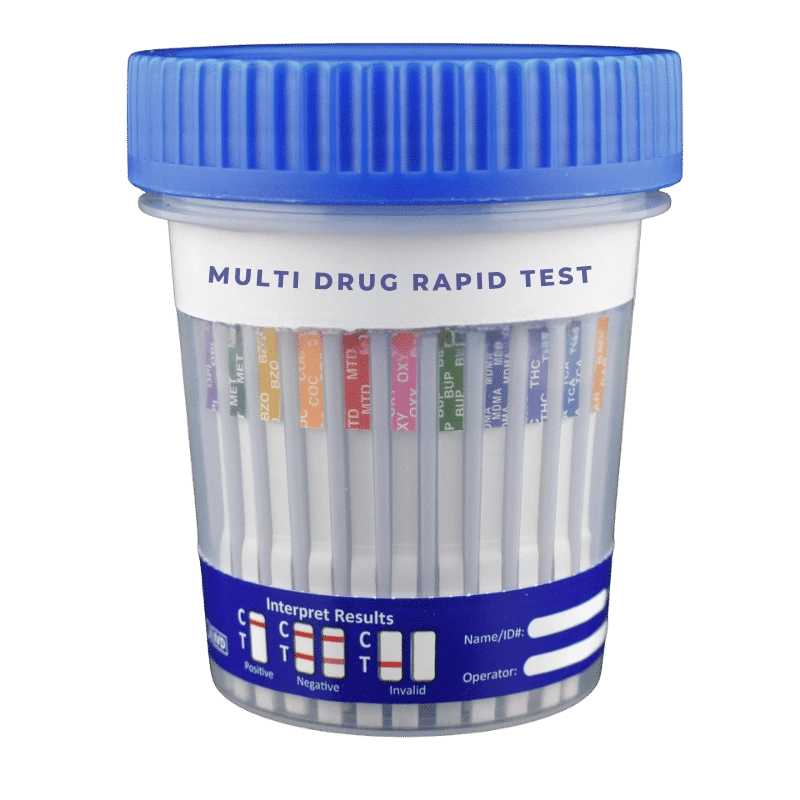
Some rapid urine tests use immunoassay technology to screen for drug classes. A laboratory may then use a more specific analytical technique when confirmation is required.
This distinction matters because a screening result is not always the final interpretation of a drug test.
Does Meth Show Up as Amphetamine on a Drug Test?
Methamphetamine is metabolized partly into amphetamine, which can be detected alongside methamphetamine in urine. SAMHSA explains that a portion of methamphetamine is converted to amphetamine and that both substances can be present in urine after methamphetamine exposure.
Some drug-testing panels therefore report results within an amphetamine/methamphetamine category rather than treating the compounds as completely unrelated substances.
The exact reporting format depends on the test and laboratory.
Can a Drug Test Tell When Someone Used Meth?
Usually, no.
A positive drug test generally establishes that the relevant drug or metabolite was detected at or above the applicable cutoff. It does not provide a precise timestamp showing when the person used meth.
The same positive result can occur at different points in the detection window depending on:
- Dose
- Frequency of use
- Metabolism
- Urine pH
- Specimen type
- Test cutoff
- Time between use and collection
ARUP Consult also notes that urine drug testing cannot provide reliable information about the dose taken, impairment, or exact timing of drug use.
Does Drinking Water Make Meth Leave Your System Faster?
Drinking water does not provide a reliable way to rapidly eliminate methamphetamine or guarantee a negative drug test.
Urine concentration can be affected by hydration and dilution, but that does not mean the drug has been removed from the body faster. Drug-testing programs can also evaluate specimen validity, including characteristics associated with dilution or substitution.
There is therefore no dependable method that can predictably make a drug test negative within a specific number of hours.
Can a Urine Drug Test Detect Meth After the Effects Wear Off?
Yes.
The subjective effects of methamphetamine and the analytical detection window are different things.
Someone may no longer feel the stimulant effects while methamphetamine or its metabolites remain detectable in urine or another specimen.
This is why “I don’t feel high anymore” does not mean “a drug test cannot detect meth.”
How Long Does Meth Stay in Your System? Quick Answer
If you’re asking specifically about urine drug testing, methamphetamine is commonly detectable for approximately 2–4 days, although SAMHSA guidance gives a general range around 2–3 days and notes that higher-dose use may produce positive urine results for 2–4 days.
For other testing methods:
- Urine: about 2–4 days
- Blood: generally a shorter window than urine
- Saliva/oral fluid: around 1 day in SAMHSA guidance
- Hair: approximately 7–10 days after use through about 3 months, depending on hair length and testing conditions
These timeframes are estimates and should never be treated as a guarantee of a negative or positive result.
Frequently Asked Questions
How long does meth stay in your system?
Methamphetamine can remain detectable for different periods depending on the specimen. Urine commonly detects methamphetamine for about 2–4 days, while oral fluid generally has a shorter window and hair can provide a much longer historical window.
How long does meth stay in urine?
A typical urine detection period is approximately 2–4 days, although individual results vary.
How long does meth stay in urine for a drug test?
For many urine drug tests, methamphetamine may be detectable for around 2–4 days after last use. The actual window depends on the individual, specimen, cutoff, and test method.
Can meth show up on a urine drug test?
Yes. Methamphetamine is one of the substances that can be included in urine drug testing, including federal workplace testing programs.
How long does meth stay in blood?
Blood generally has a shorter detection window than urine because it is more closely associated with the drug currently circulating in the body. The exact window depends on collection timing and the analytical method.
How long does meth stay in saliva?
SAMHSA’s current guidance states that methamphetamine and amphetamine are generally detectable in oral fluid for about one day.
How long does meth stay in hair?
Hair testing can provide a much longer detection history. SAMHSA materials describe a window beginning approximately 7–10 days after use and extending to about three months, depending on the length of hair tested.
Does meth turn into amphetamine?
Yes. Methamphetamine is partially metabolized into amphetamine, which can also be present in urine following methamphetamine exposure.
Can drinking water guarantee a negative meth drug test?
No. Hydration can change urine concentration but does not provide a reliable way to eliminate methamphetamine or guarantee a negative test.
Does a positive meth test prove when someone used the drug?
No. A positive result indicates detection above the applicable cutoff; it generally cannot establish an exact time of use.
Final Takeaway
How long meth stays in your system depends on the type of test being used. For urine testing, methamphetamine is commonly detectable for approximately 2–4 days, although some people may fall outside that range. Oral-fluid testing generally has a shorter window, blood testing is typically shorter still, and hair testing can provide evidence of exposure over a period of roughly three months depending on the specimen and testing method.
The most important point is that drug detection is not the same as feeling the effects of meth or having the drug fully eliminated from the body. Detection depends on the specimen, timing, metabolism, urinary conditions, test cutoff, and analytical method.
If you are researching methamphetamine because of an upcoming drug test, remember that no detection-window chart can guarantee an individual result. Testing should be interpreted according to the specific specimen, test, cutoff, and laboratory procedures involved.
Medical/health information disclaimer: This article is for general educational purposes and does not diagnose substance use or predict an individual’s drug-test result. For questions about methamphetamine use, exposure, withdrawal, or treatment, consult a qualified healthcare professional.