
Primer Dimers in qPCR: ΔG First, Then the Bench Matrix
Primer dimers are short, non-specific products formed when primers bind each other instead of your target, and they show up as low-melting-temperature peaks or extra bands that distort Cq values. The fastest fix on the bench is a no-template control paired with a melt curve: if you see a low-Tm peak, switch to a hot-start polymerase and raise your annealing temperature before touching anything else. Clearing dimers protects quantification accuracy and preserves the dynamic range you need for reliable results.
TL;DR:
- Run an NTC with a melt curve; a broad, low temperature peak suggests dimers, while placing controls last and using fresh mix reduces contamination risk.
- When melt peaks overlap, verify product identity with high resolution gel or capillary electrophoresis; dimers typically appear as 30 to 80 base pair products.
- First raise annealing temperature by 2 to 4°C, lower primer concentrations, and use a hot start polymerase before changing primer sequences.
- SYBR Green exposes dimers in melt curves, whereas probe assays can hide them; competition can still delay low copy targets despite clean fluorescence.
- Redesign when concentration matrices and temperature gradients cannot remove dimers without weakening low copy detection; test two or three candidate pairs side by side.
Table of Contents
- How to Recognize Primer Dimers in Your Data
- Why Primer Dimers Form: Thermodynamics and Reaction Chemistry
- Design-Time Checks That Screen Out Dimer-Prone Primers
- Bench Optimizations: Matrices, Temperature, Enzymes, and Additives
- How Detection Chemistry Changes Your Dimer Strategy
- A One-Session Troubleshooting Checklist for Primer Dimers
- Validation Resources and Reagent Classes That Support Clean qPCR
- Balancing Sensitivity and Robustness When Dimers Threaten an Assay
- Reagents and Support to Resolve Primer-Dimer Issues Faster
- FAQ
- Sources
How to Recognize Primer Dimers in Your Data
Amplification plots alone will not tell you the truth. A reaction full of primer dimer can still produce a clean-looking exponential curve, especially with SYBR Green, because the dye binds any double-stranded DNA regardless of sequence. The giveaway sits in the melt curve: primer dimers typically melt at a lower temperature than your specific product and produce a broader, sometimes shouldered peak rather than the sharp single peak of a clean amplicon.
No-template controls (NTCs) remain the fastest confirmation tool. Run them last in your plate setup and use fresh master mix aliquots, since cross-contamination from pipetting template-containing wells earlier in the run can produce a false positive that looks exactly like dimer formation. If an NTC amplifies and its melt peak sits at a lower Tm than your sample wells, you are very likely looking at primer dimer rather than contamination.
- Low-Tm, broad or shouldered peaks on the derivative melt plot usually indicate dimer rather than specific product.
- NTCs that amplify late but still cross threshold should always get a melt-curve check, not a pass by Cq alone.
- A high-resolution gel or capillary electrophoresis step confirms band identity when melt data looks ambiguous.
- Running melt acquisition at a slightly elevated starting temperature can separate dimer and product peaks that otherwise overlap.
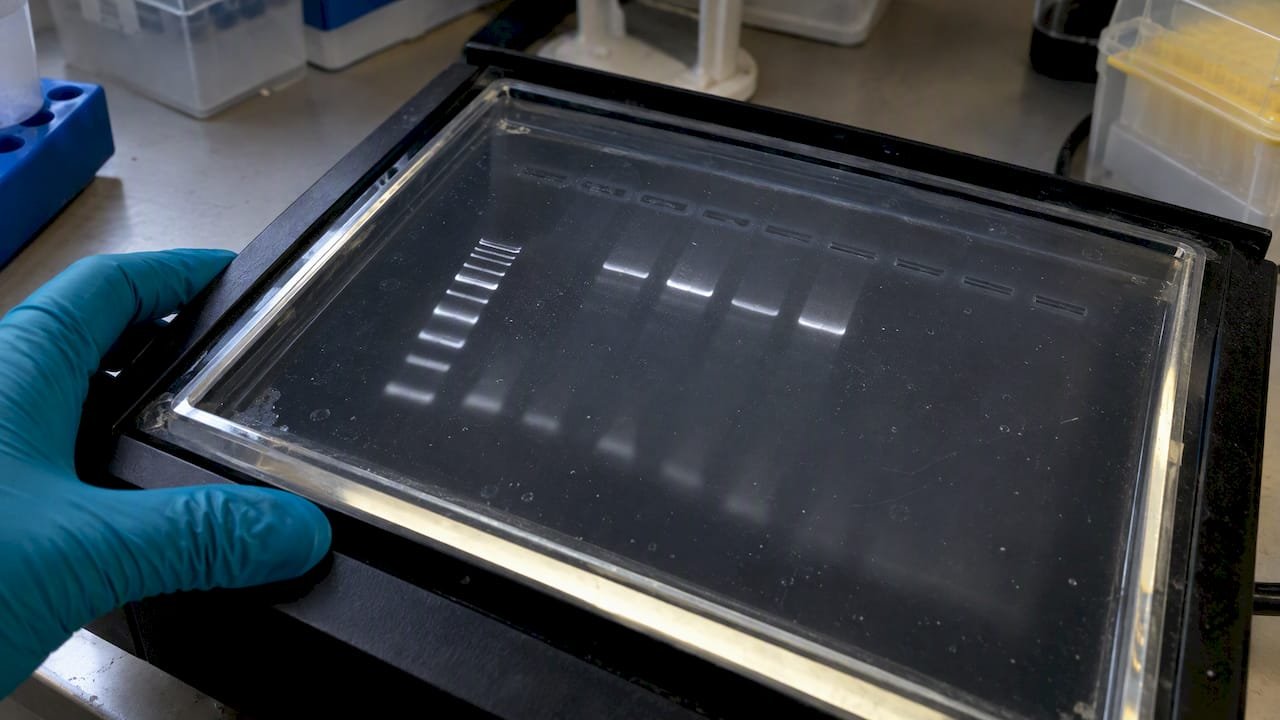
Primer dimers typically run 30 to 80 base pairs, appearing as a smear or faint low-molecular-weight band on a gel and as a distinct low-Tm shoulder on melt curves, which makes gel verification a useful tiebreaker when melt peaks are close together.
If you need definitive proof, run the PCR product on a high-resolution agarose or polyacrylamide gel alongside a low-range ladder. Dimer products run as that tight, low-weight smear, distinct from your expected amplicon size. Capillary electrophoresis gives sharper resolution for assays where the specific product and dimer length are close enough to blur on a standard gel.
Why Primer Dimers Form: Thermodynamics and Reaction Chemistry
Primer dimers form when two primer molecules (or one primer folding on itself) have enough complementary bases at their 3’ ends to let polymerase extend from that mismatched pairing. The key variable is not just whether bases match, but whether the resulting duplex is thermodynamically stable and extendable. A primer pair can show some complementarity in silico without ever causing problems if that pairing sits far from the 3’ end or the predicted free energy (ΔG) of the interaction is too weak to persist at annealing temperature.
Three structural issues drive most dimer problems:
- Extendable 3’-terminal complementarity between forward and reverse primers, which lets polymerase build a double-stranded product from the mispriming event.
- Primer hairpins or template secondary structure that physically block correct primer binding, pushing the reaction toward the path of least resistance, which is often self- or cross-dimerization.
- High primer concentration relative to template, which increases the statistical odds of primer-primer collisions early in the reaction before target is abundant enough to compete effectively.
Reaction chemistry compounds the problem. Elevated Mg2+ stabilizes weak, non-specific duplexes, including primer dimers, the same way it stabilizes your intended product. Standard (non-hot-start) polymerases extend at room temperature during reaction assembly, giving dimers a head start before thermal cycling even begins. Thermodynamic models in Primer3 and ntthal capture this behavior more reliably than simple sequence alignment, because they score the stability of the duplex rather than just counting matching bases.
This is also why BLAST alone cannot catch dimer risk. BLAST tells you whether a primer might bind off-target genomic sequence, which matters for specificity, but it says nothing about whether two primers in your own tube will anneal to each other. A primer pair can pass every BLAST specificity check and still dimerize badly because BLAST does not model the thermodynamics of primer-primer interaction at your annealing temperature.
Design-Time Checks That Screen Out Dimer-Prone Primers
Catching dimer risk before primers are synthesized saves time and reagent cost. A short design-stage checklist:
- Run a 3’-end (END) and overall (ANY) interaction check on every candidate pair; a primer whose 3’ terminus forms a stable, extendable duplex with its partner or with itself is a redesign candidate regardless of how clean the rest of the sequence looks.
- Apply composition heuristics at the 3’ terminus: aim for roughly two G or C residues in the last five bases and one in the last three, with an A or T at the very last position, which reduces the chance of a stable, extendable terminal duplex forming by accident.
- Check GC content (typically 40 to 60%) and avoid long stretches of complementarity between the forward and reverse 3’ ends, since even four or five matching bases at both termini can be enough to prime an extendable dimer.
- Use Primer3 or its ntthal module for thermodynamic hairpin and dimer prediction, OligoAnalyzer for a quick secondary check on a specific pair, and Primer-BLAST when you also need genomic specificity screening alongside dimer and hairpin output.
- Match amplicon size to chemistry: SYBR Green assays generally perform best with shorter amplicons (around 70 to 200 base pairs) because shorter dimer products compete more directly with short targets, while probe-based assays have more flexibility since the probe itself adds a layer of specificity beyond primer binding alone.
No single tool catches everything. Primer3’s thermodynamic calculations and ntthal’s dimer-propensity scoring outperform simple alignment-based checks precisely because they model free energy rather than just matching letters, which is why combining a thermodynamic tool with a specificity tool like Primer-BLAST remains the practical standard.
Bench Optimizations: Matrices, Temperature, Enzymes, and Additives
When a primer pair already in hand shows dimer signal, redesigning from scratch is not always the first move. Several reaction-level fixes resolve the problem without touching the sequence:
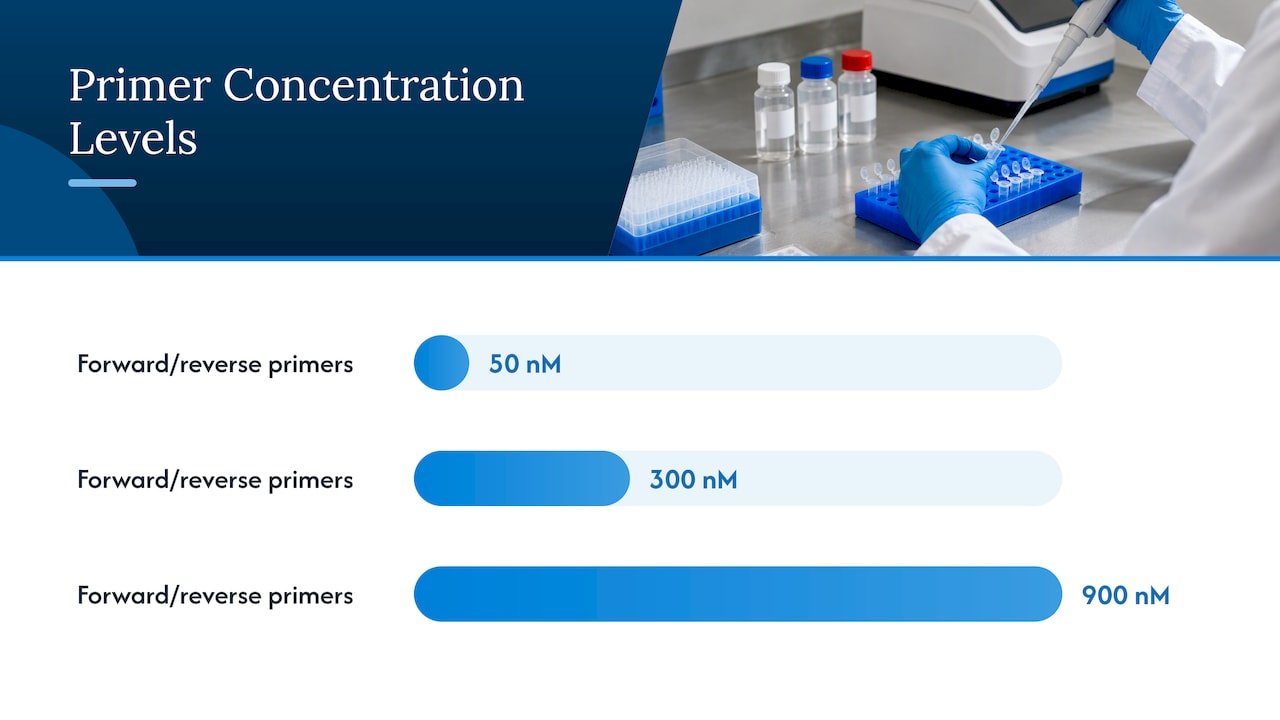
- Build a primer concentration matrix. Test forward and reverse primers across a small grid, for instance 50, 300, and 900 nanomolar each, and read both Cq and melt curve for every combination. A primer-optimization matrix run across 60 RT-qPCR assays found that specific concentration combinations reduced dimer formation and improved Cq values, and that this adjustment often delivers bigger gains than tweaking probe concentration.
- Run an annealing temperature gradient. Step up in roughly 2°C increments across a thermocycler gradient block; Ta, not Tm, is the variable that most determines assay robustness, and raising it even slightly often suppresses dimer amplification while leaving specific product intact. Touchdown PCR, starting a few degrees above the calculated Ta and stepping down over the first several cycles, helps when a single fixed Ta cannot cleanly separate specific binding from dimer formation.
- Switch to a hot-start polymerase. Hot-start enzymes stay chemically or physically blocked until the initial high-temperature activation step, preventing the room-temperature extension during reaction setup that gives dimers a head start before cycling even begins.
- Titrate Mg2+ and consider additives carefully. Lower Mg2+ concentrations reduce non-specific duplex stability, including dimers, though too low a concentration can also suppress genuine amplification efficiency. DMSO or betaine can help with GC-rich or structured templates by disrupting secondary structure, but both require empirical testing since they also shift effective Tm and can need Ta reoptimization.
- Decide when to redesign. If the matrix and temperature gradient do not clear the dimer signal, or if clearing it requires primer concentrations too low to give reliable amplification, redesign is faster than continued bench tweaking.
Pro Tip: Design and order two or three candidate primer pairs per target up front, then run them side by side across a quick temperature gradient. Picking the pair with the lowest Cq and no detectable dimer is often faster than repeatedly re-optimizing one marginal pair.
Because master mix formulation changes the optimal annealing temperature, a primer pair validated on one kit does not necessarily behave the same way on another. Validate on the exact master mix you plan to use in your final assay rather than assuming transferability from a different chemistry.
Keeping reagents properly chilled during setup also reduces early non-specific annealing before cycling starts. A dedicated PCR cold work rack keeps primers and master mix at a stable low temperature on the bench, which is a simple habit that complements hot-start chemistry rather than replacing it.
How Detection Chemistry Changes Your Dimer Strategy
SYBR Green and other intercalating dyes bind any double-stranded DNA, which means dimers contribute directly to signal and distort both Cq and endpoint fluorescence. This is inconvenient during a run, but it is also an advantage during assay development: SYBR Green shows you dimer problems you would otherwise miss.
Probe-based assays behave differently. A hydrolysis probe only generates signal when it binds its specific target sequence, so dimer product does not directly add fluorescence the way it does with SYBR Green. That does not mean dimers are harmless in a probe assay: they still compete with your target for primers and polymerase in the same tube, which can reduce amplification efficiency and shift Cq even when the readout looks clean.
- SYBR Green assays require melt-curve analysis on every run, not just during development, since new reagent lots or sample matrices can reintroduce dimer issues.
- Probe assays validated only by Cq output can carry hidden dimer competition that quietly reduces sensitivity at low template copy numbers.
- A practical workflow is to optimize a new primer pair with SYBR Green first, where dimers are visible, and move to a probe-based format once the melt curve confirms a clean, single product.
- When dimer signal appears stubborn in a probe assay, redesigning probe placement, not just primer sequence, sometimes resolves the issue by shifting the amplicon window away from a primer-interaction hotspot.
This two-stage approach, SYBR first for visibility, probe second for specificity and multiplex capability, gives you the diagnostic clarity of one chemistry and the practical advantages of the other without guessing at which one is hiding a problem.
A One-Session Troubleshooting Checklist for Primer Dimers
When dimer signal shows up mid-project, a structured single session usually resolves it or tells you clearly that redesign is needed.
- Check the NTC melt curve first: a low-Tm peak confirms dimer, a flat NTC with no amplification rules it out for that run.
- Run a gel or capillary electrophoresis check if melt peaks are close in temperature, since a 30 to 80 base pair band confirms dimer identity directly.
- Try the fast fixes same day: raise annealing temperature by 2 to 4°C, reduce primer concentration, and confirm your master mix uses a hot-start enzyme.
- If dimer signal persists, set up a primer concentration matrix across several forward and reverse combinations before deciding to redesign.
- Document every change, including primer lot, concentration, Ta, and melt results, so the optimization record satisfies MIQE-style reporting expectations.
| Check | What it tells you | Next action if dimer confirmed |
|---|---|---|
| NTC melt curve | Low-Tm peak signals dimer, not contamination | Raise Ta, switch to hot-start enzyme |
| Gel or capillary electrophoresis | Confirms a short, low-molecular-weight dimer band | Proceed to primer concentration matrix |
| Primer concentration matrix | Identifies forward/reverse combination with lowest Cq, no dimer | Lock in optimized concentrations |
| Repeat melt after fixes | Confirms single, sharp product peak | Document and finalize assay conditions |
Keeping a simple log of each attempted fix, not just the final working condition, makes it far easier to troubleshoot the next assay that shows similar symptoms.
Validation Resources and Reagent Classes That Support Clean qPCR
Getting a new assay to a clean melt curve is usually a reagent question as much as a design question. Hot-start chemistry is non-negotiable groundwork rather than a nice-to-have, since it removes the room-temperature extension window that gives dimers their head start. Our qPCR and RT-qPCR reagent line includes hot-start formulations built for exactly this kind of troubleshooting work, alongside probe-based mixes for labs moving from SYBR-based optimization into a validated multiplex format.
A validation checklist worth running on every new assay before calling it final:
- Primer concentration matrix across at least three forward and reverse combinations, read by both Cq and melt curve.
- NTC included on every plate, not just during initial development, per MIQE-style reporting practice.
- Gel or capillary confirmation for any assay where melt peaks sit within a few tenths of a degree of each other.
- A documented Ta that was empirically chosen on the master mix used in the final protocol, not inherited from a different kit’s default.
For ancillary reagents like MgCl2 for titration work, our other PCR reagents page covers the additives referenced in the bench optimization steps above.
Balancing Sensitivity and Robustness When Dimers Threaten an Assay
The instinct when a dimer shows up is to chase it away completely, but that is not always the right call. Pushing primer concentration very low or annealing temperature very high can clear a dimer peak while also quietly reducing sensitivity at your lowest target copy numbers, which defeats the purpose of the assay in applications like low-titer viral detection or rare transcript quantification.
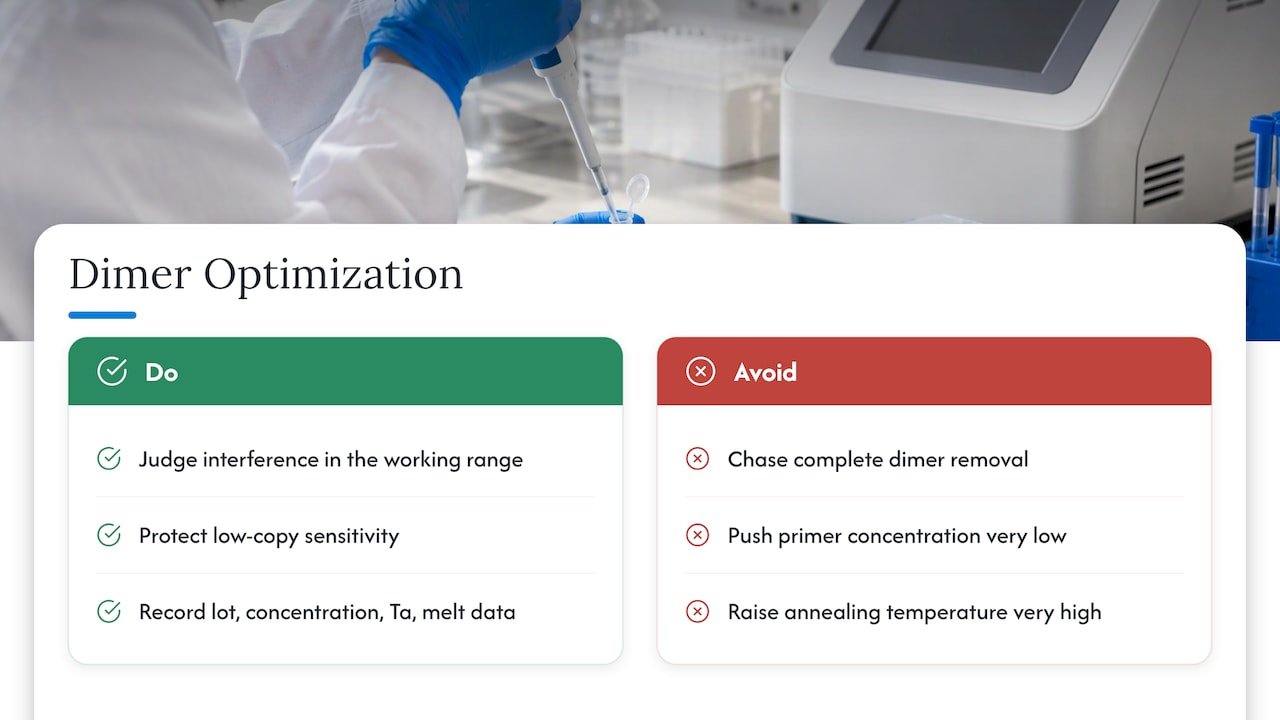
The better question is whether the dimer signal interferes with your actual working range. A faint, late-cycling dimer that never crosses threshold within your sample’s expected Cq window is a cosmetic problem. A dimer that competes hard enough to delay detection of low-copy targets is a real one, and that distinction should guide how aggressively you optimize.
Whatever you decide, write it down. The next person troubleshooting this assay, including a future version of yourself, needs the primer lot, concentration, Ta, and melt data to avoid repeating the same diagnostic loop. For assay-specific troubleshooting, our technical support team is available to review your optimization data and recommend next steps.
— Alina
Reagents and Support to Resolve Primer-Dimer Issues Faster
Working through a dimer problem is faster with reagents built for hot-start chemistry and a team that can review your melt data directly. Our HOT FIREPol® Probe Universal qPCR Mix is built around hot-start activation, which removes the room-temperature extension window where many dimer problems get their start, and it pairs well with probe-based assays once SYBR-stage optimization has confirmed a clean, single product.

A practical starting combination for a lab troubleshooting dimer issues:
- A hot-start probe mix for the validated, multiplex-ready stage of your assay once SYBR optimization confirms specificity.
- Ancillary reagents like MgCl2 for titration experiments, available through our other PCR reagents catalog.
- Direct technical support to review your melt curves, Cq data, or primer matrix results and recommend specific next steps for your assay.
If you are weighing reagent purity alongside performance, a certificate of analysis review process is worth understanding before you commit a protocol to a new lot. For full catalog access across our molecular biology, antibody, and bioassay lines, visit our product pages to find the reagents that fit your current workflow.
FAQ
What does a primer dimer look like on a melt curve?
A primer dimer typically appears as a peak at a lower melting temperature than your specific product, often broader or shouldered compared to the sharp single peak of a clean amplicon. Running a no-template control alongside your samples makes this pattern easier to confirm since the NTC should only show the dimer peak if one exists.
How do I stop primer dimers in a multiplex qPCR reaction?
Start by checking each primer pair individually for self- and hetero-dimer risk using a thermodynamic tool like Primer3 or ntthal, since cross-reactions between unrelated primer pairs become more likely as more primers share a tube. Lowering primer concentrations through a matrix test and confirming hot-start enzyme use both reduce multiplex-specific dimer risk significantly.
Can primer dimers affect my qPCR quantification even if Cq looks normal?
Yes, dimers can compete for primers and polymerase in a way that shifts Cq without being obvious from amplification curves alone, especially in probe-based assays where dimer product does not directly add fluorescence. Dimers can outcompete low-template targets because their shorter length amplifies faster, which is why melt-curve or gel confirmation matters even when results look clean.
Is raising the annealing temperature always the right fix for primer dimers?
Raising Ta in small steps is often the fastest and least disruptive fix, since Ta is the variable most tied to assay robustness across different master mixes. It is not guaranteed to work alone, though, and should be combined with a primer concentration check and confirmation that your polymerase is a hot-start formulation.
When should I redesign primers instead of optimizing the reaction?
Redesign makes sense when a concentration matrix and temperature gradient cannot clear dimer signal without dropping primer concentration low enough to hurt sensitivity. Ordering two or three candidate pairs up front and testing them side by side is often faster overall than repeatedly re-optimizing one problematic pair.
Sources
- Impact of Primer Dimers and Self-Amplifying Hairpins on Reverse-Transcription LAMP Detection of Viral RNA
- Determining optimal primer concentrations via a primer optimisation matrix
- Primer3—new capabilities and interfaces
- qPCR primer design revisited: troubleshooting and fine-tuning procedures for qPCR system design
- Primer dimer characteristics and their impact on qPCR assays




