Urine vs Saliva Drug Testing:
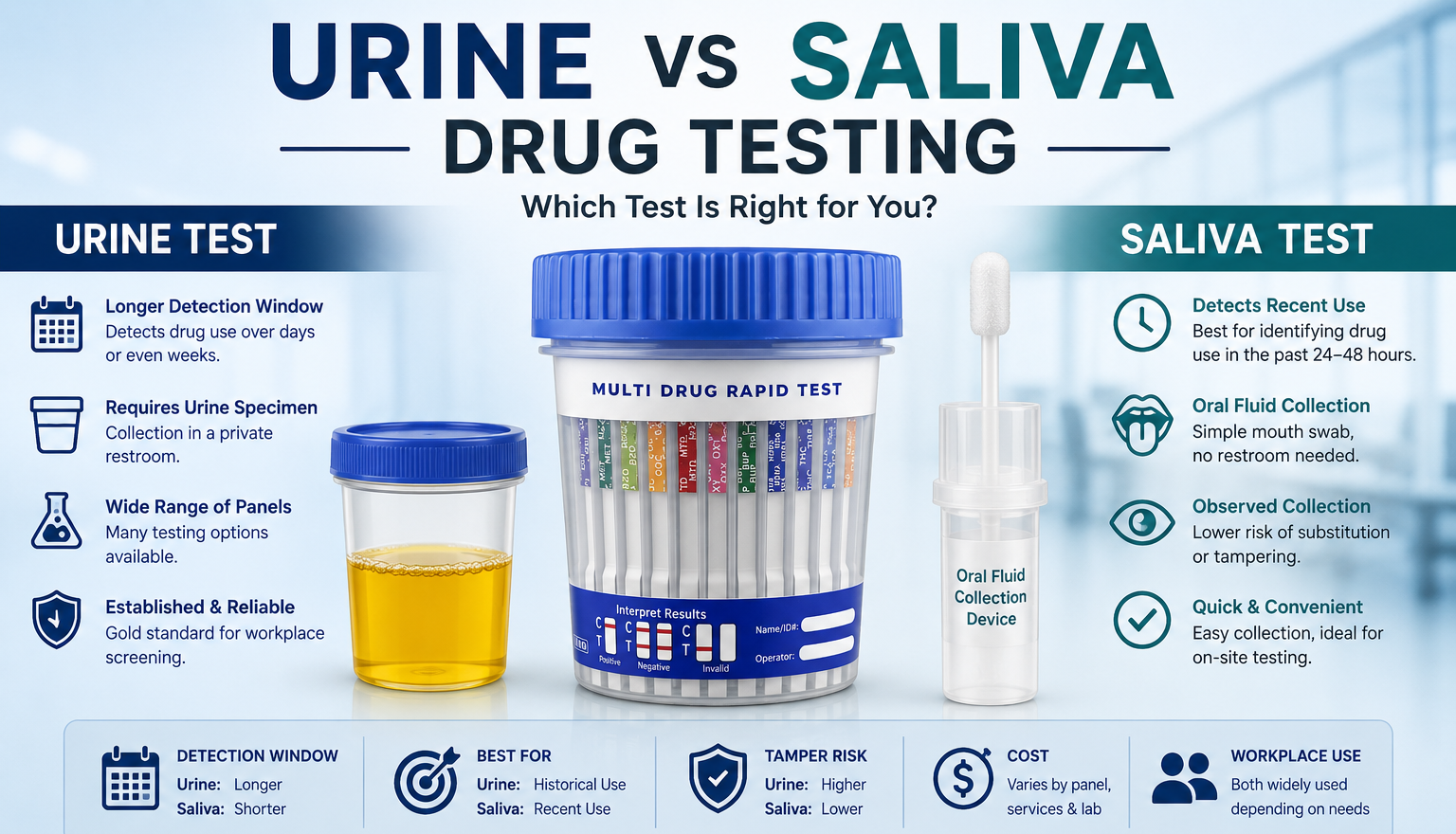
When comparing urine vs saliva drug testing, the biggest difference is the type of drug exposure each test is designed to detect and how long substances remain detectable in the specimen. Urine testing generally provides a longer detection window, while saliva or oral fluid testing is particularly useful for identifying more recent drug use.
Both methods are widely used for workplace and other drug-screening programs, but neither test is automatically “better” in every situation. The right choice depends on factors such as the drug being tested, detection window, collection process, testing purpose, cost, and whether rapid or laboratory testing is required.
Urine vs Saliva Drug Testing: Quick Comparison
| Feature | Urine Drug Test | Saliva Drug Test |
|---|---|---|
| Specimen | Urine | Oral fluid/saliva |
| Common name | Urine drug screen | Mouth swab/oral fluid test |
| Detection window | Generally longer | Generally shorter |
| Recent-use detection | Good | Often better suited to very recent exposure |
| Collection | Requires urine specimen | Mouth swab or oral fluid collection |
| Restroom required | Usually | No |
| Collection observation | Depends on testing protocol | Can be directly observed |
| Substitution risk | Greater potential for substitution | Much lower opportunity for substitution |
| Adulteration concerns | Can include dilution or additives | Generally less susceptible to traditional urine adulteration |
| Rapid testing | Available | Available |
| Laboratory confirmation | Available | Available |
| Workplace use | Common | Increasingly used |
| Best suited for | Broader/longer detection | Recent-use screening and convenient collection |
The exact detection period varies by substance, dose, frequency of use, individual factors, specimen type, and test cutoff.
What Is a Urine Drug Test?
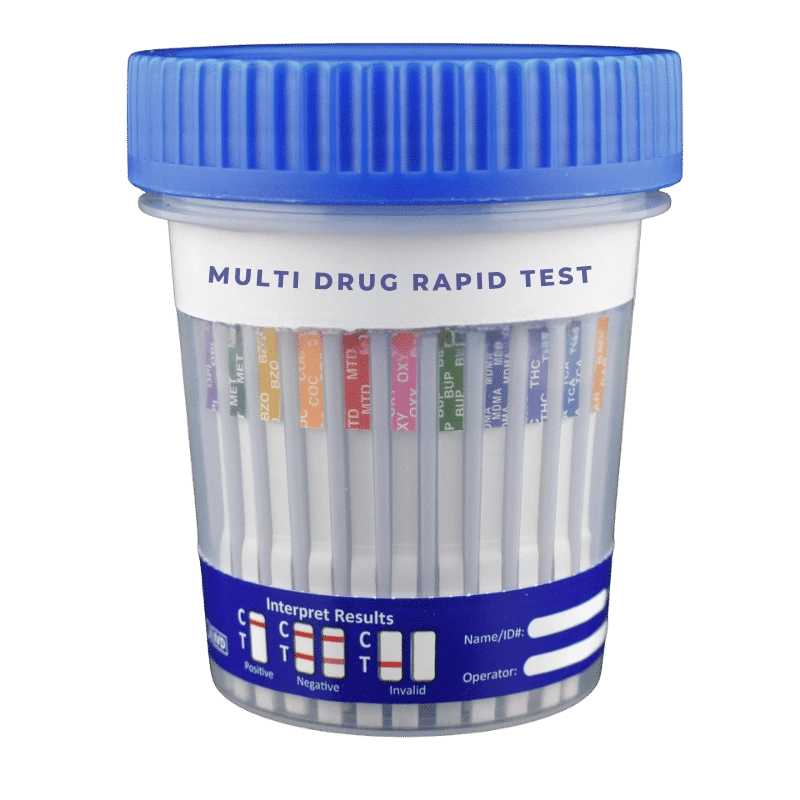
A urine drug test analyzes a urine specimen for specific drugs or their metabolites. It is one of the most established forms of drug testing and is commonly used for workplace screening, pre-employment testing, random testing, and other programs where detecting drug exposure over a longer period is important.
Many urine drug tests begin with an initial screening method. If a result is presumptively positive, laboratory confirmation may be performed using more specific analytical techniques.
How urine drug testing works
After a urine specimen is collected, the sample can be screened for one or more substances. Depending on the test, a panel may include drugs such as:
- Marijuana/THC
- Cocaine
- Amphetamines
- Methamphetamine
- Opioids
- Benzodiazepines
- PCP
- Fentanyl
- Other substances included in the specific test panel
A urine test may detect the original drug, metabolites, or both, depending on the substance and testing method.
Advantages of urine drug testing
Urine testing has several practical advantages:
- It generally offers a longer detection window than oral fluid testing.
- It is widely available.
- Many different drug panels are available.
- Rapid urine screening and laboratory testing are both available.
- It has a long history of workplace use.
- Specimen validity testing can help identify certain abnormal or adulterated specimens.
Limitations of urine drug testing
Urine testing also has limitations:
- Collection may be less convenient than saliva collection.
- A restroom or private collection area is generally required.
- Urine specimens can be susceptible to dilution, substitution, or adulteration attempts.
- A positive result does not necessarily indicate current impairment.
- Detection periods vary substantially between drugs and individuals.
What Is a Saliva Drug Test?
A saliva drug test, more accurately called an oral fluid drug test, analyzes a sample collected from the mouth.
The collection process typically involves placing a collection device or swab in the mouth. Depending on the device, the collector may collect fluid from the cheek or other areas of the mouth.
Because collection can be directly observed, oral fluid testing can reduce some of the substitution and tampering concerns associated with urine collection.
How saliva drug testing works
After collection, the oral fluid specimen is screened for the substances included in the test panel.
Oral fluid testing can detect certain drugs or drug compounds that are present in the mouth and bloodstream after recent use. The detection window is generally shorter than urine testing, which makes the specimen particularly useful when recent exposure is the primary concern.
Advantages of saliva drug testing
Saliva testing offers several benefits:
- Collection is quick and straightforward.
- No restroom is required.
- Collection can be observed.
- There is less opportunity for specimen substitution.
- It can be useful for detecting relatively recent drug exposure.
- Rapid point-of-collection tests are available.
- Collection can be convenient for mobile or on-site testing.
Limitations of saliva drug testing
Oral fluid testing also has limitations:
- Detection windows are generally shorter than urine.
- Detection varies by drug and test technology.
- Some substances may be more difficult to detect in oral fluid.
- Collection conditions can affect the specimen.
- A positive result does not prove current impairment by itself.
- Testing requirements and available methods vary by program and jurisdiction.
Urine vs Saliva Drug Test: What Is the Difference?
The most important differences involve detection window, specimen collection, recent-use detection, adulteration, and testing purpose.
1. Detection Window
The detection window is the period during which a drug or its relevant metabolites can be detected by a particular test.
In general:
Urine: tends to provide a longer detection window.
Saliva/oral fluid: tends to provide a shorter detection window and can be useful for identifying more recent exposure.
However, there is no single detection time that applies to every drug.
Factors that can influence detection include:
- Type of drug
- Dose
- Frequency of use
- Route of administration
- Individual metabolism
- Chronic versus occasional use
- Test sensitivity
- Cutoff concentration
- Specimen collection time
- Laboratory or device methodology
For this reason, detection-time charts should be treated as approximate rather than guaranteed.
Urine vs Saliva Drug Test Detection Times
A general comparison looks like this:
| Factor | Urine | Saliva/Oral Fluid |
|---|---|---|
| General detection pattern | Longer | Shorter |
| Very recent exposure | May have a limited early window | Often useful |
| Exposure over previous days | Often useful | More limited |
| Long-term repeated exposure | Can remain detectable longer | Usually shorter |
| THC | Detection varies substantially | Usually shorter than urine |
| Cocaine | Often detectable beyond the immediate-use period | Generally emphasizes more recent exposure |
| Amphetamines | Often longer than oral fluid | Often shorter |
| Opioids | Generally longer | Generally shorter |
These are broad comparisons, not guarantees for a specific person or test.
For an actual testing program, the manufacturer’s instructions, laboratory methodology, cutoff concentrations, and applicable regulations should be reviewed.
2. Which Is More Accurate: Urine or Saliva?
There is no simple answer that one specimen is always more accurate.
Urine and saliva answer somewhat different testing questions.
A urine test may be more useful when the goal is to identify drug exposure over a broader period. Oral fluid can be useful when the goal is to identify more recent exposure.
Accuracy also depends on:
- The substance being tested
- Collection quality
- Test device
- Cutoff levels
- Laboratory methodology
- Screening procedure
- Confirmatory testing
A rapid screening test and a laboratory confirmation test should not be treated as identical.
Screening vs. confirmation
An initial drug screen is generally a screening test, meaning it identifies specimens that may require further analysis.
A presumptive positive can then be confirmed using a more specific laboratory method, such as mass spectrometry.
Confirmation may involve technologies such as:
- GC-MS
- LC-MS/MS
This additional testing can help identify the specific substance responsible for the result.
3. Which Test Detects Recent Drug Use Better?
For many substances, oral fluid testing is particularly useful for detecting relatively recent exposure.
This is one reason oral fluid testing can be considered for situations where the timing of use matters.
Urine testing generally has a broader detection window, so it may continue to detect drug metabolites after the period of very recent exposure has passed.
However, neither specimen should be described as a direct test of impairment.
Drug detection is not the same as impairment
A positive drug test indicates that the tested specimen contains a substance or its relevant marker above the applicable testing threshold.
It does not automatically establish that a person is impaired at the time of collection.
This distinction is important when interpreting workplace drug-test results.
4. Collection: Urine vs Mouth Swab
Collection is one of the most noticeable differences between the two methods.
Urine collection
A urine test generally requires the individual to provide a urine specimen in a collection area.
Depending on the testing program, procedures may include:
- Providing identification and completing required paperwork.
- Receiving collection instructions.
- Providing the urine specimen.
- Having the specimen checked and handled according to testing procedures.
- Sending the specimen for screening or laboratory analysis when required.
The exact procedure varies by testing program.
Saliva collection
An oral fluid test typically uses a swab or collection device placed in the mouth.
A general collection process may involve:
- Completing the required documentation.
- Following the collector’s instructions.
- Placing the collection device in the mouth.
- Allowing the device to collect oral fluid.
- Completing the collection according to the device instructions.
- Performing the screening or sending the specimen for laboratory analysis.
One major advantage is that the collection can generally be observed without requiring a restroom.
5. Which Is Harder to Tamper With?
Oral fluid testing generally provides fewer opportunities for traditional specimen substitution because collection can be directly observed.
Urine testing can present challenges such as:
- Substitution
- Dilution
- Certain adulterants
- Attempts to interfere with the specimen
Testing programs can use specimen validity procedures to identify certain abnormal urine specimens.
Saliva collection reduces many of these issues because the specimen is collected directly from the mouth under observation.
However, no testing method should be described as completely immune to interference or collection problems.
6. Urine vs Saliva Drug Test Cost
The cost of a drug test depends on more than the specimen type.
Pricing can vary according to:
- Number of drugs included in the panel
- Rapid versus laboratory testing
- Confirmation requirements
- Collection fees
- Testing location
- Employer program
- Service provider
- Mobile or on-site collection
- Regulatory requirements
A basic urine screen may cost less in some situations, while a particular oral fluid program may be more economical in others.
Therefore, there is no universal rule that urine is always cheaper than saliva or vice versa.
When comparing prices, compare the same number of drugs, testing level, collection service, and confirmation process.
7. Which Test Is Better for Workplace Drug Testing?
The better test depends on the purpose of the workplace program.
Urine may be a good choice when:
- A longer detection window is desired.
- The employer has an established urine-testing program.
- Laboratory testing is required.
- Broader historical exposure is relevant.
- Applicable rules or policies specify urine testing.
Saliva may be a good choice when:
- Recent drug exposure is the primary concern.
- Convenient collection is important.
- Restroom-free collection is preferred.
- Directly observed collection is desirable.
- Rapid or on-site screening is useful.
- The testing program permits oral fluid testing.
Employers should always verify the requirements that apply to their specific industry, jurisdiction, and testing program.
8. Which Test Is Better for Pre-Employment Testing?
Urine testing remains a common choice for pre-employment drug screening, particularly when the employer wants a longer detection window and established laboratory workflows.
Oral fluid testing can also be useful for pre-employment programs when the employer’s testing policy and applicable requirements allow it.
The decision should be based on what the employer wants the test to answer:
Is the goal to identify drug exposure over a broader period, or is the priority more recent exposure?
That question is often more useful than simply asking which test is “better.”
9. Which Test Is Better After an Accident?
Oral fluid testing can be attractive for certain post-incident or post-accident situations because collection is convenient and focuses more heavily on recent exposure.
However, the appropriate testing method depends on:
- Employer policy
- Industry requirements
- Applicable regulations
- Timing of the incident
- Testing program
- Laboratory availability
A drug test should not be interpreted as a standalone determination of impairment.
10. What Drugs Can Urine and Saliva Tests Detect?
Both urine and oral fluid tests can be designed to detect multiple drug classes.
Depending on the specific panel, testing may include:
- THC/marijuana
- Cocaine
- Amphetamines
- Methamphetamine
- Opioids
- Benzodiazepines
- PCP
- Fentanyl
- Other prescription or illicit substances
Not every test detects every drug.
The test panel and manufacturer specifications determine which substances are included.
This is particularly important when comparing products marketed as “multi-panel” tests.
Can You Pass a Urine Test but Fail a Saliva Test?
Yes, it is possible for urine and saliva results to differ.
The two specimens have different detection characteristics, and drug concentrations change over time.
For example, oral fluid may detect relatively recent exposure while urine may detect exposure over a longer period.
The reverse can also occur depending on:
- Timing
- Drug
- Dose
- Individual metabolism
- Detection thresholds
- Test methodology
- Collection quality
Therefore, passing one specimen test does not guarantee that another specimen collected at a different time will produce the same result.
Can You Pass a Saliva Test but Fail a Urine Test?
Yes.
This can occur because urine and oral fluid have different detection windows.
A person may have drug exposure that is no longer detectable in oral fluid but remains detectable in urine.
This is one of the primary reasons the choice of specimen matters.
Is a Mouth Swab Better Than a Urine Test?
Neither is universally better.
A mouth swab/oral fluid test may be preferable when the priority is:
- Recent-use detection
- Convenient collection
- Observed collection
- Rapid point-of-collection testing
- Avoiding a restroom collection
A urine test may be preferable when the priority is:
- A longer detection window
- Established workplace testing procedures
- Broader historical exposure
- Laboratory-based testing
The best specimen is the one that matches the purpose of the testing program.
Urine vs Saliva Drug Testing: Pros and Cons
Urine testing
Pros
- Longer detection window for many substances
- Widely used
- Broad range of test panels
- Rapid and laboratory options
- Established laboratory procedures
- Specimen validity testing is available
Cons
- Requires urine collection
- Usually requires a restroom
- More opportunity for substitution or dilution
- Less focused on the most recent exposure
- Collection may feel less convenient
Saliva testing
Pros
- Simple collection
- No restroom required
- Directly observed collection is possible
- Lower opportunity for specimen substitution
- Useful for recent exposure
- Rapid point-of-collection options are available
- Convenient for on-site testing
Cons
- Generally shorter detection window
- Detection varies significantly by substance
- Not every drug is equally suited to oral fluid testing
- Collection and testing requirements vary
- A positive result does not establish impairment by itself
Urine vs Saliva Drug Testing: Which Should You Choose?
The easiest way to choose is to start with the question you want the test to answer.
Choose urine when your priority is:
A broader detection window and established workplace screening.
Consider saliva/oral fluid when your priority is:
Convenient collection and identifying relatively recent drug exposure.
If you need both:
Some testing programs may use different specimen types for different situations. For example, one method may be appropriate for routine screening while another may be considered when recent exposure is especially relevant.
The appropriate approach depends on the testing program, applicable requirements, and the substances being tested.
Frequently Asked Questions
Is urine or saliva drug testing more accurate?
Neither is universally more accurate. Accuracy depends on the substance, detection period, test method, cutoff level, specimen collection, and whether laboratory confirmation is performed.
How long does a saliva drug test detect drugs?
Oral fluid generally has a shorter detection window than urine, often emphasizing recent exposure. The actual period varies substantially by drug, dose, frequency of use, test sensitivity, and other factors.
How long does a urine drug test detect drugs?
Urine generally provides a longer detection window than oral fluid, but the exact period varies by substance and individual. Some drugs may be detectable for days, while certain substances can have substantially different detection patterns with repeated use.
Is a saliva drug test the same as a mouth swab?
In most workplace drug-testing contexts, “saliva test,” “mouth swab test,” and “oral fluid test” are commonly used to describe testing involving an oral fluid specimen. The specific collection device and testing method can differ.
Can a saliva test detect THC?
Yes. Oral fluid tests can be designed to detect THC. However, the detection period and cutoff depend on the specific test and testing methodology.
Can a urine test detect prescription drugs?
Some urine drug panels can detect prescription medications or their metabolites. Whether a particular medication is included depends on the drug panel.
A laboratory or medical review process may be used to evaluate a presumptive positive result in the context of a legitimate prescription.
Which test is easier to collect?
Saliva/oral fluid testing is generally simpler from a collection standpoint because it does not require a restroom or urine specimen.
Which drug test is harder to tamper with?
Oral fluid collection can reduce opportunities for substitution because the specimen can be collected under direct observation. Urine testing can use specimen validity procedures to identify certain abnormal samples.
Does a positive saliva test mean someone is impaired?
No. A positive drug test indicates that the relevant substance or marker was detected according to the test’s criteria. It does not, by itself, establish current impairment.
Does a positive urine test mean recent drug use?
Not necessarily. Because urine generally has a longer detection window, a positive result can reflect exposure that occurred earlier rather than very recent use.
Can urine and saliva drug tests give different results?
Yes. Different specimens have different detection windows and concentrations. Results can therefore differ depending on the substance, timing, cutoff, collection method, and testing technology.
Which is better for workplace drug testing?
It depends on the purpose and requirements of the workplace program. Urine is commonly used for established screening programs and longer detection windows, while oral fluid can be useful when recent exposure and convenient observed collection are priorities.
Final Verdict: Urine vs Saliva Drug Testing
The choice between urine vs saliva drug testing comes down to what the testing program needs to detect.
Urine testing generally provides a longer detection window and remains a widely used option for workplace and other drug-screening programs.
Saliva or oral fluid testing offers convenient, observable collection and can be particularly useful when the focus is on relatively recent drug exposure.
Neither specimen is automatically the “best” choice for every situation. The most appropriate method depends on the drug being tested, desired detection window, collection requirements, testing technology, applicable regulations, and the purpose of the test.
The key difference can be summarized simply:
Urine is generally better suited to detecting drug exposure over a longer period, while saliva is particularly useful for convenient collection and detecting more recent exposure.
For any workplace or regulated testing program, use the applicable testing requirements and the laboratory or device manufacturer’s instructions when selecting and interpreting a test.