What Is a Non-DOT Drug Test?
If you have been asked to take a non-DOT drug test, you may wonder what “non-DOT” actually means, what substances the test checks for, and how it differs from a DOT drug test.
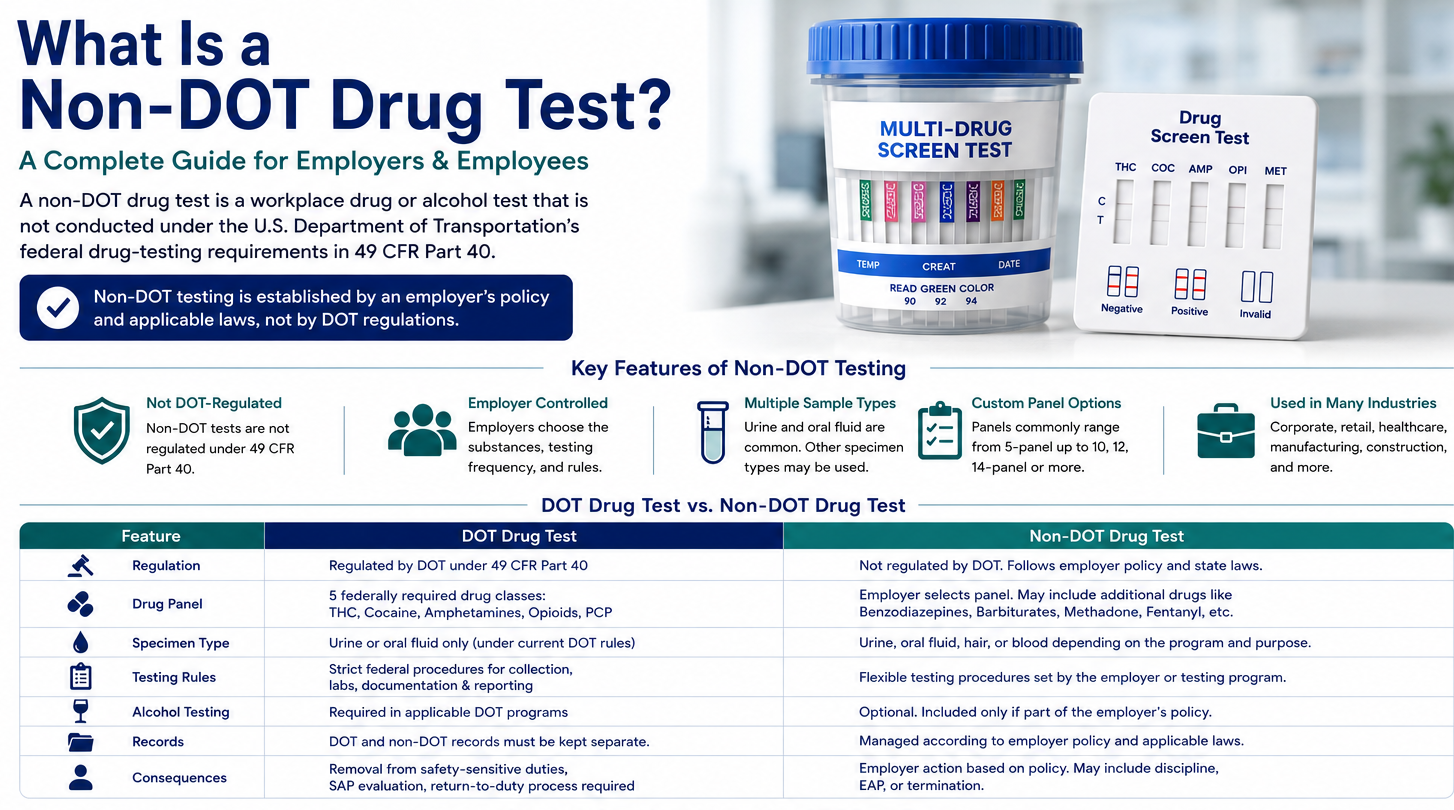
A non-DOT drug test is a workplace drug or alcohol test that is not conducted under the U.S. Department of Transportation’s federal drug-testing requirements in 49 CFR Part 40. Non-DOT testing is generally established according to an employer’s testing policy and applicable federal, state, and local laws. Because it is not a DOT test, employers may have more flexibility in choosing the testing panel, specimen type, and testing program.
DOT’s Part 40 regulations govern drug and alcohol testing for federally regulated transportation workplaces.
Key Takeaways
- Non-DOT means the test is not being conducted as a DOT-regulated test under 49 CFR Part 40.
- Employers can establish non-DOT testing programs based on their workplace policies and applicable laws.
- Non-DOT drug tests may screen for different substances and panel configurations.
- Urine and oral-fluid testing are common specimen options, while other testing methods may be used depending on the program and applicable requirements.
- A non-DOT test is not the same as a DOT drug test.
- DOT and non-DOT tests must be kept separate when both are conducted.
- There is no single universal “non-DOT drug test panel”; the substances tested depend on the specific testing program.
What Does Non-DOT Mean on a Drug Test?
Non-DOT means the drug test is not being performed under the U.S. Department of Transportation’s regulated drug and alcohol testing program.
DOT-regulated testing follows 49 CFR Part 40, which establishes federal procedures for covered transportation employees and employers. Non-DOT testing does not operate under those DOT testing requirements.
For example, a company may have a workplace drug-testing policy requiring applicants or employees to complete a 5-panel, 10-panel, 12-panel, or another customized drug test. If that test is being performed under the company’s non-DOT program rather than a DOT-regulated testing event, it is considered a non-DOT drug test.
The exact requirements can vary by employer, industry, testing provider, and applicable state or local law.
How Does a Non-DOT Drug Test Work?
Although procedures vary between testing programs, a typical non-DOT workplace drug test may involve these steps:
- The employer establishes a testing policy.
- The employee or applicant is selected for testing.
- A specimen is collected, such as urine or oral fluid, depending on the program.
- The specimen is screened for the substances included in the selected panel.
- A non-negative screening result may require laboratory confirmation, depending on the testing method and program.
- Results are reported according to the employer’s testing policy and applicable requirements.
- The employer determines any next steps based on its policy and applicable law.
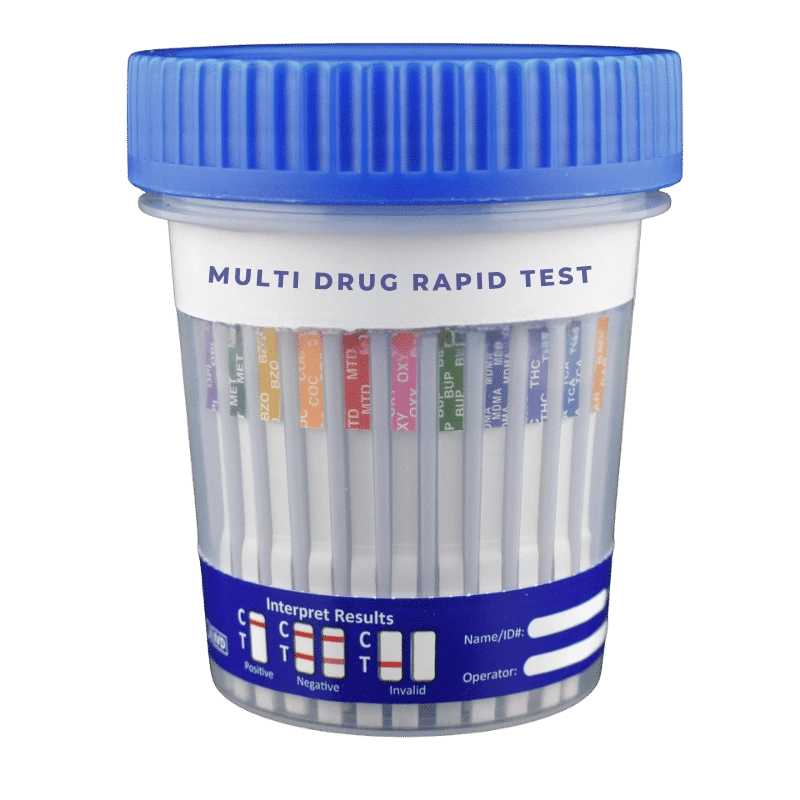
A rapid urine drug test cup can provide an initial screening result, but a preliminary or non-negative screen should not automatically be treated as proof of current impairment or definitive proof of drug use.
What Does a Non-DOT Drug Test Test For?
Unlike DOT testing, there is no single federally mandated non-DOT drug panel that every employer must use.
A non-DOT program can be designed around the employer’s workplace policy and applicable legal requirements.
Common substances included in non-DOT panels can include:
| Drug or Drug Class | Common Abbreviation |
|---|---|
| Marijuana metabolites | THC |
| Cocaine metabolites | COC |
| Amphetamines | AMP |
| Methamphetamine | MET |
| Opioids | OPI |
| Phencyclidine | PCP |
| Benzodiazepines | BZO |
| Barbiturates | BAR |
| Methadone | MTD |
| Oxycodone | OXY |
| Buprenorphine | BUP |
| Fentanyl | FEN |
The actual substances included depend on the specific panel.
For comparison, federal DOT drug testing requires laboratories to test for five drug classes: marijuana metabolites, cocaine metabolites, amphetamines, opioids, and PCP. DOT specimens cannot be tested for additional drugs outside those authorized under Part 40.
What Is a 5-Panel Non-DOT Drug Test?
A 5-panel non-DOT drug test generally refers to a five-drug or five-class screening panel selected by an employer or testing provider.
However, it is important not to assume that every non-DOT 5-panel test has exactly the same configuration.
The term “5-panel” describes the number of drug categories being tested, not necessarily one universal non-DOT formula.
For this reason, employers should check the manufacturer’s or laboratory’s specific panel configuration before ordering a test.
What Is a 10-Panel Non-DOT Drug Test?
A 10-panel non-DOT drug test screens for a broader group of substances than a typical five-panel test.
Depending on the product or laboratory, additional categories may include drugs such as:
- Benzodiazepines
- Barbiturates
- Methadone
- Oxycodone
- Buprenorphine
- Other prescription or illicit drug classes
The exact substances and cutoff levels vary by test.
What Is a 12-Panel Non-DOT Drug Test?
A 12-panel non-DOT drug test is a broader workplace screening option designed to detect multiple drug classes in one testing device or laboratory panel.
A 12-panel configuration may include common drugs such as:
- THC
- Cocaine
- Amphetamines
- Methamphetamine
- Opiates
- PCP
- Benzodiazepines
- Barbiturates
- Methadone
- Oxycodone
- Buprenorphine
- Fentanyl
The exact configuration matters. Two products advertised as “12-panel” tests may test for different substances.
Therefore, always review the product’s analytes and cutoff levels rather than choosing a test based solely on the number of panels.
What Types of Samples Can a Non-DOT Drug Test Use?
Non-DOT testing can be designed around different specimen types.
Urine Drug Testing
Urine drug testing is one of the most widely used approaches for workplace drug screening.
Urine tests are available in:
- Multi-panel cups
- Dip cards
- Laboratory testing
- Rapid screening formats
A urine drug test can screen for multiple drug classes simultaneously, depending on the selected panel.
Oral Fluid Drug Testing
Oral-fluid testing, sometimes called saliva testing, uses a sample collected from the mouth.
It can be useful when an employer wants a less invasive collection process and a test focused on more recent drug exposure.
It’s important to distinguish non-DOT oral-fluid testing from DOT oral-fluid testing because DOT has specific federal requirements governing its testing program.
Hair Drug Testing
Hair testing can be used in some non-DOT workplace programs and is generally associated with a longer detection history than urine testing.
However, hair and urine tests should not be interpreted as interchangeable. Each specimen type has different detection characteristics and limitations.
Blood Testing
Blood testing can also be used in certain circumstances, although it is not typically the first choice for routine workplace drug screening.
The appropriate specimen depends on the employer’s purpose, testing policy, applicable law, and testing provider.
DOT vs Non-DOT Drug Test: What’s the Difference?
The biggest difference is regulatory authority.
DOT testing is governed by federal DOT regulations, including 49 CFR Part 40, while non-DOT testing is conducted outside that DOT-regulated program.
| Feature | DOT Drug Test | Non-DOT Drug Test |
|---|---|---|
| Federal DOT regulation | Yes | No |
| 49 CFR Part 40 | Applies | Does not govern the test |
| Testing panel | Federally specified | Employer/program dependent |
| Additional drug classes | Not permitted on DOT specimen | May be included depending on program |
| Specimen type | Urine or oral fluid under current DOT rules | Depends on program and applicable requirements |
| Testing procedures | Strict federal requirements | Employer/program requirements |
| Employer policy | Must comply with DOT requirements | Central to program design |
| Alcohol testing | Required in applicable DOT programs | May be included depending on the program |
| DOT CCF/ATF | Required for DOT testing | Must not be used for non-DOT testing |
| Testing records | Subject to DOT requirements | Managed under applicable non-DOT requirements |
Current DOT regulations authorize for DOT drug testing, with testing performed at HHS-certified laboratories. DOT does not authorize point-of-collection drug tests, hair testing, or instant drug tests as DOT drug-testing methods.
Is a Non-DOT Drug Test the Same as a Regular Drug Test?
Not necessarily.
“Regular drug test” is a broad, informal phrase. It doesn’t identify a specific regulatory program.
A non-DOT drug test generally means a test being conducted outside the DOT-regulated testing framework.
For example, an employer might require a non-DOT urine drug test for:
- A job applicant
- An employee involved in a workplace incident
- Random workplace screening
- Reasonable-suspicion testing
- A company drug-free workplace program
The actual testing requirements depend on the employer’s policy and applicable laws.
When Are Non-DOT Drug Tests Used?
Employers may use non-DOT testing programs for several purposes.
Pre-Employment Drug Testing
Some employers require applicants to complete drug screening before starting a job.
The purpose may be to support workplace safety and comply with the employer’s drug-free workplace policy.
Random Drug Testing
An employer may establish a random testing program in which employees are selected according to the company’s policy.
Whether random testing is permitted or required can depend on the industry, applicable law, contracts, and company policy.
Post-Accident Drug Testing
Some employers conduct drug or alcohol testing after workplace incidents.
However, employers should have clear written policies explaining when post-incident testing is appropriate and ensure their procedures comply with applicable laws.
Reasonable-Suspicion Testing
Testing may also occur when an employer has documented, policy-based grounds to suspect an employee may be under the influence of drugs or alcohol.
The standards and procedures should be clearly defined in the employer’s workplace policy.
Return-to-Work Testing
Some companies use testing as part of a return-to-work or follow-up program.
The exact process varies considerably between non-DOT employers.
Does a Non-DOT Drug Test Test for Alcohol?
It can, but alcohol is not automatically included in every non-DOT drug test.
A non-DOT program may include alcohol testing if the employer’s policy and applicable law permit or require it.
This is different from asking whether a particular urine drug test cup detects alcohol. Many standard multi-panel urine drug tests are designed to detect drug metabolites rather than alcohol.
If alcohol testing is required, the employer may use a separate alcohol-testing method or device.
Therefore, always check the specific test configuration and workplace policy.
Does a Non-DOT Drug Test Test for Marijuana?
Yes, a non-DOT drug test can include marijuana/THC testing.
Whether marijuana is included depends on the employer’s testing panel and applicable law.
A marijuana result also should not automatically be interpreted as proof that an employee is currently impaired. Drug tests generally identify the presence of a target analyte or metabolite at or above a specified cutoff; they do not by themselves establish current impairment.
What Happens If You Get a Positive Non-DOT Drug Test?
The consequences of a positive non-DOT result depend on the testing program.
A typical process may involve:
Initial screening → confirmation when applicable → result review/reporting → employer action under policy
An initial rapid screening result should not necessarily be treated as a definitive laboratory-confirmed result.
Depending on the program, a non-negative screening result may be sent for confirmatory laboratory analysis.
After the final result is reported, the employer may take action according to its written policy and applicable law.
Possible employer responses can vary and may include:
- No employment action
- Additional review
- A request for clarification
- Employee assistance resources
- Disciplinary action
- Termination
- A return-to-work or follow-up process
There is no single consequence that applies to every non-DOT positive result.
What Is a CCF in Drug Testing?
CCF stands for Custody and Control Form.
The federal Drug Testing Custody and Control Form is used for DOT-regulated drug testing.
It documents important information about the collection and handling of a DOT specimen.
A critical distinction is that employers must not use the DOT CCF or Alcohol Testing Form (ATF) for non-DOT drug and alcohol testing programs. DOT regulations specifically require DOT and non-DOT testing to remain separate.
The federal CCF was revised in 2026, with the revised version becoming effective April 27, 2026. DOT states that the 2023 version may continue to be used by DOT-regulated employers and service agents through May 30, 2027, subject to the applicable transition rules.
Can DOT and Non-DOT Drug Tests Be Done at the Same Time?
They can occur for the same employee, but DOT and non-DOT tests must be treated as separate testing events.
DOT regulations state that DOT tests must be completely separate from non-DOT tests and must take priority when both are being conducted. If a DOT urine test is performed first, a separate urine specimen must be collected for the subsequent non-DOT test.
Employers also cannot use the DOT specimen to test for additional drugs that aren’t authorized under the DOT program.
This distinction is particularly important for employers that have both DOT-regulated and non-DOT employees.
Are Non-DOT Drug Tests Federally Regulated?
A non-DOT test is not governed by DOT’s 49 CFR Part 40 testing program.
However, that does not mean employers can ignore all laws.
Non-DOT workplace testing can still be affected by:
- Federal employment laws
- State drug-testing laws
- Local requirements
- Industry regulations
- Collective bargaining agreements
- Employer policies
- Privacy requirements
- Medical and disability laws where applicable
Because requirements vary by jurisdiction and situation, employers should review the laws applicable to their workforce before implementing or changing a drug-testing program.
Who Uses Non-DOT Drug Testing?
Non-DOT testing can be used by organizations that are not conducting DOT-regulated testing, including employers in areas such as:
- Construction
- Manufacturing
- Healthcare
- Retail
- Warehousing
- Hospitality
- Corporate offices
- Private businesses
- Some government organizations
- Schools and educational organizations
The exact testing requirements vary by employer and jurisdiction.
A company can also have both DOT and non-DOT employees. In that situation, the employer must maintain the appropriate separation between the two testing programs.
What Is a Non-DOT Urine Drug Test?
A non-DOT urine drug test is a urine-based drug screening conducted outside the DOT-regulated testing program.
It can be performed using different formats, including:
- Multi-panel urine cups
- Dip cards
- Laboratory urine testing
- Other authorized screening and confirmation methods depending on the program
The number of substances tested depends on the selected panel.
For example, a non-DOT urine test could be designed as a 5-panel, 10-panel, 12-panel, 14-panel, or another configuration.
Always check the specific analytes and cutoff levels rather than assuming every test with the same panel number detects exactly the same substances.
What Are Cutoff Levels on a Non-DOT Drug Test?
A cutoff level is a predefined concentration used to determine whether a specimen is reported as negative or non-negative for a particular analyte.
Different tests can have different cutoff levels.
For example, two urine drug tests may both test for THC but use different cutoff concentrations.
This is why a complete drug-test specification should identify:
- Drug/analyte
- Cutoff concentration
- Specimen type
- Testing method
- Whether the test is screening or confirmatory
- Applicable regulatory status
Cutoff levels should not be confused with impairment thresholds.
Are Non-DOT Drug Tests Accurate?
The accuracy of a non-DOT drug test depends on the specific product, specimen, collection process, cutoff, testing method, and quality controls.
Rapid immunoassay tests are generally designed as screening tests, not as a substitute for definitive laboratory confirmation in situations where confirmation is required.
Factors that can affect a screening result include:
- Specimen quality
- Collection errors
- Cross-reactivity
- Timing of drug exposure
- Detection characteristics of the specimen
- Test sensitivity and specificity
- Storage and handling
- Expired or improperly stored test devices
A non-negative screening result should therefore be interpreted according to the manufacturer’s instructions and the employer’s testing protocol.
Non-DOT Drug Test vs DOT Drug Test: A Simple Example
Imagine a construction company that is not subject to DOT drug-testing requirements.
The company might create a workplace policy requiring a 12-panel urine drug test that includes THC, cocaine, amphetamines, benzodiazepines, opioids, fentanyl, and other drug classes.
That would be a non-DOT testing program if it is not being conducted as a DOT-regulated test.
Now consider a DOT-regulated transportation employee undergoing a DOT drug test.
That testing event must follow the applicable DOT requirements under 49 CFR Part 40, including the federally specified drug panel and authorized testing procedures. DOT laboratories are required to test for marijuana metabolites, cocaine metabolites, amphetamines, opioids, and PCP.
The two tests should not be treated as interchangeable.
Why Does the Difference Between DOT and Non-DOT Matter?
Understanding the distinction matters because the two testing programs can have different:
- Testing requirements
- Drug panels
- Collection procedures
- Documentation
- Laboratory requirements
- Reporting procedures
- Employer responsibilities
- Employee consequences
A company should not assume that a test labeled “non-DOT” automatically meets DOT requirements.
Likewise, a DOT test should not be modified by adding unrelated drug tests to the DOT specimen. DOT specifically prohibits testing DOT specimens for additional drugs outside those authorized by the regulations.
Frequently Asked Questions About Non-DOT Drug Tests
What is a non-DOT drug test?
A non-DOT drug test is a drug or alcohol test conducted outside the U.S. Department of Transportation’s regulated testing program under 49 CFR Part 40. The employer’s testing policy and applicable laws generally determine how the program operates.
Does a non-DOT drug test test for the same drugs as a DOT test?
Not necessarily. DOT testing has a federally specified drug panel, while non-DOT programs can use different panels depending on the employer’s needs and applicable requirements.
Does non-DOT mean the test is not regulated?
It means the test is not governed by the DOT’s Part 40 testing program. Other federal, state, or local laws may still apply.
Is a non-DOT drug test usually urine?
Urine is a common specimen type for workplace drug testing, but non-DOT programs may use other specimen types depending on the program and applicable requirements.
Does a non-DOT urine test test for alcohol?
It depends on the test and employer’s program. Many multi-panel urine drug tests do not include alcohol, so the specific test configuration should be checked.
Does a non-DOT drug test test for THC?
It can. THC/marijuana testing may be included in a non-DOT drug-testing panel, subject to the employer’s policy and applicable law.
Does a non-DOT test include fentanyl?
It can if fentanyl is included in the selected panel. Fentanyl is not part of the five drug classes listed for DOT drug testing under §40.82, while a non-DOT program may be configured to test for additional substances.
Can a non-DOT drug test have more than five panels?
Yes. Non-DOT testing programs can use expanded panels. The exact substances included depend on the specific product or laboratory panel.
What is the difference between DOT and non-DOT testing?
DOT testing follows federal DOT regulations under 49 CFR Part 40. Non-DOT testing is conducted outside that DOT framework and generally follows the employer’s policy and applicable laws.
Can a company use a 12-panel drug test for non-DOT testing?
A company may choose an expanded drug-testing panel for a non-DOT program if it is appropriate for its workplace policy and applicable legal requirements. The exact substances in a 12-panel test vary by manufacturer.
Can DOT and non-DOT tests use the same specimen?
DOT regulations require DOT and non-DOT tests to be separate. When a DOT urine test is followed by a non-DOT test, a separate urine specimen must be collected for the non-DOT test.
Can a non-DOT test be used for employment?
Yes. Employers may establish workplace drug-testing programs outside the DOT framework, subject to applicable laws and their own policies.
What happens if a non-DOT drug test is positive?
The response depends on the employer’s policy and applicable law. A non-negative screening result may also require confirmation depending on the testing program.
Is a non-DOT test the same as a home drug test?
No. “Non-DOT” describes the regulatory context of a workplace testing program. A home drug test describes where or how a test is used. A non-DOT test can be performed through a workplace testing provider or laboratory.
Is a non-DOT drug test federally regulated?
It is not regulated under DOT’s 49 CFR Part 40 program. However, other laws and regulations may apply to workplace testing.
Are cutoff levels the same for DOT and non-DOT tests?
Not necessarily. DOT testing has federally specified requirements, while non-DOT testing specifications can vary according to the testing program.