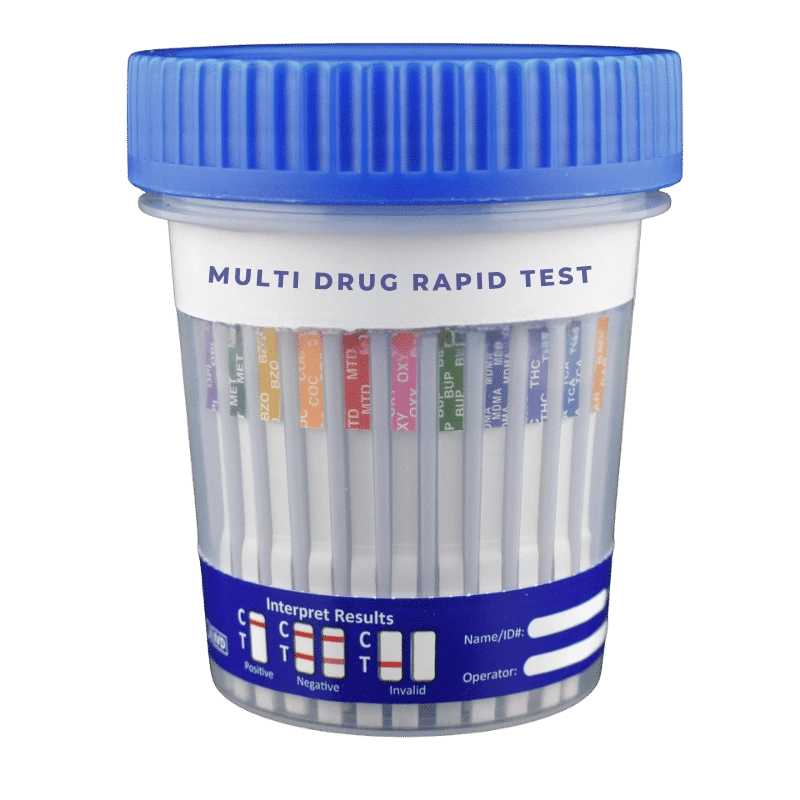
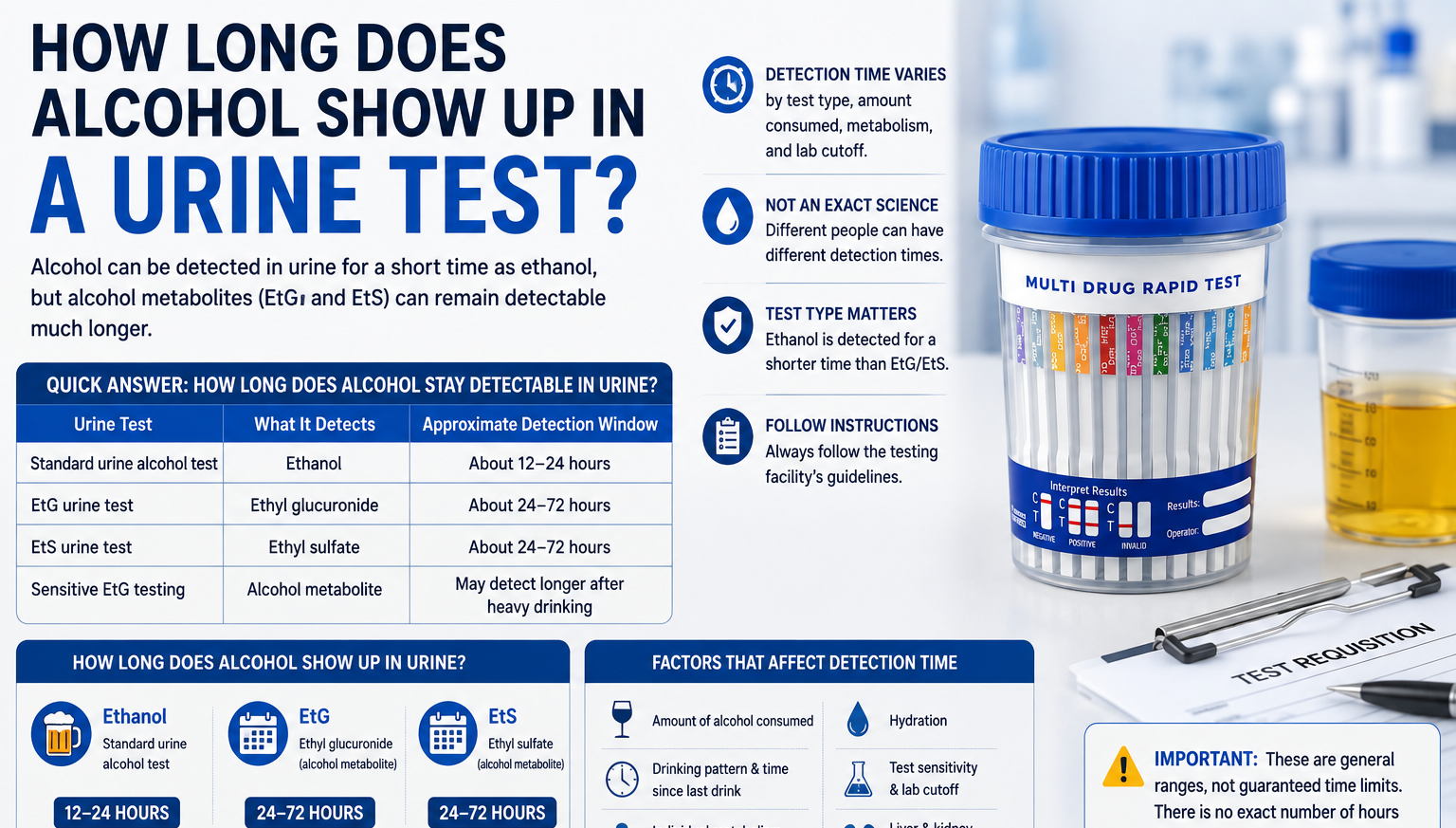
How Long Does Alcohol Show Up in a Urine Test?
If you have an upcoming urine test, you may be wondering how long alcohol shows up in a urine test after drinking. The answer depends on what the test is actually measuring.
A standard urine alcohol test looks for ethanol, the alcohol itself, and generally has a relatively short detection window. Other urine tests look for alcohol metabolites such as ethyl glucuronide (EtG) and ethyl sulfate (EtS). These metabolites can remain detectable after the alcohol itself has already left the body.
In general, alcohol may be detectable in urine for approximately 12 to 24 hours, while an EtG urine test may detect recent alcohol use for about 24 to 72 hours and sometimes longer after heavy drinking.
The exact detection time varies according to the type of test, amount consumed, drinking pattern, metabolism, and laboratory cutoff.
Quick Answer: How Long Does Alcohol Stay Detectable in Urine?
The detection window depends primarily on the type of urine test:
| Urine Test | What It Detects | Approximate Detection Window |
|---|---|---|
| Standard urine alcohol test | Ethanol | About 12–24 hours |
| EtG urine test | Ethyl glucuronide | About 24–72 hours |
| EtS urine test | Ethyl sulfate | About 24–72 hours |
| Sensitive EtG testing | Alcohol metabolite | May detect longer after heavy drinking |
These are general ranges, not guaranteed time limits. A person’s alcohol exposure, drinking amount, metabolism, hydration, test sensitivity, and laboratory cutoff can all influence the result.
What Does a Urine Alcohol Test Detect?
A urine alcohol test does not always look for the same substance.
Some tests measure ethanol, while others measure metabolites created when the body processes alcohol. This distinction is important because ethanol disappears from the body much faster than some of its metabolites.
Ethanol
Ethanol is the alcohol contained in alcoholic beverages. Once consumed, the body absorbs it into the bloodstream and begins metabolizing it.
Because ethanol is eliminated relatively quickly, a urine test that specifically measures ethanol generally has a shorter detection window.
Ethyl Glucuronide (EtG)
Ethyl glucuronide (EtG) is a metabolite produced after the body processes alcohol.
EtG can remain detectable in urine after a person no longer feels intoxicated or impaired. This is why someone can feel completely sober and still have a positive EtG result.
EtG testing is commonly associated with situations where recent alcohol exposure needs to be monitored, including certain workplace, legal, treatment, or compliance testing programs.
Ethyl Sulfate (EtS)
Ethyl sulfate (EtS) is another alcohol metabolite that can be measured in urine.
Like EtG, EtS can provide evidence of recent alcohol exposure after ethanol itself has been eliminated.
How Long Does Alcohol Show Up in a Urine Test?
For a standard urine alcohol test, alcohol may generally be detectable for around 12 to 24 hours after drinking.
However, an EtG or EtS urine test can have a considerably longer detection window.
A general guide is:
- Ethanol: approximately 12–24 hours
- EtG: commonly around 24–72 hours
- EtS: commonly around 24–72 hours
- Heavy alcohol consumption: metabolites may sometimes remain detectable beyond the typical range
The important distinction is that “alcohol” and “alcohol metabolites” are not the same thing.
A test that detects ethanol may become negative relatively quickly, while a test designed to detect EtG can remain positive for substantially longer.
How Long Does EtG Stay in Urine?
EtG is one of the most important terms to understand when researching urine alcohol testing.
After alcohol enters the body, a small portion is converted into metabolites including EtG. Unlike ethanol, EtG remains in the body longer and can be detected through urine testing after the effects of alcohol have worn off.
A commonly cited EtG detection range is approximately 24 to 72 hours.
In some circumstances, particularly following heavier alcohol consumption, EtG may be detectable for up to around 80 hours. However, this should not be interpreted as a guaranteed detection period.
The result can vary based on:
- Amount of alcohol consumed
- Frequency of drinking
- Time since the last drink
- Individual metabolism
- Kidney function
- Hydration
- Test sensitivity
- Laboratory cutoff level
- Type of specimen and testing method
Therefore, there is no exact number of hours that guarantees a negative EtG test.
Alcohol Urine Test Detection Window
Understanding the different detection windows can make urine alcohol testing easier to understand.
Standard Urine Alcohol Test
A standard urine alcohol test may detect ethanol for approximately 12 to 24 hours.
Because ethanol is eliminated relatively quickly, this type of test is primarily useful for identifying relatively recent alcohol consumption.
The detection period can vary depending on the amount consumed and individual factors.
EtG Urine Test
An EtG test detects ethyl glucuronide, rather than measuring only the alcohol itself.
EtG generally has a longer detection window than ethanol. A urine EtG test may detect recent alcohol exposure for approximately 24 to 72 hours, with longer detection possible in some circumstances.
EtS Urine Test
EtS testing detects ethyl sulfate, another alcohol metabolite.
EtS can also remain detectable after ethanol has been eliminated and is sometimes evaluated alongside EtG.
Using EtG and EtS together can provide additional information when a laboratory is specifically testing for recent alcohol exposure.
What Factors Affect How Long Alcohol Shows Up in Urine?
There is no universal detection time that applies to everyone.
Several factors can influence how long alcohol or its metabolites remain detectable.
1. Amount of Alcohol Consumed
The amount you drink is one of the most important factors.
A single standard drink and several drinks consumed over a short period do not necessarily produce the same detection pattern.
Greater alcohol consumption can result in higher levels of alcohol metabolites and potentially extend the period during which they can be detected.
2. Drinking Pattern
The pattern of consumption also matters.
Occasional drinking, repeated drinking, and heavy drinking can produce different detection profiles.
For example, someone who consumes a large amount of alcohol over several hours may have a longer metabolite detection window than someone who consumes a smaller amount.
3. Time Since Your Last Drink
The longer the time between drinking and testing, the more time the body has had to metabolize and eliminate alcohol and its metabolites.
However, time alone cannot guarantee a negative test result, particularly when an EtG test is being used.
4. Individual Metabolism
Alcohol is primarily metabolized by the liver, but the rate at which alcohol is processed differs among individuals.
Factors such as genetics, age, body composition, liver health, and overall health can influence alcohol metabolism.
5. Hydration
Hydration can affect the concentration of substances in urine.
Drinking excessive amounts of water, however, is not a reliable way to eliminate alcohol metabolites. Testing laboratories may also evaluate urine concentration and identify a specimen as diluted.
6. Test Sensitivity
Not every urine alcohol test has the same sensitivity.
Laboratories may use different testing technologies and cutoff concentrations. A more sensitive test may detect lower concentrations of an alcohol metabolite.
This is one reason why two people can have different results even when their drinking patterns appear similar.
Can You Test Positive for Alcohol After You Feel Sober?
Yes.
Feeling sober does not necessarily mean that every alcohol-related substance has disappeared from your body.
A person may no longer feel the effects of alcohol while an EtG or EtS test can still detect alcohol metabolites in urine.
This happens because:
Alcohol consumption → alcohol metabolism → alcohol metabolites → urine elimination
The alcohol itself can disappear relatively quickly, while metabolites such as EtG can remain detectable for longer.
Therefore, sobriety and a negative urine alcohol test are not necessarily the same thing.
Does a Regular Drug Test Check for Alcohol?
Usually, not necessarily.
A standard multi-panel drug test is generally designed to screen for specific drugs or drug metabolites. Alcohol is not automatically included in every routine drug test.
Whether alcohol is tested depends on:
- The test panel
- Employer requirements
- Testing program
- Laboratory procedure
- Court or probation requirements
- Treatment program
- Safety-sensitive workplace policies
For example, a drug test that screens for substances such as marijuana, cocaine, amphetamines, opioids, or benzodiazepines does not automatically mean that the same test is checking for alcohol.
If alcohol testing is required, a separate alcohol test or an alcohol-specific component may be used.
Can Alcohol Show Up on a 5-Panel or 10-Panel Drug Test?
A 5-panel or 10-panel drug test does not automatically test for alcohol simply because it tests multiple substances.
The exact substances included depend on the specific panel.
Some testing programs may add alcohol or alcohol metabolites such as EtG to a drug-testing program. Others may not.
Therefore, the name or number of panels alone is not enough to determine whether alcohol is included.
Always check the test’s listed analytes or the testing instructions to determine whether alcohol, EtG, or EtS is being tested.
Can You Test Positive for EtG Without Drinking Alcohol?
Certain products and exposures may contain alcohol or trace amounts of alcohol.
Examples can include:
- Alcohol-containing mouthwash
- Breath sprays
- Alcohol-based hand sanitizer
- Some cosmetics
- Certain cleaning products
- Fermented foods or beverages
- Some “non-alcoholic” beverages
However, exposure does not automatically mean that someone will receive a positive laboratory result. The likelihood and significance depend on the product, exposure level, testing method, cutoff, and circumstances.
If you are undergoing an alcohol-specific test, tell the testing provider about relevant alcohol-containing products you have used.
Does Mouthwash Affect an Alcohol Urine Test?
Some mouthwashes contain alcohol, which is why they are frequently mentioned when discussing EtG testing.
However, drinking mouthwash and using a normal alcohol-containing mouthwash are not equivalent exposures.
If you are preparing for a test, follow the testing facility’s instructions and avoid unnecessary exposure to alcohol-containing products when instructed to do so.
Do not assume that using mouthwash will definitely cause a positive result.
Does Hand Sanitizer Affect an EtG Test?
Many hand sanitizers contain ethanol or other alcohols.
Because EtG tests are sensitive to alcohol exposure, incidental exposure is sometimes considered when interpreting unexpected results.
Normal use of hand sanitizer does not necessarily mean that an individual will fail an EtG test. Laboratory interpretation depends on exposure, concentration, timing, cutoff levels, and the testing method.
If you are concerned about an unexpected result, discuss the result and any potential exposure with the testing provider rather than trying to interpret the result based only on a detection-time chart.
Can Drinking Water Remove Alcohol From Urine?
No reliable method can rapidly remove alcohol or its metabolites from the body.
Water is important for normal hydration, but drinking excessive amounts of water does not make the liver metabolize alcohol faster.
Large amounts of water can also dilute a urine specimen.
A diluted sample may be identified by the laboratory through measures of urine concentration and may lead to additional testing or a request for another specimen.
The safest approach is not to rely on excessive water intake or other methods intended to manipulate a urine test.
Does Coffee Make Alcohol Leave Your System Faster?
No.
Coffee may make someone feel more alert because caffeine is a stimulant, but it does not significantly accelerate the body’s alcohol metabolism.
Similarly, cold showers, exercise, or other popular “sobering up” methods do not reliably make alcohol disappear faster.
The body needs time to metabolize alcohol naturally.
Does Food Make Alcohol Leave Your Urine Faster?
Food can influence how quickly alcohol is absorbed, particularly when consumed before or while drinking.
However, once alcohol has entered the bloodstream, eating food does not provide a reliable way to accelerate its elimination.
Food should not be considered a method for shortening the detection window of a urine alcohol test.
Urine Alcohol Test vs. Other Alcohol Tests
Different testing methods have different purposes and detection windows.
| Test Type | What It Measures | General Detection Pattern |
|---|---|---|
| Urine ethanol | Alcohol in urine | About 12–24 hours |
| Urine EtG | Alcohol metabolite | About 24–72 hours; sometimes longer |
| Urine EtS | Alcohol metabolite | About 24–72 hours |
| Blood test | Alcohol in blood | Primarily recent use |
| Breath test | Alcohol associated with breath/BAC | Primarily recent use |
| Hair testing | Longer-term alcohol exposure markers | Much longer timeframe |
These ranges are general. A test’s actual detection capability depends on its methodology and purpose.
How Accurate Are Urine Alcohol Tests?
Urine alcohol testing can be useful for identifying recent alcohol exposure, but no test should be interpreted without considering its methodology.
Accuracy can be influenced by:
- Collection procedures
- Sample handling
- Laboratory testing method
- Cutoff concentration
- Specimen dilution
- Timing
- Potential incidental exposure
- The substance being tested
EtG testing is particularly useful because it can detect alcohol exposure after ethanol itself is no longer readily detectable.
However, an EtG result does not necessarily tell you exactly how much alcohol someone consumed or exactly when they consumed it.
Can a Urine Test Tell How Much Alcohol You Drank?
Not necessarily.
An alcohol urine test can indicate the presence of alcohol or alcohol metabolites, depending on the test.
EtG concentration may provide information about recent exposure, but it should not be treated as a precise measurement of the number of drinks consumed.
Factors such as timing, metabolism, hydration, test cutoff, and incidental exposure can affect the concentration.
For this reason, a urine EtG result should be interpreted in the context of the testing method and circumstances.
Why Can Two People Have Different Alcohol Detection Times?
Two people can drink similar amounts and still have different testing results.
Differences may involve:
- Body composition
- Age
- Metabolism
- Liver function
- Drinking frequency
- Amount consumed
- Time between drinking and testing
- Hydration
- Test sensitivity
- Laboratory cutoff
This is why online “exact hour” calculators should not be treated as guarantees.
There is no reliable formula that can tell everyone exactly when a urine alcohol test will become negative.
How Long Does One Drink Stay in Your System?
A standard drink is often used as a reference point when discussing alcohol metabolism.
Examples of a standard drink include approximately:
- 12 ounces of regular beer
- 5 ounces of wine
- 1.5 ounces of distilled spirits
The body generally metabolizes alcohol at a relatively steady rate, but individual differences are substantial.
More importantly, the time required to metabolize alcohol is not the same as the time an alcohol metabolite may remain detectable in urine.
Therefore, even if the alcohol itself has been metabolized, an EtG urine test may still detect evidence of recent alcohol exposure.
What Should You Know Before an Alcohol Urine Test?
If you have an upcoming test, the most important thing is to understand what the test is designed to detect.
Check whether the test measures:
- Ethanol
- EtG
- EtS
- Other alcohol biomarkers
You should also understand the collection instructions provided by the testing facility.
Avoid attempting to manipulate the specimen with excessive water or other substances. If you have questions about the testing procedure, ask the laboratory, employer, healthcare provider, or organization that ordered the test.
Frequently Asked Questions
How long does alcohol show up in a urine test?
Alcohol itself may generally be detected in urine for around 12 to 24 hours. Tests for alcohol metabolites such as EtG can detect recent alcohol exposure for approximately 24 to 72 hours, with longer detection possible after heavier drinking.
How long does EtG stay in urine?
EtG is commonly detectable in urine for approximately 24 to 72 hours. In some circumstances, detection may extend to around 80 hours or longer.
Can alcohol show up in a regular urine drug test?
Not automatically. A routine drug test only detects the substances included in its testing panel. Alcohol or EtG must be specifically included or separately tested.
Can you test positive for alcohol after drinking the day before?
Yes, depending on the type of test. A urine ethanol test and an EtG test have different detection windows, and EtG may remain detectable after alcohol itself has been eliminated.
Can drinking water help pass a urine alcohol test?
Drinking water does not reliably eliminate alcohol or EtG faster. Excessive water can dilute a urine specimen and may result in a diluted or invalid sample.
Does coffee remove alcohol from your system?
No. Coffee may make you feel more awake, but it does not reliably speed up alcohol metabolism.
Can mouthwash cause an EtG positive?
Alcohol-containing products are sometimes considered when evaluating an unexpected EtG result. Normal exposure does not automatically mean a positive result, but relevant products should be disclosed to the testing provider when appropriate.
Does an EtG test show how much alcohol I drank?
No. EtG testing can identify recent alcohol exposure, but the result should not be used as a precise measurement of the amount consumed.
Is being sober the same as testing negative?
No. You can feel completely sober while an alcohol metabolite such as EtG remains detectable in urine.
How long should I wait before a urine alcohol test?
There is no universal waiting period that guarantees a negative result. Detection depends on the test, amount consumed, timing, individual factors, and laboratory cutoff.