16 Panel Drug Test: What It Screens For and How to Buy
A 16 panel drug test is a urine screen that checks for 16 drugs or drug classes in one sample, usually on an instant cup read in about five minutes. There is no single national definition of the 16 panel, so the exact list depends on the manufacturer or laboratory. This guide explains what is typically included, how to read a result, what a positive does and does not mean, and what a program buyer should verify before ordering 16-panel cups in volume.
Table of Contents
- TL;DR
- What a 16 panel drug test screens for
- How our 16-panel cup is built
- CLIA waived or Forensic Use Only: know which cup you need
- Reading a 16-panel result
- Cutoffs: why the same drug can read differently
- How long drugs stay detectable in urine
- Our perspective: a bigger panel is not a better program
- What to check before you buy 16-panel cups in bulk
- Wholesale pricing for 16-panel cups
- FAQ
- Sources
TL;DR
- A 16 panel drug test is a presumptive urine screen. A positive is preliminary and needs confirmation by GC/MS or LC-MS/MS before anyone acts on it.
- The 16 analytes are not standardized. Always read the package insert for the exact drugs and cutoffs of the cup you buy.
- Our 16-panel cup adds kratom and TCA and carries ETG alcohol and fentanyl. It is Forensic Use Only and not CLIA waived. Our 12-panel cup with PCP is the CLIA-waived, FDA-cleared option.
- Detection windows range from hours for alcohol to a month or more for chronic heavy cannabis use, so a result never shows when someone last used or whether they are impaired.
Quick answer: A 16 panel drug test screens urine for 16 drugs or drug classes at preset cutoff concentrations. Common targets are amphetamines, barbiturates, benzodiazepines, cocaine, methadone, opiates, oxycodone and PCP, with newer cups adding fentanyl, alcohol (ETG) and others. Results are presumptive. Positives go to a laboratory for confirmation.
What a 16 panel drug test screens for
The number 16 describes how many tests sit on one device or order, not a fixed list of drugs. That is why two products sold as “16 panel” can differ by several analytes.
Published laboratory menus show how much the lists vary. A forensic laboratory 16-panel with confirmation lists amphetamines, barbiturates, benzodiazepines, cocaine (as benzoylecgonine), methadone, opiates including oxycodone and oxymorphone, phencyclidine and propoxyphene. A different national laboratory’s urine 16 profile includes fentanyl, ethyl alcohol, 6-acetylmorphine, buprenorphine, methylphenidate, tapentadol, THC and tramadol, among others. A third commercial 16-panel urine offering adds marijuana, meperidine, ketamine, norfentanyl and tramadol.
Those are laboratory services, and an instant cup is built differently. But the lesson carries over: the label alone does not tell you what is tested.
The drugs most 16-panel screens share
Across products, a core group appears again and again:
- Amphetamines, often with methamphetamine
- Barbiturates
- Benzodiazepines
- Cocaine (detected through its metabolite)
- Methadone
- Opiates, with oxycodone often broken out separately
- Phencyclidine (PCP)
- THC (marijuana)
The remaining slots are filled differently depending on who designed the panel. Common choices are fentanyl, buprenorphine, tramadol, propoxyphene, meperidine, ketamine, alcohol through its metabolite ethyl glucuronide (ETG), and newer additions such as kratom.
Why the lists keep changing
Laboratory medicine is moving away from fixed bundles. The professional guidance from ADLM notes that automated immunoassays and mass spectrometry make testing more flexible, and that in the U.S. there is regulatory and payer movement away from bundling tests. For a buyer, that means a “16 panel” is best seen as a menu designed for a particular program, not a standard.
If you want the full analyte breakdown from our side, we keep a guide on what a 16-panel drug screen tests for.
How our 16-panel cup is built
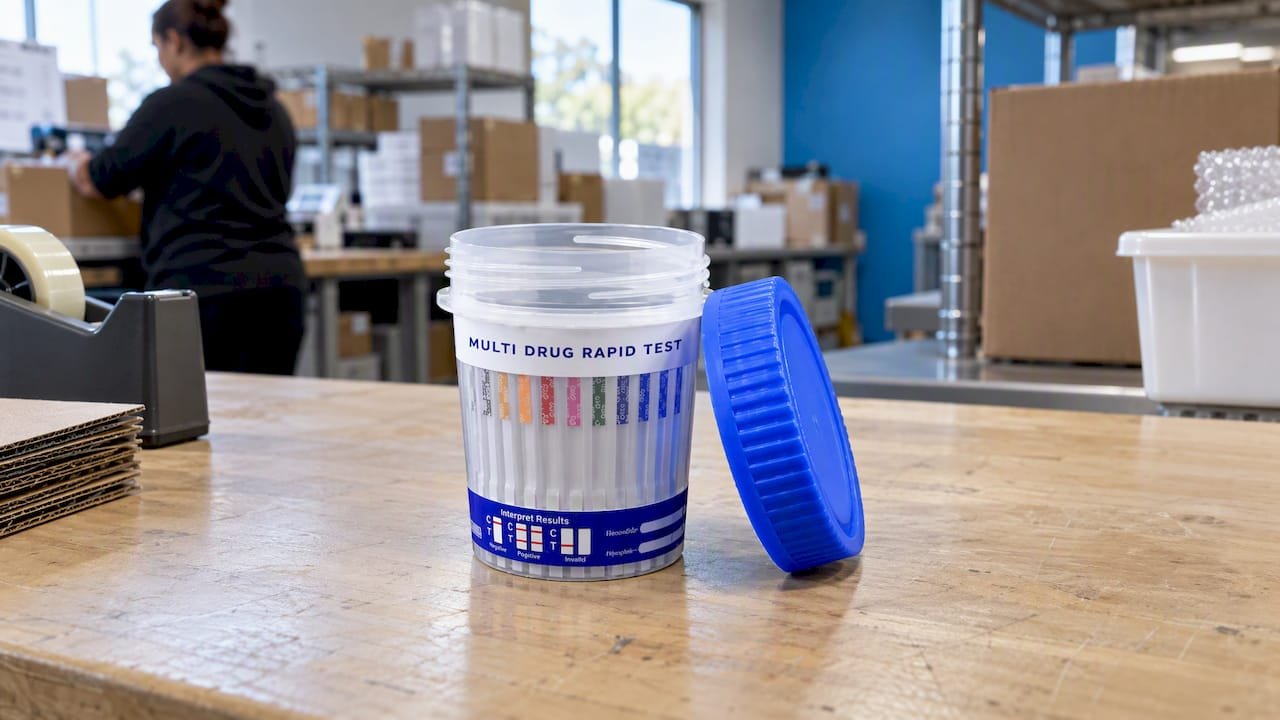
Mayflower Bioscience is a US-based wholesale supplier of rapid multi-panel urine drug test cups for clinics, behavioral health programs, employers, drug courts, corrections and distributors. We keep the catalog to four configurations on purpose, so buyers can compare cups without sorting through dozens of near-identical SKUs.
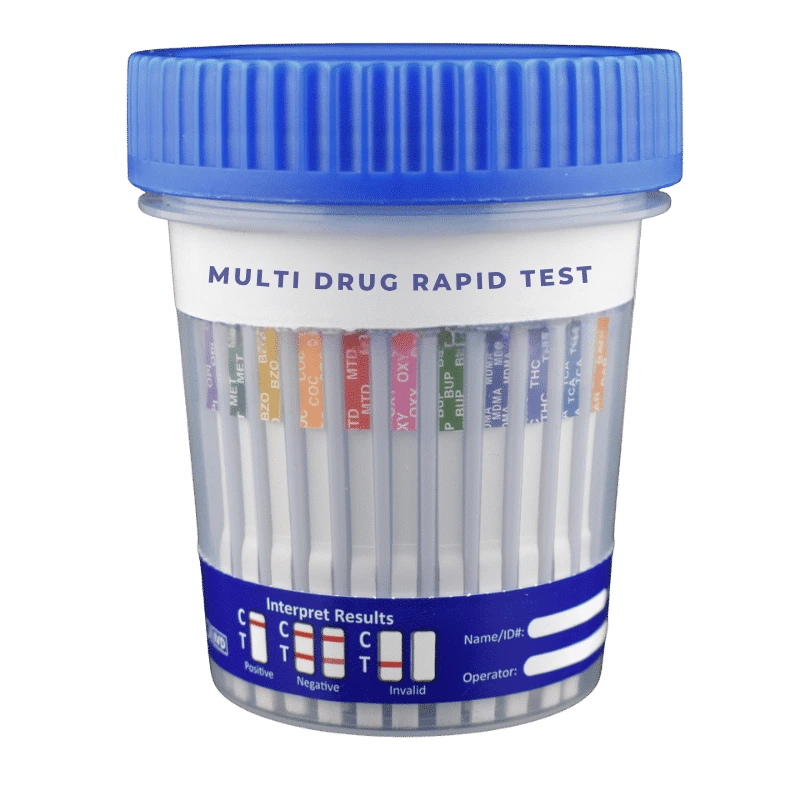
Our 16 panel drug test cup with ETG, fentanyl and kratom is the broadest of the four. What we can state about it:
- It is a 16-panel cup that adds kratom and TCA (tricyclic antidepressants) to the 14-panel configuration, which already carries PCP, ETG alcohol and fentanyl.
- It has an integrated temperature strip, so the collector can check the specimen temperature at the time of collection.
- It gives a rapid read in about five minutes.
- It is a Forensic Use Only cup. It is not CLIA waived.
- Pricing starts from $2.59 per cup, with free shipping on 100+ cups and same-day dispatch from US stock.
The full analyte list and the cutoff for each drug are printed in the package insert and on the product page. Read those before you set a testing policy, because your policy should name the drugs you actually screen for.
Where the other three cups fit
The smaller configurations exist for programs that do not need the full menu:
- 12-panel CLIA-waived, FDA-cleared cup with PCP. The option for point-of-care settings that need a waived test.
- 12-panel forensic-use cup with ETG alcohol and fentanyl. Compact, and adds the two analytes many monitoring programs ask about first.
- 14-panel cup with PCP, ETG and fentanyl. The middle step before kratom and TCA.
If you are deciding between sizes, our comparisons of 12 vs 14 panel and 14 vs 16 panel cups go through the drug lists side by side. A broader panel is not automatically better. Every extra analyte is another possible presumptive positive that someone has to handle.
CLIA waived or Forensic Use Only: know which cup you need
This is the first question a compliance lead should ask, and the answer decides which cup is even allowed in your setting.
A CLIA-waived test can be performed in a point-of-care setting under a certificate of waiver. In our catalog, that is the 12-panel cup with PCP, which is also FDA cleared. A Forensic Use Only cup is built for non-clinical screening programs such as workplace, court-supervised, corrections and similar monitoring. Our 12-panel ETG/fentanyl cup, 14-panel cup and 16-panel cup are in that group. They are not CLIA waived.
In practice:
- If a clinician will use the result for patient care at the point of care, start with the CLIA-waived cup and confirm your regulatory requirements with your own compliance advisor.
- If you run a screening program where a presumptive result triggers a confirmation order or a policy step, a forensic-use cup with a wider menu may fit.
- If you are unsure, ask your medical director or legal counsel before buying, not after the cups arrive.
We would rather you pick the right cup than the biggest one. If you cannot say which category your program falls into, our team can talk it through when you request a quote.
Reading a 16-panel result
A cup shows a result for each drug. In general, a line in the test region means no drug at or above the cutoff was detected, and a missing line means the sample is presumptively positive for that drug. Your cup’s insert has the exact reading instructions, including what to do with faint lines and invalid tests. Follow the insert, not a general description.
Negative, positive and invalid
A negative means the drug was not found above the cutoff. It does not mean the person used nothing. A drug can be present below the cutoff, or the window can have passed.
A positive is presumptive. Professional guidance distinguishes presumptive testing, which gives preliminary evidence of presence or absence, from definitive testing, which identifies specific drugs, metabolites or quantities. ADLM adds that immunoassay results are presumptive, and mass spectrometry is the definitive or confirmation method.
An invalid result, such as a missing control line, means the test did not work. Retest with a new cup.
Why confirmation matters
Immunoassays react to classes of molecules. A peer-reviewed practical guide to urine drug monitoring explains that they can produce false positives or false negatives because they lack the specificity of chromatography. The same guide notes that analytes such as fentanyl, oxycodone, methadone, buprenorphine and tramadol have to be separately ordered or built into the panel. That is the reason a cup that lists those drugs matters, and also the reason a negative on a cup without them tells you nothing about them.
So the rule for any program: a presumptive positive from a cup is a reason to send the specimen for GC/MS or LC-MS/MS confirmation. It is not a finding on its own. Do not take adverse action, and do not make a clinical decision, from the cup result alone.
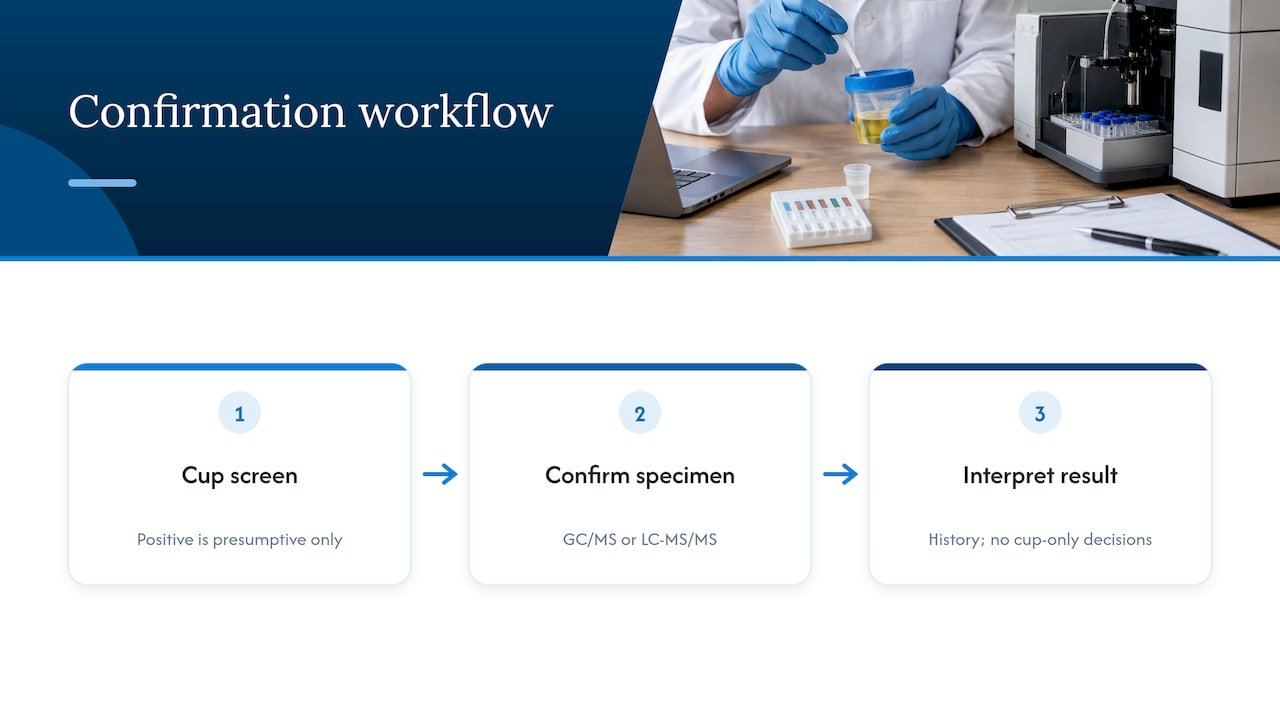
NIDA is direct about the limits. Urine tests do not establish when a drug was last taken, how long someone has used, or whether they are intoxicated, and results should be read together with clinical history and other assessment.
Cutoffs: why the same drug can read differently
A cutoff is the concentration, usually in ng/mL, at which the test calls a result positive. Set it higher and you miss lower concentrations. Set it lower and you catch more, but you also see more cross-reactivity.
There is no single standard. ADLM states that there is no universal consensus on optimal cutoff levels for 16-panel drug tests, and that immunoassay cutoffs are often set by manufacturers while mass spectrometry cutoffs are set by individual laboratories. The same guidance recommends that results come with interpretive comments on cutoffs and cross-reactivity.
What this means when you buy:
- Get the insert for the exact lot you are buying. The cutoffs for every analyte are listed there.
- Write the cutoffs into your policy. Staff should know what “positive” means in your program.
- Do not compare cups on the number of panels alone. Two 16-panel cups can have different cutoffs for the same drug.
- Check that the confirmation lab uses a compatible approach. A confirmation threshold is set by that laboratory, not by the cup.
We do not publish generic cutoff figures in this article, because they differ by product and we would rather you read them from the insert than from a blog post.
How long drugs stay detectable in urine
Detection windows are the most misunderstood part of urine testing. They vary by drug, dose, frequency of use, body mass, urine pH and the person’s metabolism. An academic clinician’s guide from Mayo Clinic Proceedings describes that urine detection depends on pharmacokinetics, metabolites, body mass, short- versus long-term use, urine pH and time since last ingestion. Its examples run from about 7 to 12 hours for alcohol to around 30 days for long-acting benzodiazepines, and beyond 30 days for chronic heavy cannabis use.
Two points follow for a program manager:
- Short windows mean a negative is not proof of abstinence. A person who used a short-acting drug a few days ago may test negative.
- Long windows mean a positive is not proof of recent use. A positive for cannabis in a heavy user may reflect use weeks earlier.
Neither pattern tells you about impairment. For that reason, programs usually combine testing with observation, interviews and clinical judgment, which is also what NIDA advises.
A note on alcohol (ETG)
Our 14- and 16-panel cups include ETG, a metabolite of alcohol. A metabolite test can show alcohol exposure beyond the few hours that alcohol itself stays in the body, which is why monitoring programs ask for it. The insert gives the ETG cutoff for the cup. Because ETG is very sensitive, your policy should say how positives are reviewed and confirmed before anyone relies on them.
Our perspective: a bigger panel is not a better program
We supply these cups every week to clinics, behavioral health programs, courts and employers, and one pattern repeats. Buyers start by asking for the largest panel, then discover that the panel was never the hard part.
The hard parts are the decisions around the cup. Who collects, and do they check the temperature strip every time? What happens after a presumptive positive: who orders the confirmation, how fast, and who sees the result? Which drugs does your policy actually act on? A 16-panel cup that screens for drugs nobody in your program is prepared to handle creates results with no plan behind them.
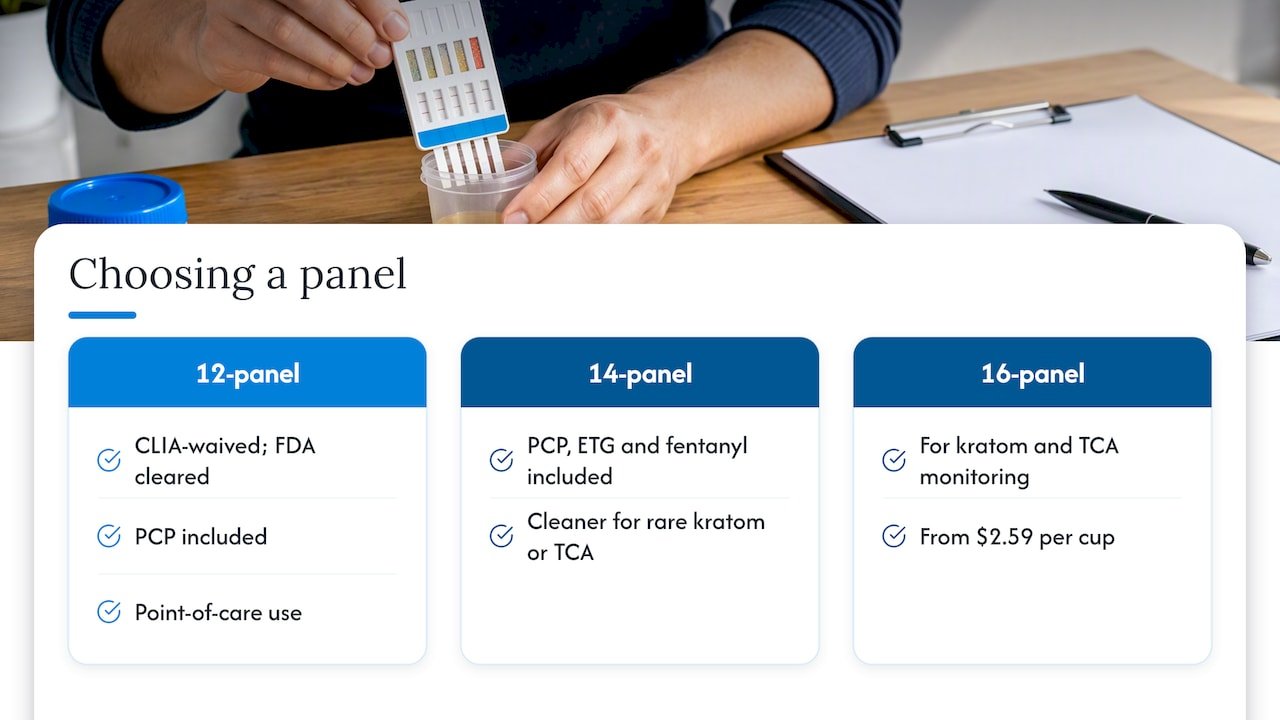
That is why we keep the catalog to four cups. If your population rarely involves kratom or tricyclics, the 14-panel with PCP, ETG and fentanyl may be the cleaner choice. If you need a CLIA-waived cup for point-of-care use, the 12-panel with PCP is the one. If you have a monitoring program that does see kratom and TCA, the 16-panel is there and priced from $2.59 per cup.
We also want to be plain about what a cup cannot do. It cannot tell you when someone last used, cannot tell you if they are impaired, and cannot stand in for a laboratory confirmation. We would never advise anyone on how to get around a test, and we will not help with that. Our job is to supply reliable screening devices for programs that use them properly.
— Alina
What to check before you buy 16-panel cups in bulk
Use this list when you compare suppliers of any kind, including us.
- Regulatory category. Is the cup CLIA waived or Forensic Use Only? Match it to your setting.
- Analyte list. Does it include the drugs your policy covers, such as fentanyl or ETG? Confirm each one on the insert.
- Cutoffs. Request the insert and keep a copy with your policy.
- Temperature strip. Integrated strips save a step at collection and help flag specimens outside the expected range.
- Read time. Our cups read in about five minutes, which keeps collection lines moving.
- Stock and dispatch. Same-day dispatch from US stock matters when you run low mid-quarter.
- Shipping terms. We ship free on 100+ cups.
- Recurring orders. Multi-site and standing orders should go through a quote, so pricing and delivery are set once.
- Confirmation plan. Choose your GC/MS or LC-MS/MS laboratory before the first test, not after the first positive.
Laboratories confirming specimens usually report in days, not minutes. One forensic laboratory lists a turnaround of 1 to 3 days, so plan how your program handles the interval between a presumptive positive and a confirmed result.
If fentanyl is the main reason you are looking at a 16 panel, our guide on which drug test panels include fentanyl covers the 12, 14 and 16 configurations.
Wholesale pricing for 16-panel cups
Our 16 panel cup with ETG, fentanyl and kratom starts from $2.59 per cup, with volume pricing, free shipping on 100+ cups and same-day dispatch from US stock. For multi-site or recurring accounts, we set terms through a wholesale quote.

Tell us your monthly volume, the sites you serve and whether you need CLIA-waived or forensic-use cups, and we will match you with the right configuration. You can see all four cups on our multi-drug test cup page.
FAQ
What is the difference between a 12, 14 and 16 panel drug test?
Each step adds analytes. In our catalog, the 12-panel cups cover the core drugs, with PCP on the CLIA-waived version and ETG alcohol and fentanyl on the forensic-use version. The 14-panel carries PCP, ETG and fentanyl, and the 16-panel adds kratom and TCA. See our 12 panel guide and 14 panel guide for the lists.
Does gabapentin show up on a 16 panel drug test?
Only if the specific panel includes it. Some laboratory 16-panel configurations are built with gabapentin, but it is not among the additions we describe for our 16-panel cup, which adds kratom and TCA. Check the insert of any cup you are considering, and ask the laboratory if you need it tested on a confirmation order.
Is a 16 panel drug test result final?
No. A cup result is presumptive, so a positive should be confirmed with GC/MS or LC-MS/MS before any decision is made. Professional guidance describes immunoassays as presumptive and mass spectrometry as definitive.
How far back does a 16 panel urine test look?
It depends on the drug and the person. Clinical references give examples from about 7 to 12 hours for alcohol to a month or more for chronic heavy cannabis use. A urine test cannot show exactly when a drug was taken.
Where can I buy 16 panel drug test cups in bulk?
We supply them wholesale from St. Louis, Missouri, with volume pricing from $2.59 per cup on the 16-panel, free shipping on 100+ cups and same-day dispatch from US stock. Request a quote for multi-site or recurring orders through Mayflower Bioscience.
Sources
- Forensic Urine Drug Abuse Screen 16 with Confirmation
- ToxAssure Flex 16, Urine
- 16 Panel Drug Test, US Drug Test Centers
- ADLM guidance on laboratory testing for drugs of misuse
- Appropriate Use of Drug Testing in Clinical Addiction Medicine (ASAM)
- A Practical Guide to Urine Drug Monitoring
- Drug Testing, National Institute on Drug Abuse
- Urine Drug Screening: Practical Guide for Clinicians, Mayo Clinic Proceedings