PCR vs. Isothermal Amplification: How to Choose
Choose PCR (including qPCR) when you need quantification, multiplexing or the broadest assay flexibility in a equipped laboratory. Choose isothermal amplification, such as LAMP or RPA, when you need a fast, single-target yes/no answer and you cannot count on a thermal cycler. Both are nucleic acid amplification methods. They differ in how they copy the target, what hardware they need, how they fail, and what you can do with the result.
This guide walks through those differences with the published evidence, then gives a decision framework, a workflow checklist, and a short walkthrough of qPCR standard curve preparation, since many readers comparing the two methods end up there.
TL;DR
- PCR cycles through three temperature steps (denaturation, annealing, extension). Isothermal amplification runs at one constant temperature, so it does not need a thermal cycler.
- Isothermal methods often report results in roughly 15 to 60 minutes, and in one comparison LAMP detected 0.01 ng/µL of target DNA against 1.0 ng/µL for conventional PCR. Sensitivity depends heavily on the assay, so validate in your own matrix.
- qPCR remains the default for absolute quantification, multi-target panels and high-throughput reference work.
- “Isothermal” describes only the amplification step. Extraction, inhibitors and result readout can still decide whether the assay works.
- Run a standard curve with every new qPCR assay, and expect efficiency between 90% and 110%.
Table of Contents
- How the two methods actually work
- Side-by-side comparison
- Where PCR is the better choice
- Where isothermal amplification is the better choice
- What the marketing leaves out
- A practical way to choose
- Our perspective
- Preparing a qPCR standard curve
- Matching reagents to your decision
- Shop molecular biology reagents with US-based support
- FAQ
- Sources
How the two methods actually work
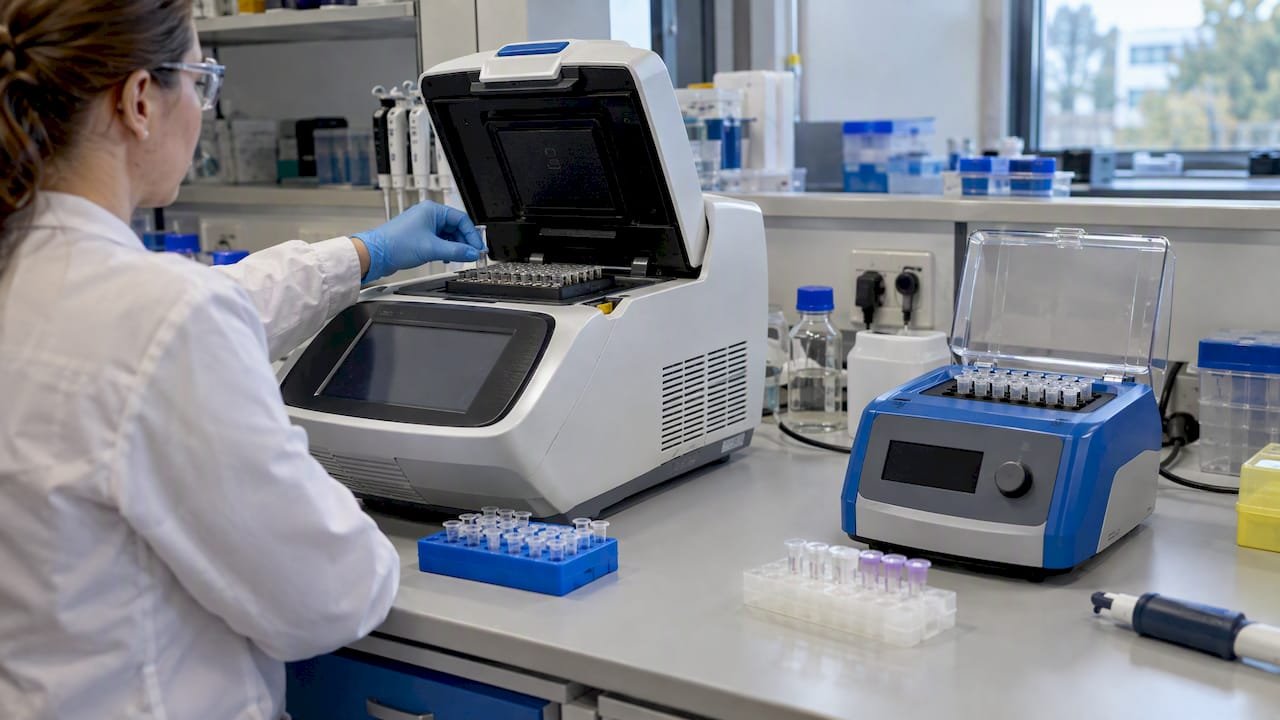
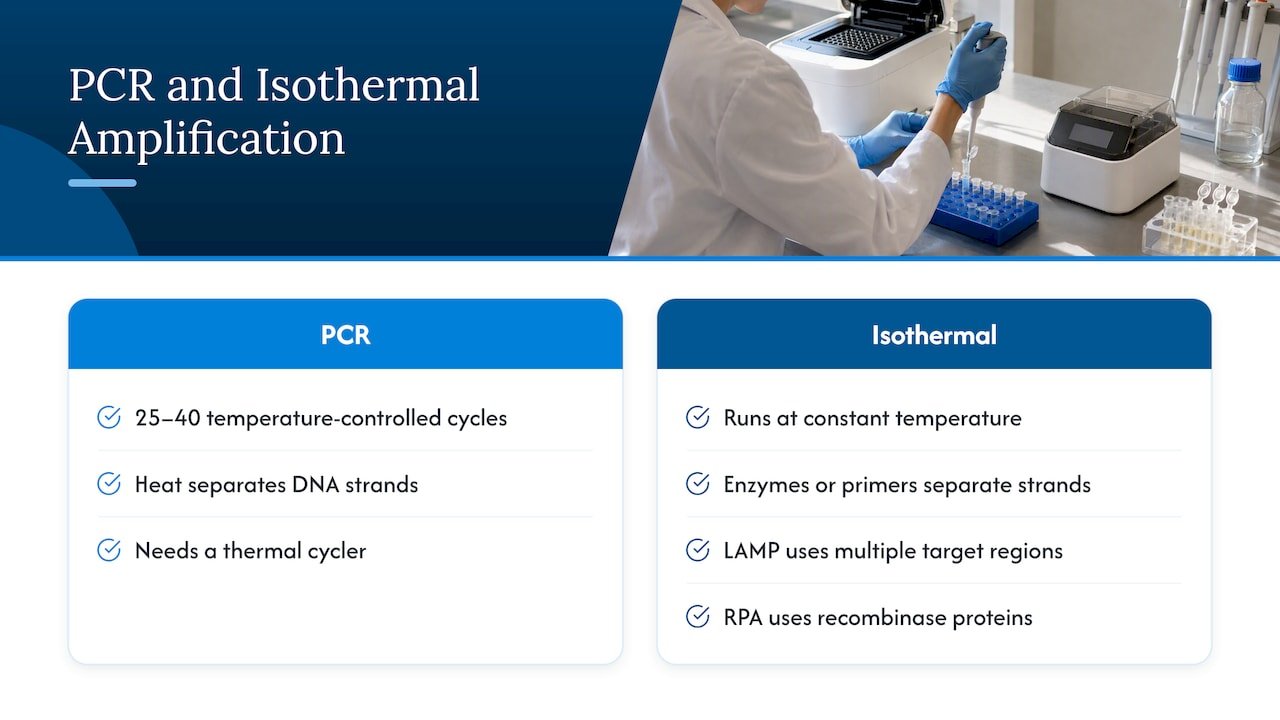
PCR amplifies a specific DNA fragment through three temperature-controlled steps: denaturation, annealing and extension. Heat separates the strands, primers bind as the temperature drops, and a polymerase extends them. Repeating that loop 25 to 40 times produces an exponential increase in copies. The loop is the reason PCR needs a thermal cycler with fast, accurate heating and cooling.
Isothermal amplification (IA) skips the loop. As one review puts it, IA operates at a constant temperature, removing the need for a complex, energy-intensive thermal cycler. Strand separation is handled by enzymes or by the primer design itself, rather than by heat. The best-known formats are loop-mediated isothermal amplification (LAMP), which uses a set of several primers recognizing multiple regions of the target, and recombinase polymerase amplification (RPA), which uses recombinase proteins to help primers invade double-stranded DNA. Other formats exist, and a comprehensive review of isothermal methods covers the range.
PCR came first, and it is still the benchmark. A CDC-hosted overview noted early on that PCR remains the most popular amplification method, with alternatives under active consideration. Two decades later that is still largely true in research labs, even as isothermal assays have entered diagnostics.
A quick note on terms
People often mix up qPCR and RT-PCR. They are different things. RT-PCR uses reverse transcriptase to convert RNA into cDNA before amplification. qPCR (real-time PCR) monitors amplification as it happens so you can quantify the starting material. The CDC’s overview of molecular assays for influenza draws this line and notes that RT-PCR and other nucleic acid amplification tests detect viral RNA. You can combine both in RT-qPCR. The isothermal counterpart for RNA targets is RT-LAMP, which is how several SARS-CoV-2 tests were built, such as the Color SARS-CoV-2 RT-LAMP Diagnostic Assay and the In-Dx SARS-CoV-2 RT-LAMP Assay, both reviewed by the FDA under emergency use authorizations as qualitative tests.
Side-by-side comparison
| Criterion | PCR / qPCR | Isothermal (LAMP, RPA) |
|---|---|---|
| Temperature profile | Cycled, three steps | One constant temperature |
| Instrument | Thermal cycler or real-time instrument | Heat block, water bath or simple portable device |
| Typical time to result | Longer, often an hour or more of cycling | Often 15 to 60 minutes |
| Quantification | Strong: Cq values and standard curves, absolute or relative | Possible with real-time readout, but less established; many assays are qualitative |
| Multiplexing | Mature, well supported | Harder; primer interactions complicate it |
| Assay design | Two primers (plus a probe for probe-based qPCR); many validated designs | More primers or specialized design; fewer off-the-shelf designs |
| Readout | Fluorescence, gel (endpoint) | Fluorescence, turbidity, colorimetric, lateral flow |
| Best setting | Research and reference labs, high throughput | Point of care, field work, rapid screening |
The speed and equipment claims come from the literature. In a comparison of PCR-based, LAMP and RPA-CRISPR/Cas12a assays built to detect a soybean fungal pathogen, isothermal methods delivered results in about 15 to 60 minutes, and LAMP reached a detection limit of 0.01 ng/µL versus 1.0 ng/µL for conventional PCR. That is one organism and one assay set, so treat it as an example of what is possible, not a rule that LAMP is always a hundred times more sensitive.
Where PCR is the better choice
Quantification
If your question is “how much,” use qPCR. Real-time monitoring lets you compare Cq values across samples or calculate copy number against a standard curve. Researchers who reviewed the evidence point out that PCR’s versatility with multiplex targets and its absolute quantification are why it stays dominant in large-scale, high-throughput reference laboratories. Copy-number work is a good example: genotyping tasks such as those discussed in this clinical lab guide to CYP2D6 copy number depend on precise quantitative molecular methods rather than a binary answer.
Multi-target screening
Experts weighing diagnostic options describe PCR as the favored route for complex, multi-pathogen screening and high-precision quantification. Multiplex qPCR lets you read several targets plus an internal control in one well by assigning different fluorophores. Multiplexing a LAMP reaction is possible but far less routine, because the many primers in a single tube can interfere with each other.
Flexibility and reagent availability
PCR design rules are well established, polymerases and master mixes come in many formulations (hot start, high fidelity, fast cycling, probe-based, dye-based), and one thermal cycler runs all of them. If your lab changes targets often, that flexibility counts for more than raw speed. Our guides on types of molecular biology assays and on setting up optimized PCR workflows go through those choices.
Where isothermal amplification is the better choice
Speed and simple hardware
When the result must come back while the patient, farmer or inspector is still waiting, isothermal methods have an edge. Specialists describe the shift toward them as driven by decentralized, point-of-care testing in resource-limited or field settings, where thermal cyclers and stable electricity are not guaranteed. A review of the field notes that IA is increasingly used in point-of-care settings, while PCR is traditionally done in specialized laboratories. For clinicians thinking about where such tests fit in practice, this overview of point-of-care testing in decentralized healthcare is a useful companion.
Single-purpose yes/no questions
The same expert commentary says isothermal methods are increasingly preferred for rapid, single-purpose screening where time to result matters most. Think of a presence/absence call for one pathogen, one contaminant or one genetically modified trait. If you do not need a number and you have a single target, a LAMP or RPA assay is a strong fit.
Low-resource and field validation
A 2026 overview of isothermal techniques as alternatives to PCR frames the appeal in terms of dropping the thermal cycler and simplifying the setup. That matters for teaching labs, agricultural field stations and outreach programs. It matters less in a core facility that already owns three cyclers.
What the marketing leaves out
The headline benefits are real. The practical problems are less advertised, and they are where labs switching from PCR get surprised.
“Isothermal” covers one step only
Many isothermal workflows still need nucleic acid extraction, and extraction can be the most time-consuming and labor-intensive part. A 10-minute amplification does not make a 10-minute test if sample preparation takes 45 minutes. When you compare methods, time the whole workflow from sample to answer, as the comparative evaluation cautions.
Inhibitors and sample matrix
Complex clinical or environmental samples carry inhibitors: humic substances, heme, polysaccharides, detergents and carry-over from lysis buffers. The reviewed evidence flags that isothermal reactions can be more sensitive to such interference than traditional PCR, which means upstream purification matters even if the amplification is “one pot.” Literature on LAMP is not unanimous here: some reports describe tolerance to compounds that inhibit standard PCR, which is a good reason to test your own matrix rather than trust either claim. Spike a known amount of target into a representative negative sample and compare it to the same amount in clean buffer.
Colorimetric readouts are subjective
Visual readouts, often a pH-driven color change, are convenient. They can also be misread when buffer capacity is overwhelmed or when the operator is not trained to separate subtle shifts at low target levels. In professional settings, instrument-based confirmation such as spectrophotometry is often required. If a result will drive a decision, use a quantitative optical readout, or write a clear interpretation rule and train to it.
Design and false positives
Because LAMP uses several primers at once, primer design is harder than for standard PCR and non-specific amplification can appear late in the reaction. Run no-template controls every time, keep pre- and post-amplification areas physically separate, and set a hard time cutoff for calling a positive. These are standard good practices, and isothermal reactions amplify so efficiently that contamination is easy to create.
A practical way to choose
Work through these questions in order.
- Do you need a number? If you need copy number, fold change or a viral load trend, use qPCR or RT-qPCR. If a yes/no answer is enough, either method can work.
- How many targets per sample? Three or more targets plus an internal control points to multiplex qPCR.
- Where will the test run? A bench with a cycler and trained staff favors PCR. A clinic room, truck or field site favors isothermal.
- How dirty is the sample? If your matrix is challenging, budget for extraction and inhibitor testing whichever method you pick.
- How much validation can you afford? PCR has many published, validated designs. For a new isothermal assay, plan more time for primer screening and specificity testing.
- What regulatory path applies? Diagnostic use has its own rules. The FDA emergency use summaries linked above show how RT-LAMP tests were described as qualitative assays for specific intended uses. Research use only reagents are not a shortcut into clinical claims.
If you answer “number, many targets, bench” you are looking at qPCR. If you answer “yes/no, one target, field,” start with LAMP or RPA. Most real projects land in between, and many labs run isothermal screening in the field and confirm positives by PCR back at the bench.
Our perspective
We talk with research and testing labs about amplification workflows every week, and the pattern is consistent: the method debate is rarely the real problem. Labs that struggle usually have a sample preparation problem, a controls problem or a validation problem, and swapping PCR for LAMP (or the reverse) does not fix any of them.
Our advice is to pick the method that matches the question you have to answer, then spend your effort on the boring parts. Write down the acceptance criteria before the first run. Test your extraction on your real samples, not on a clean control. Keep a standard curve and an internal control in every qPCR run. For isothermal assays, build in a no-template control and a defined time cutoff, and confirm any unexpected result with a second method.
We also think labs underestimate how much flexibility a good PCR reagent set gives them. Endpoint PCR, qPCR, RT-qPCR and specialty mixes cover most research questions without a new instrument. Isothermal reagents earn their place when speed or portability is the actual constraint, and we are glad to talk through whether that is true for your project.
— Alina
Preparing a qPCR standard curve
Readers who compare these methods often want the qPCR standard curve procedure next, because it is how you turn Cq values into quantities and check that your assay behaves.
Build the dilution series
Use a template of known concentration: a purified amplicon, a plasmid carrying the target, or a synthetic standard. A practical standard curve walkthrough recommends about five to eight points, with 10-fold dilutions as the usual choice, since each 10-fold step translates into a whole-cycle Cq shift. Prepare each dilution fresh from the previous one, change tips at every step, and mix thoroughly. Dilution error is one of the commonest causes of a poor curve.
Run it properly
- Run every point in at least triplicate on the same plate as your unknowns.
- Include a no-template control.
- Use the same master mix, primers and probe as the samples.
- For RNA targets, decide whether your standard is RNA (best, because it includes the reverse transcription step) or DNA, and state which.
Read the results
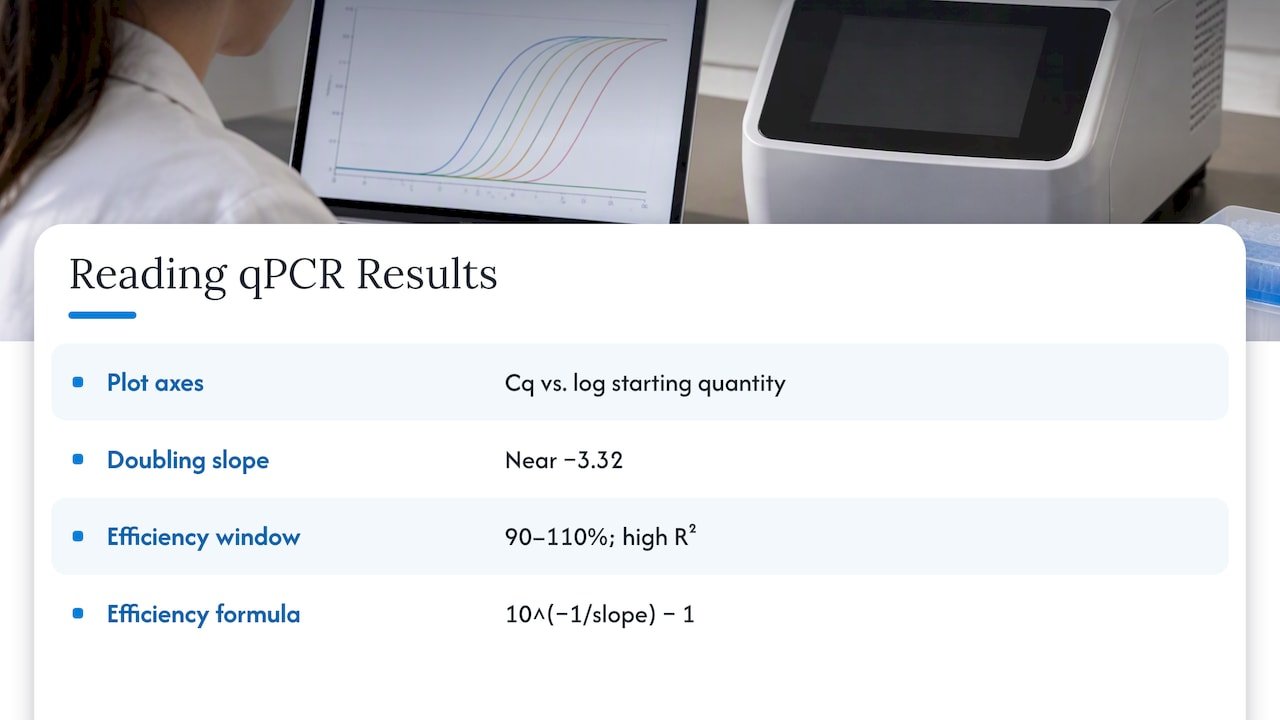
Plot Cq on the y-axis against the log of the starting quantity on the x-axis. Fit a line and calculate efficiency from the slope as 10^(−1/slope) − 1. A slope near −3.32 corresponds to doubling every cycle, or roughly 100% efficiency, and the same guide gives 90% to 110% efficiency as the usual acceptance window, together with a high R². If efficiency falls outside the window, check for inhibitors, primer design, dilution error and pipetting before you blame the instrument. A flattened top point (the highest concentration) often signals that the template is too concentrated or that inhibitors are present.
Our qPCR and RT-qPCR reagents and data analysis guide are good starting points if you are tightening up this part of your workflow.
Matching reagents to your decision
Once you know which approach fits, the reagent list follows.
- qPCR and RT-qPCR: master mixes, probes and dyes for quantification. See the qPCR and RT-qPCR category.
- Endpoint PCR: polymerases and mixes for cloning, genotyping and presence/absence checks that you read on a gel. See Endpoint PCR.
- Isothermal workflows: reagents for constant-temperature amplification are collected on our isothermal amplification page.
- Everything around the reaction: additives, enzymes and supporting reagents under other PCR reagents.
If you are designing a panel with several targets, our multiplex assay design guide covers the planning side.
Shop molecular biology reagents with US-based support
Mayflower Bioscience supplies research laboratories, biotech companies and institutions with molecular biology reagents, including PCR and qPCR products, sourced globally and supported by a US-based team. If you are not sure whether your project calls for qPCR, endpoint PCR or an isothermal format, browse our product catalog or use the contact form on mayflowerbio.com and tell us your target, sample type and throughput. Our products are for research use, and we will help you find a fit.
FAQ
Is LAMP more sensitive than PCR?
Sometimes, but not always. In one published comparison, LAMP detected 0.01 ng/µL of target DNA while conventional PCR detected 1.0 ng/µL. Sensitivity depends on primer design, sample type and the PCR format you compare against, since qPCR is more sensitive than gel-based endpoint PCR. Validate with your own samples before you decide.
Can isothermal amplification quantify the target?
Some real-time isothermal assays give a time-to-positive that correlates with the starting amount, but quantification is far less standardized than in qPCR. Most commercial isothermal tests are designed as qualitative tests. If you need absolute numbers, use qPCR with a standard curve.
Are qPCR and RT-PCR the same thing?
No. RT-PCR first converts RNA to cDNA with reverse transcriptase and then amplifies it. qPCR monitors amplification in real time so you can quantify. RT-qPCR does both, and is the usual choice for measuring RNA or RNA viruses.
Do I still need a thermal cycler if I switch to LAMP?
Not for the amplification itself. You need a stable heat source and a way to read the result. You may still need equipment for extraction, such as a centrifuge or magnetic rack, and a plate reader or fluorometer if you want an objective readout rather than a color change.
What are non-PCR-based amplification methods?
The main ones are LAMP, RPA, helicase-dependent amplification, nucleic acid sequence-based amplification and strand displacement amplification. A review of isothermal amplification methods describes how they differ. Each has its own enzymes, primer requirements and typical applications.
Sources
- Comparative evaluation of PCR-based, LAMP and RPA-CRISPR/Cas12a assays (PMC)
- Isothermal Amplification Technology for Disease Diagnosis (PMC)
- CDC: Information on rapid molecular assays, RT-PCR and other molecular assays for influenza
- CDC: Basic Molecular Biology Modules, Principle of PCR
- CDC Emerging Infectious Diseases: DNA Amplification, Current Technologies and Applications
- Isothermal nucleic acid amplification techniques as alternatives to PCR (PubMed)
- Isothermal amplifications: a comprehensive review on current methods (PubMed)
- FDA: Color SARS-CoV-2 RT-LAMP Diagnostic Assay EUA Summary
- FDA: In-Dx SARS-CoV-2 RT-LAMP Assay EUA Summary
- Building and Validating a qPCR Standard Curve